RME Portable Studio Recorder, USB 2.0 (FF UCX II)
Price$1,699
Free Shipping

Free Shipping
from Santa Fe Springs, CA
Listed:over a month ago
Views:1,130
Saves:20
Offers:0

Santa Fe Springs, CA, United States
Our users rate Reverb
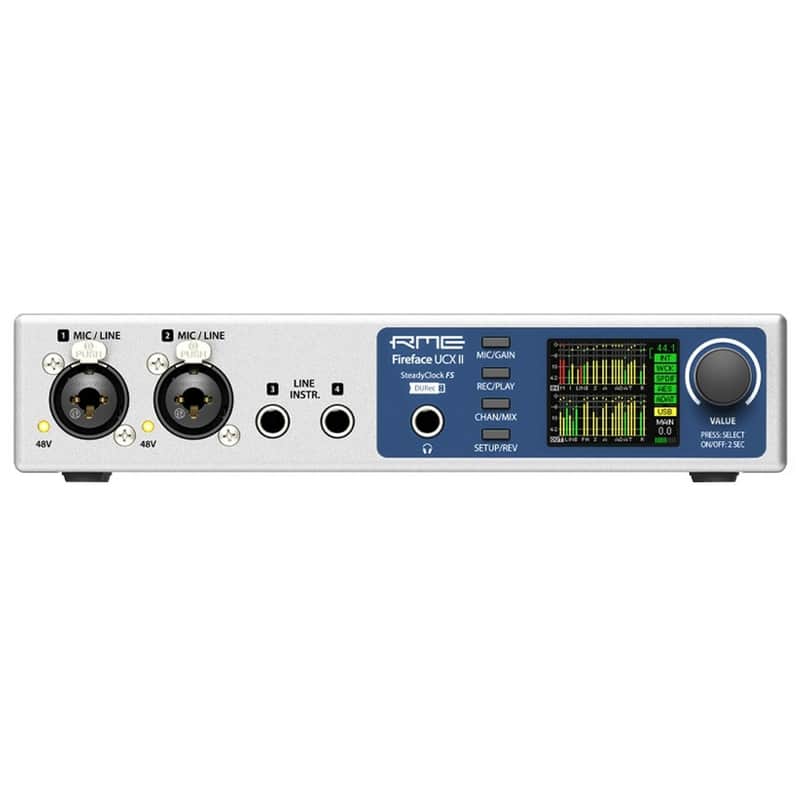
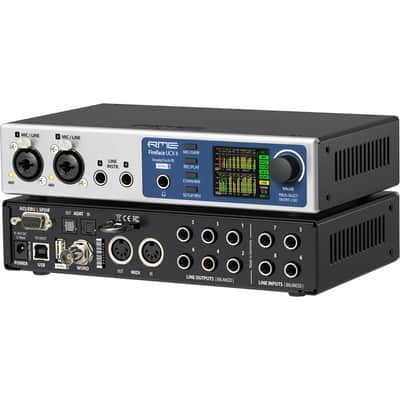
The Fireface UCX II is a highly integrated pro audio solution in an ultra-compact format for studio and live recordings. It continues RME's long tradition of designing compact advanced interfaces, packing into a half-rack size unit what usually would be spread out over two or three 19 inch panels.\n\nThe most powerful & portable RME Audio USB Interface\nThis unique audio system is capable of transferring analog and digital audio data directly to Windows and Mac computers. The latest Plug and Play technology guarantees a simple installation, even for the inexperienced user. Numerous unique features like a well thought-out Settings dialog and an integrated routing solution realize a quick, comfortable and efficient operation of the Fireface UCX II.\n\nThe Fireface UCX II houses two mic/line preamps in XLR combo configuration on the front panel, along with two digitally controlled line/instrument inputs, followed by a headphone jack, various control buttons, a display, and the main volume knob. At the rear is a set of ten analogue balanced line inputs and outputs, MIDI I/O, ADAT I/O, AES/EBU and SPDIF I/O, USB 2.0 as well as a switchable word clock I/O.\n\nWith the SteadyClock FS, the Fireface UCX II features the latest clock and jitter rejection technology from RME. Based on a femtosecond clock, SteadyClock FS reduces the intrinsic jitter when converting from and to analogue over all digital formats to a new all-time low.\n\nFull Stand-alone Functionality\nControl all device states directly from the front panel for convenient, direct access to all features. Four keys and the encoder, the high-resolution and clear color display, and a well thought-out menu structure enable the user to quickly change and configure the device’s settings. Additionally internal memory allows for the permanent storage of six different states of the unit. Therefore the Fireface UCX II is able to operate fully stand-alone, without any connected computer. In stand-alone operation it can transform into totally different devices by the simple click of a button. Furthermore TotalMix FX can also be controlled via MIDI.\n\n40-Channels ready for your Mobile Recording Rig\nDURec is an integrated digital recorder for all inputs and outputs directly to USB memory devices via the rear USB port. It allows to record on USB thumb drives or hard drives with up to 2 TB capacity. The recording functionality is provided by the internal DSP, and is therefore independent from a connected Windows or Mac computer. This USB port can alternatively be used for direct connection of RME’s optional ARC USB remote control.\n\nThe Direct USB Recording converts the Fireface UCX II into a stand-alone field recorder and a powerful multichannel live player for previous recordings, e. g. for virtual sound checks. Live concerts, band rehearsals or spontaneous jam sessions can be directly recorded and played back from the medium - even completely stand-alone without computer or software. All input and output channels can be individually chosen for recording and playback.\n\nPowerful Applications for Mixing, Monitoring and Measurement included\nThe Fireface UCX II comes with the TotalMix FX DSP mixer offering comprehensive routing and monitoring options, as well as the DIGICheck Analyzer allowing to measure and analyze the digital data feed in both directions with maximum precision. TotalMix FX can completely replace an external mixer, enabling the creation of multiple latency-free monitor mixes with EQ, Dynamics, Reverb and Delay for any outputs, incl. main monitors and headphone mixes for musicians.\n\nThe additional TotalMix Remote is a remote control for TotalMix FX, to control the hardware mixer and effects in RME audio interfaces. TotalMix Remote mirrors the current state of the host system on the iPad and Windows/Mac computers - the entire mixing state, the complete routing, all FX settings, up to the level meters, and everything in real-time. Easily adjust all the mixer and FX settings from a distance, via Ethernet and WiFi.\n\nDC-Coupled Outputs - CV/Gate Voltage Control\nMost audio interfaces are traditionally designed with what is called 'AC-coupled outputs', where capacitors are used to filter out any extreme low frequencies.\n\nWhilst these frequencies are generally considered undesirable for audio - eating into headroom and potentially causing damage to other equipment - one instance where DC-coupling remains desirable is the world of modular synthesizers, where static or slow-moving signals are used for control over various parameters such as pitch note values or LFOs.\n\nAll of the Fireface UCX II’s line-level outputs are fully DC-coupled, allowing for the sending of control voltages (CV) or Gate information to modular synthesizers (such as the popular Eurorack and Moog/MOTM/Synthesizers formats) and other studio hardware.\n
Key Features
\n\n- \n
- 8 x Analog I/O \n
- 2 x XLR/TRS Mic/Inst/Line \n
- 2 x Line/Inst Input \n
- 1 x Phones Output \n
- 1 x AES I/O \n
- 1 x ADAT I/O \n
- 1 x SPDIF I/O Coax \n
- 1 x Word Clock I/O \n
- 1 x MIDI I/O \n
- Class Compliant Mode \n
- TotalMix FX \n
- ARC USB \n
- RME USB 2.0 \n
- DC-coupled Outputs \n
- SteadyClock FS \n
- DURec \n
- AutoSet Digital Gain Controla \n
Technical Specifications
\nAD, Line In 5-8, rear\nResolution AD: 24 bit\nSignal to Noise ratio (SNR): 112 dB RMS unweighted, 115 dBA\nFrequency response @ 44.1 kHz, -0.1 dB: 5 Hz - 20.8 kHz\nFrequency response @ 96 kHz, -0.5 dB: 3 Hz - 45.8 kHz\nFrequency response @ 192 kHz, -1 dB: 2 Hz - 92 kHz\nTHD: < -110 dB, < 0.00032 %\nTHD+N: < -104 dB, < 0.00063 %\nChannel separation: > 110 dB\nInput: 6.3 mm TRS jack, electronically balanced\nInput impedance: 8 kOhm unbalanced, 12 kOhm balanced\nInput sensitivity switchable to +19 dBu and +13 dBu\nVariable gain: 0 to +12 dB\nMinimum level for 0 dBFS: +1 dBu, -1.2 dBV\nLine In 3-4, front\nAs AD, but:\nAdditional Gain stage: 0 up to +12 dB\nMaximum input level, +19 dBu, Gain 0 dB: Line +19 dBu, Inst +13 dBu\nMaximum input level, +13 dBu, Gain 12 dB: Line +1 dBu, Inst -5 dBu\nInput impedance: Instrument 1 MOhm. Line 13 kOhm balanced, 9 kOhm unbalanced\nInput Gain Inst: +6 dB\nInput mode: Line balanced (TRS), Inst unbalanced (TS)\nMicrophone In 1-2, front\nAs AD, but:\nInput: XLR, electronically balanced\nInput impedance: 5.4 kOhm\nGain range: 75 dB\nMaximum input level, Gain 0 dB: +18 dBu\nMaximum input level, Gain 75 dB: -57 dBu\nEIN: -128 dBu A-weighted, 60 dB gain,150 Ohm, 20 Hz - 20 kHz\nLine In 1-2\nAs AD, but:\nInput: TRS, electronically balanced\nInput impedance: 10 kOhm balanced, 5 kOhm unbalanced\nMaximum input level, Gain 0 dB: +24 dBu\nMaximum input level, Gain 75 dB: -51 dBu\nDA, Line Out 1-6, rear\nResolution: 24 bit\nDynamic range (DR): 112 dB RMS unweighted, 115 dBA\nFrequency response @ 44.1 kHz, -0.5 dB: 5 Hz - 20.8 kHz\nFrequency response @ 96 kHz, -0.5 dB: 5 Hz - 45 kHz\nFrequency response @ 192 kHz, -1 dB: 5 Hz - 89 kHz\nTHD: < -108 dB, < 0.0004 %\nTHD+N: < -104 dB, < 0.00063 %\nChannel separation: > 110 dB\nMaximum output level: +19 dBu\nOutput: 6.3 mm TRS jack, servo-balanced\nOutput impedance: 75 Ohm\nOutput level switchable +19 dBu, +13 dBu, +4 dBu\nDA - Stereo Monitor Output Phones (7-8)\nAs DA, but:\nOutput: 6.3 mm TRS stereo jack, unbalanced\nMaximum output level at 0 dBFS, High: +19 dBu\nMaximum output level at 0 dBFS, Low: +4 dBu\nOutput impedance: 1 Ohm\nMax power per channel @ 32 Ohm load, 0.1% THD: 210 mW (2.6 Vrms, +10.5 dBu)\nMIDI\n1 x MIDI I/O via 5-pin DIN jacks\nGalvanically isolated by optocoupled input\nHi-speed mode: Jitter and response time typically below 1 ms\nSeparate 128 byte FIFOs for input and output\nDigital\nClocks: Internal, ADAT, AES, SPDIF, word clock\nJitter suppression of external clocks: > 50 dB (2.4 kHz)\nEffective clock jitter influence on AD and DA conversion: near zero\nPLL ensures zero dropout, even at more than 100 ns jitter\nDigital Bitclock PLL for trouble-free varispeed ADAT operation\nSupported sample rates: 28 kHz up to 200 kHz\n\nDigital Inputs\nAES/EBU\n1 x XLR, transformer-balanced, galvanically isolated, according to AES3-1992\nHigh-sensitivity input stage (< 0.3 Vpp)\nSPDIF compatible (IEC 60958)\nAccepts Consumer and Professional format\nLock range: 27 kHz - 200 kHz\nJitter suppression: > 50 dB (2.4 kHz)\nSPDIF coaxial\n1 x RCA, according to IEC 60958\nHigh-sensitivity input stage (< 0.3 Vpp)\nAccepts Consumer and Professional format, copy protection will be ignored\nLock Range: 27 kHz - 200 kHz\nJitter suppression: > 50 dB (2.4 kHz)\nADAT Optical\n1 x TOSLINK, format according to Alesis specification\nStandard: 8 channels 24 bit, up to 48 kHz\nDouble Speed (S/MUX): 4 channels 24 bit 96 kHz\nQuad Speed (S/MUX4): 2 channels 24 bit 192 kHz\nBitclock PLL ensures perfect synchronisation even in varispeed operation\nLock range: 31.5 kHz ? 50 kHz\nJitter suppression: > 50 dB (2.4 kHz)\nSPDIF compatible (automatic detection)\nWord Clock\nBNC\nInternal termination 75 Ohm switchable\nAutomatic Double/Quad Speed detection and internal conversion to Single Speed\nSteadyClock guarantees super low jitter synchronization even in varispeed operation\nNot affected by DC-offsets within the network\nSignal Adaptation Circuit: signal refresh through auto-center and hysteresis\nOvervoltage protection\nLevel range: 1.0 Vpp ? 5.6 Vpp\nLock Range: 27 kHz - 200 kHz\nJitter suppression: > 50 dB (2.4 kHz)\n\nDigital Outputs\nAES/EBU\nXLR, transformer-balanced, galvanically isolated, according to AES3-1992\nOutput level Professional 4.5 Vpp, Consumer 2.6 Vpp\nFormat Professional according to AES3-1992 Amendment 4\nFormat Consumer (SPDIF) according to IEC 60958\nSingle Wire mode, sample rate 28 kHz up to 200 kHz\nSPDIF coaxial\n1 x RCA, according to IEC 60958\nOutput level Professional 1.2 Vpp, Consumer 0.6 Vpp\nFormat Professional according to AES3-1992 Amendment 4\nFormat Consumer (SPDIF) according to IEC 60958\nSingle Wire mode, sample rate 28 kHz up to 200 kHz\nADAT\n1 x TOSLINK, format according to Alesis specification\nStandard: 8 channels 24 bit, up to 48 kHz\nDouble Speed (S/MUX): 4 channels 24 bit 96 kHz\nQuad Speed (S/MUX4): 2 channels 24 bit 192 kHz\nWord Clock\nBNC\nMax. output voltage: 5 Vpp\nOutput voltage @ 75 Ohm termination: 4.0 Vpp\nOutput impedance: 10 Ohm\nFrequency range: 27 kHz - 200 kHz\n\nGeneral\nPower supply: external power supply\nTypical power consumption: 13 Watts\nCurrent at 12 Volt operating voltage: 910 mA (11 Watts)\nDimensions incl. rack ears, full depth (WxHxD): 265 x 44 x 155 mm (10.5" x 1.73" x 6.1")\nDimensions without rack ears, body depth (WxHxD): 215 x 44 x 130 mm (8.5" x 1.73" x 5.1")\nWeight: 910 g ( 2.0 lbs)\nTemperature range: +5? up to +50? Celsius (41? F up to 122?F)\nRelative humidity: < 75%, non condensingReverb Buyer Protection
Reverb has your back if your item is lost, damaged, or doesn't match its description. Simply report any issues within 7 days and we'll help you get a full refund.Learn more about Reverb Buyer Protection.

| Condition | Brand New (New) Brand New items are sold by an authorized dealer or original builder and include all original packaging.Learn more |
|---|---|
| Brand | |
| Model |
|
| Finish |
|
| Categories | |
| Year |
|
| Computer Connectivity |
|
| Sample Rate |
|
| Digital Input Format |
|
| Electronics |
|
| Digital Output Format |
|
| Compatibility |
|
| Format |
|
| Bus-Powered |
|
| Number of Mic Preamps |
|
| Number of Headphone Outputs |
|
| Number of MIDI Outputs |
|
| Number of MIDI Inputs |
|
| Number of Digital Outputs |
|
| Number of Digital Inputs |
|
| Number of Analog Outputs |
|
| Number of Analog Inputs |
|
Product safety information may be available here.

