Roland Juno-6 61-Key Polyphonic Synthesizer 1982 - 1984 - Black


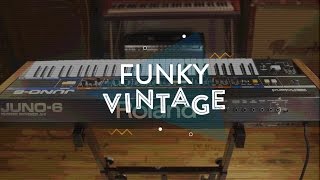
Roland Juno-6 61-Key Polyphonic Synthesizer 1982 - 1984 - Black
This seller has not set a shipping cost for Portugal. Please contact them to ask about shipping.


Our users rate Reverb
greaaaat condition Juno 6, borderline minty condition. bought it on reverb a little over a year ago!
has met all my roland 80’s poly needs and then some! super lush when you want it to be, ultra “direct” analog sound always, in a roland jupiter 4 way. excellent for everything you throw at it, pads, leads, bass, fx. etc.
will double box to ensure it’s safety shipping wise.
let me know if you have any questions, you can message me through here or find me @ imperialsoundst on IG!
here is more info i pulled from smemmusic:
The Juno-6 is a six-voice polyphonic analog synthesizer produced by Roland Corporation from May to September 1982. It’s the first instrument of the Juno Series. Due to its lack of memory for presets storage, it was replaced by the Juno-60 a few months later. Despite its short and moderate success, it is nonetheless the initiator of a serie of instruments that would shape the sound of the 1980’s.
FEATURES & USE
The Juno-6 is famous for making the best out of a limited set of features. Its single but surprisingly thick oscillator could mix four sources (Square, Triangle, Sub Osc, Noise). It features a high-class voltage controlled resonant 24db low pass filter and a non-resonant high-pass filter and incorporates one of the most famous chorus effects of all time, inheriting from the sound of the renown Roland DC-50. The onboard chorus was added to make the single oscillator’s sound even thicker, allowing for warm, fuzzy and stereophonic sounds.
In addition to the wide range of sounds available, the Juno-6 was also easy to perform with. Not only could all its parameters be directly controlled, the Juno-6 also featured an externally syncable and flexible arpeggiator, hold function for sustaining notes and a key transpose option. All these features allowed for inspiring compositions without requiring strong playing skills. This combination of elements rapidly set new standards in the industry.
APPLICATION IN MUSIC
The satisfying sound of the Juno-6 and its accessible performing possibilities allowed the instrument to quickly find its place in the productions of its time, a place it is one of the rare instruments to have maintained until today. Furthermore, the Juno- style arpeggios played an influential role in the birth on many synth-related pop subgenres and inspired an important legacy of popular compositions. Among the most famous examples is Madonna’s Borderline from her eponymous debut album, her first hit to reach the TOP 10’s Billboard Classics. Soon after, the Juno-60 was released and the two instruments – indistinguishable in sound – were used in countless hits: A-ha’s Take on Me, Wham!’s Last Christmas, Sweet Dreams by Eurythmics, Can You Feel it by Mr. Fingers and many many more. Today, one can still hear « the Juno Sound » in many hits such as Metronomy’s The Bay.
GENESIS AND DISTRIBUTION
Those familiar with the greek mythology might have already linked the Juno-6 to another legendary instrument by Roland: the Jupiter-8. The Juno-6 was indeed created so that Roland could offer a more accessible alternative to their flagship product. It should be remembered that the Jupiter-8 was sold at that time for 2699£ GBP or 5’295$ USD. It was aimed at a high-end, professional market. At the time, this represented about 38% of the US average wage. So, when Korg – Roland’s fierce competitor – released the Polysix for less than half the price (1200£ or 2200$) with only a few features less than the Jupiter-8, the engineers at Roland had to catch up if they did not want to lose the new market Korg had entered in.
The Juno-6 was released in May 1982 with a deal-breaking price of 699£ or 1295$, being the first analog polysynth in history under 2000$. It had almost all the features of Polysix plus the chorus and arpeggiator, but it lacked a preset memory found in Korg's latest instrument. As Roland found that their product was not selling as well as expected, they released the Juno-60 a few months later, incorporating a 56-slots memory support and a few additional features.
RECEPTION AND LEGACY
The marketing period for the Juno-6 was short as it was quickly replaced by the Juno-60. In that regard, the Juno-6 remains a sort of « forgotten elder brother" of the Juno-60, whose undeniable success cast a shadow on its predecessor. The Juno-6 remained however a rarer but even cheaper alternative for the few who did not consider the need for a memory support.
These two first versions of the Juno family –followed by the Juno- 106 in 1984 – are nonetheless often considered together in terms of branding and popularity. Their almost identical aesthetic and architecture remained an all-time classic of the early 1980’s synthesizer era and they are still the most famous instrument of the Juno Series, even though Roland has produced many ulterior versions since: the Juno Alpha Series (1985), the Juno-D (2004), Juno-G (2006), Juno-Stage (2008), Juno-Di (2009), Juno-Gi (2010), JU-06 (2015), Ju-06A (2019), the Juno-60 Software Edition (2021) and, finally, the Juno-X (2022). This unmatched legacy did not limit itself to Roland’s product as it also inspired the architecture of the Behringer Deepmind 6 and 12 (both 2017) and many software emulations from brands such as Arturia, IK Multimedia and Togu Audio Line. All in all, the early Junos account nowadays as some of the most famous instruments in recent history. Roland is said to have sold about 116’000 of them, including the Juno-106.
TECHNICAL DETAILS
The Juno-6 was the first synthesizer on the market to feature a digitally controlled analog oscillator (DCO) instead of a voltage controlled analog oscillator (VCO). This new feature allowed for a perfectly stable tuning, a coherent choice for a synthesizer that was not designed to stay in the studio – as the Jupiter-8 – but to be used and played in various contexts and by users ranging from the professional to the amateur, maybe unaware of calibration issues in analog circuitry.
The Juno-6’s VCF filter also deserves a closer attention. As it is commonly known, the filter plays a crucial role in the quality of the produced sound. In this case, the engineers at Roland used an operational transconductance amplifier (or OTA) design filter, commonly found in their classic analog synthesizers like the Jupiter-8. The similarities do not stop there. Indeed, the components used for the Juno-6’s filter are six Roland IR3109 VCF chips, the same as the Jupiter-8. This design strategy, combined to the thick oscillator and chorus previously mentioned are the key elements that explain the Juno-6 and 60’s renown sound quality.
KEYBOARD
61 Keys, 5 Octaves
DCO
Waveform
Pulse Width Modulation
PWM Mode Switch (ENV / MANUAL / LFO)
Sub Oscillator Level
LFO modulation
Noise Level
HPF
Cutoff Frequency
VCF
Cutoff Frequency
Resonance
Envelope Modulation
Polarity Switch
LFO Modulation
KCV follow (0-100%)
VCA
Control Signal Select Switch
ENVELOPE GENERATOR
Attack Time
Decay Time
Sustain Level
Release Time
LFO
Rate
Trigger mode switch (AUTO/MAN)
Delay Time
CONTROLLERS
Volume Knob
Octave transpose (DOWN/NORMAL/UP)
LFO trigger button
DCO bend sensitivity
VCF bend sensitivity
Bender lever
ARPEGGIO
Mode switch (UP/UP & DOWN/DOWN)
Range Switch (1. 2. 3)
Rate
ON-OFF Switch
HOLD
ON-OFF Switch
KEY TRANSPOSE
Key Transpose Button
CHORUS
Mode Switch (OFF , | , ||)
REAR PANEL
Output Jack (Mono / Stereo)
Output level (L / M / H)
Phone Jack (Stereo)
VCF control jack (FV-200)
Pedal Hold Jack (DP-2)
Arpeggio clock input jack (1 step / 1 pulse=over + 2.5V)
Tune (+50 cent)
DIMENSIONS
1060(W) x 113(H) x 378(D) mm
41-3/4 x 4-7/16 x 14-7/8 inch
WEIGHT
11 kg /24 lb 4 oz
POWER
25 W

| Listed | a day ago |
|---|---|
| Condition | Very Good (Used) Very Good items may show a few slight marks or scratches but are fully functional and in overall great shape.Learn more |
| Brand | |
| Model |
|
| Finish |
|
| Categories | |
| Year |
|
| Made In |
|
| Number of Keys |
|
| Keyboard Action |
|
| Analog / Digital |
|
| Key Size |
|
| Polyphony |
|
Product safety information may be available here.


