


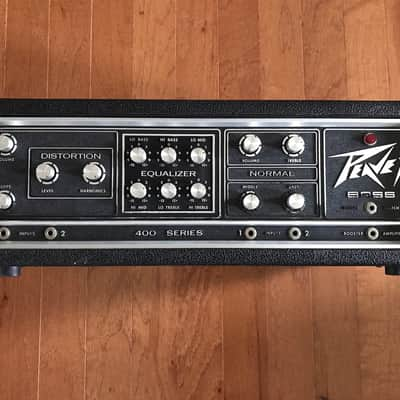
Peavey 400 Series Bass Head 1977 - Black

Devrait bientôt être vendu
Il n’en reste plus que 1 et 1 autre personne l’a dans son panier

Nos utilisateurs évaluent Reverb
LEGGI LA DESCRIZIONE FINO IN FONDO!
leggendaria testata per basso Peavey 400 versione 220 volt. Questo è il modello MK1 prodotto nel 1977. All'interno c'è un timbro che data il collaudo il 14 febbraio 1977.
Questa testata ha la particolarità di avere un canale con integrato distorsore e fuzz, un equalizzatore parametrico e la possibilità di utilizzare i due canali (clean e drive) in serie o parallelo.
A differenza di molte testate analoghe sul mercato questa è stata revisionata con la sostituzione dei principali condensatori elettrolitici tutti top di gamma (come TAD, F+T, ecc...).
E' un amplificatore subito pronto per suonare senza nessun intervento da fare.
Molto ricercato per generi come Stoner, Doom, Sludge, ecc...
PEAVEY "THE BASS" 400 SERIES (Mid-1970s)
• Produttore: Peavey Electronics (USA)
• Periodo di produzione: Circa 1974 - 1977
• Tecnologia: Stato Solido (Solid State)
• Potenza di uscita:
• 200 Watt RMS su carico minimo di 2 Ohm
• Circa 130-140 Watt RMS su carico di 4 Ohm
• Canali: 2 canali miscelabili (Normal / Harmonics)
SEZIONE PREAMPLIFICAZIONE E CONTROLLI
• Canale 1 (Normal / Clean):
• Controlli: Volume, Bass, Middle, Treble (Equalizzazione passiva)
• Canale 2 (Harmonics / Distortion):
• Controlli: Volume, Distortion, Fuzz, Slope (Risonanza/Bass-boost)
• Equalizzatore Integrato:
• EQ Grafico attivo a 6 bande (±14 dB)
• Assegnazione: Di fabbrica agisce esclusivamente sul canale Harmonics (se utilizzato in modalità canali separati) o sul segnale combinato (in modalità Series)
INGRESSI FRONTALI (Sistema Automix)
• Ingresso Normal: Canale pulito indipendente
• Ingresso Harmonics: Canale distorto indipendente
• Ingresso Parallel: Sdoppia il segnale inviandolo a entrambi i canali contemporaneamente (permette di miscelare pulito e distorto per non perdere le frequenze basse)
• Ingresso Series: Invia il segnale al canale Normal che fa da booster ed entra successivamente nel canale Harmonics (massimo guadagno e sustain del Fuzz)
PANNELLO POSTERIORE E CONNESSIONI
• Uscite Cassa: 2 uscite Jack da 1/4" collegate in parallelo (Impedenza minima totale: 2 Ohm)
• Uscite di linea: Booster Out (uscita preamplificata a 1V RMS per finali esterni)
• Ingresso Footswitch: Remote Switch Jack (permette il controllo remoto della distorsione e dell'EQ grafico)
CARATTERISTICHE FISICHE
• Chassis: Struttura in legno rivestita in Tolex nero, angoli di protezione in metallo, pannello frontale in alluminio spazzolato.
READ THE FULL DESCRIPTION!
Legendary Peavey 400 bass head 220 volt version. This is the MK1 model, manufactured in 1977; there is an internal stamp dating its quality control check to February 14, 1977.
This head features a channel with built-in distortion and fuzz, a parametric equalizer, and the ability to run the two channels (clean and drive) in either series or parallel.
Unlike many similar heads on the market, this unit has been serviced and had its main electrolytic capacitors replaced with top-tier components (such as TAD, F+T, etc.).
It is an amplifier that is ready to play immediately, requiring no further work.
Highly sought-after for genres such as Stoner, Doom, Sludge, etc...
PEAVEY "THE BASS" 400 SERIES (Mid-1970s)
• Manufacturer: Peavey Electronics (USA)
• Production Period: Approx. 1974–1977
• Technology: Solid State
• Output Power:
• 200 Watts RMS into a minimum 2-Ohm load
• Approx. 130–140 Watts RMS into a 4-Ohm load
• Channels: 2 blendable channels (Normal / Harmonics)
PREAMP SECTION AND CONTROLS
• Channel 1 (Normal / Clean):
• Controls: Volume, Bass, Middle, Treble (Passive EQ)
• Channel 2 (Harmonics / Distortion):
• Controls: Volume, Distortion, Fuzz, Slope (Resonance/Bass-boost)
• Integrated Equalizer:
• 6-band active Graphic EQ (±14 dB)
• Assignment: Factory-configured to affect only the Harmonics channel (when used in separate channel mode) or the combined signal (in Series mode)
FRONT PANEL INPUTS (Automix System)
• Normal Input: Independent clean channel
• Harmonics Input: Independent distorted channel
• Parallel Input: Splits the signal, sending it to both channels simultaneously (allows blending clean and distorted tones to preserve low frequencies)
• Series Input: Sends the signal to the Normal channel (acting as a booster) before it enters the Harmonics channel (maximum gain and sustain) Fuzz)
REAR PANEL AND CONNECTIONS
• Speaker Outputs: Two 1/4" jack outputs wired in parallel (Minimum total impedance: 2 Ohms)
• Line Outputs: Booster Out (1V RMS pre-amplified output for external power amps)
• Footswitch Input: Remote Switch Jack (allows remote control of distortion and graphic EQ)
PHYSICAL SPECIFICATIONS
• Chassis: Black Tolex-covered wooden housing, protective metal corners, brushed aluminum front panel.
Cet article est vendu « en l’état »
Cet article est vendu « en l'état » et ne peut pas être retourné sauf s'il est dans un état différent de ce qui est décrit ou photographié. Les articles doivent être retournés dans leur état d'origine, tels qu'ils ont été expédiés, dans leur emballage d'origineEn savoir plus.
| Mis en ligne | il y a 11 jours |
|---|---|
| État | Très bon (occasion) Le matériel en état « Très Bon » fonctionne bien mais a quelques dommages cosmétiques.En savoir plus |
| Marque | |
| Modèle |
|
| Finaliser |
|
| Catégories | |
| Année |
|
| Nombre de canaux |
|
| Type de tube de puissance |
|
| Sortie directe |
|
| Nombre d’entrées |
|
| Électronique |
|
| Couleur principale |
|
| Impédance |
|
| Puissance de sortie (Watts) |
|
Des informations concernant la sécurité des produits peuvent être disponibles ici.

