Allen Synthesis EuroPi 2020s - Silver
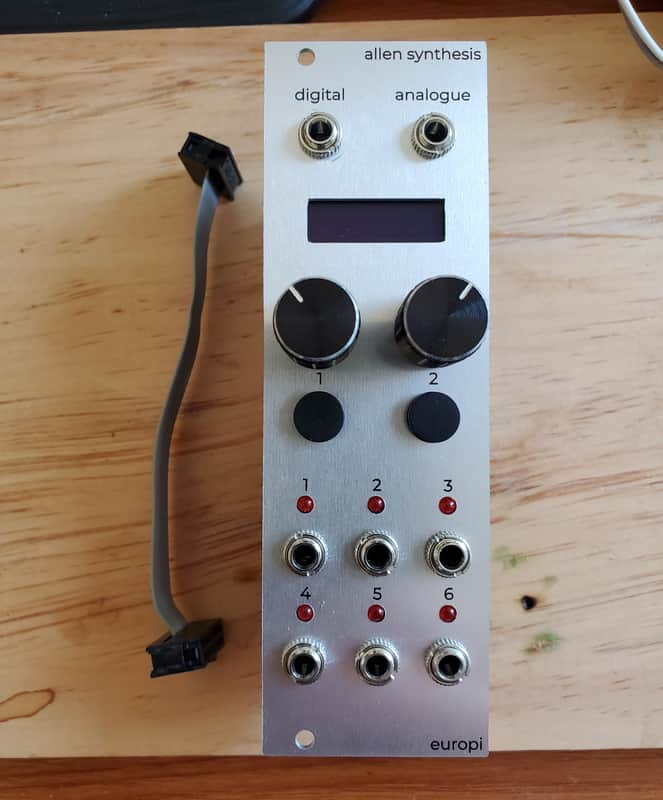


Allen Synthesis EuroPi 2020s - Silver
This seller has not set a shipping cost for Malta. Please contact them to ask about shipping.

Our users rate Reverb
Wonderful Macro-Module. Aluminum Faceplate - Mint Condition. Worth it for the Pam's Clone and Turing Machine alone - not to mention all the other awesome functions. Includes power cable and module.
Installed functions include:
Arpeggiator: A quantized scale/arpeggio generator
Bernoulli Gates: A probability script based on Mutable Instruments Branches
Bezier Curves: Smooth random voltages based on bezier curves. Inspired by the ADDAC507 Random Bezier Waves module.
Binary Counter: A simple gate sequencer implemented using a 6-bit binary counter.
Bit Garden: Mirrors a gate/trigger input, with adjustable skip probability across channels.
Clock Modifier: A clock multiplier or divider. Each channel has an independently-controllable modifier, multiplying or dividing an external clock signal on din.
Coin Toss: A probability utility with an output based on a percentage choice between 1 or 0
Consequencer: A gate and CV sequencer inspired by Mutable Instruments Grids and the Music Thing Modular Turing Machine
Conway: A semi-random LFO that uses John Conway's Game Of Life to produce CV and gate signals.
CVecorder: 6 channels of control voltage recording
Daily Random: A pseudo-random gate and CV sequencer that uses a realtime clock to generate patterns.
DCSN-2: A loopable random gate sequencer based on a binary tree. Inspired by the Robaux DCSN3
DFAM Controller: A trigger sequencer designed to interact with the Moog DFAM. Allows DFAM to play sequences of different lengths and adds a reset button & patch point. Inspired by the Sonoclast MAFD.
Egressus Melodium: Clockable and free-running LFO and random CV pattern generator
Envelope Generator: An attack release envelope with optional sustain and looping functionality. Envelopes are triggered or gated by the digital input, and the envelope is output, along with a copy of the digital input and an inverted copy of the envelope.
Euclid: Euclidean rhythm generator. Each channel can generate an independent euclidean rhythm.
Gates and Triggers: Convert incoming triggers to gates or gates to triggers. Buttons allow manually creating gates/triggers, knobs control the duration of the output signals.
Gate Phaser: A script which attempts to answer the question "What would Steve Reich do if he had a EuroPi?"
Hamlet: A variation of the Consequencer script specifically geared towards driving voices
Harmonic LFOs: 6 tempo-related LFOs with adjustable wave shape
Itty Bitty: Dual-channel 8-bit trigger+gate+cv sequencer based on the binary representation of an 8-bit number.
Kompari: Compares AIN to K1 and K2, outputting 5V digital signals on CV1-CV5, and an analogue output signal based on comparing all 3 sources.
Logic: Treats both inputs as digital on/off signals and outputs the results of binary AND, OR, XOR, NAND, NOR, and XNOR operations on outputs 1-6.
Lutra: Six syncable LFOs with variable wave shapes. The clock speed of each LFO is slightly different, with an adjustable base speed and CV-controllable spread. Inspired by Expert Sleepers' Otterley module.
Master Clock: A master clock and clock divider.
Morse: A gate sequencer that uses Morse code to generate the on/off pattern.
Noddy Holder: Two channels of sample/track and hold based on a single trigger and CV source
Pam's "EuroPi" Workout: A re-imaging of ALM/Busy Circuit's Pamela's "NEW" Workout. Turns the EuroPi into a clocked modulation source with multiple wave shapes, optional quantization, euclidean rhythm outputs and external start/stop trigger input.
Particle Physics: An irregular LFO based on a basic 1-dimensional physics simulation. Outputs triggers when a particle bounces under the effects of gravity. Outputs control signals based on the particle's position and velocity.
Piconacci: A clock divider whose divisions are based on the Fibonacci sequence.
Poly Square: Six independent oscillators which output on CVs 1-6.
Polyrhythmic Sequencer: A sequencer that advances notes according to a polyrhythmic clock, inspired by the operation of the Moog Subharmonicon sequencer
Probapoly: Creates interesting polyrhythmic gate patterns while also allowing probabilities to be set on gates.
Quantizer: Quantizes input analog signals to a customizable scale. Additional signals output the same note shifted up or down to create harmonies across multiple oscillators.
Radio Scanner: A tool for exploring sounds and control voltage combinations by navigating a 2D plane
Scope: An oscilloscope script to monitor the analogue and digital inputs
Sequential Switch: A 2-6 output sequential switch. The analogue input is mirrored to one of the outputs, with the specific output changed every time a trigger is received.
Sigma: Random CV, optionally quantized, voltages based on controllable normal distributions. Inspired by Magnetic Freak's Gaussian module.
Slopes: CV analyzer that produces gates & CV outputs based on the slope of the incoming signal
Smooth Random Voltages: Random CV with adjustable slew rate, inspired by: .
Strange Attractor: A source of chaotic modulation using systems of differential equations such as the Lorenz System
Traffic: A re-imagining of Jasmine and Olive Tree's Traffic module. Triggers are sent to both inputs generating CV signals based on which trigger fired most recently and a pair of gains per channel.
Turing Machine: A script meant to recreate the Music Thing Modular Turning Machine Random Sequencer as faithfully as possible on the EuroPi hardware.
Volts: Generates static voltages on CV1-6. Useful for when you need a reliable, fixed voltage source as an input.
| Listed | 3 months ago |
|---|---|
| Condition | Excellent (Used) Excellent items are almost entirely free from blemishes and other visual defects and have been played or used with the utmost care.Learn more |
| Brand |
|
| Model |
|
| Finish |
|
| Categories | |
| Year |
|
Product safety information may be available here.


