New Systems Instruments - Discrete Map + Expander - Most inspiring sequencer in eurorack - 2026 Latest
This seller has not set a shipping cost for Denmark. Please contact them to ask about shipping.
Pricekr.4,210.20
+ Shipping

Listed:17 hours ago
Views:26
Saves:2
Offers:0

Rockville, MD, United States
Our users rate Reverb
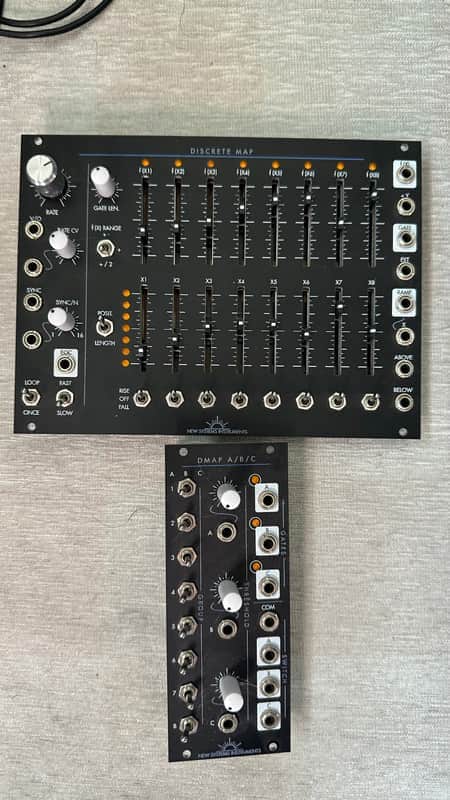
Mint in Box. Discrete Map Sequencer + Expander
- Not a basic step sequencer. It does not just count 1-2-3-4.
- It reads moving voltage and turns it into notes, gates, rhythm, switching, and stepped CV.
- Continuous-time sequencing. Most sequencers obey a clock grid. Discrete Map obeys voltage motion. LFO, envelope, ramp, chaos, audio signal—feed it movement, it maps the movement.
- No microprocessor. No conventional DAC/ADC. No hidden sample-rate feel. No menu brain. No digital choke point. Logic + analog circuit behavior.
- Audio-rate control is the big kill shot. Normal sequencers live at rhythm speed. This can run into audio-rate shape work: graphic VCO, waveshaper, bitcrusher-style stepped waveform, phase-motion source.
- Clock range is huge. Internal clock goes from ultra-slow 4 minutes per cycle to 12kHz FAST mode. Slow composition or audio-rate abuse—same module.
- Tracks about 7 octaves. V/O input controls the internal oscillator, so this is not just “sequencer clock.” It can become a pitched signal core.
- Eight threshold stages. Bottom sliders decide where events happen. Each stage can fire on RISE, FALL, or stay OFF. Direction matters. Voltage travel matters. Not dumb step order.
- POSIT. mode = place events in voltage/time. Move a stage wherever you want. Steps can happen out of order. Normal step sequencers do not move like this.
- LENGTH mode = control the gap between stages. Step length becomes slider-controlled. You stretch time directly instead of fighting clock divisions.
- Eight f(X) voltage sliders. Top sliders set the output voltage per active stage. Use them for pitch, modulation, transposition, harmonies, shaped CV, or waveform drawing.
- f(X) RANGE is useful, not decoration. −5V to +5V, 0–5V, or 0–2.5V. Big bipolar CV, normal positive CV, or tighter pitch/control range.
- Gate length goes from microscopic to long. 6μs to 2.8s. Tiny audio triggers or held gates. No extra gate mangler required.
- X input is the heart. Internal RAMP is normalized to X, but any external voltage can take over. That makes envelopes, LFOs, sequencers, chaos, and audio all valid “time engines.”
- ABOVE and BELOW redefine the slider world. External voltages can set the top and bottom of the threshold range. The map itself can be voltage-framed.
- +Y input adds precision offset/transposition. f(X) output can be shifted or combined. Useful for pitch movement, stacked maps, or live range control.
- SYNC and SYNC/N make it clock-friendly. It can still lock to conventional sequencing, but it does not need to be ruled by it.
- EOC output gives end-of-cycle logic. Patchable chain behavior, resets, sequencer-to-sequencer control, larger systems.
- EXT input cancels the active stage. That means outside gates can punch holes, interrupt events, or force stage logic. More control than simple clock-reset thinking.
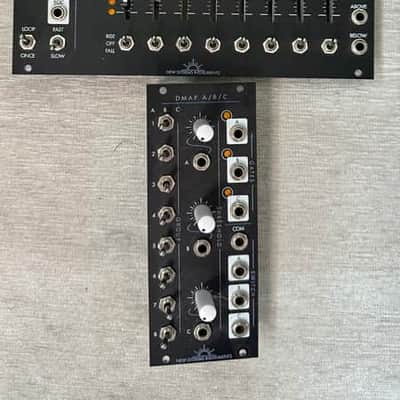
- A/B/C Expander turns 8 stages into 3 controllable event families. Assign each stage to A, B, or C. Then each group gets its own gate output and threshold CV behavior.
- Grouped gates destroy patch clutter. Instead of patching extra logic just to separate kick/snare/hat-style stages, group them at the expander and take A, B, C gates directly.
- Threshold CV per group is nasty powerful. Push one group forward/backward in time while the others stay fixed. This is step timing under voltage control.
- At audio rate, threshold CV becomes phase movement. Move part of the waveform while the rest stays still. PWM-like behavior without a normal oscillator design.
- Bidirectional sequential switch built in. COM connects to A, B, or C depending on the active group. COM can be input or output. Audio or CV. One-to-three or three-to-one.
- Temporal mixing is the weird weapon. The switch can divide time between signals. Not normal level mixing—time-window mixing. Brutal, precise, modular-native.
- A/B/C gates can become irregular frequency division. At audio rate, grouped gates are not just triggers; they become strange sync, division, and pulse sources.
- Chainable expander system. Discrete Map has a rear 16-pin expander port and can connect to more than one expander. Not a dead-end accessory.
- Compared to normal sequencers: they store steps. This maps voltage motion.
- Compared to menu sequencers: they hide timing in screens. This gives sliders, switches, jacks, and voltage behavior.
- Compared to basic analog sequencers: they step through order. This lets thresholds fire by position, direction, length, external voltage, and audio-rate movement.
- Compared to utility expanders: this is not “more jacks.” It adds grouped logic, CV timing shift, gate families, and a bidirectional routing switch.
- Best use: generative melody, voltage-addressed sequencing, non-grid rhythm, quantizer/harmonizer patches, graphic VCO, waveshaping, bitcrush texture, event routing, percussion gate grouping, temporal audio switching.
Shipping only $6.95 as I am splitting the actual cost of shipping with you.
Gorgeous, genius level unit.
Enjoy life!
| Listed | 17 hours ago |
|---|---|
| Condition | Excellent (Used) Excellent items are almost entirely free from blemishes and other visual defects and have been played or used with the utmost care.Learn more |
| Brand |
|
| Model |
|
| Categories | |
| Year |
|
Product safety information may be available here.

