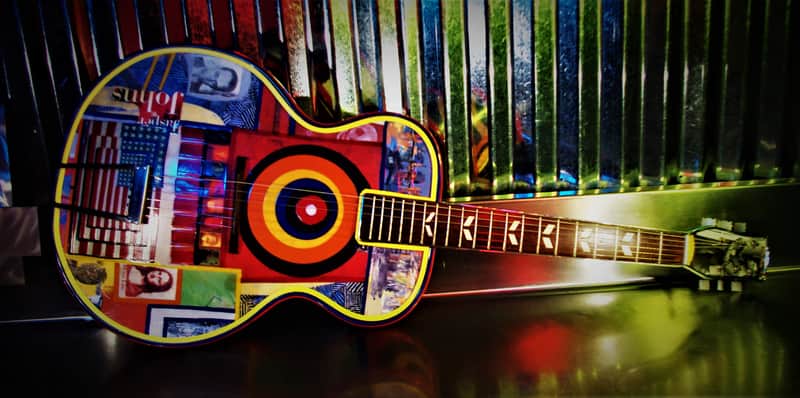
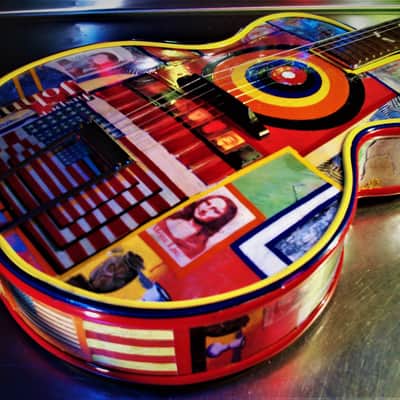
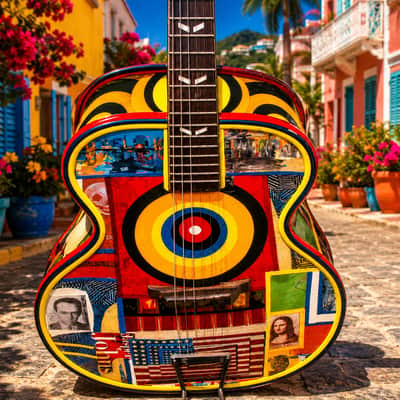
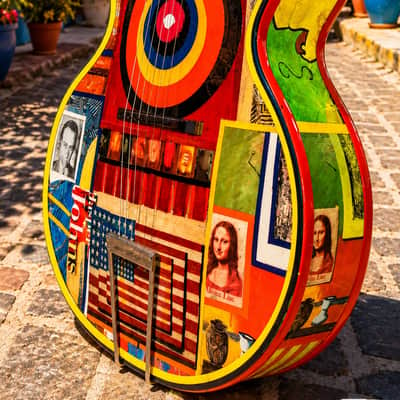
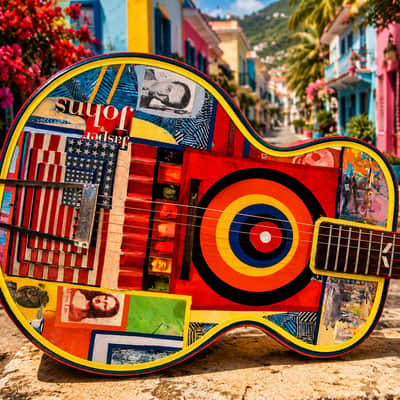
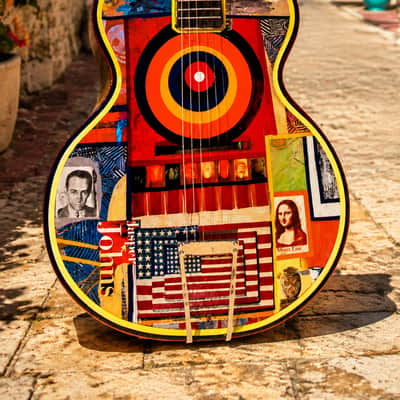
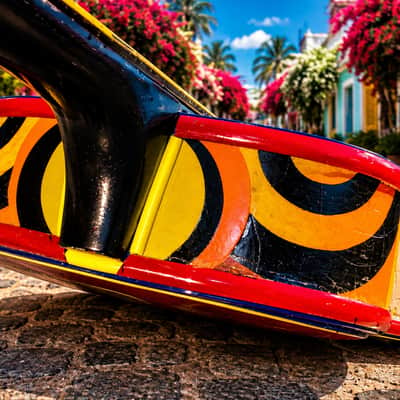
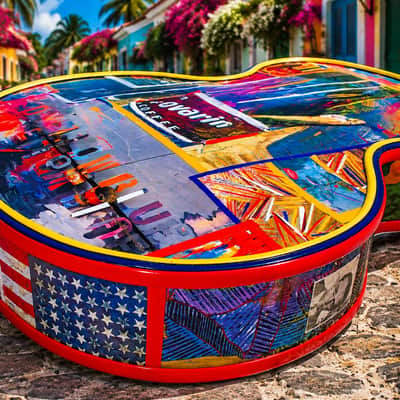
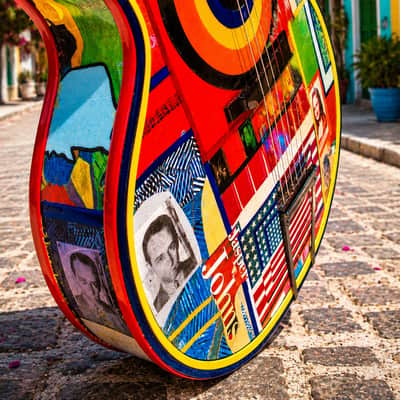
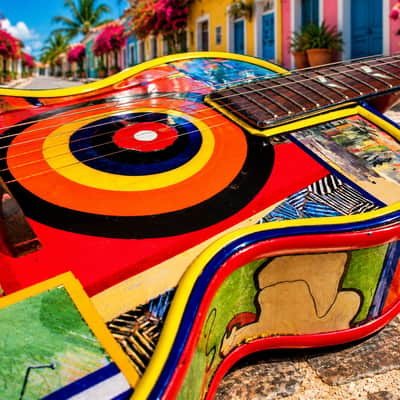
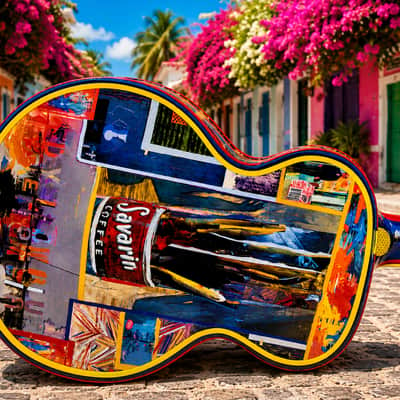
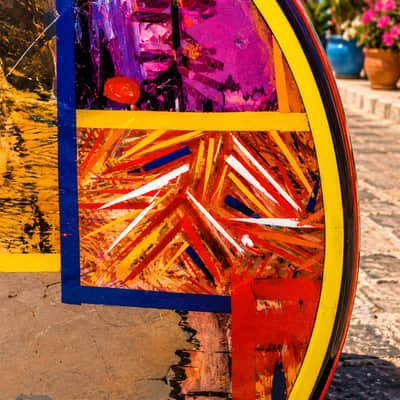
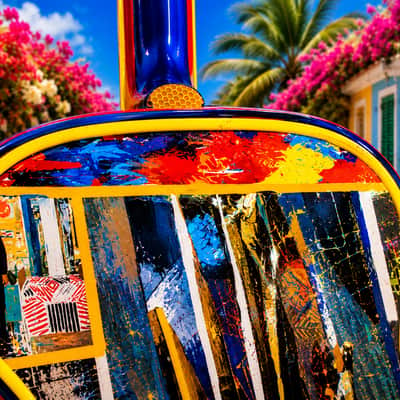
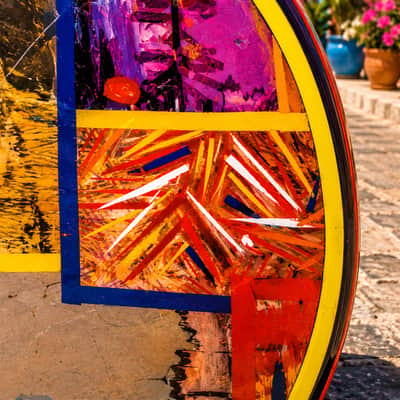
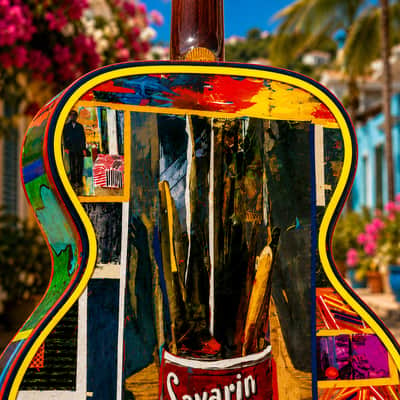
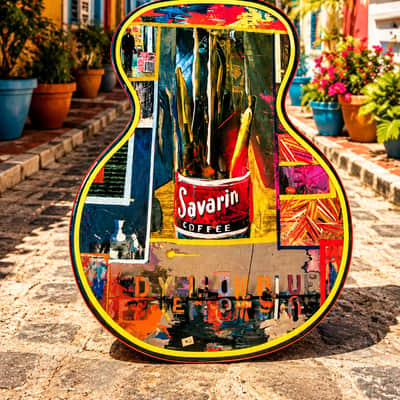
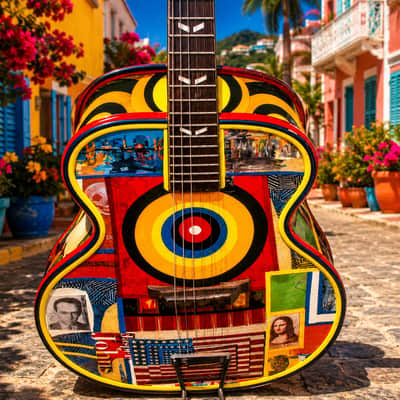
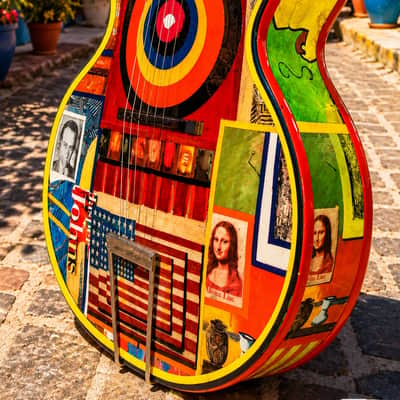
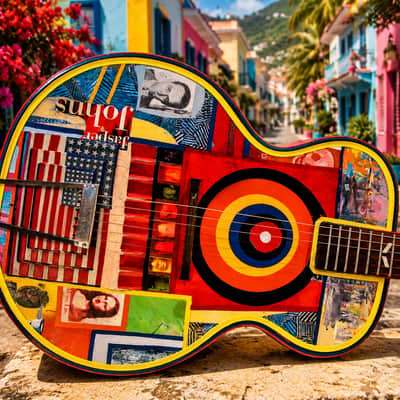
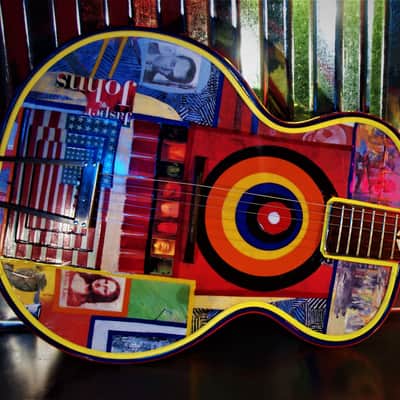
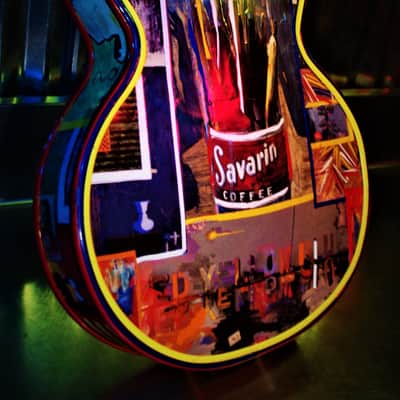
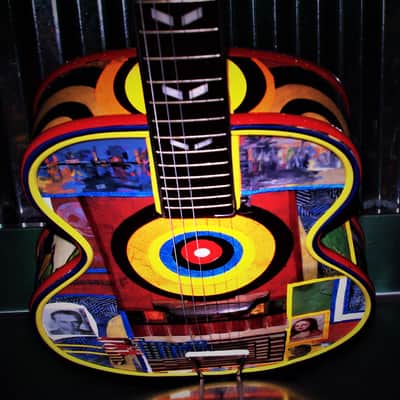
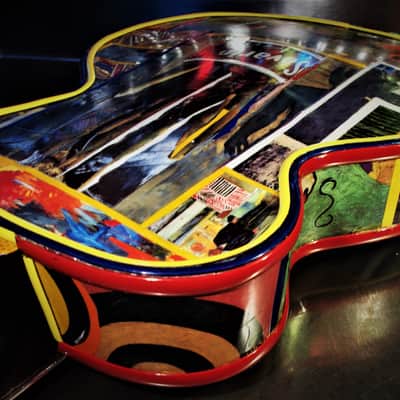
El Daga Jasper Johns "Flag Island" 2019 - Collage Dada Art Guitar. Only one.
This seller has not set a shipping cost for Austria. Please contact them to ask about shipping.

Our users rate Reverb
EL DAGA · No. 82 ·“FLAG ISLAND”
An Interpretive Collage on Guitar — A Tribute to Jasper Johns
2019 · One of One· Dada-Method Collage of Appropriated Art · Rare & Collectible
International Guitar Museum · Home of the Richard Davis Collection
The International Guitar Museum (IGM) is honored to present another irresistible “art guitar” by the artist El Daga. This piece — No. 82, titled “Flag Island” — is a tribute to the legendary American artist Jasper Johns. Johns (born Augusta, Georgia, 1930; raised in South Carolina) is a painter, sculptor, draftsman, and printmaker, and one of the central figures of American postwar art, variously associated with Neo-Dada and Pop. From 1972 he kept a home and studio on the Caribbean island of St. Martin — a Philip Johnson–designed retreat where he spent his winters working in near-total solitude. These photographs were made on that island. The title “Flag Island” folds the two together: Johns’s signature icon and the place where so much of his later art was made.
The guitar comes from the Richard Davis Collection, now housed at the International Guitar Museum, and is offered with a Certificate of Authenticity. It is one of more than one hundred El Daga works in the collection, selected pieces of which are now being made available.
Guitars as Art
Guitars as art? Yes. I have always considered guitars — especially handmade instruments — to be objects of art, and I am hardly alone. Museums have staged major exhibitions of guitar art, most famously the landmark 2000 “Dangerous Curves: Art of the Guitar” exhibition at the Museum of Fine Arts, Boston. And many artists have carried the idea further still, recreating standard guitars as alternative art pieces in their own right.
For many years I have been proud to serve as benefactor to one such artist, known by the sobriquet “El Daga.” His work resides in private collections in the USA, Luxembourg, and other countries, and in museums across the world — Singapore, the UK, Australia, the USA, and beyond. My personal El Daga portfolio comprises more than one hundred pieces: electric guitars, acoustic guitars, amplifiers, and more. I have decided to sell selected pieces from this portfolio. Each is one of a kind, and each comes with a Certificate of Authenticity.
The Method: Dada and the Collage of Appropriated Art
This piece was created in the Dadaist method — the collage of appropriated art — an artistic lineage with a century of pedigree. The Dadaists were the first to declare that art could be made by taking the existing images of the world, cutting them loose from their origins, and reassembling them into something that had never existed before: the found object transformed, the familiar made newly strange. From Duchamp’s readymades to Hannah Höch’s photomontages to the appropriation artists of the modern era, the collage of appropriated imagery has become one of the defining methods of twentieth- and twenty-first-century art.
El Daga works squarely in this tradition — and extends it. His philosophy is rooted in “escultura social” — social sculpture — the concept derived from the German artist Joseph Beuys, who proposed that sculpture made from everyday materials and displayed in real-world settings has the power to affect society at its broadest. El Daga describes his own work as “interpretive,” “creative,” and perhaps most aptly “recreative”: he takes existing works of art and recreates them. He speaks of looking at an artist’s work and listening to it — matching artists, and specific works of art, to the musical instruments that convey to him “the music of the art.” In El Daga’s hands, the guitar is the canvas, the appropriated image is the pigment, and the result is a wholly new object: Dada’s method, Beuys’s conscience, and the guitar’s voice in a single sculpture.
The Subject: Jasper Johns
To understand what El Daga appropriated, you must understand whom he appropriated. Jasper Johns stands among the most important American artists of the last seventy years. Beginning in the mid-1950s, in deliberate rebellion against the heroics of Abstract Expressionism, he built an art from what the critic Harold Rosenberg called “things the mind already knows” — flags, targets, numbers, letters, maps: ordinary, public signs lifted from the world and re-seen, with exacting craft, as paintings. Flag (1954–55), which he said came to him in a dream, remains the most famous American painting of its generation.
Two things make Johns uniquely suited to El Daga’s method. First, market gravity: Johns is one of the most valuable living American artists. When the Whitney Museum acquired his Three Flags (1958) in 1980 it paid $1 million — then the highest sum ever paid for the work of a living artist — and his major works have stood at the very top of the market ever since. Art that engages his imagery participates in that gravity. Second — and El Daga understood this — Johns was himself an appropriator. He made art by re-presenting found, common images; to appropriate Johns is therefore to appropriate an appropriator, a Dada gesture turned back on one of Dada’s own heirs. The conversation here is not decoration. It is one artist re-reading another, in the Dadaist’s grammar of cut and recomposition.
What El Daga Collaged — A Reading of the Johns Lexicon on This Guitar
El Daga did not gather these images at random. He assembled Johns’s core lexicon — the motifs by which the artist is instantly known — and recomposed them into a single new object. Read across the body of the guitar, the principal works he quotes are these:
The Flag. Johns’s signature image — the American flag of his dream — recurs across the instrument: in the broad field beneath the strings and wrapping around the rim. It is the motif that named the piece. (Flag, 1954–55.)
Three Flags. On the upper bout the flag appears stepped and nested, smaller flags receding into the larger — El Daga’s quotation of Three Flags (1958), the very work the Whitney bought in 1980 for a then-record $1 million.
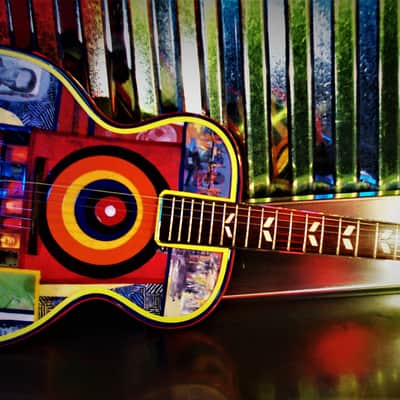
The Target. The great concentric bullseye at the soundhole position — orange, yellow, blue, and black around a red-and-white center — is Johns’s Target, and a second target wraps the lower side of the body. Directly beneath the upper target runs a row of small framed compartments holding fragments and faces — an unmistakable echo of Target with Plaster Casts (1955), in which boxed body-part casts are set in a row above the target itself.
Numbers. Gridded panels of small colored cells and figures reference Johns’s Numbers and Numbers in Color (0 through 9) — the most ordinary sequence in the world, made strange by repetition and paint.
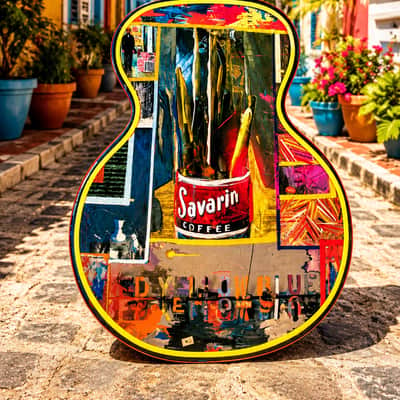
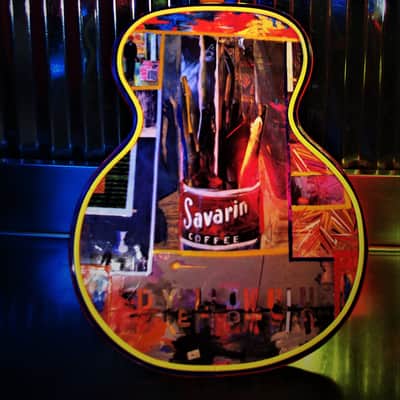
Savarin. On the back of the guitar, the unmistakable Savarin coffee can bristling with paintbrushes — Johns’s Painted Bronze (1960) and the 1977 Savarin lithograph that became the emblem of his Whitney retrospective. It is the artist’s own studio table, made into an icon.
Red / Yellow / Blue. Stenciled color words run along the body — the device Johns introduced in False Start (1959), in which the painted word and the painted color deliberately refuse to agree, setting the eye against the mind.
Crosshatch. The blue-and-black hatching panels in the corners quote Johns’s crosshatch period, inaugurated by Scent (1973) — the abstract counter-voice to his world of recognizable signs.
The Mona Lisa — appropriation three deep. The small Mona Lisa, framed in orange, is the most purely Dada gesture on the instrument. Marcel Duchamp appropriated Leonardo in L.H.O.O.Q. (1919); Johns in turn set the Mona Lisa into his own later paintings; and here El Daga appropriates Johns. It is Dada quoting Dada quoting Dada — the method openly declaring itself.
The name and the man. The stenciled words “Jasper Johns” and a sepia portrait of the artist anchor the composition — naming the subject the way Johns so often stenciled words and names into his own surfaces. The collage also reaches toward his maps and his later traced figures, gathering the whole arc of a career onto one body.
And the closing thread: these photographs were made on St. Martin, the island where Johns bought his Philip Johnson–designed house in 1972 and worked through his winters in solitude. “Flag Island” takes its name from that union — the icon and the place, the flag and the island, folded into a single sculpture.
The Art of It
Classification
Display Art — created and intended by El Daga to be shown as a floating image. It can be played, but its purpose is presence.
Medium
Collage of high-grade appropriated prints, hand-applied to a vintage guitar and sealed.
Edition
One of one. Every El Daga piece is a solitary creation. There is no second example and there never will be.
Portfolio number
No. 82 from the El Daga portfolio of the Richard Davis Collection.
Subject
Jasper Johns (b. 1930) — Flag, Three Flags, Target, Numbers, Savarin, and more.
Year
2019
Documentation
Accompanied by a Certificate of Authenticity.
Condition — Read This as a Collector of Art
This is a piece of handmade art, and it carries the hand of its maker. You will see — and learn to enjoy — its crudeness at the level of detail: lines that are not straight, images that gather randomly together to create a new and total art image. The bumps, bubbles, and rough edges that come from the hands of the artist are part of the art, exactly as they are in any Dada collage from Zürich to today. They are not flaws and carry no guarantee against them. They are the evidence of the human hand — which is the entire point.
The Artiste, in His Own Words
El Daga’s story is inseparable from his work. Born in Mexico City, he practiced his art while laboring with everyday materials — the experience that taught him to see every object before his eyes as art. In 1990 he moved into what he calls his nightmare: South Central Los Angeles. He was there in 1992 when the streets exploded, living, in his words, behind a locked and bound door while anger tore at the sky. His torment became manifest in his work — and when the skies cleared, he carried those children of his anguish into the street and burned them at midnight, an act of exculpation for what he judged his failure as an artist to bring curative restoration to the human spirit. He walked away with only his hands in his pockets, crossed the country in a journey that produced a lifetime of regret and hope in a few months, and rebuilt his life in the seclusion of the rural South — returning to the restorative labor of his hands, and ultimately to his life’s dedication: escultura social.
An artist who burned his own work in the street as penance, who rebuilt himself through labor, and who now recreates the art of the world on the bodies of guitars — collected by museums on four continents — created this tribute to Jasper Johns. Each piece is a solitary creation. This is the only one.
Provenance Statement
This specimen is offered directly from the exhibit collection of the International Guitar Museum, Durham, North Carolina.
From the Richard Davis Collection. This piece comes from the Richard Davis Collection — one of the world’s largest and most deeply curated private assemblages of vintage and custom guitars: 900+ guitars featuring 225+ unique brands from 12+ countries, alongside a curated collection of 200+ custom and vintage electric guitar amplifiers, assembled over 27 years of purposeful, scholarly collecting. This is not inventory that passed through a dealer’s hands. It is a documented piece from a single, serious collection — selected, authenticated, and preserved by one curator.
Why provenance matters now. The market has spoken decisively on what documented provenance is worth. At Christie’s landmark Jim Irsay sale in March 2026, instruments with documented collection history realized $94.5 million — 136% above estimate — confirming what serious collectors already knew: a piece’s story, chain of custody, and the collection it comes from are inseparable from its value. Single-owner pieces from major curated collections command meaningful premiums over otherwise comparable examples — and that gap is widening.
Institutional-grade documentation. This piece is accompanied by a formal Certificate of Authenticity and a transferable title registered with the International Musical Instrument Registry (IMIR), Luxembourg — providing clear chain of custody and documentation of a standard normally reserved for museum deaccessions.
When you acquire from the International Guitar Museum collection, you acquire the provenance with the piece. That value transfers with the title — and it does not expire.
| Listed | 2 days ago |
|---|---|
| Condition | Excellent (Used) Excellent items are almost entirely free from blemishes and other visual defects and have been played or used with the utmost care.Learn more |
| Brand | |
| Model |
|
| Finish |
|
| Year |
|
| Made In |
|
| Pickup |
|
| Right / Left Handed |
|
| Number of Strings |
|
Product safety information may be available here.

