Focusrite Clarett 8Pre USB Audio Interface 2010s - Red
This seller has not set a shipping cost for Austria. Please contact them to ask about shipping.


Our users rate Reverb
In perfect working order and in great shape.
The Clarett 8Pre
Currently there are four models in the range. The two larger models are out now with the smaller units forthcoming. Each model’s number refers to its available microphone preamps, but note that each unit comes equipped with additional ADAT and S/PDIF I/O as well, leading to the (input x output) totals listed here. They are the Clarett 2Pre (10 x 4), Clarett 4Pre (18 x 8), Clarett 8Pre (18 x 20), and Clarett 8PreX (26 x 28). For this review, I received the 1U rackmountable Clarett 8Pre.
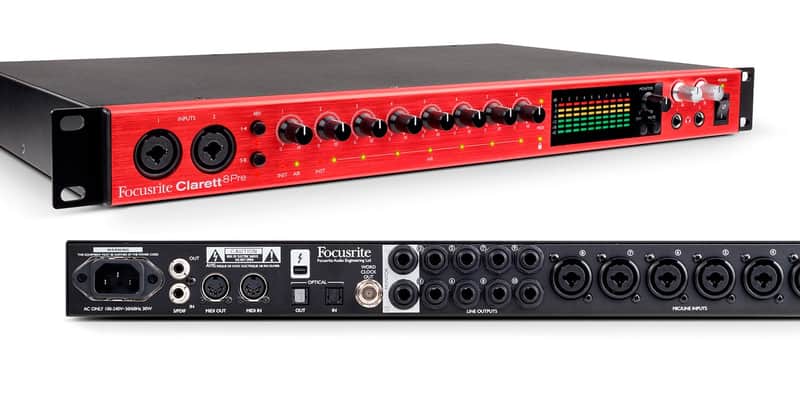
Functionally the Clarett 8Pre is one of the most straightahead interfaces I have used in a while. Unlike many modern units, which use multifunction dials, buttons and encoders, the 8Pre takes a “what you see is what it does” approach with 8 high-quality level knobs, 6-stage LCD metering for each channel, a monitor output knob, and a pair of headphone outputs, each with its own output control. There are also pushbuttons for Dim and Mute, buttons for engaging 48V phantom power for channels 1-4 and 5-8 and a pair of front panel inputs with Neutrik XLR/TRS Combo jacks for mic or instrument inputs. The only function not accessible from the front panel is the Air setting, which is accessed in the included Focusrite Control software (see below).
On the rear of the unit are 6 additional combo inputs for mic or line, 10 TRS balanced line outputs, ADAT optical I/O, SPDIF I/O, BNC Word Clock Out, a single Thunderbolt port, AC socket, and MIDI In and Out.
The software side of the Clarett package is Focusrite Control. This software controls the few internally-accessible functions of the Clarett models, like turning Air on and off. It also features a simple-to-use mixer that is scalable to your needs, with the ability to create submixes for the each of the mono or stereo output groups and each headphone output.
A full spec list is available at the Focusrite website, but a quick scan points up some relevant numbers worth quoting here. The unit provides 57 dB of input gain with a maximum input level of up to +26 dBu (line level) or +18 dBu (mic level); dynamic range is between 111 and 118 dBA depending on the input or output stage; the outputs can push a maximum signal level of +18 dBu (0 dBFS), and frequency response is flat to within 0.1 dB over the full 20 Hz-20 kHz range.
| Listed | 3 days ago |
|---|---|
| Condition | Very Good (Used) Very Good items may show a few slight marks or scratches but are fully functional and in overall great shape.Learn more |
| Brand | |
| Model |
|
| Finish |
|
| Categories | |
| Year |
|
| Computer Connectivity |
|
| Sample Rate |
|
| Bus-Powered |
|
| Digital Input Format |
|
| Electronics |
|
| Digital Output Format |
|
| Compatibility |
|
| Bit Depth |
|
| Format |
|
| Simultaneous I/O |
|
| Number of Headphone Outputs |
|
| Number of MIDI Outputs |
|
| Number of MIDI Inputs |
|
| Number of Digital Outputs |
|
| Number of Digital Inputs |
|
| Number of Analog Outputs |
|
| Number of Analog Inputs |
|
| Number of Channels |
|
| Number of Mic Preamps |
|
Product safety information may be available here.