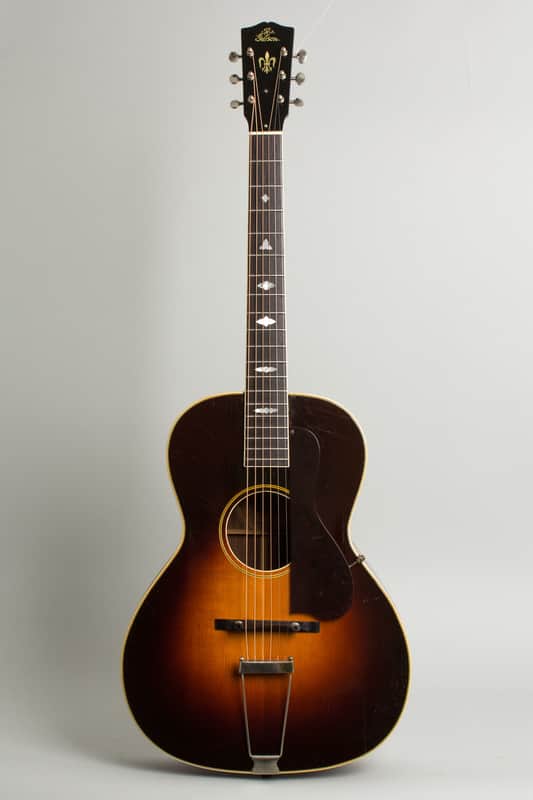
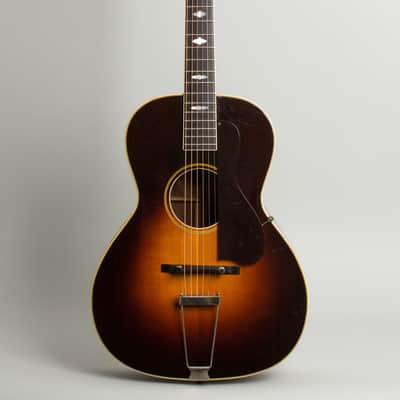
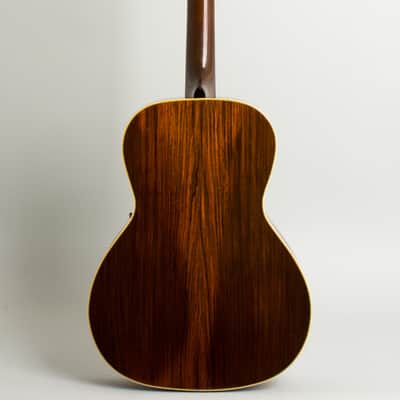
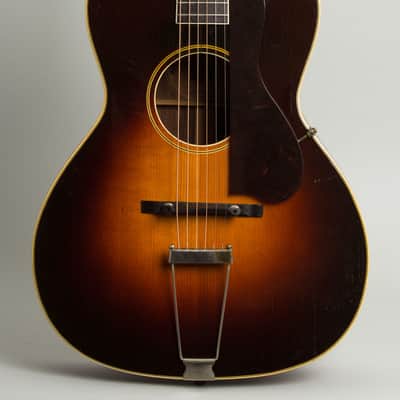
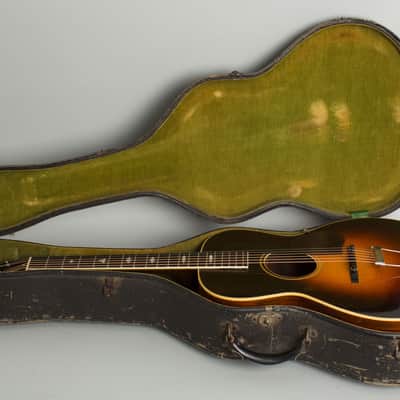
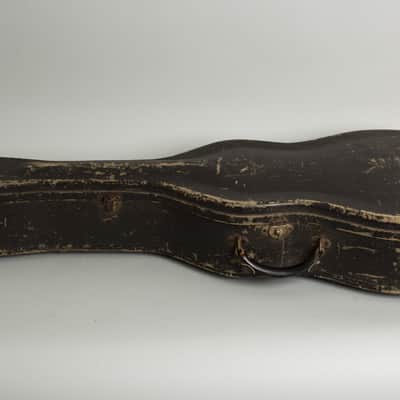
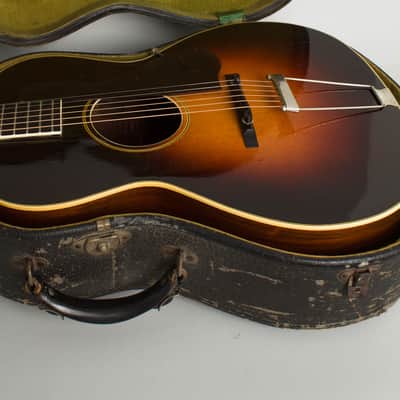
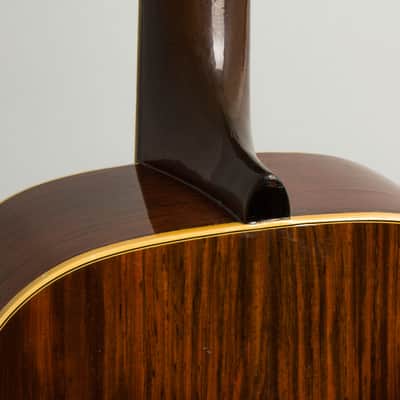
Gibson Nick Lucas Special Flat Top Acoustic Guitar (1932), ser. #88447, original black hard shell case.
This seller has not set a shipping cost for Slovakia. Please contact them to ask about shipping.
Price€27,135.85
+ Shipping
Listed:2 months ago
Views:255
Saves:31
Offers:0

Brooklyn, NY, United States
Our users rate Reverb
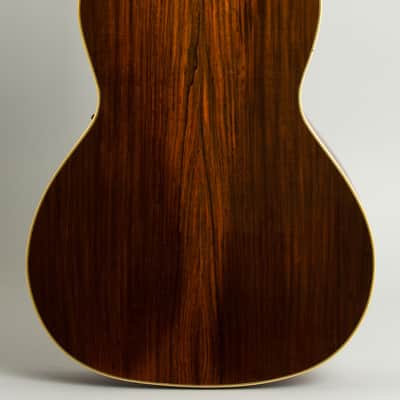
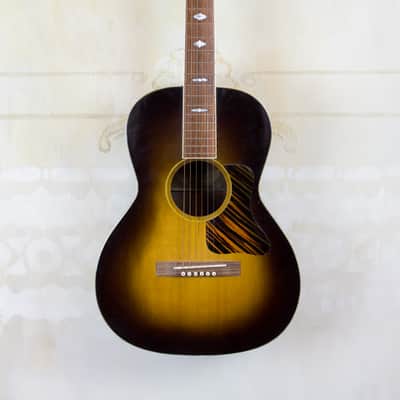
Gibson Nick Lucas Special Model Flat Top Acoustic Guitar (1932), made in Kalamazoo, Michigan, serial # 88447, sunburst lacquer finish, rosewood back and sides, spruce top; mahogany neck with rosewood fingerboard, original black hard shell case.
Guitar-slinging crooner Nick Lucas was the first pop artist to endorse a signature guitar, which was also Gibson's first namesake model. Although largely forgotten now (except as inspiration to Tiny Tim) Lucas was a huge star in the 1920's, on records then on the sliver screen. Prior to 1926 Gibson catalogs denigrated flat-top guitars as unworthy of the true artist, but with the Lucas Special the company abandoned that tack and made its first truly professional grade flat top. This one survives in very clean condition, it appears to have been re-factory worked at the Gibson factory likely in the 1940s or '50s but remains a super example.
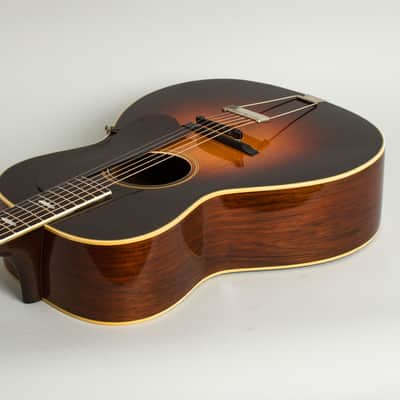
The full name of this instrument is "The Gibson Special-Nick Lucas Model" and it was Gibson's top-of-the line flat top from the mid/late 1920s well into the '30s. Over this span the Lucas model went through a complex and rapid evolution but remained a small deep-bodied flat top. This one has an odd construction feature specific to this exact era, built with a tailpiece/floating bridge layout that is very unusual on higher grade flat tops. In the desperate darkest days of the depression Gibson experimented with this briefly (it was noted as an option in the 1932 catalog) but the concept was quickly dropped. This guitar's rosewood body is also specific to this period and the two features often intersect; a large percentage of these rare rosewood models also have the tailpiece.
These traits mark this lovely 1932 guitar as the third major Lucas variation, built on Gibson's larger nearly 15" wide, less round-bottomed body introduced in 1929. It has beautifully grained rosewood for the back and sides, a premium feature that Gibson rarely indulged. Over its lifespan the Lucas model also had mahogany and maple bodies, but the rosewood version is considered the model's pinnacle. This one was also built with a very unusual 13th fret neck joint, an odd halfway step in the model's evolution from the older 12 fret to 14 fret configuration. The thin, delicately X-braced spruce top is not specifically designed for the elevated bridges construction, but does have an original heavier subtly arched bridgeplate. design later in 1932.
This Lucas is a superbly classy looking guitar. The top carries a beautiful dark sunburst finish; the rest of the instrument is finished in natural to showcase the stunning rosewood grain. This is definitely Gibson factory lacquer work but appears to date to between 15 to 25 years after the guitar was originally built. The lacquer job is superbly well done to the but not quite 1930s style. There is triple binding on the top and back and a 3-ply soundhole ring, with binding on the edge as well. The ebony adjustable bridge and tailpiece are the same used on period archtops. The tortoise celluloid pickguard is the standard elevated arch top piece Gibson fitted to flat tops before adopting a glued-to-the-top
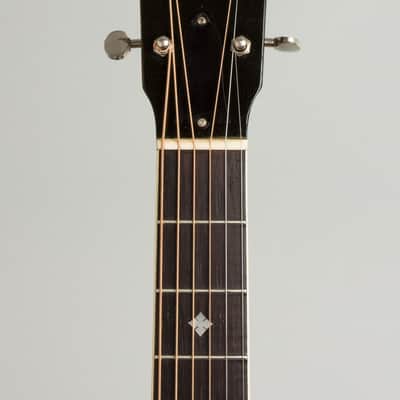
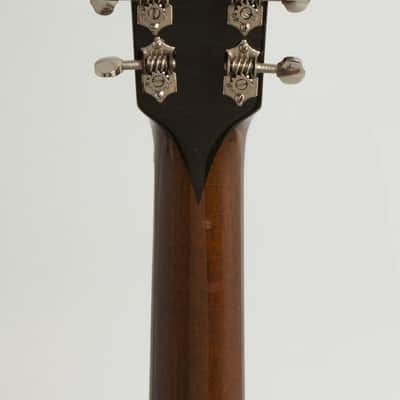
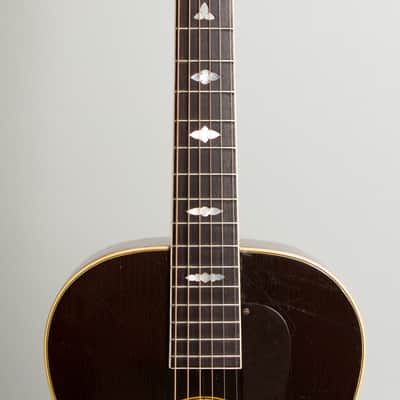
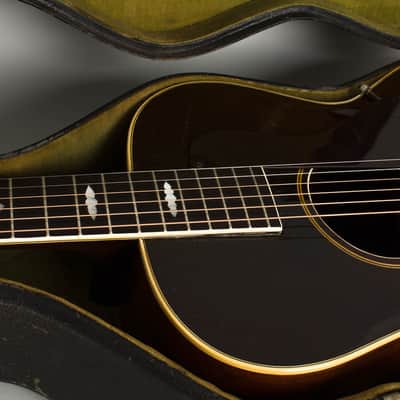
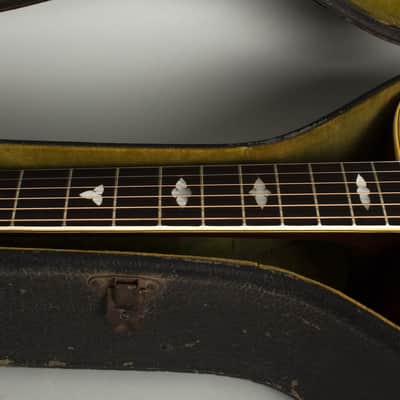
The round-backed neck has a fairly slim/flat profile, though less so than some other period L-1's and L-2s we have had. It is topped with a single bound (with a side line) rosewood fingerboard with the trademark "Lucas" shaped pearl inlay especially designed for this model. The headstock has "The Gibson" in script pearl inlay above a fleur-de-lys pearl emblem. The tuners are somewhat later Grover Sta-Tites with "butterbean" buttons; these appear factory fitted even though a style not generally used by Gibson.
This is a fine playing guitar and with its rich lush sunburst is also quite a looker as well! The tailpiece/bridge format with a sharper neck angle results in a flattop guitar with some of the kick of an archtop, trading off some sweetness for added power and punch. While we are partial to all pre-WWII Gibson flat-tops, we find the Lucas from this period to be a particularly attractive guitar. These delicately built 13-fret large Lucases were made in very limited numbers, just one short stop in the model's constant evolution. Not many survive in as fine condition as this one; while it has become common to convert these to a typical flat-top pin bridge set up, this one remains so far in original condition and yes it sounds great playing "Tiptoe Through The Tulips"!
Overall length is 39 in. (99.1 cm.), 14 3/4 in. (37.5 cm.) wide at lower bout, and 4 9/16 in. (11.6 cm.) in depth at side, taken at the end block. Scale length is 24 3/4 in. (629 mm.). Width of nut is 1 11/16 in. (43 mm.).
This is a clean guitar and very attractive overall, as noted we believe it was returned to the factory some time after the initial sale for a rework and refinish. The fretwork is more consistent with a later period at Gibson than for 1932 and there is a Gibson factory-style but later-appearing lacquer finish on the entire instrument. This is NOT a later '70s style lacquer but a stunning and beautiful earlier period lacquer. This includes black finish on the headstock rear ending in the pointed "stinger" Gibson would sometimes use. Ther is NO evidence of any cracks or breaks to the neck, but fitting the later pattern (although still vintage) Grover tuners would have required covering the old strip tuner holes.
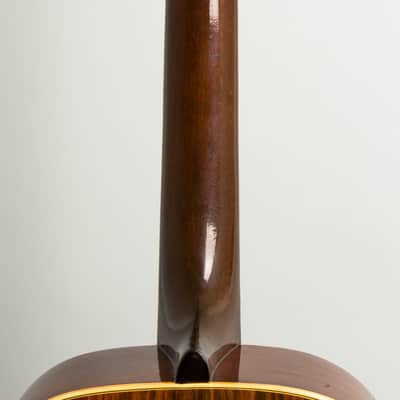
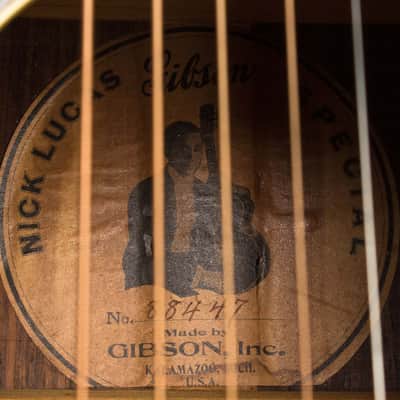
The finish shows some light play wear overall; it shows light checking overall with small dings, dents and a number of shallow pick scrapes into but not through the lacquer to several areas of the top. The back of the neck has a couple of feelable dings in the first position, the rest is quite clean. The original round "TG Nick Lucas Gibson Special" portrait label under the soundhole is intact and quite well-preserved with a bit of staining; Nick's enigmatic smile peers out clearly.
There are several tight sealed grain splits to the top, one cleated along the treble side of the fingerboard extension, another near the treble side waist and the third coming off the back edge nearing the turn of the lower treble bout. The rosewood sides have a number of tightly sealed splits; a number along the bass side rim at the turns of the bout and the waist, with a couple on the treble side lower bout as well. All are neatly sealed with no cleating and relatively inconspicuous. The back has a couple of minor grain pulls but no cracks opened up; the center seam has been tightly resealed in a couple of spots.
The eccentric tailpiece and adjustable ebony bridge remain original, the top of the saddle has been re-shaped just a bit. Since it has already had some factory re-work this guitar would be a prime candidate for conversion to a pin bridge if one is so inclined, although we strongly prefer keeping these instruments or
Guitar-slinging crooner Nick Lucas was the first pop artist to endorse a signature guitar, which was also Gibson's first namesake model. Although largely forgotten now (except as inspiration to Tiny Tim) Lucas was a huge star in the 1920's, on records then on the sliver screen. Prior to 1926 Gibson catalogs denigrated flat-top guitars as unworthy of the true artist, but with the Lucas Special the company abandoned that tack and made its first truly professional grade flat top. This one survives in very clean condition, it appears to have been re-factory worked at the Gibson factory likely in the 1940s or '50s but remains a super example.
The full name of this instrument is "The Gibson Special-Nick Lucas Model" and it was Gibson's top-of-the line flat top from the mid/late 1920s well into the '30s. Over this span the Lucas model went through a complex and rapid evolution but remained a small deep-bodied flat top. This one has an odd construction feature specific to this exact era, built with a tailpiece/floating bridge layout that is very unusual on higher grade flat tops. In the desperate darkest days of the depression Gibson experimented with this briefly (it was noted as an option in the 1932 catalog) but the concept was quickly dropped. This guitar's rosewood body is also specific to this period and the two features often intersect; a large percentage of these rare rosewood models also have the tailpiece.
These traits mark this lovely 1932 guitar as the third major Lucas variation, built on Gibson's larger nearly 15" wide, less round-bottomed body introduced in 1929. It has beautifully grained rosewood for the back and sides, a premium feature that Gibson rarely indulged. Over its lifespan the Lucas model also had mahogany and maple bodies, but the rosewood version is considered the model's pinnacle. This one was also built with a very unusual 13th fret neck joint, an odd halfway step in the model's evolution from the older 12 fret to 14 fret configuration. The thin, delicately X-braced spruce top is not specifically designed for the elevated bridges construction, but does have an original heavier subtly arched bridgeplate. design later in 1932.
This Lucas is a superbly classy looking guitar. The top carries a beautiful dark sunburst finish; the rest of the instrument is finished in natural to showcase the stunning rosewood grain. This is definitely Gibson factory lacquer work but appears to date to between 15 to 25 years after the guitar was originally built. The lacquer job is superbly well done to the but not quite 1930s style. There is triple binding on the top and back and a 3-ply soundhole ring, with binding on the edge as well. The ebony adjustable bridge and tailpiece are the same used on period archtops. The tortoise celluloid pickguard is the standard elevated arch top piece Gibson fitted to flat tops before adopting a glued-to-the-top
The round-backed neck has a fairly slim/flat profile, though less so than some other period L-1's and L-2s we have had. It is topped with a single bound (with a side line) rosewood fingerboard with the trademark "Lucas" shaped pearl inlay especially designed for this model. The headstock has "The Gibson" in script pearl inlay above a fleur-de-lys pearl emblem. The tuners are somewhat later Grover Sta-Tites with "butterbean" buttons; these appear factory fitted even though a style not generally used by Gibson.
This is a fine playing guitar and with its rich lush sunburst is also quite a looker as well! The tailpiece/bridge format with a sharper neck angle results in a flattop guitar with some of the kick of an archtop, trading off some sweetness for added power and punch. While we are partial to all pre-WWII Gibson flat-tops, we find the Lucas from this period to be a particularly attractive guitar. These delicately built 13-fret large Lucases were made in very limited numbers, just one short stop in the model's constant evolution. Not many survive in as fine condition as this one; while it has become common to convert these to a typical flat-top pin bridge set up, this one remains so far in original condition and yes it sounds great playing "Tiptoe Through The Tulips"!
Overall length is 39 in. (99.1 cm.), 14 3/4 in. (37.5 cm.) wide at lower bout, and 4 9/16 in. (11.6 cm.) in depth at side, taken at the end block. Scale length is 24 3/4 in. (629 mm.). Width of nut is 1 11/16 in. (43 mm.).
This is a clean guitar and very attractive overall, as noted we believe it was returned to the factory some time after the initial sale for a rework and refinish. The fretwork is more consistent with a later period at Gibson than for 1932 and there is a Gibson factory-style but later-appearing lacquer finish on the entire instrument. This is NOT a later '70s style lacquer but a stunning and beautiful earlier period lacquer. This includes black finish on the headstock rear ending in the pointed "stinger" Gibson would sometimes use. Ther is NO evidence of any cracks or breaks to the neck, but fitting the later pattern (although still vintage) Grover tuners would have required covering the old strip tuner holes.
The finish shows some light play wear overall; it shows light checking overall with small dings, dents and a number of shallow pick scrapes into but not through the lacquer to several areas of the top. The back of the neck has a couple of feelable dings in the first position, the rest is quite clean. The original round "TG Nick Lucas Gibson Special" portrait label under the soundhole is intact and quite well-preserved with a bit of staining; Nick's enigmatic smile peers out clearly.
There are several tight sealed grain splits to the top, one cleated along the treble side of the fingerboard extension, another near the treble side waist and the third coming off the back edge nearing the turn of the lower treble bout. The rosewood sides have a number of tightly sealed splits; a number along the bass side rim at the turns of the bout and the waist, with a couple on the treble side lower bout as well. All are neatly sealed with no cleating and relatively inconspicuous. The back has a couple of minor grain pulls but no cracks opened up; the center seam has been tightly resealed in a couple of spots.
The eccentric tailpiece and adjustable ebony bridge remain original, the top of the saddle has been re-shaped just a bit. Since it has already had some factory re-work this guitar would be a prime candidate for conversion to a pin bridge if one is so inclined, although we strongly prefer keeping these instruments or
| Listed | 2 months ago |
|---|---|
| Condition | Excellent (Used) Excellent items are almost entirely free from blemishes and other visual defects and have been played or used with the utmost care.Learn more |
| Brand | |
| Model |
|
| Finish |
|
| Year |
|
| Pickup |
|
| Color Family |
|
| Body Shape |
|
| String Type |
|
| Right / Left Handed |
|
| Number of Strings |
|
| Neck Material |
|
| Wood Top Style |
|
| Finish Pattern |
|
| Finish Style |
|
| Top Material |
|
| Model Family |
|
| Series | |
| Fretboard Material |
|
| Artist |
|
| Active Preamp |
|
| Number of Frets |
|
Product safety information may be available here.

