
Peluso P-24 Stereo Large Diaphragm Condenser Tube Microphone
This seller has not set a shipping cost for Hungary. Please contact them to ask about shipping.

Our users rate Reverb
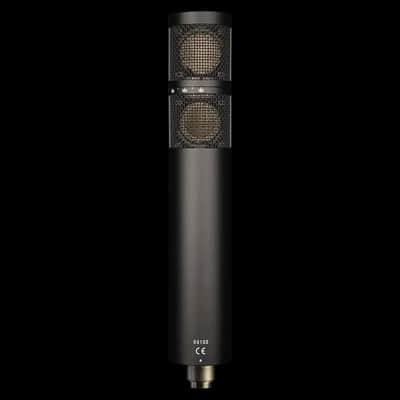
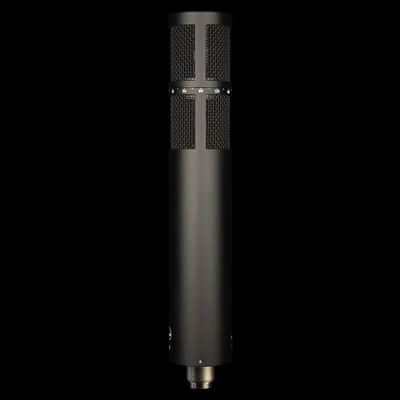
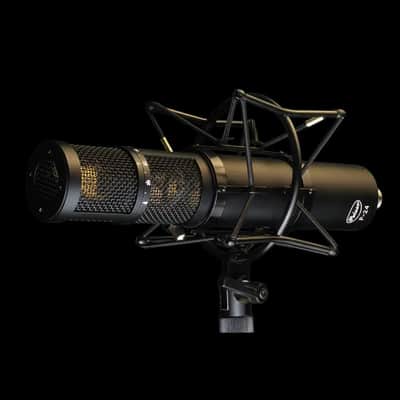
The Peluso P-24 is built as a tribute to the legendary " stereo tube condenser microphone.
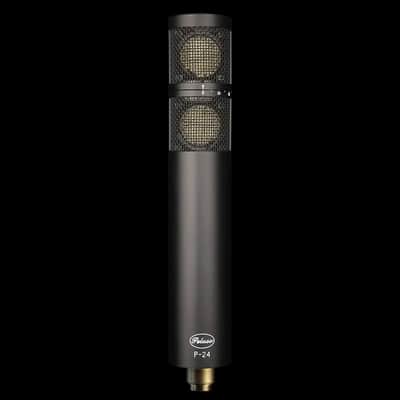
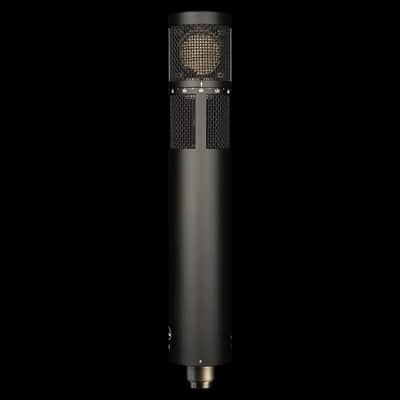
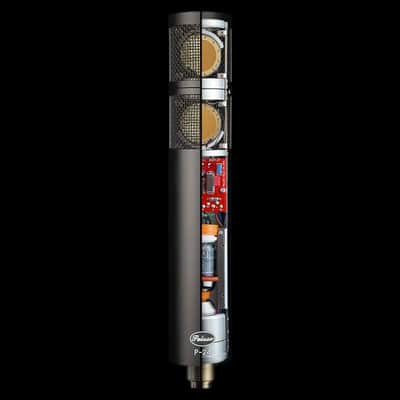
The P-24 hosts two complete large diaphragm condenser (LDC) vacuum tube microphone systems within a single microphone body. The two capsules are located directly above each other with the upper capsule capable of rotating 180 degrees. This configuration provides for quick coincident capture in X-Y, Mid-Side, and Blumlein techniques. Both the upper and lower capsules have 9 independently selectable polar patterns controlled remotely at the microphone power supply. The two signal chains run independently through individual high impedance circuit boards and isolated custom transformers, both powered by a single vintage 6072AM glass triode vacuum tube. While the similarities between the P-12 and the P-24 (as with the C 12 and C24) run very deep, there are a few key differences. The primary differences are subtle and come from running both circuits from the single 6072AM tube. The tube grid is biased differently with the load of both circuits yielding a better low-end response. Additionally, the anode of the tube is grounded differently providing a smoother and fuller top end.
First released in 1959, now long out of production and with only 800 units ever produced, very few original C 24 microphones exist today. It was originally designed to use X-Y and Mid-Side techniques. The subtle unique differences in the sonic quality of the microphone led many to believe it was of superior sound quality to the beloved AKG C 12 microphone. With today's advanced digital mixing tools it is possible to accurately tune the spatial aspects of a mix allowing for accurate positioning of instruments within the mix in the post production process. There are many independent sources that exist for information on the processing of a Mid-Side signal. For many years it has been one of John Peluso’s great ambitions to create a tribute to this very special microphone. Now after a few years of research and development, Peluso Microphone Lab is very excited to release the P-24!
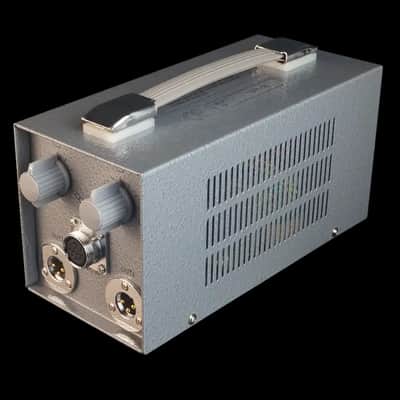
Peluso's new stereo power supply comes housed in a slightly taller steel enclosure. The front panel has all of the connections and controls. In the center is their microphone input connection. On the left side is the OUT1 XLR connection and polar pattern selector. Here you can select from 9 indexed polar patterns from Omni, to Cardioid, to Figure of ‘8’, with 6 indexed settings in between. Identical controls for OUT2 are on the right side of the face panel. OUT1 is the lower capsule, and OUT2 is the upper capsule. As always, on the rear of the power supply you will find an input for either a standard IEC power supply cable for use in the US with 115V or an EU IEC cable for use with 230V. Inside this connector there is a removable fuse tray. Inside this tray is not only the power supply fuse, but also a spare fuse to use if needed.
Peluso's other tube microphones use a rugged 8 pin connector. For a stereo tube microphone, they needed more conductors. Peluso use the same medical systems-grade component in their new 12 pin connector. As with their 8-pin connector, this high-quality connector is built to last for a lifetime of use. The housing is equipped with a key-way that engages before any of the pins contact the receivers. This assures proper alignment of the connection before the pins are pushed into the connector. And, as for the pins, yes, they are still large strong durable pins, similar to the ones in their beloved 8-pin cabling system.
Peluso's new 20' Heavy Duty 12-pin Connector Cable has been designed especially for this microphone. This cable has 12 conductors including 2 twisted pairs of signal wire to eliminate RF interference. The oxygen free conductors are double braided shielded and jacketed in a soft flexible PVC. This cable is designed for years of trouble-free use. As we all know, cables are prone to inadvertent damage so Peluso offers replacement cables for purchase on their website.
Inside the P-24 microphone we find two of the same custom T14/1 historically accurate transformers we have always used in our P-12 microphone. To eliminate any interference, they are separated into two chambers within a steel can in the base of the microphone. It is historically accurate to use this transformer in the output of this microphone. Additionally, after decades of microphone experience, Peluso has come to know and believe that the use of an output transformer is crucial to sound quality.
Peluso's 6072AM vacuum tubes have all been burned in and thoroughly tested. The ‘M’ notation at the end of the number indicates the tube has been tested to be quiet for microphone use.
When they set out to pay tribute to the C 24, Peluso wanted to start at the heart of the microphone and re-engineer the capsule from the beginning. The vintage CK 12 is a very unique capsule. Like most multi pattern LDC microphones the P-24 has a two-sided capsule. Dual edge terminated 6-micron gold mylar membranes tensioned over charged backplates are sandwiched together to create the capsule. As sound pressure waves move the diaphragm, electrical signal passes from between the back plate and diaphragm, creating the signal. The movement of this diaphragm creates sound pressure waves within the internal volumes of the capsule backplate. The design of the venting, chamber sizes and pathways within the backplate has a dramatic effect on the responsiveness of the capsule at different frequencies. The amazing sound quality of the CK 12 capsule comes from the unique and rather complicated design of the backplates and the extra chambers they employ. As a sound wave hits the front of the capsule, the pressure passes into the capsule, through the backplate chambers and in turn passes to the diaphragm on the other side. The capsule must be tuned so that the delay in this wave passing through the capsule matches the diffractive delay of the same sound traveling around the outside of the capsule. The intricate design of this backplate is different between the front side and back side of the capsule. After many decades of restoring these capsules, Peluso wanted to produce an exact historically accurate build. This provides their P-24 with the most accurate CK 12 capsule in production today. Additionally, in their repair department, they now stock diaphragms and all other replacement parts for a vintage CK 12 capsule. Providing repair clients seeking vintage restoration of damaged CK 12 capsules the options to either re-skin their original capsules, replace the original diaphragms with P-CK-12 diaphragms, or replace the entire capsules with a full replacement P-CK-12 capsule. Peluso are very proud of the results of this painstaking process to recreate this masterpiece of condenser microphone technology.
- Dual Large Diaphragm Condenser Capsules
- 32mm P-CK-12 Edge Terminated Capsule
- Glass 6072AM Vacuum Tube Amplifier Stage
- Dual Custom-Wound T14/1 Output Transformers
- 9-Polar Patterns
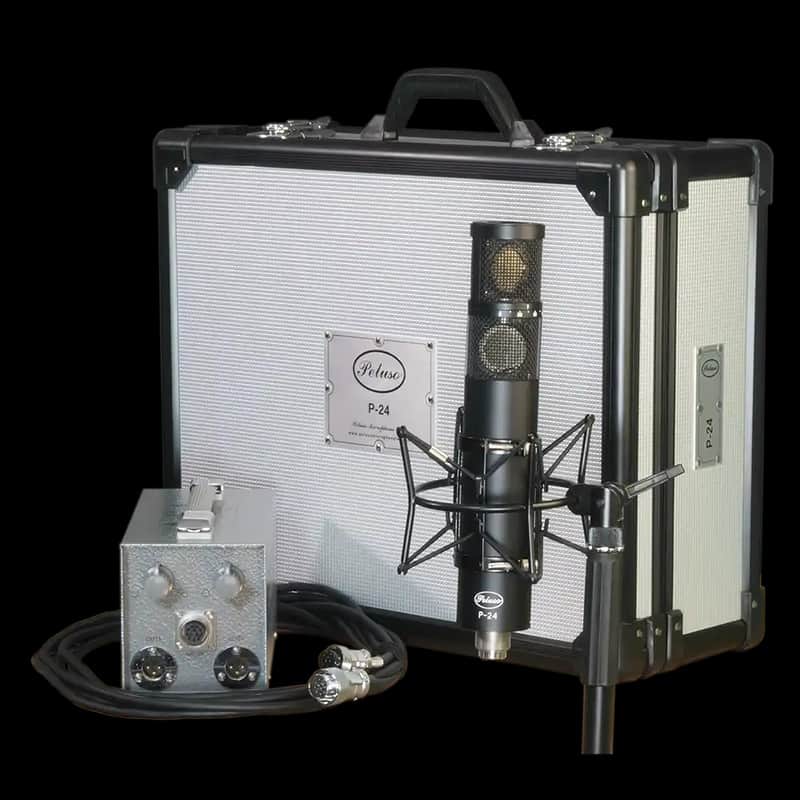
Microphone kit comes as a complete system including:
- P-24 Microphone
- Stereo Power Supply
- 12-Pin Screw-on Stereo Cable Assembly
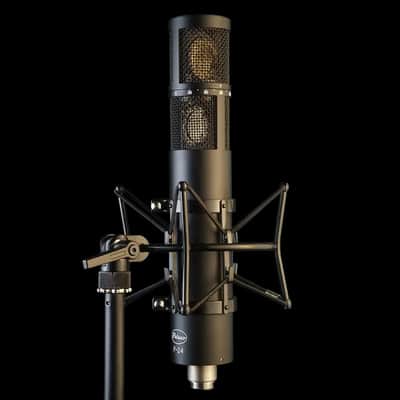
- Shock Mount
- Locking Padded Flight Case
- Capsule Type: Dual Historically accurate P-CK12 32mm Condenser Pressure Gradient, edge terminated
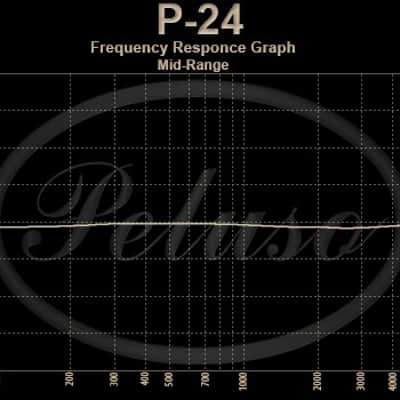
- Frequency Range: 20Hz/24Khz
- Polar Pattern: 9 - Switchable from omni- to bi-directional
- Sensitivity: 11 mv/pa
- Impedance: 200 ohms
- SPL: 138 dB
- Equivalent Noise: 15 dB(A)
- Tube Type: Single 6072A-M
- Transformer: Dual T-14/1
- Power Requirements: Dedicated Power Supply, 115V or 230V AC
- Size: 50mm x 269mm
- Weight: 1058g
The Peluso P-24 is a versatile stereo microphone. It employs two identical dual diaphragm condenser capsules. The upper capsule rotates 180 degrees from the lower capsules. Clear index markings on the head grille showing the rotational position of the capsule. Setup for a traditional X-Y or Mid-Side or Blumlein techniques can be quickly achieved by positioning the upper capsules at the 90 degree position. Users can experiment with other angles to achieve different stereo results.
One of the important benefits of a single stereo microphone is the coincident pair of diaphragms. With both diaphragms equal distance from the sound source, they both receive the sound at precisely the same moment giving great positional accuracy in the stereo image. This also provides a signal that is phase coherent, preventing phase cancellation.
Whether you are miking guitar, piano, ensembles, orchestras, drum overheads, room mics, percussion, full rock bands, or bluegrass single mic setups, the P-24 is an excellent choice for a detailed stereo capture. The nuance of each individual situation will inform what the best setting will be for you. Close miking an acoustic guitar is much different than miking an entire string ensemble. Drum overheads may require a different setup than a drum room mic. You may want more presence of the room acoustics, or more rejection from adjacent sources. The diagrams below will help you begin to understand the possibilities that are capable with the P-24.
Special Rejection in the Figure of '8' Pattern: The figure of ‘8’ pattern in a dual diaphragm condenser microphone capsule has its best rejection or null point at the sides of the capsule. When setting up a stereo miking scene this can be a very useful tool. This null point can be used to exclude one source from capture, or to widen the stereo capture. Take note of this null point in the technique diagrams below.
Blumlein Miking Technique:First developed by Alan Blumlein in 1931 at Abbey Road studios in London. Blumlein technique has the capsules oriented at 90 degrees to each other with both capsules in a Figure of '8' pattern. One way to think of Blumlein is as an X-Y setup with both capsules in figure of '8'. It provides a 360° capture with great stereo separation.
- Blumlein
- Rotation: 90°
- (1) Lower Polar Pattern: Figure of 8
- (2) Upper Polar Pattern: Figure of 8
First developed by Alan Blumlein in 1933 at EMI, Mid-Side technique has the capsules oriented at 90 degrees to each other with the Mid (#2 Upper) capsule in a Cardioid pattern and the Side (#1 Lower) capsule in a Figure of '8' pattern. The key to this technique is having the null point of the side capsule aligned with the hot side of the Mid capsule. With a variety of Mid-Side processing techniques you can make your tracks sound wider, deeper, and more focused. There is a great deal of information online about this processing, as well as special plugins designed to help you make the most of this very powerful stereo imaging technique!
- Mid-Side Traditional
- Rotation: 90°
- (1) Lower Polar Pattern: Figure of '8'
- (2) Upper Polar Pattern: Cardioid
- Mid-Side Super-Cardioid
- Rotation: 90°
- (1) Lower Polar Pattern: Figure of '8'
- (2) Upper Polar Pattern: Super-Cardioid
- Mid-Side Wide-Cardioid
- Rotation: 90°
- (1) Lower Polar Pattern: Figure of '8'
- (2) Upper Polar Pattern: Wide-Cardioid
A traditional X-Y Coincident Pair Miking technique has the capsules oriented at 90 degrees to each other in a cardioid pattern.
Modifying the angle between the mics and the polar pattern can affect the stereo image of the capture. Changing the pattern selection a couple clicks toward Figure of '8' will give you a Super Cardioid pattern. Moving the selector a couple clicks to Omni will give you a Wide Cardioid pattern. Again, the nuance of each individual situation will inform what the best setting will be for you. The diagrams below will help you begin to understand the possibilities that are capable with the P-24 in an X-Y Technique.
- X-Y 90° Traditional
- Rotation: 90°
- (1) Lower Polar Pattern: Cardioid
- (2) Upper Polar Pattern: Cardioid
- X-Y 90° Super-Cardioid
- Rotation: 90°
- (1) Lower Polar Pattern: Super-Cardioid
- (2) Upper Polar Pattern: Super-Cardioid
- X-Y 90° Wide-Cardioid
- Rotation: 90°
- (1) Lower Polar Pattern: Wide-Cardioid
- (2) Upper Polar Pattern: Wide-Cardioid
- X-Y 120° Cardioid
- Rotation: 120°
- (1) Lower Polar Pattern: Cardioid
- (2) Upper Polar Pattern: Cardioid
- X-Y 120° Super-Cardioid
- Rotation: 120°
- (1) Lower Polar Pattern: Super-Cardioid
- (2) Upper Polar Pattern: Super-Cardioid
- X-Y 120° Wide-Cardioid
- Rotation: 120°
- (1) Lower Polar Pattern: Wide-Cardioid
- (2) Upper Polar Pattern: Wide-Cardioid
| Condition | Brand New (New) Brand New items are sold by an authorized dealer or original builder and include all original packaging.Learn more |
|---|---|
| Brand | |
| Model |
|
| Categories | |
| Made In |
|
Product safety information may be available here.

