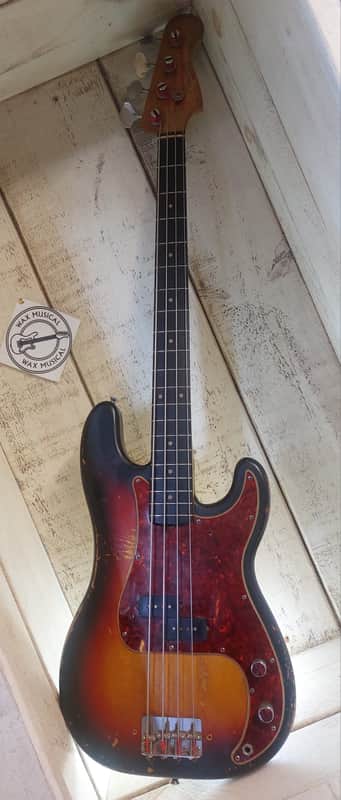
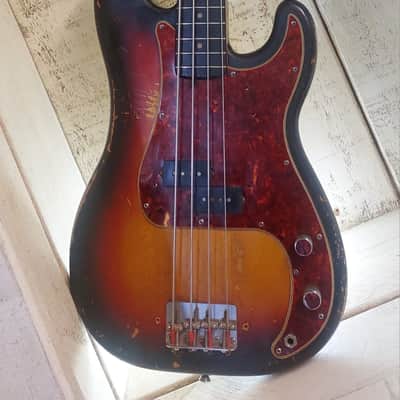
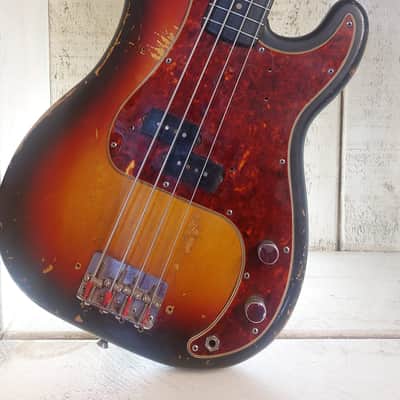
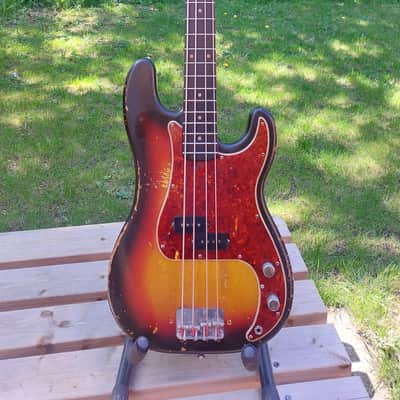
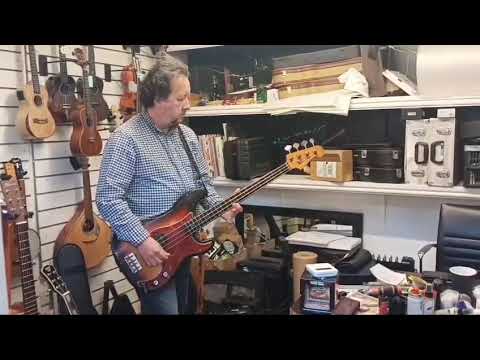
Fender Precision Bass 1962 -(Beatles & Stones support act owned)
Our users rate Reverb
UPDATE : Action has now been reduced with a removable shim - it is now playing very nicely.
- Fret wear is low due to it having been played with round wounds its entire life
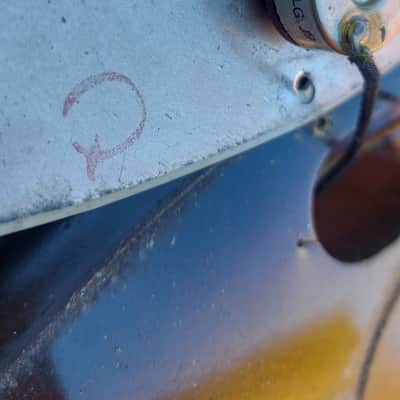
- Pot codes on tone pot date it early 1962
- I will produce bill of sale & accompanying booklet with copy pics, letters, & COA to ship with the instrument.
- This has been 'setup' by a renowned UK luthier
We survive by selling excellent gear below market values. Check our previous listings and feedback.
We send worldwide every week, safely.
--------------------------------------------------------
This is a once-in-a-lifetime chance to own not just an amazing bass guitar, but a unique piece of rock’n’roll history with a value estimated at up to £30,000.
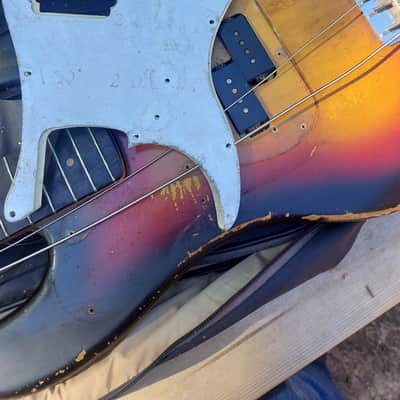
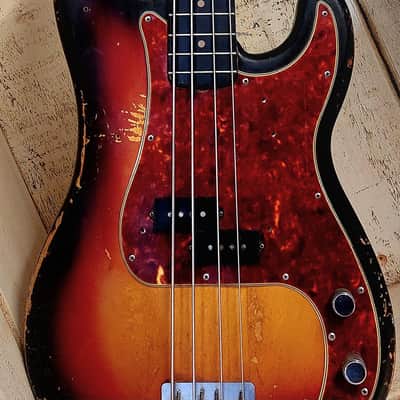
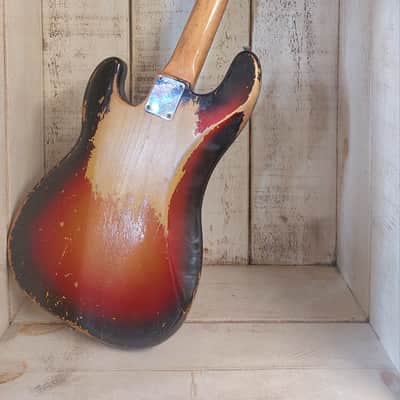
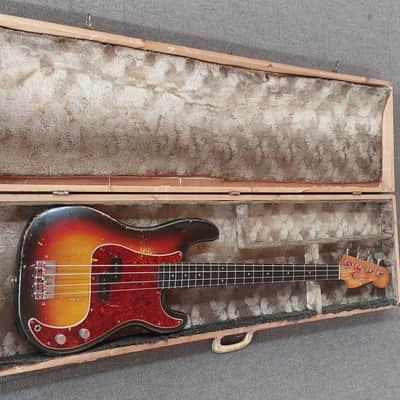
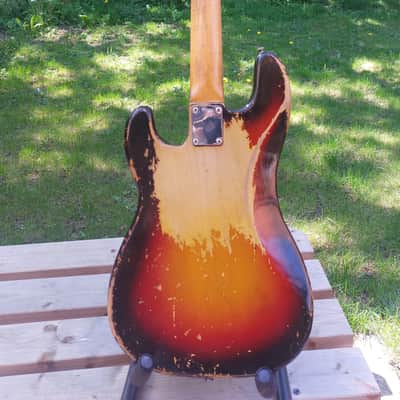
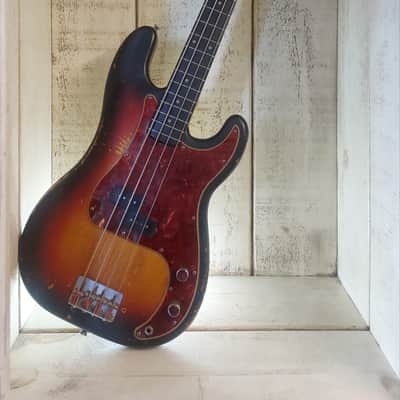
Genuine 1962 Fender Precision bass with the desirable “slab” neck. All completely original parts aside from one potentiometer. Original “sunburst” finish with a beautiful authentic patina – this is an old, well-loved instrument and it looks the part. Not only that, but it sounds just as great as you’d expect an instrument of this pedigree to sound, even 64 years later: You can see a video of it being played below.
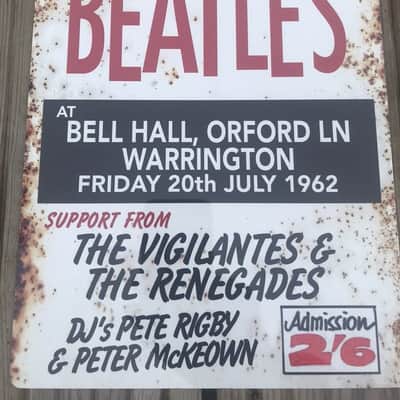
The instrument also has a remarkable claim to fame. We can directly trace its provenance to George Jones, bass player in a Warrington band called The Renegades. The Renegades played several notable gigs locally, most importantly acting as support act to The Beatles at their Bell Hall concert in July 1962, and to the Rolling Stones at Parr Hall in November 1963. This Fender P-bass was played by George at both concerts; we can provide a certificate of authenticity, as well as several items of documented evidence, to underline this.
The guitar
· 1962 Fender Precision bass
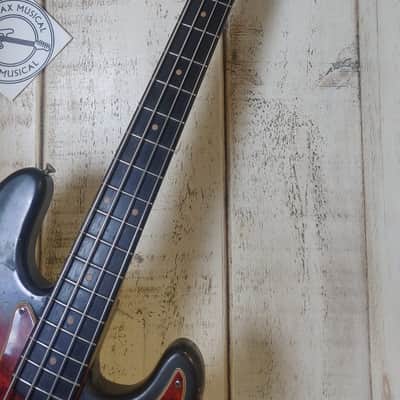
· 'slab' style neck with ceramic dot markers and side-markers
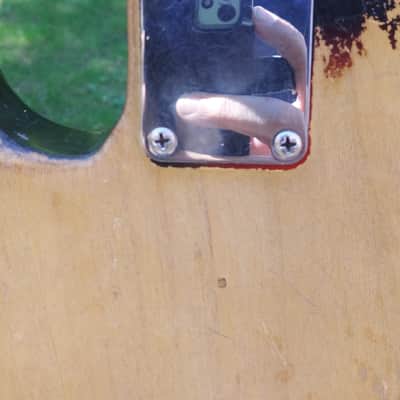
· serial number on the neck plate
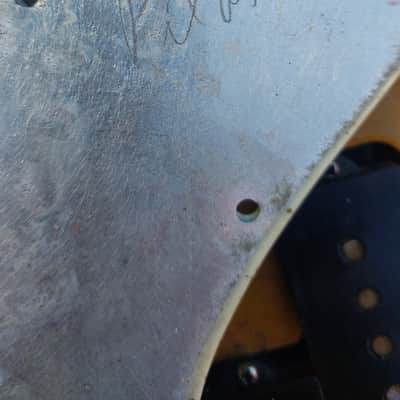
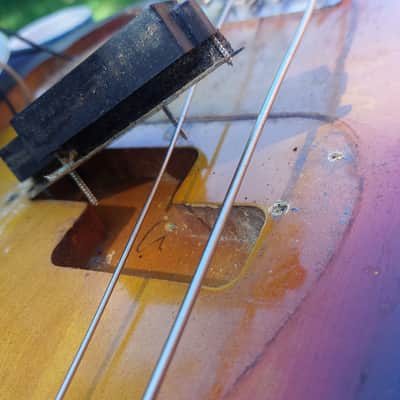
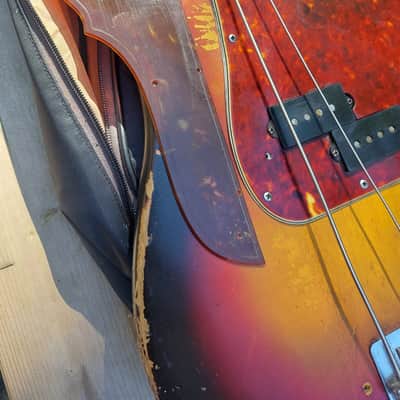
· original hand-wound Fender pickups, wound by Pilar Lopez (one of the original Fender pickup winders, who learned directly from Leo Fender). This is evidenced by her signature on the metal under-scratch plate!
· idiosyncratic body shape and depth
· original un-refinished 'sunburst' finish
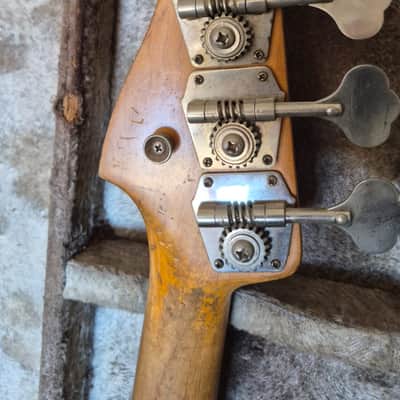
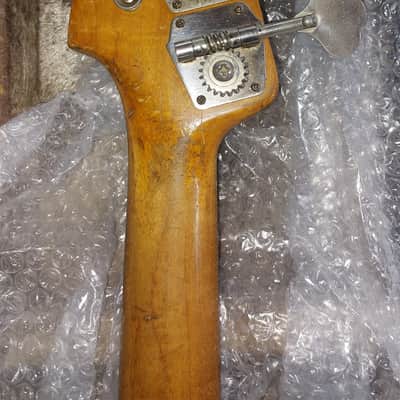
· authentic headstock layout
· original tuners
· one replaced potentiometer; the other is original
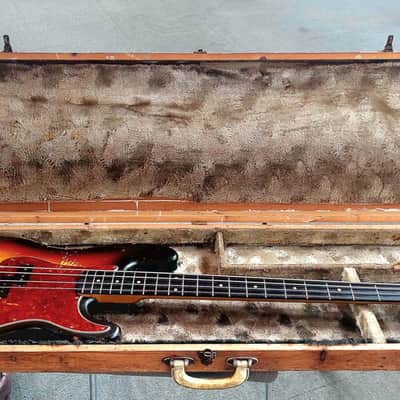
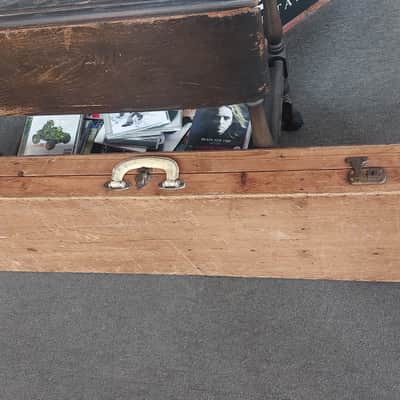
· comes with George Jones’s handmade wooden case and with lightweight pod case for easy handling
· minor crack on the back of headstock from a tuner screw; purely cosmetic and not affecting neck strength, filled and stabilise by pro guitar tech Richie Thomson.
A piece of rock history
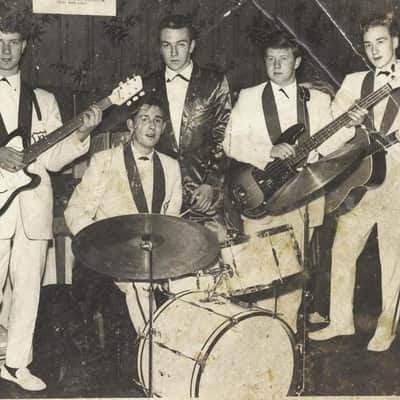
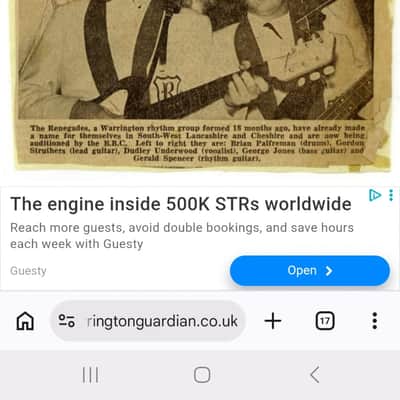
The bass was purchased from a relative of George Jones. See the photos in the listing for George with the instrument in the early 1960s, pictured with The Renegades, and for the poster advertising The Beatles at Bell Hall in 1962. There is ample proof that The Renegades were the support act at this show and that George played bass with his band that night. Similarly, when the band supported the Rolling Stones at their November 1963 Parr Hall concert, George was there, playing this very bass.
We are offering this exciting and unique instrument for sale worldwide through Reverb. Generally you would only be able to get your hands on something of this calibre by going through one of the big auction houses such as Sotheby’s or Christie’s, but selling direct through Reverb has allowed us to offer this at a lower price point than its estimated value. This is a once in a lifetime instrument and we are searching for serious buyers only.
The bass can be viewed and demo’ed by appointment at our store in Chorley, Lancs.
Final update: This instrument is now ready for serious sale and we can make the following statements having had the instrument checked by a number of experts...
1. This is a genuine 1962 Fender Precision with the desirable 'slab' neck
2. The body, the sunburst finish, the neck finish, the tuners, the neck plate, the scratchplate and aluminium under-plate are all original.
3. This guitar was owned - without a doubt - by the Bassist George Jones who played with the Renegades (Warrington). That band supported the Beatles at Bell Hall in Warrington in 1962, and the Rolling Stones at Parr Hall Warrington in 1963. These gigs are well documented, as are the Renegades appearances there. At Bell Hall the Renegades' drummer had to use Pete Best's kit due to having another gig the same evening. This was one of Pete Best's final appearances with the Beatles.
6. This sounds and plays extraordinarily well. Although there is a handmade wooden case (not a Fender case) included, we will organise a lightweight pod case in addition to enable easy handling.
7. There is no problem shipping this to USA or other nations as it was built well before the CITES conventions.
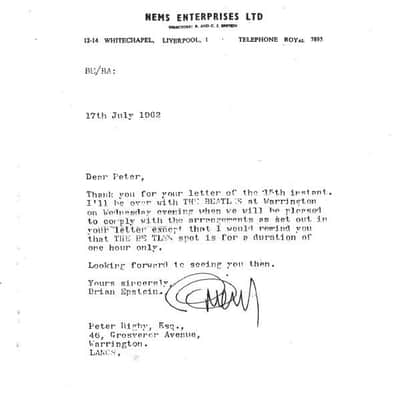
UPDATE 3: NOW DISCOVERED - THE LETTER FROM BRIAN EPSTEIN CONFIRMING THE BEATLES ATTENDANCE AT THE WARRINGTON SHOW, WHERE THEY WERE SUPPORTED BY THE RENEGADES.
UPDATE 2: ALL CONFIRMED - ORIGINAL SLAB NECK EST PRODUCTION DATE FOR BASS FEB 1962
UPDATE 1: This precision bass does has 1 original pot and the pickups are original.
This historic bass is priced below the lowest estimate that professionals have given for an instrument with this background and provenance. This is because we are selling thru Reverb and not Christies, Sotheby's or any of the big auction houses.
The estimate we were given was £20k - £30k for a '62 precision with this history.
This is a 1962 Fender Precision bass, which has the 'slab' style neck with ceramic dot markers and side-markers, the serial number on the neck plate, the signature 'Pilar' (Pilar Lopez, one of the original Fender pickup winders) on the metal 'under-scratch plate', the idiosyncratic body shape and depth, and the original un-refinished 'sunburst' finish,
The very genuine relic appearance, the layout of the headstock, the tuners, the fact that it was bought from a relative of George Jones (bass player of the Renegades) and the photo of him with the instrument in the very early 1960's all testify to the veracity of the fact that this bass guitar was used to support the Beatles on their first Warrington show.
We acquired this bass in the town of Warrington - where the Beatles played in the early 60s (see poster).
It was purchased from a relative of George Jones himself.
George Jones played bass on that show with the Renegades (again, see the pictures) and played bass with the Renegades to support the Rolling Stones on their Warrington show the year afterwards.
The bass still plays and sounds amazing. On the video shown I (Sam Dooley) am playing it with old flats thru a tinny practice guitar amp. It really does not do it justice - when we complete a set-up and play it thru a good amp we will do another video (if we still have it).
I have a whole lot more info and photos but have decided to get the listing up and running. I've received an email from Fender saying they think it is a great find. The email text is below.
We will provide a COA of when, where and how we acquired it and how the history can be supported.
There are no date stamps on the neck that I can see, but Fender say they often got rubbed off. The facts are; the serial number checks out for early '62 and everything else on the guitar is absolutely commensurate with a '62 P-Bass - include the history of the ownership.
This is a historic instrument with a great provenance and is very possibly worth much more than we are asking. It is available to play by appointment at our store in Lancs, and it plays very well indeed. I will ensure there is a proper bass amp available if this is arranged!
EMAIL FROM FENDER TO SUPPORT AUTHENTICITY HERE:
Cedric (Fender Musical Instruments)
30 Apr 2026, 16:54 BST
Dear Sam,
Thank you for reaching out and for the fascinating details you've shared about this Precision Bass. What a wonderful find — potentially a very significant piece of British beat-era music history if the provenance can be confirmed. Let me share what I can from our side.
Serial number 75733 — plausible for 1962
Your serial number 75733 is indeed consistent with 1962 production. Early Fender serial numbers were stamped on the neck plate in rough chronological batches:
Year Approximate serial range
1961 55000 – 72000
1962
72000 – 93000
1963 93000 – L10000
So 75733 would sit comfortably in early-to-mid 1962. However, we have to be transparent: neck plate serial numbers from that era are not a reliable dating tool on their own. Neck plates were produced in batches and used as needed, sometimes out of strict sequence, and plates can be swapped during repair or restoration. The serial confirms plausibility, not certainty.
About the missing date stamps
Given that you've already removed and inspected the neck pocket and neck heel without finding any date markings, the most likely explanations are:
The body has been refinished at some point, which can obscure or remove pencil marks in the neck pocket
The neck or body has been replaced during its working life (very common on gigging instruments of that era)
The pencil marks have simply faded away — they're not ink, just soft pencil on raw wood, and can disappear over 60+ years of handling and exposure
In the absence of neck/body date stamps, the most reliable remaining dating evidence will come from:
Pot codes on the potentiometers (e.g., a code such as "304 6220" would indicate CTS, week 20 of 1962)
Pickup date — sometimes written or stamped on the underside of the pickup
Period-correct hardware and components — tuners, bridge, pickguard screws, wiring, etc.
The "Pilar" signature
The signature "Pilar" on the underside of the pickguard is a genuinely encouraging sign. Fender's Fullerton factory in the early 1960s had a small team of assembly workers, and several of them — Tadeo Gomez, Virginia, Mary, Gloria, and yes, Pilar — frequently signed or initialled the components they assembled. These signatures are considered markers of authenticity and are well-documented in Fender collector circles. Finding "Pilar" on a pickguard from a 1962 P-Bass is entirely consistent and a very good sign.
The George Jones / Renegades provenance
Regarding the claim that this bass was owned by George Jones of The Renegades, who supported The Beatles in Liverpool — we unfortunately cannot verify or authenticate personal ownership history from our side. Fender does not hold ownership records for vintage instruments, and provenance claims of this nature can only be substantiated by:
Documentary evidence — original bills of sale, photographs of the musician playing the instrument, gig posters, tour programmes, letters
Chain of custody — a traceable line of previous owners with supporting paperwork
Testimony — statements from the musician, their family, bandmates, or estate
Photographic matching — period photographs where unique features of the bass (grain patterns, wear marks, scratches) can be matched to the instrument you now hold
If genuine, that is a tremendously valuable piece of Merseybeat/British Invasion history. The Renegades were indeed active in the early 1960s and had Liverpool connections, so the story is at least historically plausible — but plausible is not proven. We'd strongly encourage you to gather as much documentary evidence as possible from whoever you acquired it from.
What we can confirm from our side
Based on everything you've shared, what we can say with reasonable confidence from our end is:
The serial number 75733 is period-correct for a 1962 Precision Bass
The "Pilar" signature on the pickguard is consistent with genuine Fullerton-era factory assembly
The overall description is consistent with a genuine pre-CBS Fender Precision Bass
| Listed | a month ago |
|---|---|
| Condition | Very Good (Used) Very Good items may show a few slight marks or scratches but are fully functional and in overall great shape.Learn more |
| Brand | |
| Model |
|
| Year |
|
| Made In |
|
Product safety information may be available here.

