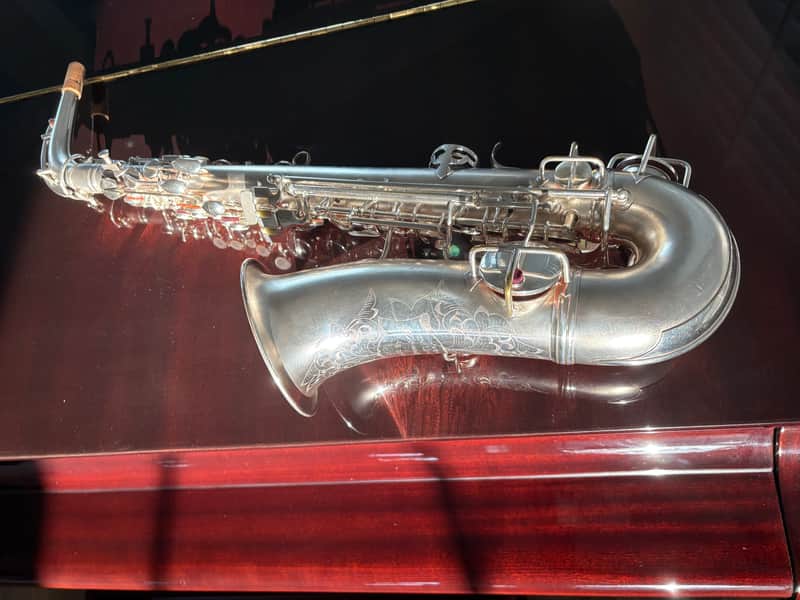
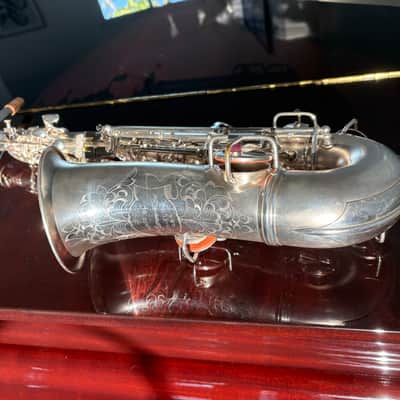
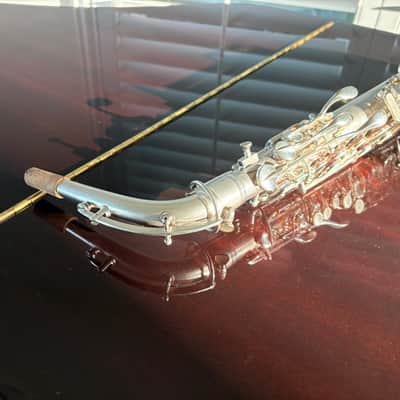
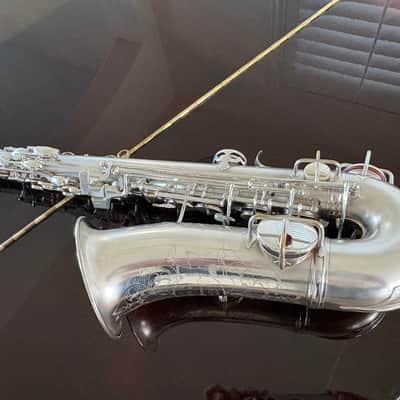
C.G. Conn New Wonder II — “The Chu Berry” 1927 - Silver plate
This seller has not set a shipping cost for Slovenia. Please contact them to ask about shipping.

Our users rate Reverb
This is the one.
Not just a vintage saxophone. Not just a conversation piece. This is a living artifact from the most electrifying era in jazz history — a 1927 C.G. Conn New Wonder Series II, the horn the saxophone world has called “The Chu Berry” for nearly a century — and it has just been completely rebuilt from the ground up so it plays exactly as it did the day it left Elkhart, Indiana.
The Horn That Defined an Era
Starting around 1923, the New Wonder Series II came to define the jazz and big-band saxophone sound of the time. This was the golden age of American instrument making — when Conn’s factory in Elkhart was producing some of the finest horns ever made, and the saxophone was becoming the defining voice of American music.
This is an iconic piece of American jazz history. The 1920s weren’t just a decade — they were a sonic revolution. Think speakeasies, smoky ballrooms, and the birth of swing. The horn in this listing was built right in the middle of all of it.
The “Chu Berry” Name & Its Colorful History
Leon “Chu” Berry was an American jazz tenor saxophonist in the 1930s, perhaps best known for his time with Cab Calloway’s big band. His mastery of advanced harmony was an influence on Dizzy Gillespie and Charlie Parker — and Parker named his first son Leon in Chu’s honor. Berry was among the musicians who took part in the jam sessions at Minton’s Playhouse in New York City, which helped lead to the development of bebop.
The name “Chu Berry” stuck to this model for generations — a testament to how closely this horn’s sound was associated with the fiery, swinging tenor tradition he represented. Technically, Berry played a later “transitional” model, but no matter — the Conn New Wonder II earned that nickname through the sheer force of its voice, and it has carried it proudly ever since.
What Makes This Horn Extraordinary
This horn produces a massive, spread, and room-filling sound that modern saxophones simply cannot replicate. Here’s why:
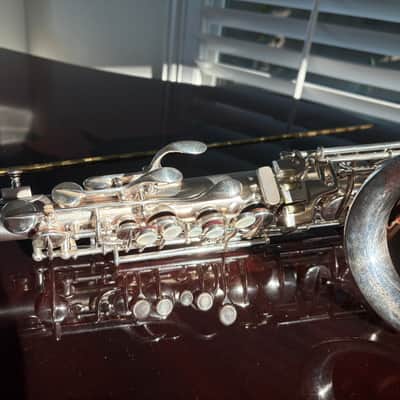
•Rolled Tone Holes — Unlike standard drawn tone holes, Conn’s famous rolled tone holes provide a broader, smoother seating area for the pads, extending pad life and significantly reducing acoustic resistance — contributing to the horn’s famously free-blowing nature.
•Cork-Based Neck — Built Right the First Time — This horn was built with a traditional cork-fitted neck rather than Conn’s original microtuner mechanism, and that was a deliberate choice. Microtuner necks, while a genuine engineering marvel of the 1920s, are notoriously problematic as they age — the threaded rings corrode, seize, and leak, and finding someone who can properly service one is increasingly difficult. A well-fitted cork neck eliminates those failure points entirely while preserving all the acoustic character of the original design. This horn will tune reliably and seal perfectly for decades to come.
•The Signature “Nail File” G# Key — The defining visual characteristic of the Series II: a cross-hatched texture on the G# key, designed to keep the player’s pinky from slipping during fast passages.
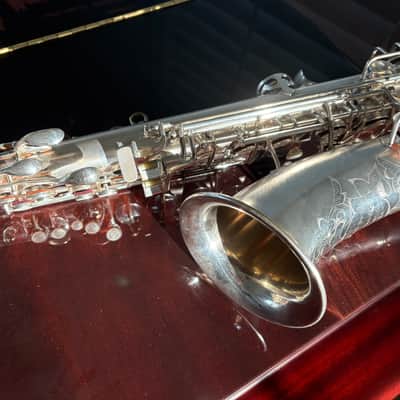
•Split Bell Keys — The B and Bb keys are on opposite sides of one another on the bell, rather than on the same side as on later models and modern saxophones. This is one of the most recognizable hallmarks of Conn craftsmanship in this era.
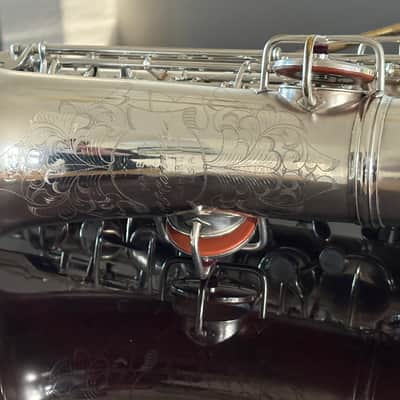
•Original-Style Resonators — This horn has been rebuilt with original-style resonators, not the modern domed plastic replacements you’ll find on most overhauled vintage horns. This preserves the authentic tonal character — that fat, dark, singing quality — that players and collectors specifically seek out in these instruments.
•Stunning Combination Brush/Bright Silver Plate Finish — The body wears a satin-brush silver finish, while the engraving, bell, and key details are brought up to a bright mirror polish — a striking two-tone contrast that was a hallmark of Conn’s finest work. Nearly a century old and still wearing it beautifully.
The Rebuild
This horn has been completely rebuilt from scratch. Every pad, cork, spring, and felt has been replaced. The action has been regulated and set up to play in perfect balance. This is not a “freshly set up” horn — it is a ground-up restoration that has returned this instrument to the condition it was in when it rolled off the Conn factory floor in 1927.
Who Is This Horn For?
If you are tired of the focused, heavily centered sound of modern French or Japanese saxophones and want a horn that produces a “wall of sound,” the Conn New Wonder II is unmatched. It takes a massive amount of air and rewards you with a fat, velvety lower register and a vibrant, singing upper register.
This horn is for the traditional jazz player who wants the real thing. The collector who wants a piece of American music history in playable condition. The gigging musician who wants to stand out from the sea of modern lacquer and turn heads the moment the first note leaves the bell.
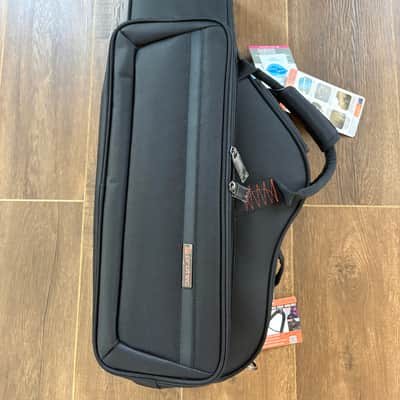
This horn will be 100 years old next year. Fully rebuilt examples with original-style resonators are increasingly rare. The New Wonder II comes in a brand-new Protec XL case to preserve its pristine new-car smell. I can provide the original wooden case and vintage accessories for an additional shipping charge.
| Listed | 2 months ago |
|---|---|
| Condition | Excellent (Used) Excellent items are almost entirely free from blemishes and other visual defects and have been played or used with the utmost care.Learn more |
| Brand | |
| Model |
|
| Finish |
|
| Categories | |
| Year |
|
| Made In |
|
Product safety information may be available here.