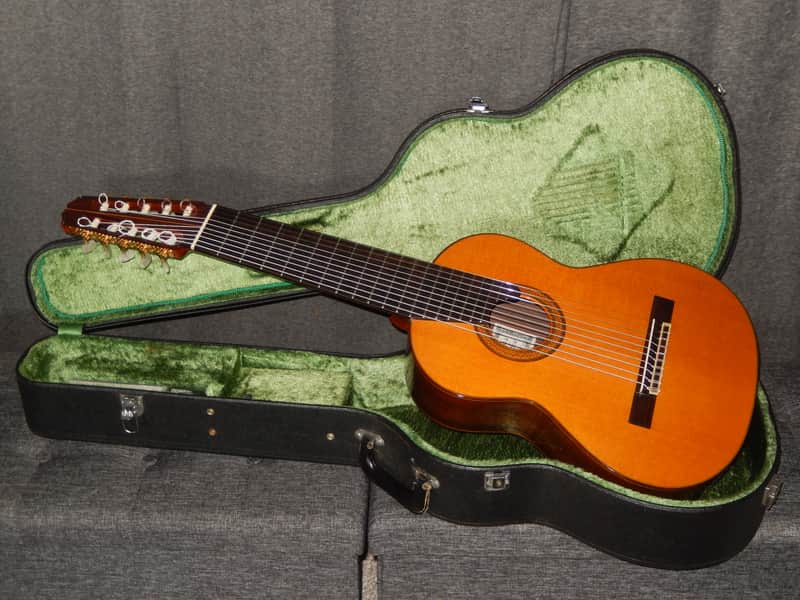
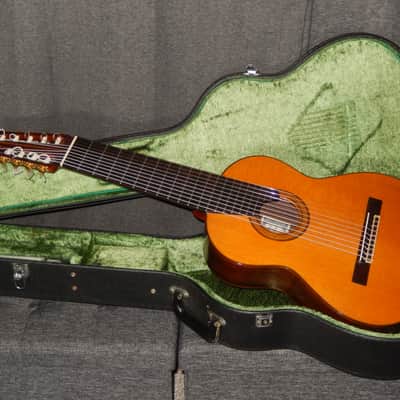
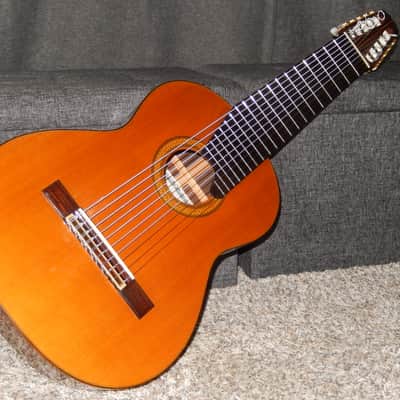
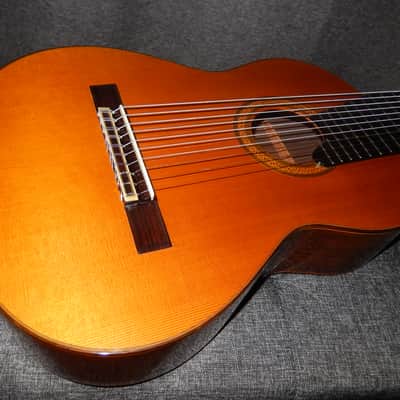
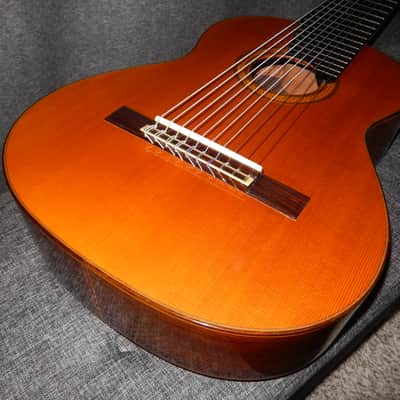
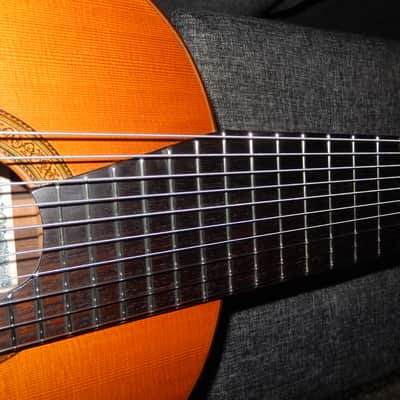
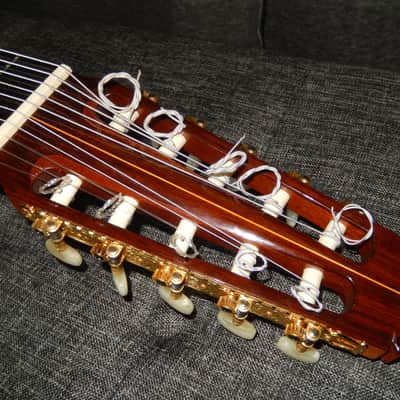
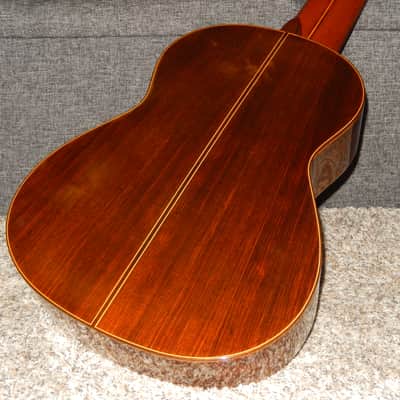
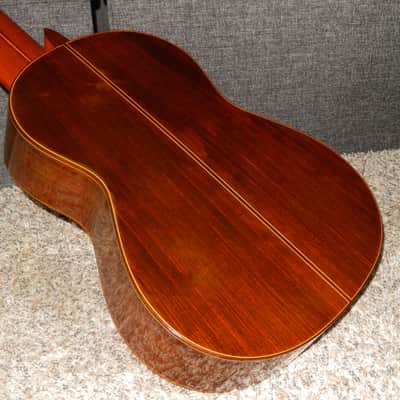
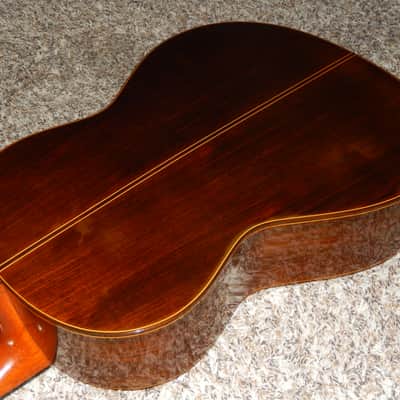
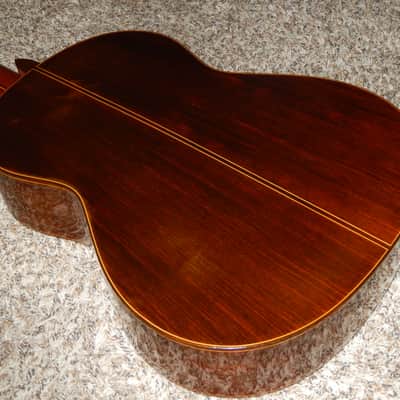
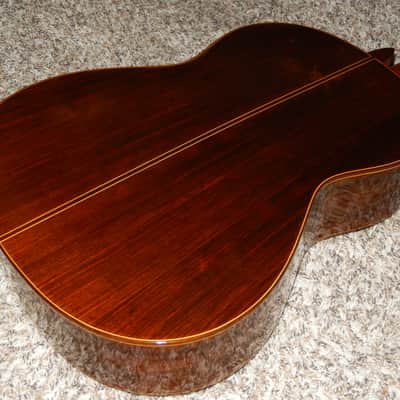
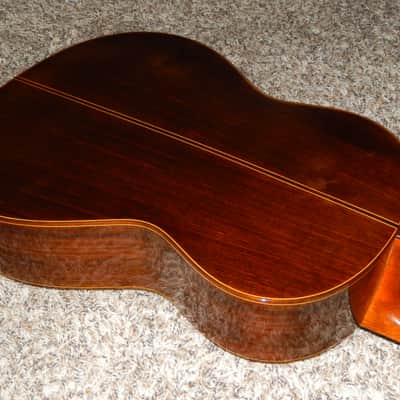
BARGAIN - RYOJI MATSUOKA M150-10 1985 - 10 STRING CLASSICAL CONCERT GUITAR
This seller has not set a shipping cost for Cyprus. Please contact them to ask about shipping.


Our users rate Reverb
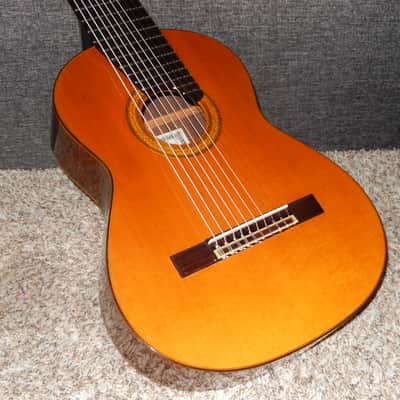
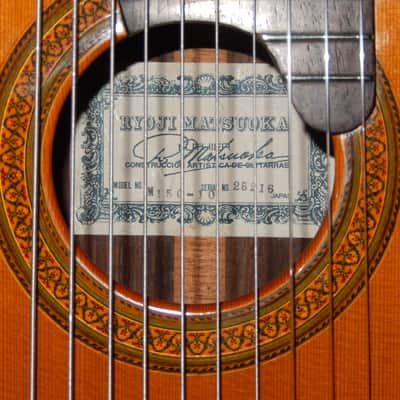
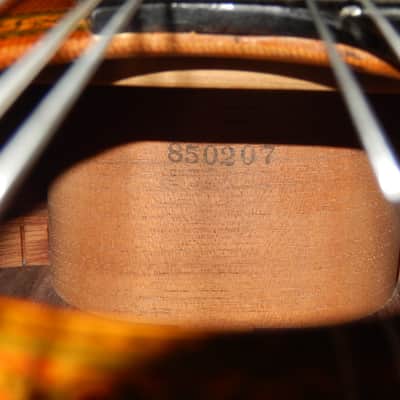
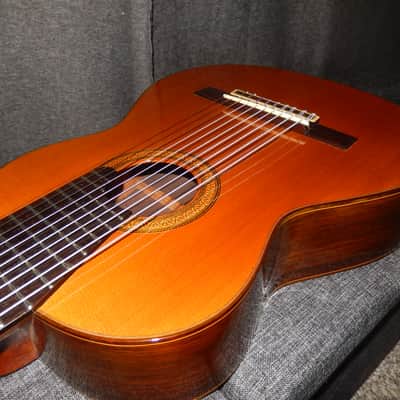
This terrific guitar was made in 1985 by Ryoji Matsuoka, who remains one of the best known Japanese luthiers all around the world.
Because after all these years Matsuoka’s 10 string guitars are very hard to find, they must have been made in rather limited numbers.
As of today, 10 string classical guitars custom made by Japanese luthiers are priced minimum $10000. Regular line Asturias 10 string model would cost at least $6500 if sold on US market.
The tonality of this guitar can be described as magical (mystique). This guitar sounds very lyrical yet with a high level of transparency. It offers great volume & response, high level of note clarity & separation, sweet & clear trebles, colorful & deeply resonating basses, all magnified by impressive sustain. Even though it has a Cedar top its treble notes are quite crisp.
The original action is set to 4.00 mm under 10th string and 3.00 mm under E1. The strings installed on the guitar are Hannabach 815 MT-10, designed for E1, B2, G3, D4, A5, E6, D7, C8, B9, A10 tuning. If you prefer Narciso Yepes tuning, you may need a different set of strings.
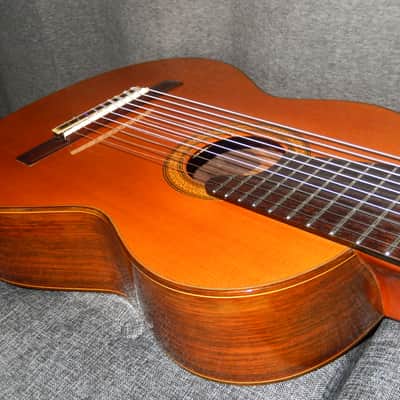
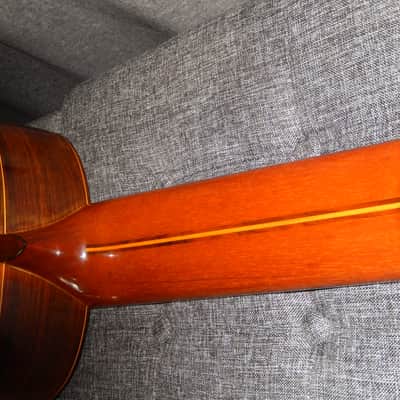
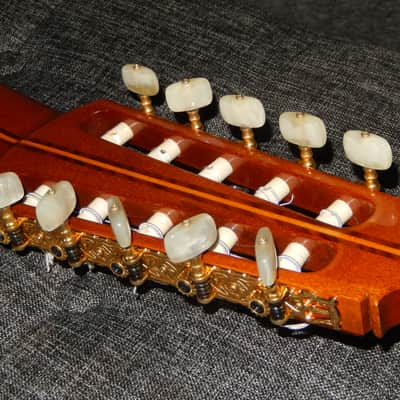
The overall condition of this guitar can be described as “excellent for its age”. Guitar’s body, neck and headstock don’t bear any “conspicuous” cosmetic imperfections. Original tuners look and work fine.
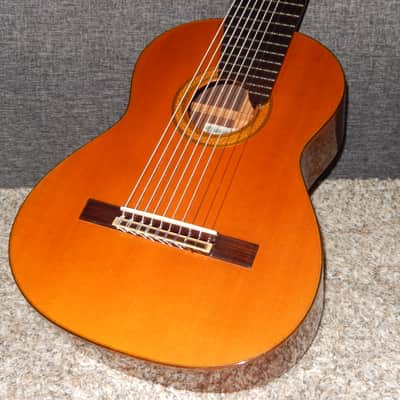
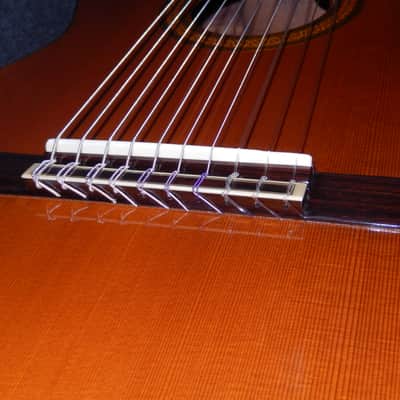
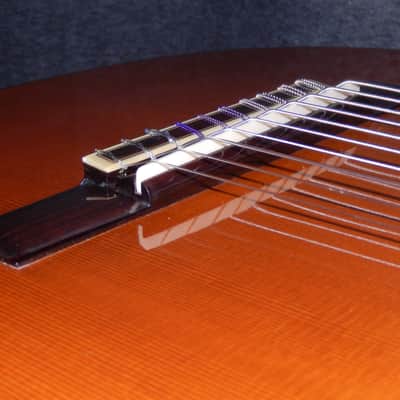
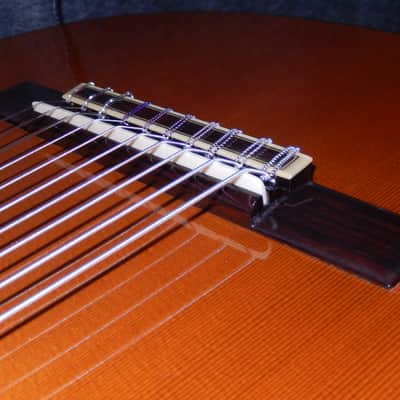
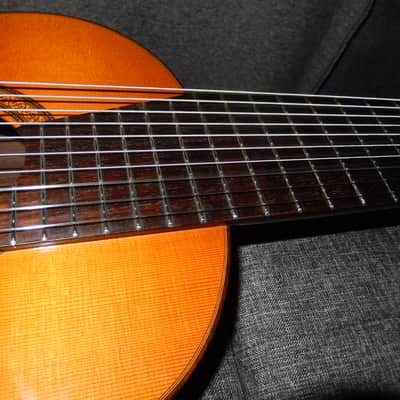
The guitar however comes with a “repair history”. Because sometime in the past its bridge had detached itself from the soundboard, and it was recently re-glued with Titebond III glue. This repair has been performed by Greg Hails (the owner of Aperio Guitar LLC. In Lawrenceville, GA). He also has refastened, relevelled, crowned and repolished all the frets.
Even though one can slide the paper under the very tips of 2 bridge corners (both pointing towards the sound hole) one shouldn’t assume that bridge is about to detach again. Titebond III is considered “the ultimate” wood glue by most carpenters and is commonly used by luthiers for similar repairs.
The patchy finish cloudiness visible on back is very common on Matsuoka guitars from that area. Being illuminated by a camera’s flashlight, it appears greatly exaggerated in the pictures.
Specification:
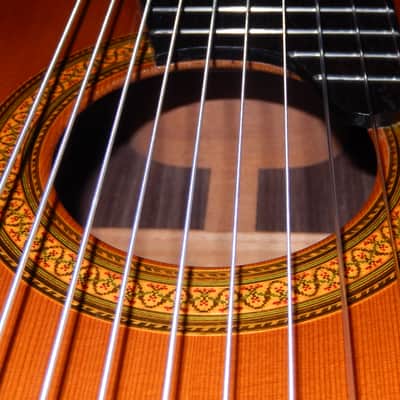
Top: Highest Grade Solid Cedar/ Cashew varnish
Back & sides: High Grade Indian Rosewood laminates/ Urethane
Neck: Mahogany with 3 layer reinforcing insert
Fingerboard: Well Ebonized Brazilian Rosewood or Indian Ebony
Scale: 650 mm
Nut width: 85 mm
String spacing at the nut: 75mm
String spacing (1-10) at the saddle: 107 mm
Guitar is equipped with original hard shell case in still very condition (except for one broken latch).
WHEN YOU BUY ANY GUITAR, YOU MUST ANTICIPATE TAKING IT TO YOUR LOCAL GUITAR SHOP FOR FINAL ADJUSTMENTS CALLED “SETUP”. DEPENIDNG ON YOUR PLAYING TECHNIQUE, THIS SETUP ON USED GUITARS MAY INCLUDE NEW CUSTOM MADE NUT AND SADLLE. IF YOU HEAR STRING BUZZ IT DOESN’T MEAN THAT THE GUITAR IS DEFECTIVE. IF YOU PLAY HARD ENOUGH ALL BASS STRINGS WILL BUZZ OVER THE FRETS, UNLESS THEY ARE SUSPENDED VERY FAR FROM THE FINGERBOARD. UNLESS YOU PLAY QUITE GENTLY, YOU CAN’T HAVE LOW ACTION AND NO BUZZES. KEEP IN MIND THAT CELLO-LIKE BASSES ON HIGH GRADE CLASSICAL GUITARS HAVE THEIR OWN NATURAL “BUZZ”.
Real Value of Japanese Vintage Guitars
The key to understand value of vintage Japanese guitars is to acknowledge galloping price inflation throughout the late 1960s and 1970s with its peak of 25% in 1974.
During 1960s and most of 1970s model numbers of Japanese guitars were strictly connected with their prices in Japanese yen.
The same class guitar sold in 1970 for 100 000 yen (labelled as model 10), would be sold for 150 000 yen in 1972 (labelled as model 15), 200 000 yen in 1974 (labelled as model 20) and 300 000 yen in 1978 (labelled as model 30). Therefore, you shouldn’t be surprised that two Yamaha GC10 guitars made 10 years apart are two instruments of totally different class. The same rule applies to all guitar models made by all other Japanese makers.
Japanese inflation slowed down in the 1980s. By the early 1980s and during following decades model numbers were no longer strictly associated with their prices. Some Japanese guitar makers introduced model names instead of model numbers. For several economic reasons, since 1980s Japanese made guitars were becoming more and more expensive, while their exports slowing down. Today (2025) Japanese high end classical guitar models are priced at $20000USD level.
| Listed | 5 months ago |
|---|---|
| Condition | Very Good (Used) Very Good items may show a few slight marks or scratches but are fully functional and in overall great shape.Learn more |
| Brand | |
| Model |
|
| Finish |
|
| Categories | |
| Year |
|
| Made In |
|
| Body Shape |
|
Product safety information may be available here.

