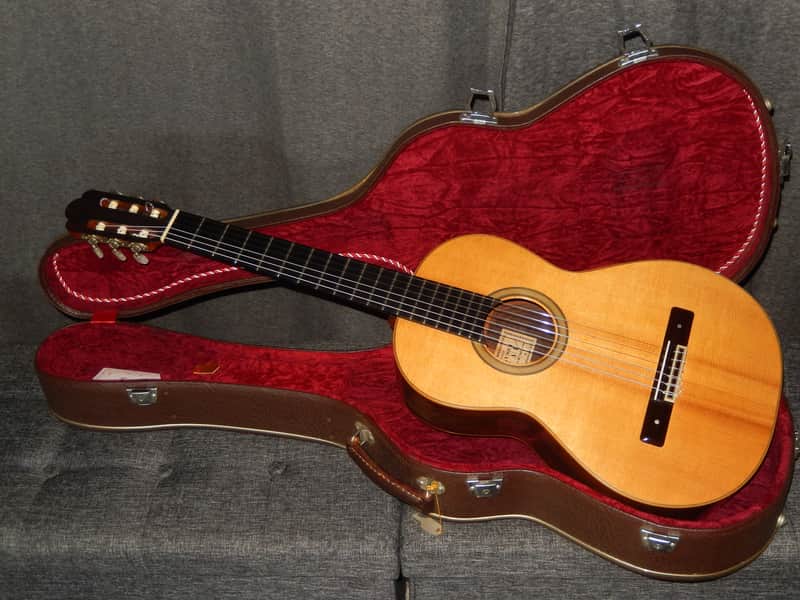
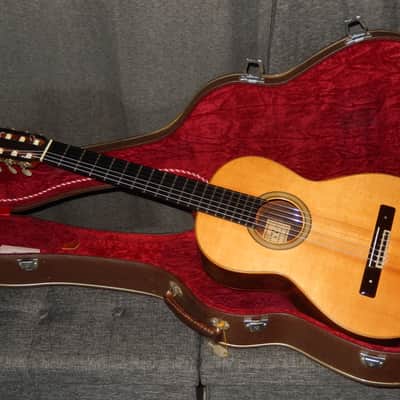
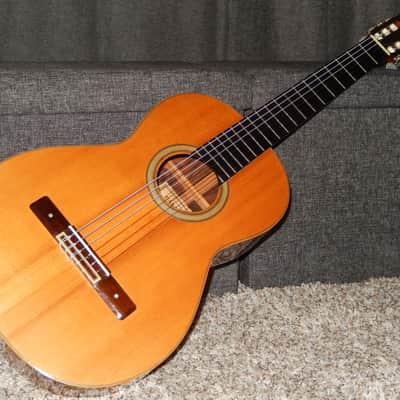
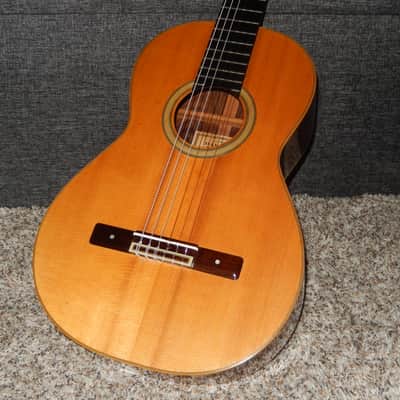
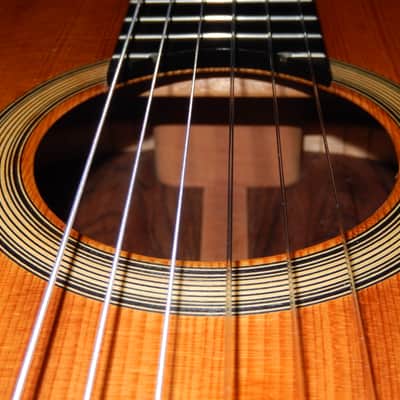
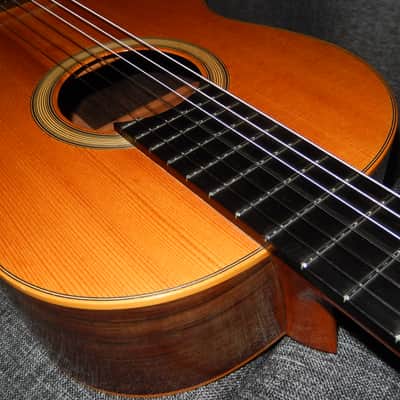
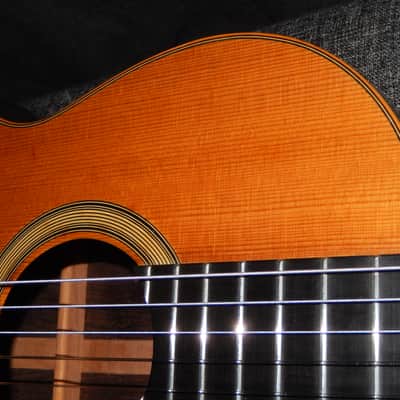
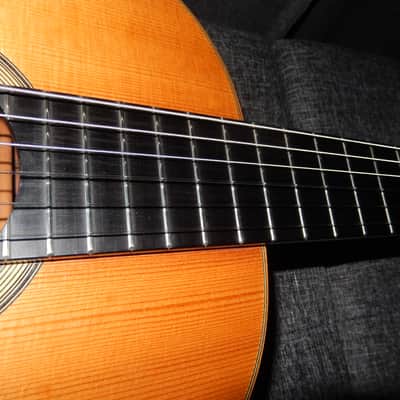
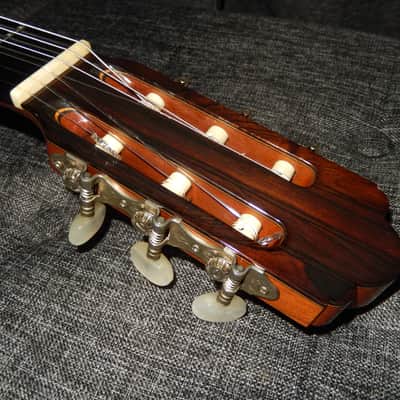
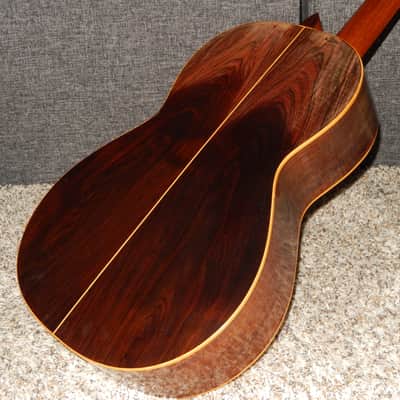
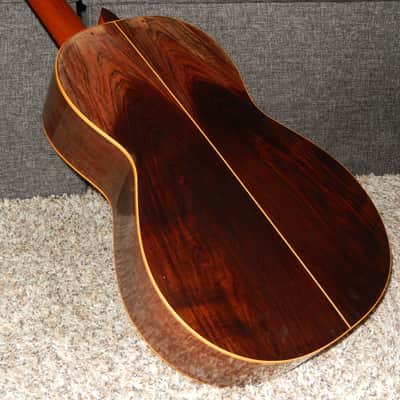
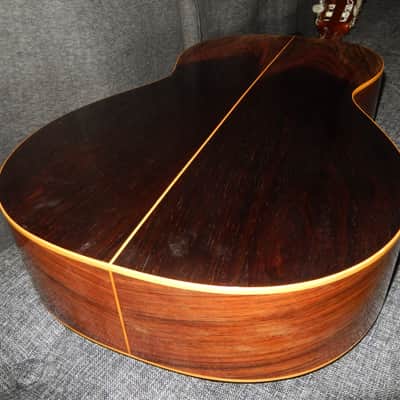
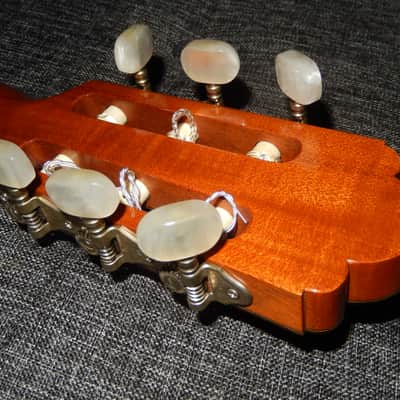
HAKUSUI IMAI No50 1985 - ANTONIO TORRES REPLICA - CLASSICAL CONCERT GUITAR - SPRUCE/BRAZILIAN ROSEWOOD
This seller has not set a shipping cost for Malta. Please contact them to ask about shipping.


Our users rate Reverb
YOU ARE LOOKING AT A WORLD CLASS INSTRUMENT PRICED AT THE BARGAIN LEVEL. CURRENTLY BRAND NEW GUITARS OF THIS CLASS MADE BY JAPANESE LUTHIERS USING OLD GROWTH FIGURED BRAZILIAN ROSEWOOD ARE PRICED MINIMUM $15000USD. DISCONTINUED IN 2025 YAMAHA GC70 WAS PRICED $18000.
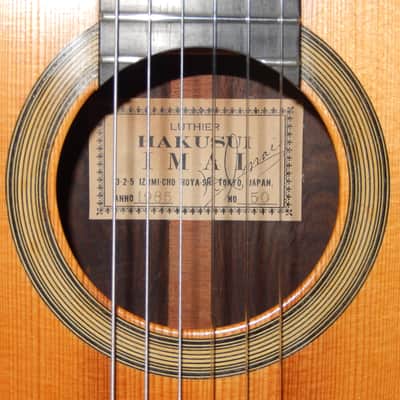
Hakusui Imai No50 1985
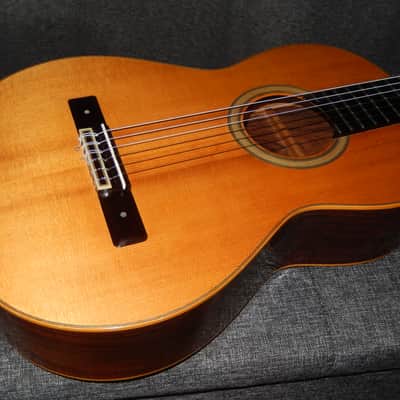
The guitar you are looking at was made in 1985 by luthier Hakusui Imai based on Antonio de Torres blueprints. With its smaller size “elongated” body, 645 mm scale, 49 mm nut, quite thin soundboard supported by asymmetrical fan of 5 braces, it closely resembles Torres’s guitars from his first epoch.
Hakusui Imai apprenticed in 1960s at Mitsuru Tamura’s workshop and established his own workshop sometime in early 1970s. He was highly regarded for his classical and flamenco guitars alike. He was on the path to far greater recognition but unfortunately passed away at relatively young (for Japanese standards) age. Therefore, his guitars are not very easy to find on secondhand markets.
Priced 500 000 yen in 1985 this guitar was among the most expensive Japanese models of that era. It was priced the same as Masaru Kohno model “Special” (No50) or Yamaha GC50. Only Masaru Kohno, Sakazo Nakade and Yamaha had higher priced custom models in 1985. For the great majority of Japanese elite luthiers 500 000 yen was the price ceiling. Ryoji Matsuoka’s top models were priced 300 000 yen, while Takamine’s and Kazuo Yairi’s highest models were priced 200 00 yen.
If today you wanted to order the same class Torres style instrument made by Japanese elite luthier using 40+ old woods, with solid Brazilian Rosewood b/s you’d need to pay at least $18000 for it.
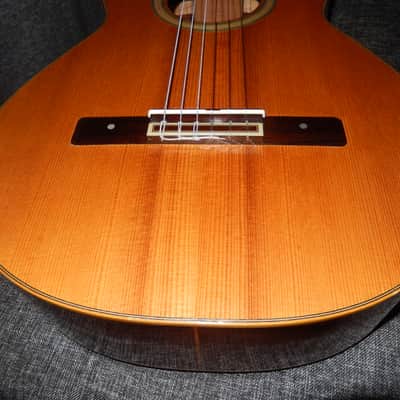
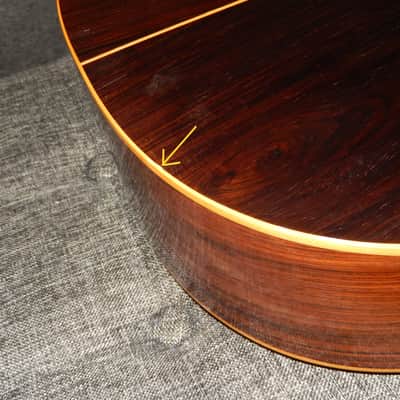
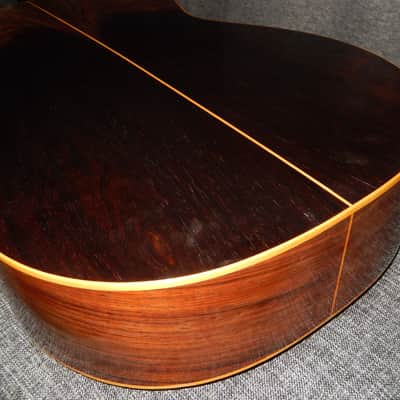
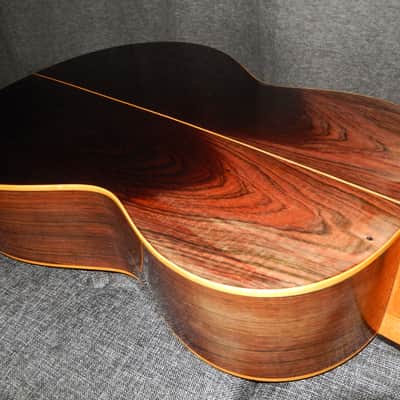
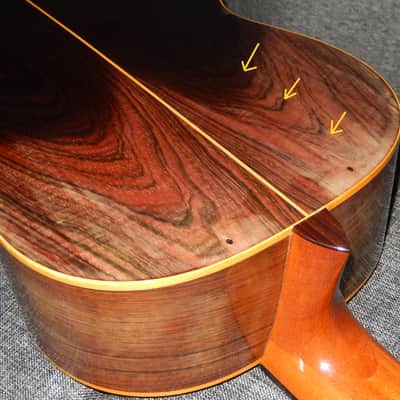
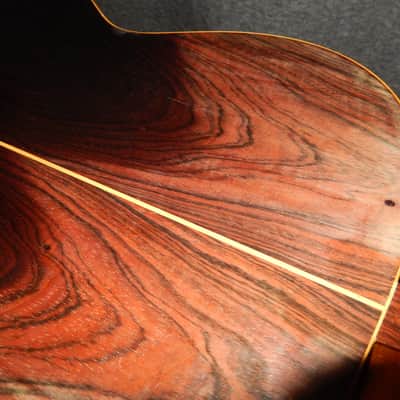
Despite its age this guitar remains in overall “excellent for its age” cosmetic and structural condition. Its body doesn’t bear noticeable dents or scratches, and its fingerboard doesn’t show the signs of intense use. The only cosmetic imperfections are the tiny chip of lacquer located on the back plate binding and repaired crack on the back plate. This was a regular crack, that stretched between the kerf wood strip and the back brace. It has been stabilized by the glue applied from the top. It is hardly visible, even from a close distance.
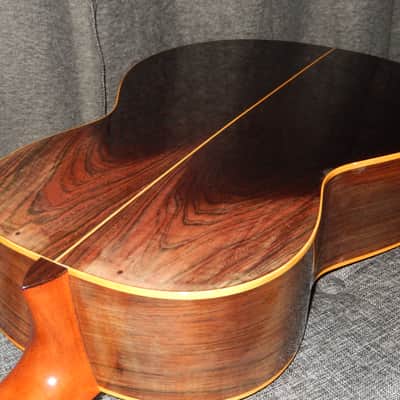
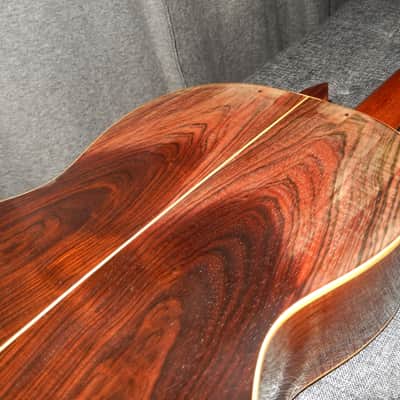
Finish cloudiness is a result of aging of shellac layers underneath the outer coat of Cashew varnish. This finish grayness is greatly exaggerated in my pictures, because of camera’s flashlight illuminating that finish. I believe that the back plates have never been uniformly dark brown, while it is obvious that side plates were originally lighter in color.
What is important mentioning is that the soundboard looks like it was purposely finished to look “well aged” with some artificial “stains” under the finish. Seeing the dark brownish color of that original finish (best visible over the originally whitish bindings), I believe that the top was made from Spruce, not Cedar. Under that finish, any Cedar would have looked much darker. Even though this guitar doesn’t sound bright, I still believe that it has Spruce top.
Despite its smaller than average dimensions, this guitar offers impressive volume & super response, sweet and colorful ultra-clear trebles, colorful & resonant and full of overtones basses, all notes well balanced and with impressive sustain. It is a very lyrical instrument, with moderately warm and mellow tonality, not too bright and not too dark either.
Specifications
Entire length: 965mm
Body length: 465mm
Body depth: 92mm
Width at upper bout: 245mm
Width at lower bout: 320mm
Width at waist: 200mm
Top: Solid Spruce with 5 braces fan /ultra-thin coat of cashew varnish
Back & Sides: Solid Brazilian Rosewood/cashew varnish
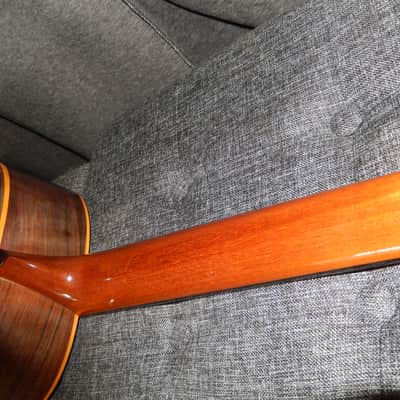
Neck: Mahogany
Fingerboard: Ebony
Scale 645 mm
Nut width 49 mm
string spacing at the nut: 40mm
string spacing at the saddle: 56mm
Strings: Knobloch 200 ADQ Low tension
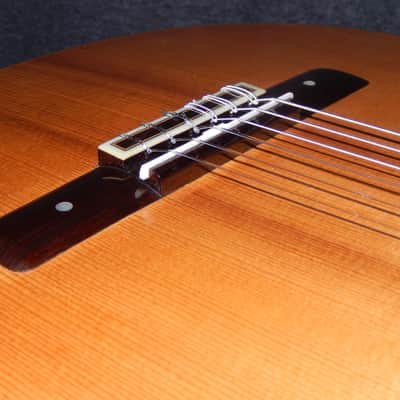
Its current action is set to 3.30 mm under E6 and 2.80 mm under E1 with still a bit of extra room on the saddle. Its original saddle sets the action at 4.00 mm E6 and 3.30 mm E1.
It will be shipped in an originally fitted hard shell case in still decent condition.
THE ONLY PURPOSE OF THIS CASE IS TO PROTECT THE GUITAR DURING SHIPMENT. I WILL NOT PROVIDE ITS DETAILED DESCRIPTION OR MAKE ADDITIONAL PICTURES, NOR I WILL ACCEPT ANY COMPLAINTS. IF YOU DON’T LIKE THIS CASE YOU WILL NEED TO BUY A DIFFERENT ONE.
WHEN YOU BUY ANY GUITAR, YOU MUST ANTICIPATE TAKING IT TO YOUR LOCAL GUITAR SHOP FOR FINAL ADJUSTMENTS CALLED “SETUP”. DEPENIDNG ON YOUR PLAYING TECHNIQUE, THIS SETUP ON USED GUITARS MAY INCLUDE NEW CUSTOM-MADE NUT AND SADDLE. IF YOU HEAR STRING BUZZ IT DOESN’T MEAN THAT GUITAR IS DEFECTIVE. IF YOU PLAY HARD ENOUGH ALL BASS STRINGS WILL BUZZ OVER THE FRETS, UNLESS THEY ARE SUSPENDED VERY FAR FROM THE FINGERBOARD. UNLESS YOU PLAY QUITE GENTLY, YOU CAN’T HAVE LOW ACTION AND NO BUZZES. KEEP IN MIND THAT CELLO-LIKE BASSES ON HIGH GRADE CLASSICAL GUITARS HAVE THEIR NATURAL “BUZZ”.
Real Value of Japanese Vintage Guitars
The key to understand value of vintage Japanese guitars is to acknowledge galloping price inflation throughout the late 1960s and 1970s with its peak of 25% in 1974.
During 1960s and most of 1970s model numbers of Japanese guitars were strictly connected with their prices in Japanese yen.
The same class guitar sold in 1970 for 100 000 yen (labelled as model 10), would be sold for 150 000 yen in 1972 (labelled as model 15), 200 000 yen in 1974 (labelled as model 20) and 300 000 yen in 1978 (labelled as model 30). Therefore, you shouldn’t be surprised that two Yamaha GC10 guitars made 10 years apart are two instruments of totally different class. The same rule applies to all guitar models made by all other Japanese makers.
Japanese inflation slowed down in the 1980s. By the early 1980s and during following decades model numbers were no longer strictly associated with their prices. Some Japanese guitar makers introduced model names instead of model numbers. For several economic reasons, since 1980s Japanese made guitars were becoming more expensive, while their exports slowing down. Today (2025) Japanese high end classical guitar models are priced at $20000USD level.
| Listed | 7 months ago |
|---|---|
| Condition | Very Good (Used) Very Good items may show a few slight marks or scratches but are fully functional and in overall great shape.Learn more |
| Brand |
|
| Model |
|
| Finish |
|
| Categories | |
| Year |
|
| Made In |
|
| Body Shape |
|
Product safety information may be available here.

