MADE IN 1981 - RYOJI MATSUOKA MH80 - GREAT HAUSER STYLE CLASSICAL CONCERT GUITAR


Our users rate Reverb
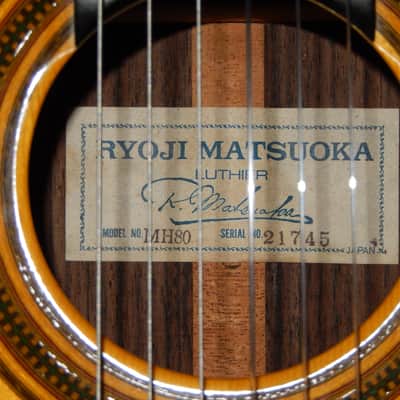
R. Matsuoka MH80 1981
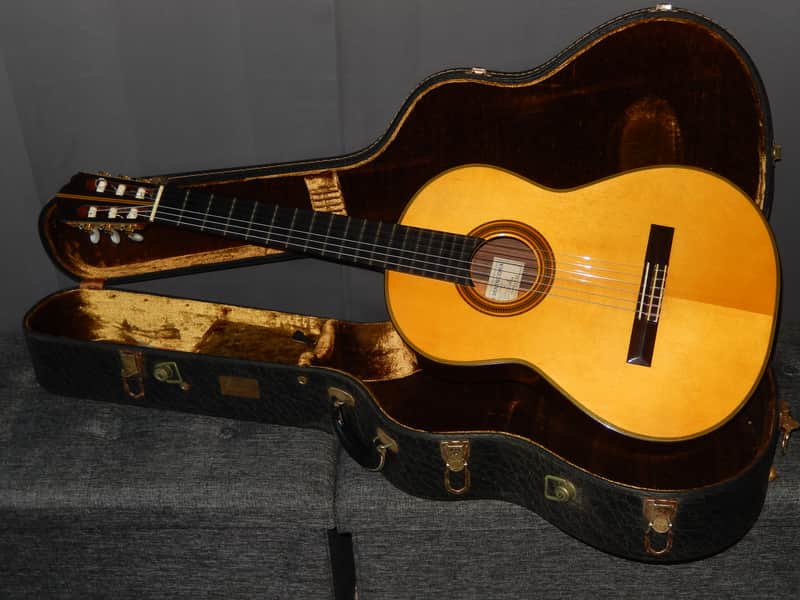
This guitar was handmade and signed by Master Luthier Ryoji Matsuoka in 1981. It was made based on the Hauser blueprints.
It is an instrument of much higher grade than models MH80 made in later years. Being priced 80 000 yen it was way underpriced if compared with instruments made by leading Japanese luthiers of that era. Since the very beginning of Ryoji's career his guitars have always offered exceptional value to all guitar lovers. It was all possible thanks to his business philosophy and a team of very skilled luthiers working under his supervision.
By the end of 1970s, due to significant changes in world's economy and currency exchange rates, all Japanese Gakkis had to redesign their guitar lineups and adjust their prices to remain competitive on international markets and still make profits. Higher end models became more expensive, while mid-range models were made with lower grade materials and had simpler construction if compared with "similarly labelled" models made during 1970s. This MH80 guitar is of much higher grade than Matsuoka's model MH80 made in 1985, or MH100 made in 1990 or MH150 made in 1995.
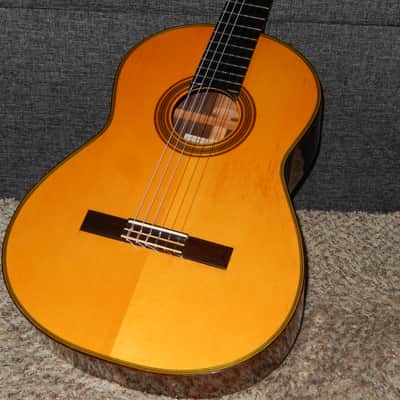
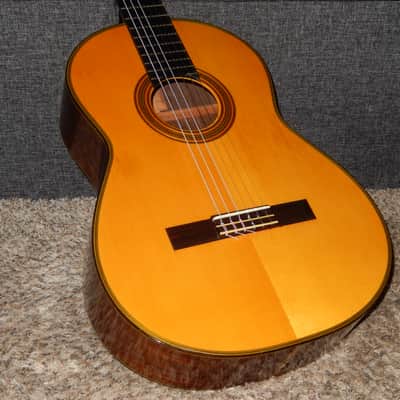
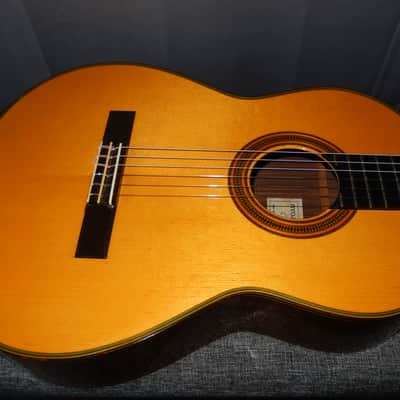
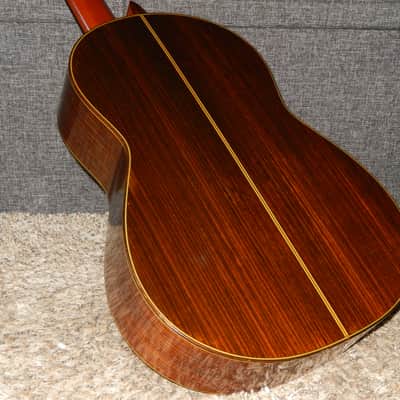
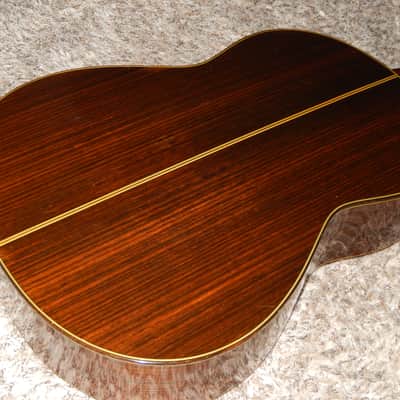
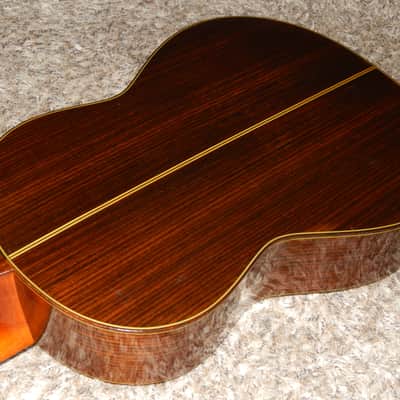
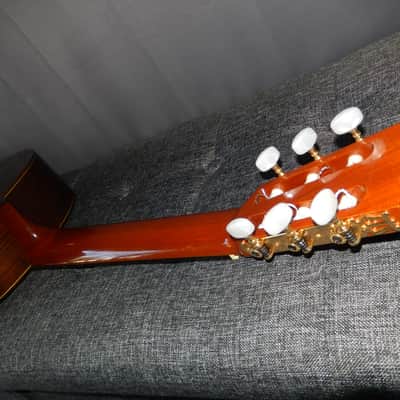
Although this guitar is still in very good functional condition, its surfaces bear multiple minor cosmetic imperfections (multiple light fingernail marks on its top, some light scratches on its back and the back of its neck, and some light abrasions along its edges). Yet the condition of its fingerboard and frets suggest that this guitar hasn’t been played a lot.
Despite all these cosmetic imperfections this is a highly valuable musical instrument that produces gorgeous sound.
The guitar offers exceptional volume and response, very deep, somewhat metallic and full of overtones basses, super sweet trebles, all well balanced, with superb note clarity and separation and very extended sustain.
Similar grade guitars currently made by Japanese luthiers are priced at least $5500. Similar grade guitars currently made in Spain are priced at least $8000.
Specification:
* Solid Spruce Top with Hauser style bracing (asymmetrical fan of 7 braces)
* Solid Indian Rosewood back and sides
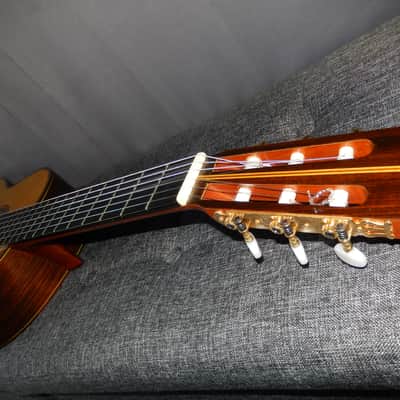
* Mahogany neck
* Ebony fingerboard
* Rosewood Bridge
* Bone nut and saddles
* Nut width: 52mm
* Scale: 650 mm
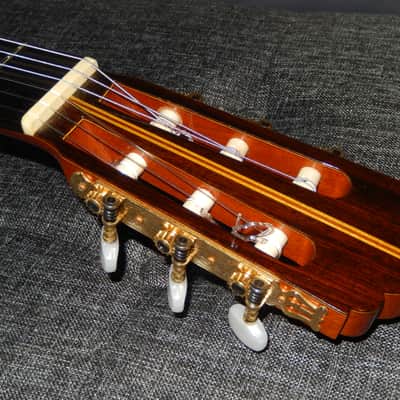
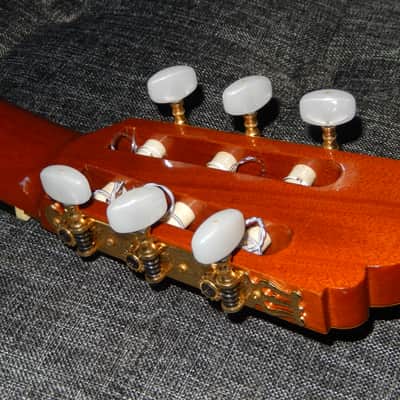
* Gold hardware
The action is set to 4.00 mm under E6 and 3.50 mm under E1 with still some extra room on the saddle
This guitar will be shipped in a used hard shell case.
THE ONLY PURPOSE OF THIS CASE IS TO PROTECT THE GUITAR DURING SHIPMENT. I WILL NOT PROVIDE ITS DETAILED DESCRIPTION OR MAKE ADDITIONAL PICTURES, NOR I WILL ACCEPT ANY COMPLAINTS. IF YOU DON’T LIKE THIS CASE YOU WILL NEED TO BUY A DIFFERENT ONE.
WHEN YOU BUY ANY GUITAR, YOU MUST ANTICIPATE TAKING IT TO YOUR LOCAL GUITAR SHOP FOR FINAL ADJUSTMENTS CALLED “SETUP”. DEPENIDNG ON YOUR PLAYING TECHNIQUE, THIS SETUP ON USED GUITARS MAY INCLUDE NEW CUSTOM MADE NUT AND SADLLE. IF YOU HEAR STRING BUZZ IT DOESN’T MEAN THAT GUITAR IS DEFECTIVE. IF YOU PLAY HARD ENOUGH ALL BASS STRINGS WILL BUZZ OVER THE FRETS, UNLESS THEY ARE SUSPENDED VERY FAR FROM THE FINGERBOARD. UNLESS YOU PLAY QUITE GENTLY, YOU CAN’T HAVE LOW ACTION AND NO BUZZES. KEEP IN MIND THAT CELLO-LIKE BASSES ON HIGH GRADE CLASSICAL GUITARS HAVE THEIR NATURAL “BUZZ”.
Real Value of Japanese Vintage Guitars
The key to understand value of vintage Japanese guitars is to acknowledge galloping price inflation throughout the late 1960s and 1970s with its peak of 25% in 1974.
During 1960s and most of 1970s model numbers of Japanese guitars were strictly connected with their prices in Japanese yen.
The same class guitar sold in 1970 for 100 000 yen (labelled as model 10), would be sold for 150 000 yen in 1972 (labelled as model 15), 200 000 yen in 1974 (labelled as model 20) and 300 000 yen in 1978 (labelled as model 30). Therefore, you shouldn’t be surprised that two Yamaha GC10 guitars made 10 years apart are two instruments of totally different class. The same rule applies to all guitar models made by all other Japanese makers.
Japanese inflation slowed down in the 1980s. By the early 1980s and during following decades model numbers were no longer strictly associated with their prices. Some Japanese guitar makers introduced model names instead of model numbers. For several economic reasons, since 1980s Japanese made guitars were becoming more and more expensive, while their exports slowing down. Today (2025) Japanese high end classical guitar models are priced at $20000USD level.
This item is sold As-Described
This item is sold As-Described and cannot be returned unless it arrives in a condition different from how it was described or photographed. Items must be returned in original, as-shipped condition with all original packaging.Learn More.
| Listed | 7 months ago |
|---|---|
| Condition | Very Good (Used) Very Good items may show a few slight marks or scratches but are fully functional and in overall great shape.Learn more |
| Brand | |
| Model |
|
| Finish |
|
| Categories | |
| Year |
|
| Made In |
|
| Body Shape |
|
Product safety information may be available here.

