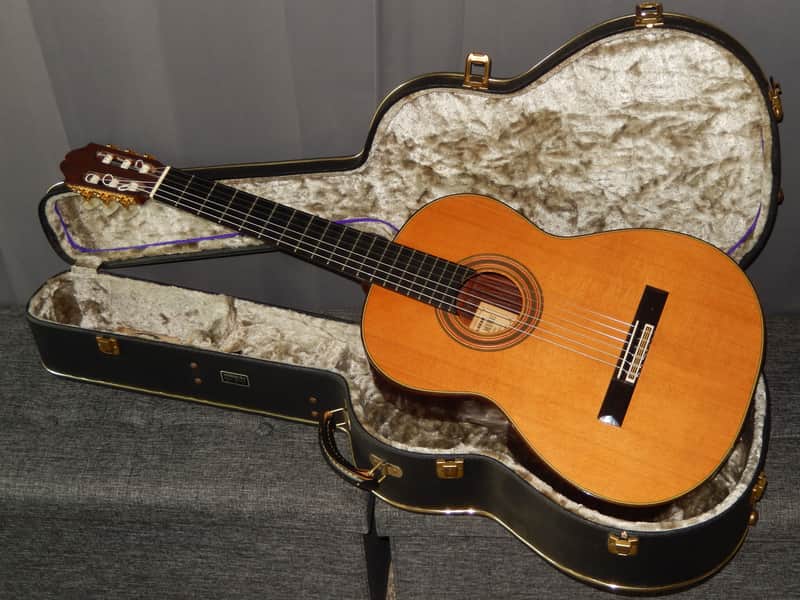
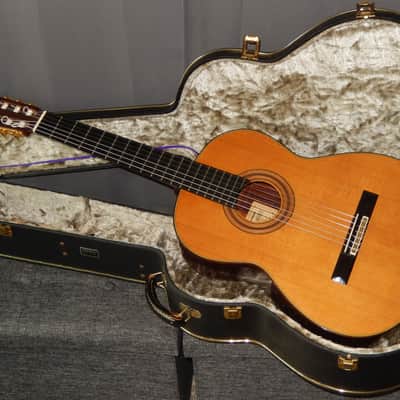
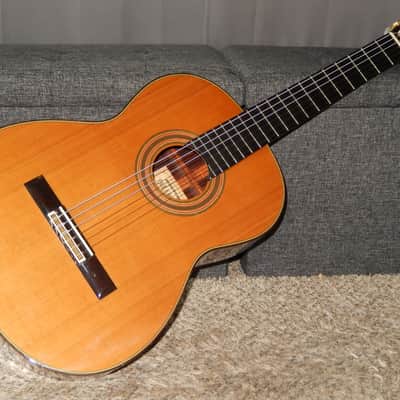
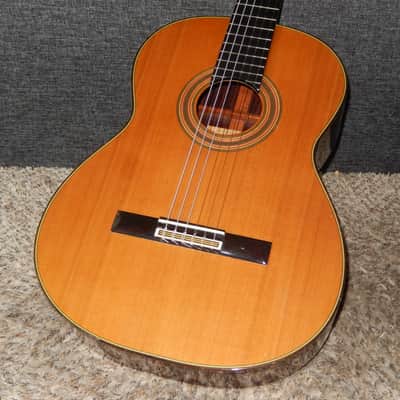
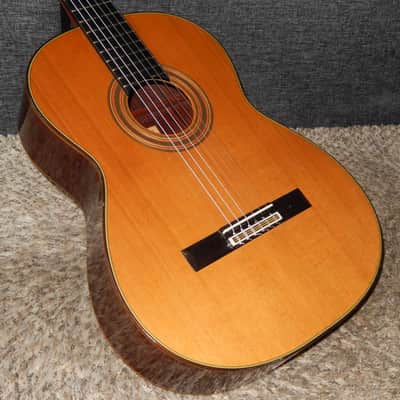
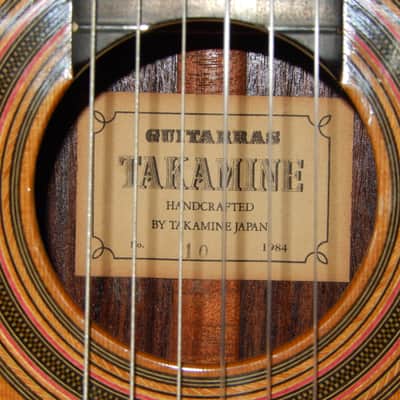
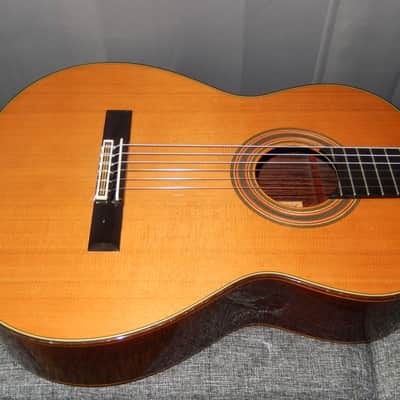
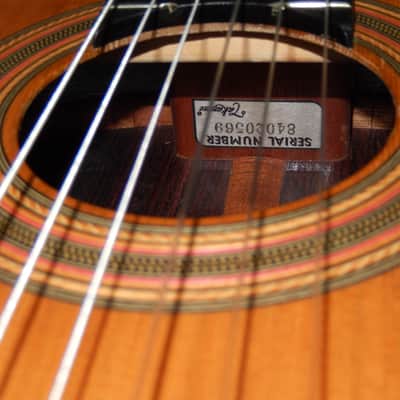
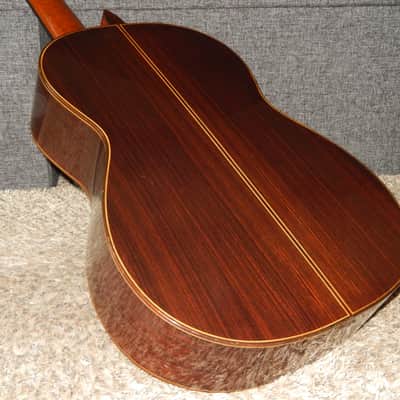
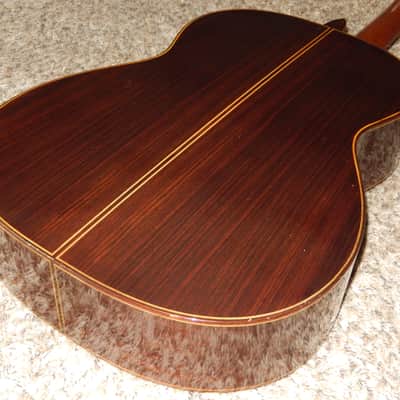
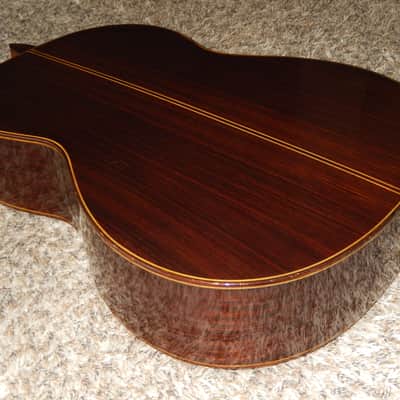
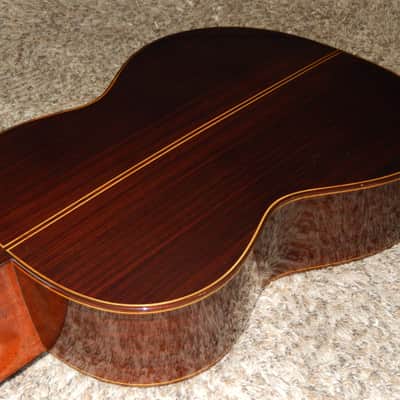
MADE IN 1984 - TAKAMINE 10 - ROBERT BOUCHET STYLE - CLASSICAL GRAND CONCERT GUITAR - CEDAR/INDIAN ROSEWOOD
This seller has not set a shipping cost for Luxembourg. Please contact them to ask about shipping.


Our users rate Reverb
Made in 1984 Takamine 10 by M.Furui
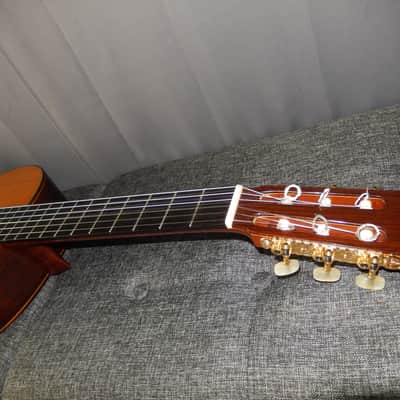
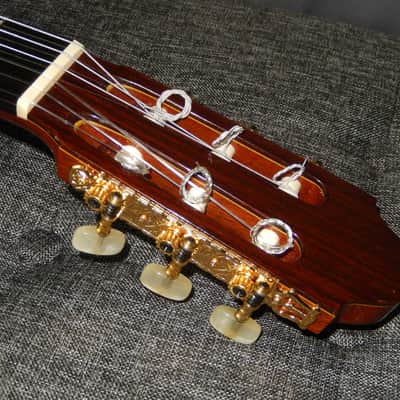
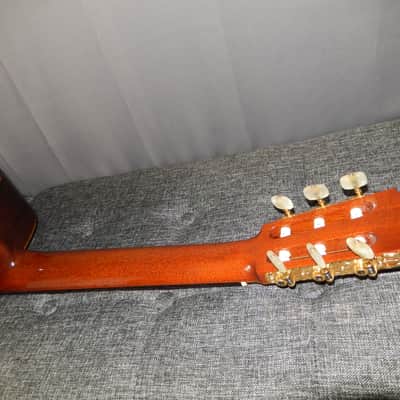
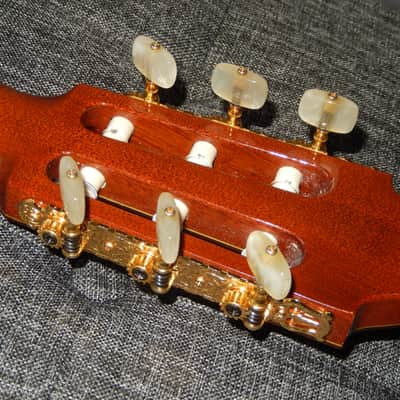
The guitar was made in 1984 under the supervision of Takamine's Headmaster Luthier Masaichi Furui based on his own design, however inspired by blueprints provided by world famous luthiers. This guitar’s headstock and rosette mimics Robert Bouchet’s designs, while bracing is the same as introduced by Antonio de Torres in 1860.
In the past I have sold a guitar made in 1978 with the same looks and design, labelled “Luthier M.Furui” by Takamine model No10.
In regular lineup of Takamine classical of mid1980s Takamine No10 was one of high-end models. The only higher models were 15 (made with solid IR b/s) and 20 (made with solid BR b/s). All these higher models were made primarily with Spruce tops, regular Takamine style headstocks, Kohno style rosettes and/or bridge decoration and Kohno style bracing. Midrange model 8 was made also with Spruce top and solid IR b/s. Lower end models 30, 40, 5, 6 and 7 were all made with solid Cedar tops, 6 & 7 with solid IR backs, while 30, 40 and 5 with non-solid IR b/s.
These (Bouchet style) M.Furui models were made in very limited numbers since 1978 until 1985.
Currently similar class classical guitars made in Japan are priced at $5000 level. Beginner's grade Takamine C132S is currently sold in USA for $1950USD.
Because of its darkish look and mellow tonality of this guitar, I strongly believe that its sounboard is made from Cedar.
This terrific and powerful instrument certainly deserves a title of Grand Concert Guitar. This gorgeous instrument offers very impressive volume and superb response, sweet and warm tonality that easily challenges higher priced models made by Japanese elite luthiers of that era. Basses are deep, warm but relatively clean. Trebles are sweet, clear, and ringing. All notes are well balanced and well separated, all magnified by great sustain. It simply is a "joy to play" guitar. I am sure that if it was made at Masaru Kohno's workshop it would certainly be priced 50% higher and labelled as model 15.
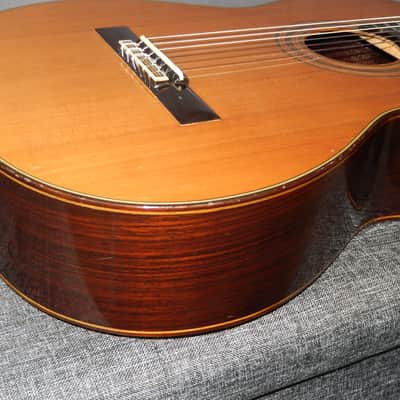
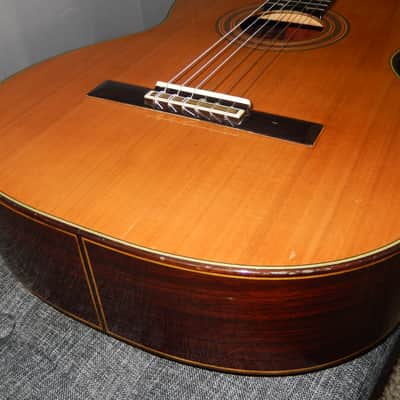
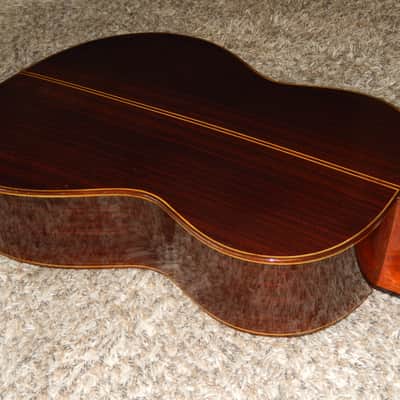
While overall condition of this guitar can be described as “excellent for its age” its surfaces bear several very light and rather small cosmetic imperfections: few tiny dents and small scratches on the top, back and sides and (perhaps most conspicuous) tiny dents and attrition along the edges of soundboards and back plate. Nevertheless, excellent condition of the neck, fingerboard and frets prove that this guitar hasn’t been played as much these cosmetic imperfections suggest. It can be played for many years without a need for any repairs or adjustments. Its high-grade tuners work smoothly.
Specifications:
Top: Solid Cedar /Torres 7 braces system/ thin coat of lacquer
Back & sides: Solid Indian Rosewood /urethane
Fingerboard: Ebony
Neck: Mahogany
Scale 650 mm
Width at Nut: 52 mm
Its action is set to 3.50 mm under E6 and 3.00 mm under E1 with still extra room on the saddle. Second saddle sets the action at 4.20mm E6 and 3.30mm E1. You may try either one.
This guitar will be shipped in a used Shimokura hard shell case in still very good condition.
THE ONLY PURPOSE OF THIS CASE IS TO PROTECT THE GUITAR DURING SHIPMENT. I WILL NOT PROVIDE ITS DETAILED DESCRIPTION OR MAKE ADDITIONAL PICTURES, NOR I WILL ACCEPT ANY COMPLAINTS. IF YOU DON’T LIKE THIS CASE YOU WILL NEED TO BUY A DIFFERENT ONE.
WHEN YOU BUY ANY GUITAR, YOU MUST ANTICIPATE TAKING IT TO YOUR LOCAL GUITAR SHOP FOR FINAL ADJUSTMENTS CALLED “SETUP”. DEPENIDNG ON YOUR PLAYING TECHNIQUE, THIS SETUP ON USED GUITARS MAY INCLUDE NEW CUSTOM-MADE NUT AND SADDLE. IF YOU HEAR STRING BUZZ IT DOESN’T MEAN THAT GUITAR IS DEFECTIVE. IF YOU PLAY HARD ENOUGH ALL BASS STRINGS WILL BUZZ OVER THE FRETS, UNLESS THEY ARE SUSPENDED VERY FAR FROM THE FINGERBOARD. UNLESS YOU PLAY QUITE GENTLY, YOU CAN’T HAVE LOW ACTION AND NO BUZZES. KEEP IN MIND THAT CELLO-LIKE BASSES ON HIGH GRADE CLASSICAL GUITARS HAVE THEIR NATURAL “BUZZ”.
Takamine History.
Takamine Gakki was founded in 1962 and during its first few years of operations, it wasn’t considered as leading Japanese guitar manufacture. It all changed in 1968 when Masaru Kohno took this company “under his umbrella” (most likely be became its owner or co-owner) and his pupil Mass Hirade became its director and leading Master Luthier. Until late 1970s Masaru Kohno personally supervised guitar production at Takamine Co. Right after this transition in 1968 Takamine Gakki adopted ne guitar designs launching 3 series of guitars: Elite, TG and the most precious Yamato guitars (by early 1970s renamed to Aranjuez).
Elite series had Ramirez style headstock and Ramirez style bracing. TG series guitars kept old style Takamine headstock but also had Ramirez style bracing. Aranjuez guitars had Takamine’s unique design headstock (used on Takamine guitars until today) and Kohno style bracing (which is nothing but simple lattice bracing). American luthier & guitar importer (also manufacturer of Luthier & Aranjuez strings) Juan Orozco invested and was deeply engaged in creation of Aranjuez guitar brand, even though these guitars were made only for Japanese domestic market. The truth behind Aranjuez guitars is that right from the start they were designed to satisfy less wealthy Japanese guitar enthusiasts, who couldn’t afford guitars made by Masaru Kohno or other Japanese elite luthiers. Aranjuez guitar have always offered exceptional value for the money. The bodies of all models were made by Takamine workshop. Top Aranjuez models were being finished at Kohno workshop and equipped with soundboards made by Masaru Kohno or his associates. Traditionally the very top Aranjuez model was assembled personally by Masaru Kohno. These very top Aranjuez models were nothing but Kohno guitars priced 50% down. Aranjuez 7 made in 1973 was decisively better than Kohno #10 from the same year and could easily compete with Kohno #15. Aranjuez 720 (priced 200 000 yen) made in 2000 could easily compete with Kohno model Professional R (priced 450 000 yen). Until 1976 all Aranjuez guitars had Kohno stamp on their labels. Starting in 1977 Kohno stamp was no longer used on Aranjuez guitars, even though their production was still closely supervised by Masaru Kohno’s workshop.
In the same late 1970s Takamine Gakki launched new series of guitars named simply “Guitarras Takamine”. These “new” Takamine guitars had the same construction and looks as “old” Aranjuez guitars. The lower Takamine models 20,30 and 40 had their own unique rosettes, while higher models 5, 6, 7, 8, 10 had Kohno style rosettes. The very top Takamine models 15 & 20 had Kohno style purflings and Kohno style decorated bridge. This classical guitar lineup remained unchanged until late 1980s.
Since early 1980s bodies of Aranjuez guitar were made by Ryoji Matsuoka, while the very top model still assembled at Kohno’s and later (after Masaru Kohno’s death in 1998) at Masaki Sakurai/Kohno workshop. After Matsuoka’s workshop was closed in September of 2014, bodies of Aranjuez guitars are again made by Takamine co. while the very top Aranjuez 725 is assembled personally by Masaki Sakurai who also makes its soundboard all by himself. Just like in the early days of Aranjuez guitars this model 725 is of the same grade as sold at 100% higher price Masaki Sakurai model Concert R.
Real Value of Japanese Vintage Guitars
The key to understand value of vintage Japanese guitars is to acknowledge galloping price inflation throughout the late 1960s and 1970s with its peak of 25% in 1974.
During 1960s and most of 1970s model numbers of Japanese guitars were strictly connected with their prices in Japanese yen.
The same class guitar sold in 1970 for 100 000 yen (labelled as model 10), would be sold for 150 000 yen in 1972 (labelled as model 15), 200 000 yen in 1974 (labelled as model 20) and 300 000 yen in 1978 (labelled as model 30). Therefore, you shouldn’t be surprised that two Yamaha GC10 guitars made 10 years apart are two instruments of totally different class. The same rule applies to all guitar models made by all other Japanese makers.
Japanese inflation slowed down in the 1980s. By the early 1980s and during following decades model numbers were no longer strictly associated with their prices. Some Japanese guitar makers introduced model names instead of model numbers. For several economic reasons, since 1980s Japanese made guitars were becoming more and more expensive, while their exports slowing down. Today (2025) Japanese high end classical guitar models are priced at $20000USD level.
This item is sold As-Described
This item is sold As-Described and cannot be returned unless it arrives in a condition different from how it was described or photographed. Items must be returned in original, as-shipped condition with all original packaging.Learn More.
| Listed | 6 months ago |
|---|---|
| Condition | Very Good (Used) Very Good items may show a few slight marks or scratches but are fully functional and in overall great shape.Learn more |
| Brand | |
| Model |
|
| Finish |
|
| Categories | |
| Year |
|
| Made In |
|
| Body Shape |
|
Product safety information may be available here.

