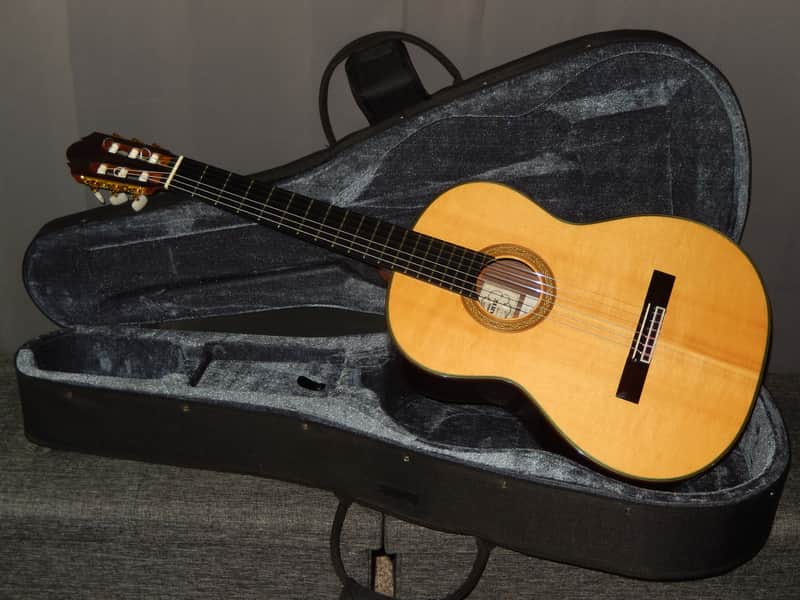
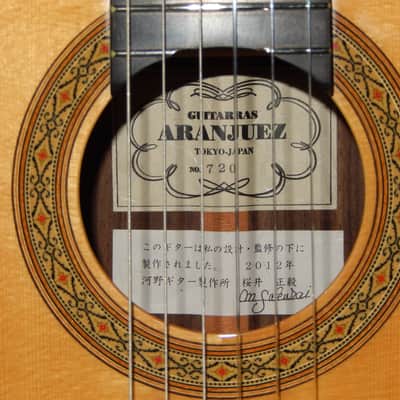
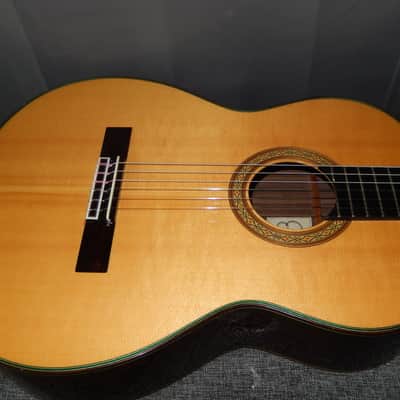
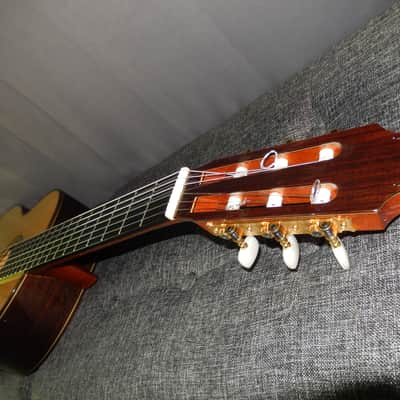
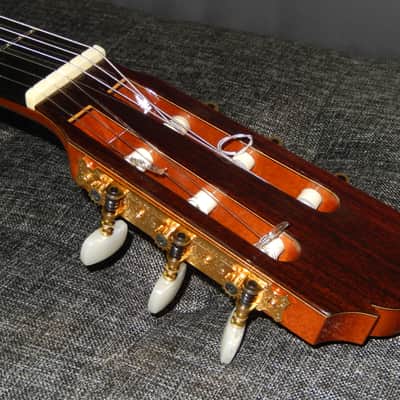
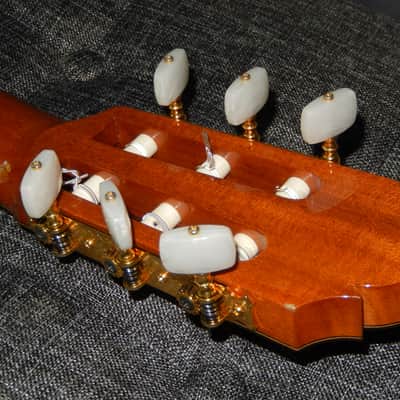
MADE IN 2012 BY RYOJI MATSUOKA & MASAKI SAKURAI - ARANJUEZ 720 - CLASSICAL CONCERT GUITAR
This seller has not set a shipping cost for Luxembourg. Please contact them to ask about shipping.

Our users rate Reverb
Aranjuez 720 2012
This guitar being the top-of-the-line model, was hand made in 2012 in cooperation between Ryoji Matsuoka and Masaki Sakurai workshops. Ryoji Matsuoka's workshop made the neck and the body, while Masaki Sakurai made the soundboard and performed final assembly of this terrific instrument. Since the very beginning of Aranjuez brand (1968) the very top model was assembled and finished at Masaru Kohno workshop with the soundboard made by either Kohno himself or one of his associates. After Kohno's passing in 1998, his workshop was run by Masaki Sakurai who also oversaw production of Aranjuez guitars (perhaps being the owner of this brand). He was making the soundboards and assembled highest Aranjuez models, placing his personal label below the brand label.
Over recent decades, Masaki Sakurai was one of highest respected Japanese luthiers. He has won International Luthier’s Competition in 1988 in Paris. He passed away in July 2025. Masaru Kohno’s workshop is now run by his grandson, So Kimishima.
After winning the 1st prize at international competition in 1967 in Belgium, international markets were wide open for Masaru Kohno “brand name”. He was smart enough to take full advantage of his fame turning few new ideas into great profits. One of these ideas was to purchase Takamine co, in 1968 and placing his pupil Mass Hirade at its helm. Another idea was a line of very high-grade guitars designed for domestic market, sold at moderate prices, hence affordable to average Japanese citizens. Originally (1968) named Yamato guitars, they became Aranjuez guitars by early 1970s. While most models were entirely made by Takamine workshop, top Aranjuez guitars were assembled at Kohno’s workshop with soundboards also made at Kohno’s workshop. Until 1978 all Aranjuez guitars had Kohno stamp on their labels.
Until 1978 Takamine's own classical guitar models (sold in Japan as Takamine Elite series) were made basing on Ramirez blueprints with Ramirez style headstock, while Aranjuez guitars were made based on Kohno's blueprints with original headstock (used on Takamine guitars until today). Sometime in 1979 Takamine Elite series and Aranjuez guitar line were discontinued, while Takamine guitars were made the same way and with the same looks as earlier Aranjuez guitars.
Aranjuez as the brand was resurrected sometime in late 1990s in cooperation with Ryoji Matsuoka workshop. After Matsuoka's passing in 2014 and closure of his Japanese workshop, Aranjuez guitars are made again in cooperation with Takamine workshop.
In September 2023 Aranjuez 720 became model 725, priced 3.5 times higher than Takamine C312S currently sold in USA for $1950. It is rather obvious that if distributed in USA in 2025 by the same importer, this guitar would be priced $4500.00
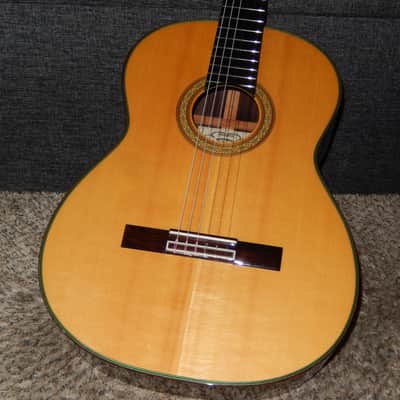
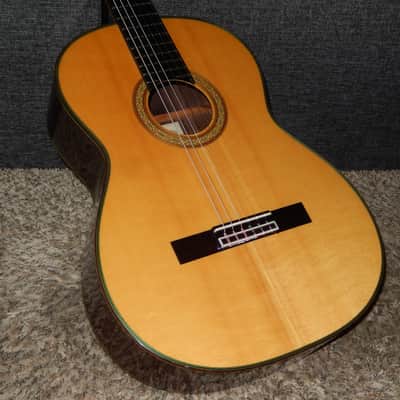
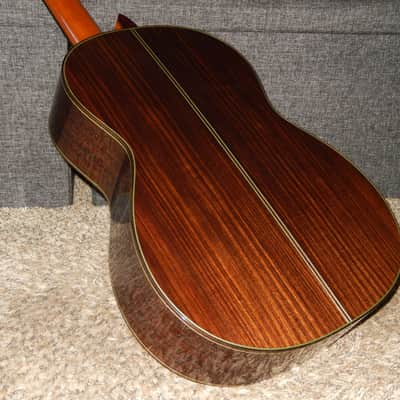
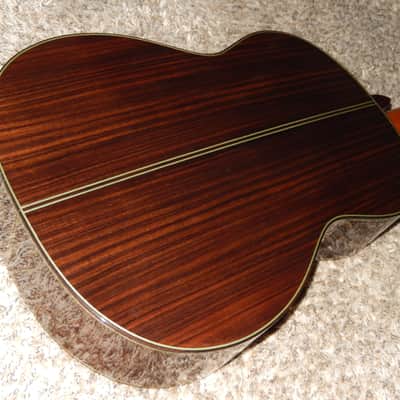
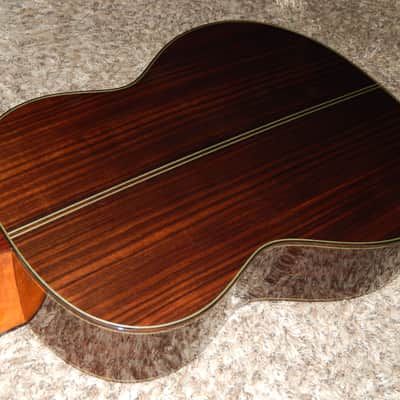
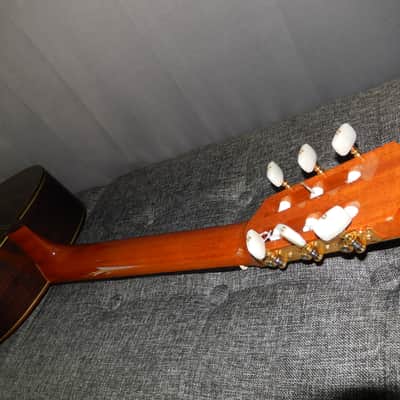
Despite a few very small (non-conspicuous) marks on its body, the overall condition of this Aranjuez 720 guitar must be described as “excellent" with very minor signs of actual use. Its very comfortable neck is straight, while frets and fingerboard remain in "near mint" condition.
Just like all other Aranjuez guitars ever made, this one also offers incredible value for the price paid. It sounds “on pair” with many higher priced guitars made by leading Japanese luthiers, not much different from Masaki Sakurai's own (lowest) model Professional R sold at 125% higher price.
It certainly is a concert level instrument, offering great volume combined with relatively warm lyrical & colorful tonality, with high level of note clarity and separation, high level of transparency, all magnified by impressive sustain. With its current action it plays super easy.
Since it is "nearly unused" guitar, it needs to be played systematically for a few months to reveal its full potential.
SPECIFICATIONS:
Top: Very High-Grade Solid “Yezo” Spruce/lacquer
Back & sides: Solid Indian Rosewood/urethane
Neck: Mahogany
Fingerboard: Ebony
With at the nut: 50 mm
Scale: 650 mm
Current action is set to 3.30 mm under E6 and 2.80 mm under E1 with still extra room on the saddle. This action is way lower than standard for classical guitars, hence means great comfort of playing, but can lead to buzzes if strings are played hard enough. With my playing technique I don't create buzzes. If you do, you will need to invest in higher saddle.
This guitar will be shipped in lightly used hard polyfoam case.
THE ONLY PURPOSE OF THIS CASE IS TO PROTECT THE GUITAR DURING SHIPMENT. I WILL NOT PROVIDE ITS DETAILED DESCRIPTION OR MAKE ADDITIONAL PICTURES, NOR I WILL ACCEPT ANY COMPLAINTS. IF YOU DON’T LIKE THIS CASE YOU WILL NEED TO BUY A DIFFERENT ONE.
WHEN YOU BUY ANY GUITAR, YOU MUST ANTICIPATE TAKING IT TO YOUR LOCAL GUITAR SHOP FOR FINAL ADJUSTMENTS CALLED “SETUP”. DEPENIDNG ON YOUR PLAYING TECHNIQUE, THIS SETUP ON USED GUITARS MAY INCLUDE NEW CUSTOM-MADE NUT AND SADLLE. IF YOU HEAR STRING BUZZ IT DOESN’T MEAN THAT GUITAR IS DEFECTIVE. IF YOU PLAY HARD ENOUGH ALL BASS STRINGS WILL BUZZ OVER THE FRETS, UNLESS THEY ARE SUSPENDED VERY FAR FROM THE FINGERBOARD. UNLESS YOU PLAY QUITE GENTLY, YOU CAN’T HAVE LOW ACTION AND NO BUZZES. KEEP IN MIND THAT CELLO-LIKE BASSES ON HIGH GRADE CLASSICAL GUITARS HAVE THEIR NATURAL “BUZZ”.
| Listed | 7 months ago |
|---|---|
| Condition | Excellent (Used) Excellent items are almost entirely free from blemishes and other visual defects and have been played or used with the utmost care.Learn more |
| Brand | |
| Model |
|
| Finish |
|
| Categories | |
| Year |
|
| Made In |
|
| Body Shape |
|
Product safety information may be available here.

