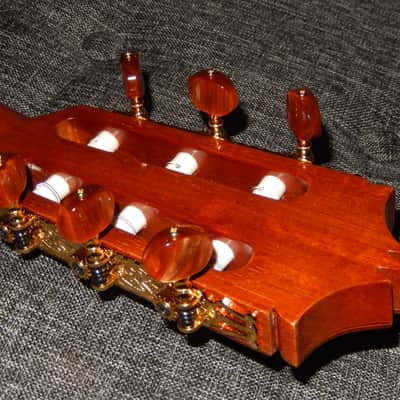
BARGAIN - HIROSHI "TOMY" TAMURA C100 1977 - RAMIREZ 1a CLASS FLAMENCO CONCERT GUITAR - CEDAR/CYPRESS
This seller has not set a shipping cost for Norway. Please contact them to ask about shipping.


Our users rate Reverb
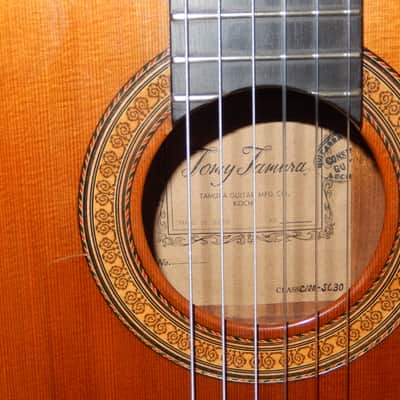
Hiroshi “Tomy” Tamura C100-SC30 1977
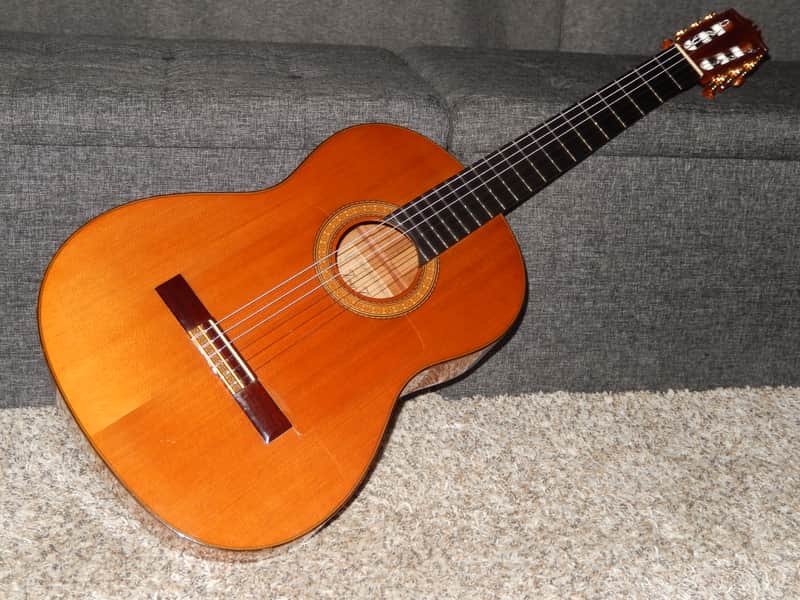
This guitar was made around 1976/77 by Hiroshi Tamura, one of the best luthiers in Japanese history. Its sound matches the fame of its maker.
Just like many other famous Japanese luthiers of that era, Hiroshi and Mitsuru Tamura have learned their craft during their stay in Spain in late 1950s/early 1960s. After their return from Spain Tamura brothers were making superb quality flamenco guitars that easily challenged guitars made by the most famous Spanish luthiers. Their flamenco guitars have earned them international recognition and were played by many professional players. Strangely enough, their oldest classical guitars available on Japanese secondhand market were made no earlier than 1966.
It is quite possible that, during 1960s, both brothers shared the same workshop located in Kochi, Japan. Although both brothers were equally skilled, it was Hiroshi who has gathered more international and domestic rewards. Because his guitars often sounded much better that those made Jose Ramirez, Hiroshi has earned a nickname “Tamirez” As the matter of fact, Hiroshi’s rewards outnumbered those collected by Masaru Kohno.
During mid1960s Hiroshi was giving his guitar models quite heavenly names: Venus, Jupiter, Sirius, Meteor or Comet. Since 1968 his classical models were labelled as P series and flamenco guitars as C series.
In 1972 Hiroshi was financially rewarded by Japanese Ministry of Technology. Soon after, he moved to another shop, but not far from his brother’s, hired several associates and started to make his P and C models in greater numbers, successfully exporting many of them outside Japan. Only the very top models Hiroshi was making by himself.
Mitsuru Tamura has continued to work as individual luthier, and with just couple of apprentices, was making about 15-20 guitars a month. As the result Mitsuru’s guitars are harder to find on Japanese secondhand market and they often reach higher prices than guitars made by Hiroshi.
Sometime in 1976, after his “factory” started to produce financial losses, Hiroshi had to declare bankruptcy and moved back to smaller workshop, making fewer number of guitars with just couple of helpers.
Both Tamura brothers passed away in mid 1980s. I have seen one Hiroshi's guitar made in 1986 but none made in later years. I believe Mitsuru died couple years earlier. Just like in case of their superb flamenco guitars, classical guitars made by Tamura brothers are equally regarded in Japan.
(Because I have already had very similar instrument with an identical label dated to 1977 and model no 100) I am sure that guitar you are looking at was made either in early 1977 or perhaps in late 1976. It was the time Hiroshi when was trying to reorganize his business after declaring bankruptcy a year earlier. He was now working on new model designs and lineups, experimenting with new headstock designs, new rosettes, new label designs and nick names like “Tomy Tamura” or “Fumio Tamura”. Since early 1978 he was using yet another design label (which he kept unchanged till the end) and his models were no longer P or C series.
Being priced 100 000 yen in 1977 it this was quite expensive instrument, certainly not only to Japanese players. As of today similar class Japanese made Cedar top flamenco guitars are priced at $6500 level. Similar level instruments sold by Casa Ramirez are priced 50% higher.
Most likely the only higher flamenco model of that era was C150. Perhaps Hiroshi has also made some higher priced custom made guitars. All these higher end models were made with different tops and different scales and certainly in limited numbers. They very rarely appear on Japanese secondhand market. Abbreviation “SC” means Cedar top and Cypress b/s.
This guitar plays easy and sounds fantastic. It is a very light and highly responsive instrument. Its tonality can be described as between traditional and modern era high end flamencos. Even though it was made with cedar soundboard this guitar sounds different from many other Cedar top flamencos I have ever encountered. There is nothing “nasal” about its sound. When played gently it sounds sweet and lyrical and you can play any romantic piece that you can imagine. When played harder it produces raspy flamenco sound at a very good volume, with relatively deep, somewhat metallic basses and brilliantly crisp trebles. All notes are well balanced, with moderately long flamenco style sustain. When the chords are played one can hear a good bit of wonderful overtones. Perhaps the most important (to experienced players) attribute of this guitar is its exceptionally high level of note clarity and separation, which leads to great level of transparency when it comes to playing arpeggios and solos.
If you primarily looking for a loud instrument just to accompany a dancer, you should be looking for a different one. If you however believe in reaching for Paco de Lucia level, you should be very interested in this C100 guitar
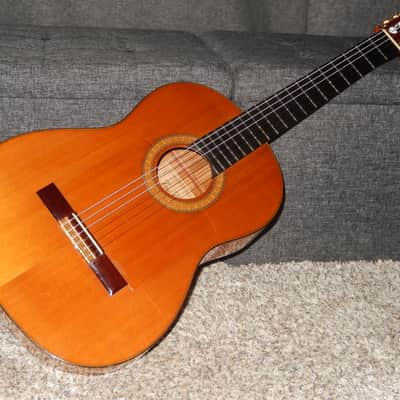
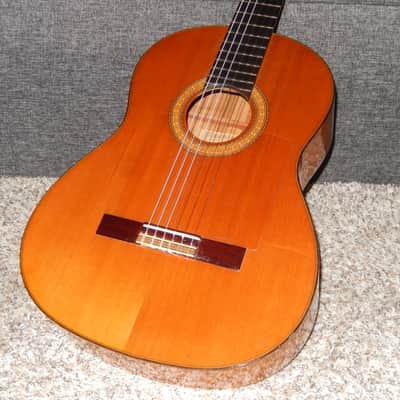
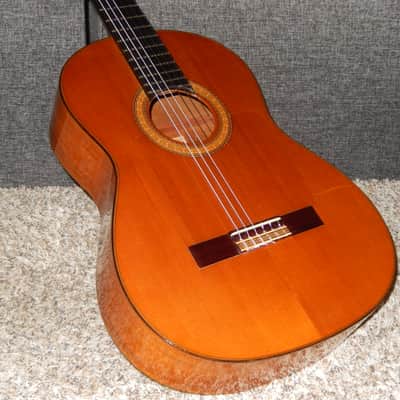
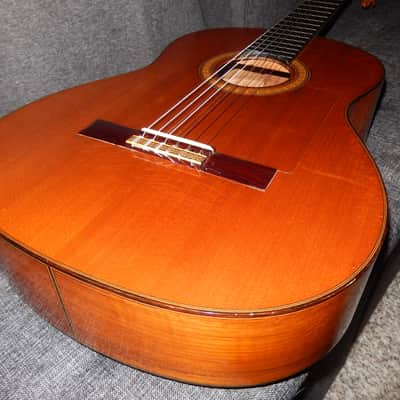
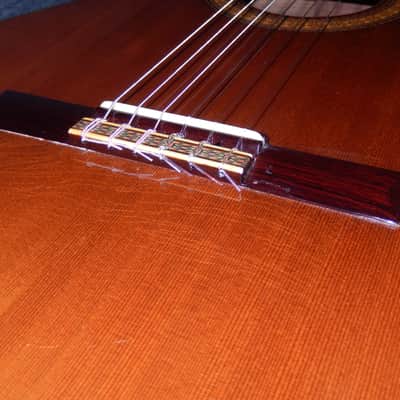
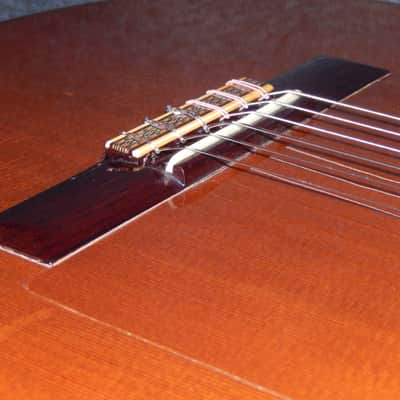
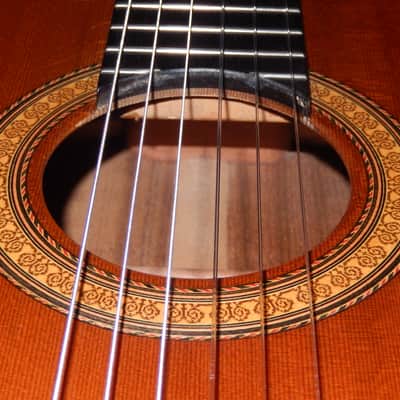
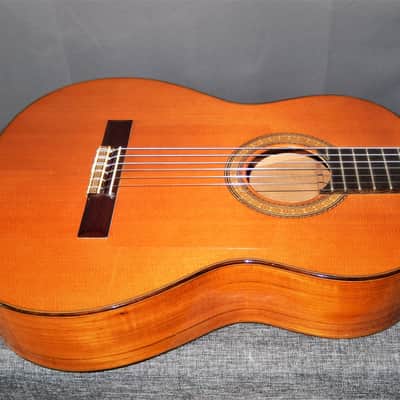
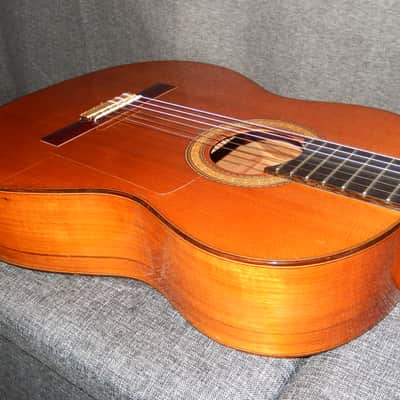
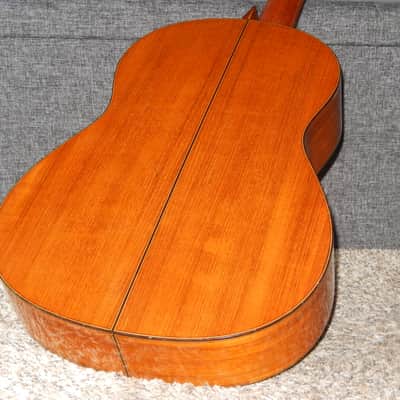
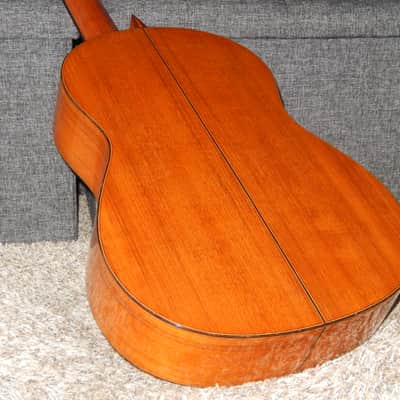
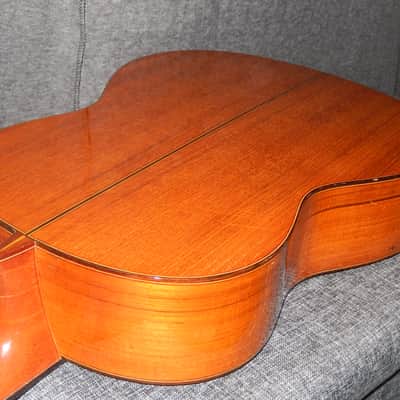
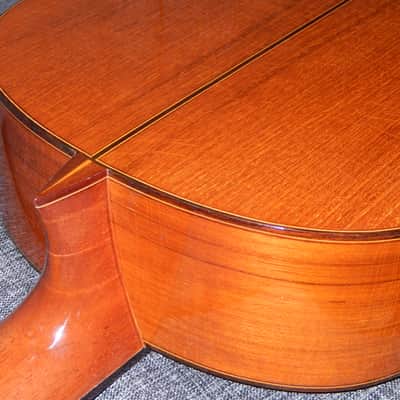
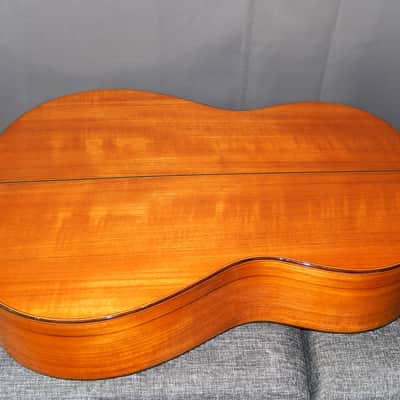
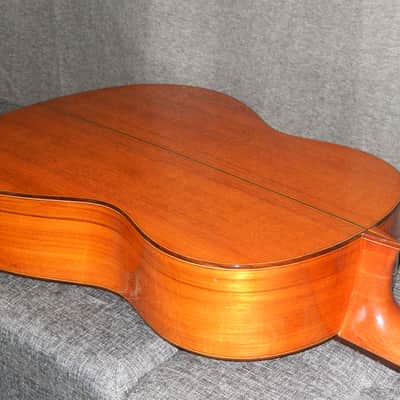
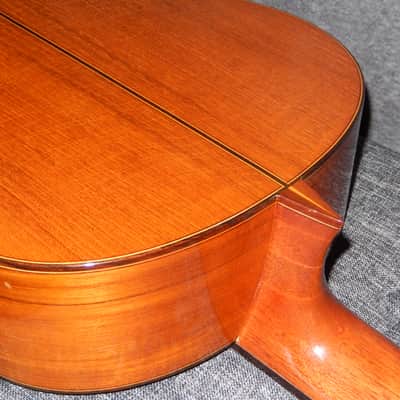
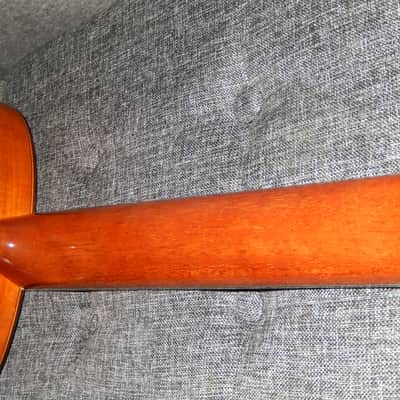
Even though its body bears few very small and light dents, the overall condition of this guitar can be described as “excellent for its age”. Its woods are very well preserved without any conspicuous scratches or cracks. Visible in the pictures horizontal line near the lower right part of tap plate, is a very light scratch on the very surface of the finish. Very importantly its neck is straight, fingerboard and leveled frets remain in very good condition, while neck/body angle allows for very low action.
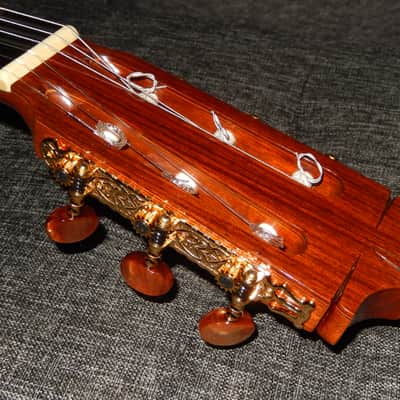
Original tuners have been replaced with the brand new Gotoh set.
This action is currently set to 2.50mm under E6 and 2.20mm under E1 just because it was possible. This action means exceptional ease of playing but also occasional buzzes and/or “clicks” along trebles (especially when strings are played harder). The truth is that many professional players favor higher action. If you prefer higher action you will need to invest in higher saddle.
Specifications:
Top: Solid Cedar/5 braces fan/cashew lacquer
Back & Sides: Solid Japanese Cypress/cashew lacquer
Neck: Mahogany
Fingerboard: Ebony
Bridge: Rosewood
Scale: 664mm
Nut width: 51mm
Hardware: Gold plated Gotoh tuners with 39mm peg roller spacing
Action is set to 2.50 mm under E6 and 2.20 mm under E1, with still extra room on the saddle.
Guitar will be shipped in a lightly used very thick padded (semi-hard) case.
THE ONLY PURPOSE OF THIS CASE IS TO PROTECT THE GUITAR DURING SHIPMENT. I WILL NOT PROVIDE ITS DETAILED DESCRIPTION OR MAKE ADDITIONAL PICTURES, NOR I WILL ACCEPT ANY COMPLAINTS. IF YOU DON’T LIKE THIS CASE YOU WILL NEED TO BUY A DIFFERENT ONE.
WHEN YOU BUY ANY GUITAR, YOU MUST ANTICIPATE TAKING IT TO YOUR LOCAL GUITAR SHOP FOR FINAL ADJUSTMENTS CALLED “SETUP”. DEPENIDNG ON YOUR PLAYING TECHNIQUE, THIS SETUP ON USED GUITARS MAY INCLUDE NEW CUSTOM-MADE NUT AND SADDLE. IF YOU HEAR STRING BUZZ IT DOESN’T MEAN THAT GUITAR IS DEFECTIVE. IF YOU PLAY HARD ENOUGH ALL BASS STRINGS WILL BUZZ OVER THE FRETS, UNLESS THEY ARE SUSPENDED VERY FAR FROM THE FINGERBOARD. UNLESS YOU PLAY QUITE GENTLY, YOU CAN’T HAVE LOW ACTION AND NO BUZZES. KEEP IN MIND THAT CELLO-LIKE BASSES ON HIGH GRADE CLASSICAL GUITARS HAVE THEIR NATURAL “BUZZ”.
Real Value of Japanese Vintage Guitars
The key to understand value of vintage Japanese guitars is to acknowledge galloping price inflation throughout the late 1960s and 1970s with its peak of 25% in 1974.
During 1960s and most of 1970s model numbers of Japanese guitars were strictly connected with their prices in Japanese yen.
The same class guitar sold in 1970 for 100 000 yen (labelled as model 10), would be sold for 150 000 yen in 1972 (labelled as model 15), 200 000 yen in 1974 (labelled as model 20) and 300 000 yen in 1978 (labelled as model 30). Therefore, you shouldn’t be surprised that two Yamaha GC10 guitars made 10 years apart are two instruments of totally different class. The same rule applies to all guitar models made by all other Japanese makers.
Japanese inflation slowed down in the 1980s. By the early 1980s and during following decades model numbers were no longer strictly associated with their prices. Some Japanese guitar makers introduced model names instead of model numbers. For several economic reasons, since 1980s Japanese made guitars were becoming more and more expensive, while their exports slowing down. Today (2025) Japanese high end classical guitar models are priced at $20000USD level.
| Listed | 6 months ago |
|---|---|
| Condition | Excellent (Used) Excellent items are almost entirely free from blemishes and other visual defects and have been played or used with the utmost care.Learn more |
| Brand | |
| Model |
|
| Finish |
|
| Categories | |
| Year |
|
| Made In |
|
| Body Shape |
|
Product safety information may be available here.

