
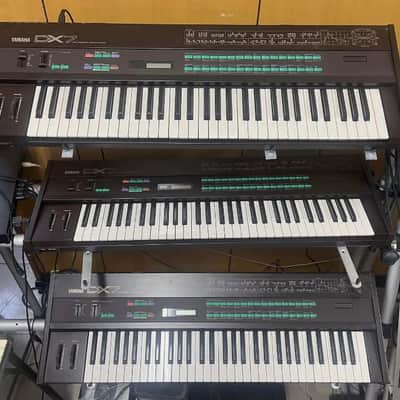

Yamaha DX7 Programmable Algorithm Synthesizer

YAMAHA DX7 Digital Algorithm Synthesizer 100v version,100v Version
We accommodate different regions by supplying the correct power transformer according to your local voltage (e.g., 110-120V or 220-240V).
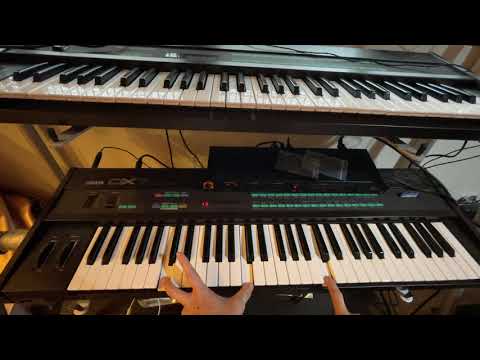
more real sound test video on my DB Studio TV yotube channel
The Yamaha DX7 is a synthesizer manufactured by the Yamaha Corporation from 1983 to 1989. It was the first successful digital synthesizer and is one of the best-selling synthesizers in history, selling more than 200,000 units.
In the early 1980s, the synthesizer market was dominated by analog synthesizers. FM synthesis, a means of generating sounds via frequency modulation, was developed by John Chowning at Stanford University, California. FM synthesis created brighter, "glassier" sounds, and could better imitate acoustic sounds such as brass. Yamaha licensed the technology to create the DX7, combining it with very-large-scale integration chips to lower manufacturing costs.
With its complex menus and lack of conventional controls, few learned to program the DX7 in depth. However, its preset sounds became staples of 1980s pop music, used by artists including A-ha, Kenny Loggins, Kool & the Gang, Whitney Houston, Chicago, Phil Collins, Luther Vandross, and Billy Ocean. Its electric piano sound was particularly widely used, especially in power ballads. The English producer Brian Eno was proficient at programming his own sounds, and it was instrumental to his work in ambient music. Chips based on the DX7 sound chip, such as the YM2612 and YM3812, were used in technologies such as the Sega Genesis game console.
The DX7 was succeeded by FM synthesizers including the DX1, DX21, DX27 and DX100. In later years, the DX7 sounds came to be seen as dated or clichéd and its use declined.
The DX7 has been used by the Crystal Method, Kraftwerk, Underworld, Orbital, BT, Talking Heads, Brian Eno, Tony Banks, Mike Lindup of Level 42, Jan Hammer, Roger Hodgson, Teddy Riley, Brian Eno, T Lavitz of the Dregs, Sir George Martin, Supertramp, Phil Collins, Stevie Wonder, Daryl Hall, Steve Winwood, Scritti Politti, Babyface, Peter-John Vettese, Depeche Mode, D:Ream, Les Rhytmes Digital, Front 242, U2, A-Ha, Enya, The Cure, Astral Projection, Fluke, Kitaro, Vangelis, Elton John, James Horner, Toto, Donald Fagen, Michael McDonald, Chick Corea, Level 42, Queen, Yes, Michael Boddicker, Julian Lennon, Jean-Michel Jarre, Sneaker Pimps, Lynyrd Skynyrd, Greg Phillanganes, Jerry Goldsmith, Jimmy Edgar, Beastie Boys, Stabbing Westward and Herbie Hancock. Pretty impressive for just a partial listing!
Still the DX7 has remained the all around best and most popular DX synth due to its affordable price, professional features for studio and live performance and its excellent range of sonic possibilities and extensive programmability. In fact the reason the DX7 is always so affordable is because there are so many of them out there, still being used and traded! And they are reliable, still functioning well over 20 years later unlike older analog gear.
Yamaha DX7: Features & Functionality
Released in 1983, the Yamaha DX7 was the first commercially successful digital synthesizer, and it helped define the sound of the 1980s.
🔧 Key Features:
- FM Synthesis (Frequency Modulation):
- Instead of traditional analog subtractive synthesis, the DX7 uses FM synthesis, developed by John Chowning.
- Produces bright, metallic, complex, and percussive sounds not easily achievable with analog synths.
- 16-Voice Polyphony:
- Allows up to 16 notes to be played simultaneously.
- Velocity & Aftertouch Sensitivity:
- One of the first synths to respond to how hard a key is struck (velocity) and pressure after the key is held (aftertouch).
- Preset Sounds:
- 32 built-in patches, with the iconic “E. Piano 1” (electric piano) becoming legendary.
- Other notable sounds: bells, basses, strings, and brass.
- MIDI Connectivity:
- Early adopter of MIDI, allowing it to communicate with other instruments and computers.
- Digital Display & Membrane Buttons:
- The DX7 became a staple in pop, rock, R&B, and jazz during the 1980s and early 1990s. Below are key examples.🎤 Pop & Rock🎷 Jazz & Fusion🎧 Electronic & Experimental🎼 Others📀 Albums Featuring the DX7The Yamaha DX7's unique sound defined an era and influenced countless artists and producers. Its “E. Piano 1” patch became so popular it was often criticized for being overused, yet it remains beloved.Even today, the DX7 and its software emulations are used in modern music production, both for nostalgia and for its uniquely crystalline FM tones.
Voltage
Please check the power requirements for this device and the specifications of your power supply. If you need to use this item in a 117-240 V environment, you'll need a transformer. which will allow you to use this item safely and with good performance in your country.
Import tax・ Import duties, taxes, and other charges which are not included in the item price or shipping charges are the buyer's responsibility.・ Please check with your country's customs office to determine what these additional costs will be prior to bidding or buying. - Menu-based editing with parameter numbers, though deep programming was considered non-intuitive.
Artists, Songs, and Albums that Used the DX7
- Menu-based editing with parameter numbers, though deep programming was considered non-intuitive.
- Toto – "Africa"
- The iconic keyboard sound includes DX7 electric piano patches.
- A-ha – "Take On Me"
- Synth textures created with DX7 alongside other synths.
- Whitney Houston – "Saving All My Love for You"
- Smooth electric piano sounds using the DX7.
- Phil Collins – "One More Night"
- Uses DX7 electric piano prominently.
- Chicago – "Hard Habit to Break"
- Rich DX7 layers used for ballad textures.
- Herbie Hancock
- One of the first jazz musicians to embrace the DX7 for its dynamic electric piano tones.
- George Duke
- Frequently used the DX7 for fusion and funk textures.
- Brian Eno
- Explored the sonic possibilities of FM synthesis for ambient music.
- Depeche Mode
- Used the DX7 among other synths to shape their dark electronic sound.
- Brian Ferry (Roxy Music)
- Duran Duran
- Madonna
- Michael Jackson
- His producers used DX7 in various arrangements, notably on Bad and Dangerous.
- Phil Collins – No Jacket Required
- Whitney Houston – Whitney Houston
- Tears for Fears – Songs from the Big Chair
- Prince – Purple Rain (used alongside other synths)
- Dire Straits – Brothers in Arms (digital textures and piano)
Legacy
This item is sold As-Described
This item is sold As-Described and cannot be returned unless it arrives in a condition different from how it was described or photographed. Items must be returned in original, as-shipped condition with all original packaging.Learn More.

| Listed | a year ago |
|---|---|
| Condition | Excellent (Used) Excellent items are almost entirely free from blemishes and other visual defects and have been played or used with the utmost care.Learn more |
| Brand | |
| Model |
|
| Categories | |
| Made In |
|
| Number of Keys |
|
| Keyboard Action |
|
| MIDI I/O |
|
| Key Size |
|
| Polyphony |
|
| Analog / Digital |
|
Product safety information may be available here.

