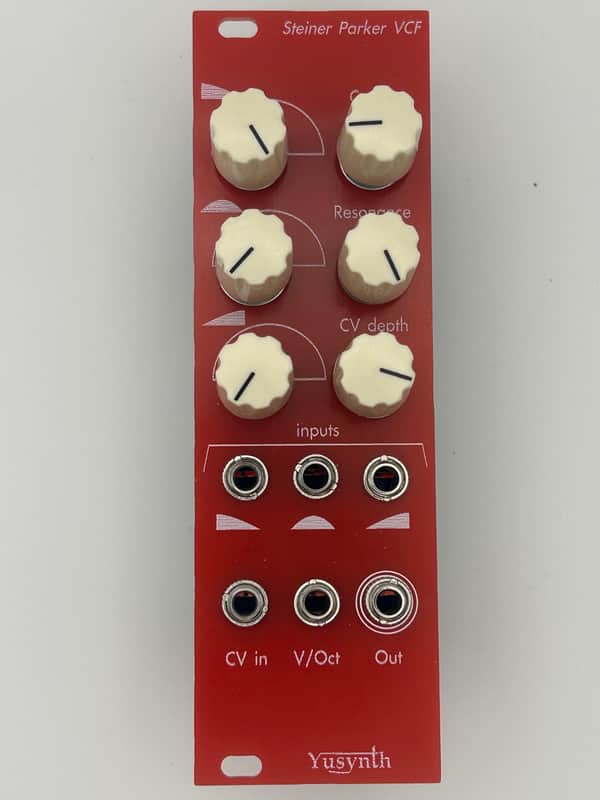
Timo Rozendal Steiner-Parker VCF Eurorack Module
This seller has not set a shipping cost for Netherlands. Please contact them to ask about shipping.


14-Day Return Policy
Enjoy peace of mind with your new gear
Our users rate Reverb
While tinkerers have built and used Steiner-type VCFs for ages, Arturia’s use of the filter in their ‘Brute’ line of synthesizers made the filter accessible to a wide range of musicians in the 2010s. Both this module and the Arturia circuit were designed by Yves Usson, with Timo Rozendal handling the Eurorack adaptation.
This VCF is a 12 dB/octave multi-mode type with inputs for lowpass, bandpass, and highpass responses. Plugging a sound source into the lowpass input jack sends it to the bandpass and highpass inputs as well; patching cables into those will break this connection. This setup allows you to use different sound sources for each one, with dedicated volume knobs mixing/blending any combination of the three. Using a single sound source, these can also be used to get notch/band-reject and allpass responses.
This filter has a reputation for getting dirty and unstable, especially when the resonance is cranked up. The feedback from the resonance path collides with the inputs, which can result in some unintended (and fantastic!) consequences. This feedback path can also affect cutoff frequency stability toward the top of the Resonance control’s range, resulting in howling self-resonance. A word of caution—the output can get LOUD when this happens!
The core of this filter was designed by Nyle Steiner (thus called the Steiner VCF) and debuted on Steiner-Parker’s Synthacon in the mid-1970s. Lowpass diode ladder filters were fairly common at the time—especially for those companies trying to evade Moog’s filter patents—but adapting these to provide different response types (e.g. bandpass, allpass) was proving tricky. To provide this flexibility, Steiner used a single long rail of diodes with tap points after every two/three; by injecting the input signal at different points along the rail, the rail was able to provide lowpass, bandpass, and highpass responses. Resonance was achieved by routing the final output to an attenuator knob and then back in via the bandpass tap points.
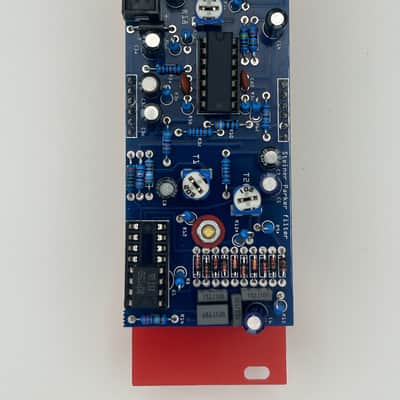
The testing and tweaking required to get Usson’s circuit properly got quite involved. The first challenge is getting a very closely-matched pair of PNP BJTs and filter capacitors. We tried all sorts in our pre-production prototypes, eventually winding up with a matched set of German WIMA FKS2 poly film caps and Latvian-production КТС3103А1 chips (so don’t be surprised by the Cyrillic symbols when you turn it over). The other major hurdle was tuning the resonance control range+curve. With Rozendal’s recommended values, turning the control past ~95% resulted in the output dropping out altogether; this was remedied by changing the trimmer/potentiometer values. If you’d like to change it back, there’s a screwdriver adjustment on the back of the module to do so.
Specs:
- Size: Eurorack/8HP
- Depth: 47mm (w/o cable)
- Lowpass Slope: 12 dB/octave
- Bandpass Slope: 12 dB/octave (6dB/octave high + 6dB/octave low)
- Highpass Slope: 12 dB/octave
- Current Draw: 10mA@-12V, 15mA@+12V
Exact components may vary from module to module, as each unit is tuned individually. Each module has been rigorously tested and as such, fingerprints and slight blemishes may be present (though we do our best to avoid these!). Depth and current draw measurements are approximations intended to help with planning your Eurorack setup; please allow for additional space/current to allow for a margin of error.
| Condition | Brand New (New) Brand New items are sold by an authorized dealer or original builder and include all original packaging.Learn more |
|---|---|
| Brand | |
| Model |
|
| Finish |
|
| Categories | |
| Year |
|
| Made In |
|
Product safety information may be available here.

