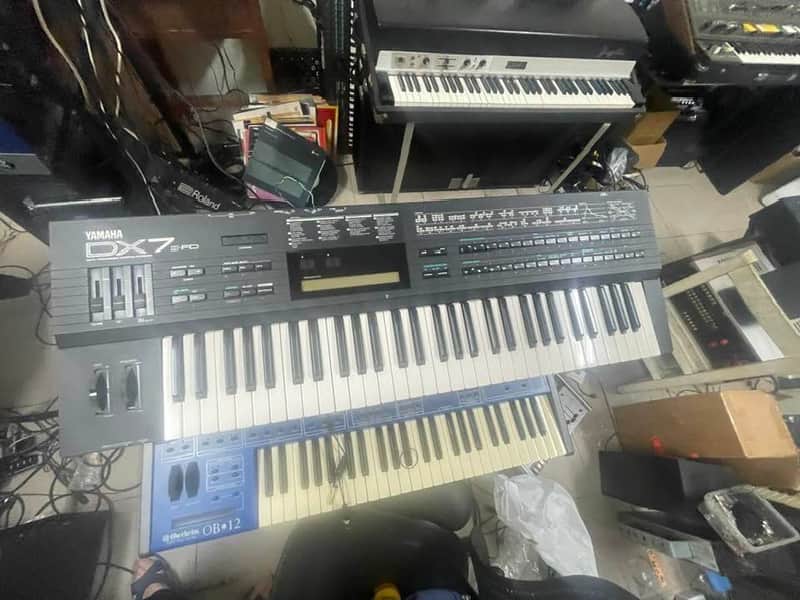
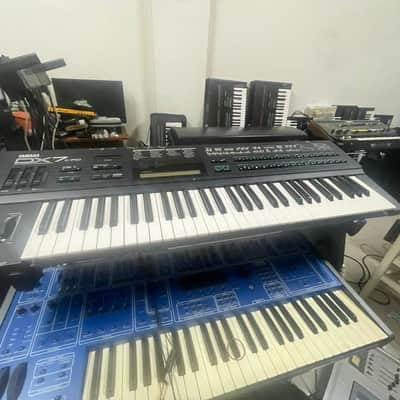
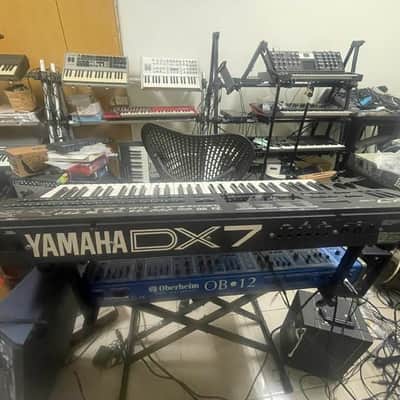
Yamaha DX7IIFD 16-Voice Synthesizer with Floppy Drive *New Internal Battery*

Product description.
It’s very difficult to follow up on something as sensational as the original Yamaha DX7 which still remains one of the bestselling synthesizers of all time. Yamaha did the obvious and took what was already very good and made it better. The DX7IIFD was a natural evolution and kept the DX brand going for a further 3 years.
First impressions/Delight.
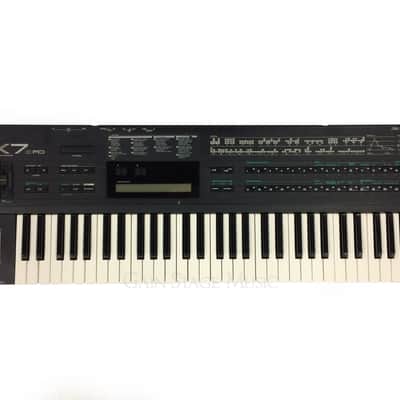
Our first impression was that it looks very true to the 1980s. Yamaha made the right decision to ditch the brown and make it “Black”. Every new piece of audio gear at that time from Speakers to Walkmans were black. While it is proportionately similar to the original DX7 it physically looks very different due to a few updates that are obvious upon first view. Firstly, the unreliable membrane buttons were replaced by actual push buttons. The yellow backlit screen is larger than that on the previous model and there are two new control sliders next to the volume control.
Exterior Design Review.
It looks as good today as it did in 1986 and that is mainly due to its solid build and practical layout. The face plate is a single 2.5mm thick sheet of aluminium. The push buttons are positioned perfectly within a series of 1.5mm wide horizontal groove lines that run the length of the face plate. The screen is housed in a large acrylic panel that looks very slick and cool.
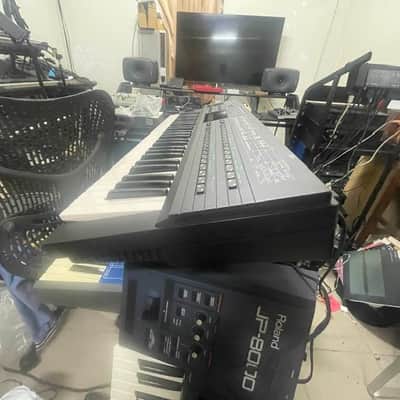
The excessively thick faceplate has been expressed quite brutally on the sides. It’s industrial looking but somehow still feels more streamline than its predecessor. The surface is not smooth and has a very fine grainy texture that adds to the solid feel of this machine. There is also a slightly glossy sheen to the black paint.
On the underside of the end panels Yamahas Designers introduced corrugated sculptural ribbing which improves grip when carrying this unit by the ends. At the rear Yamaha proudly has its name with a new logo design for the “DX” with a double lined font.
As with the original DX7 there is a pitch bend and modulation wheel on the left end panel and they look to be the only parts designed identical to the original though in black.
Craftsmanship.
The body is robust and composed of a solid industrial quality metal face plate and rigid plastic end panels. It was designed to survive studios and concerts and Yamaha must have learnt by studying what did not ware well on the original DX7. The Mk II Yamaha gained small bumpers on the back of the end panels in anticipation of being bumped around. We think these could have been finished with neat rubber ends for further strength and protection. The front corners are neatly rounded with plenty of space to rest your left hand, which us useful if you enjoy using the pitch bender wheel.
The more you study this machine the more you sense and appreciate its build quality. It looks and feels purposeful like a stealth military tank. If you took away the keys it looks indeed like a high tech piece of military equipment. Despite its strength and rigidity, it is a whole 3 kilos lighter than its predecessor.
FUNCTION- Experience.
The keys feel nice and were highly praised back in the day. The white keys are intentionally warm in colour like ivory. The push buttons connect in a unique way that encourages the user to run their fingers over them as a fast way to scroll through different sounds or editing functions. Users from the day will remember this action with its distinct sound and feel, unique to the Mk II DX7. The screen is beautiful and has a clever way of glowing more yellow and bright when it is dark. The graphics are of a high-quality print and keep the user well informed.
The MK II has significant internal improvements with sound and memory. It feels much more professional and capable than its predecessor. An aftermarket upgrade was available by a company called Grey Matter and units with this upgrade are known as having an ‘E” upgrade. The modifications were done internally and the only sign that a DX7IIFD has an E upgrade is from a large sticker you could apply to the front panel. A DX7IIFD “E” will have certain special enhancements but this does not necessarily add more value from a collectability stand point.
The pitch and modulation wheels appear to be the only design element similar to those on the original DX7, but changed from brown to black. Everything else on the MKII was rethought and redesigned.
Desirability / Collectibility.
The DX7IIFD was Yamahas flagship model of the day and is definitely the pick over the S or IID variants in terms of function and collectability. It is not as iconic as the original DX7 but certainly superior in everyway and worth owning. It feels more eighties and pop like, whereas its brown predecessor looks out of the 70s disco era.
If you are patient, able to hunt vigilantly and willing to pay more, you will land yourself a mint DX7IIFD that will continue to appreciate.
The original accessories are also becoming sought after, and anything your DX7IIFD comes with is a bonus as most sellers won’t mark up their price significantly for included accessories. All the accessories combined can easily cost more than the keyboard itself when purchased independently.
WORD OF THE WOLF.
As an evolution/improvement over the original, the MK II is very successful. All the changes and upgrades are logical and well thought through. Its solid industrial looks make it stand out amongst other synths of the day and even those that have followed till present day. It was very much a result of form following function. Even those groove lines could be seen as having a purpose by defining rail tracks for the buttons and graphics. There is something very pure about this synthesizer that we appreciate.
The Mk II existed in a time when Yamaha faced fierce competition from Roland’s D-50 and Korg’s M1. Those rivals introduced ROM samples and effects processors. The M1 even had an onboard sequencer. The age of the workstation had arrived and the MK II felt a little basic and outdated by comparison. It survived mainly due to a loyal DX fan base so Yamaha was desperate to try and follow up with the next big thing.
Power Supply : AC100V 50/60Hz 28W
Voltage
Please check the power requirements for this device and the specifications of your power supply. If you need to use this item in a 220-240 V environment, you'll need a transformer. We sell high quality Japanese compact transformers (Nissyo), which will allow you to use this item safely and with good performance in your country.
Import tax
・Import duties, taxes, and other charges which are not included in the item price or shipping charges are the buyer’s responsibility.
・Please check with your country’s customs office to determine what these additional costs will be prior to bidding or buying.
・Except in the case of faulty or damaged items, refunds do not include any return shipping or shipping charges. Your return shipping charge will be deducted from your refund if you receive any.
Reverb Buyer Protection
Reverb has your back if your item is lost, damaged, or doesn't match its description. Simply report any issues within 7 days and we'll help you get a full refund.Learn more about Reverb Buyer Protection.
| Listed | 2 years ago |
|---|---|
| Condition | Excellent (Used) Excellent items are almost entirely free from blemishes and other visual defects and have been played or used with the utmost care.Learn more |
| Brand | |
| Model |
|
| Finish |
|
| Categories | |
| Number of Keys |
|
| Keyboard Action |
|
| MIDI I/O |
|
| Key Size |
|
| Polyphony |
|
| Analog / Digital |
|
Product safety information may be available here.

