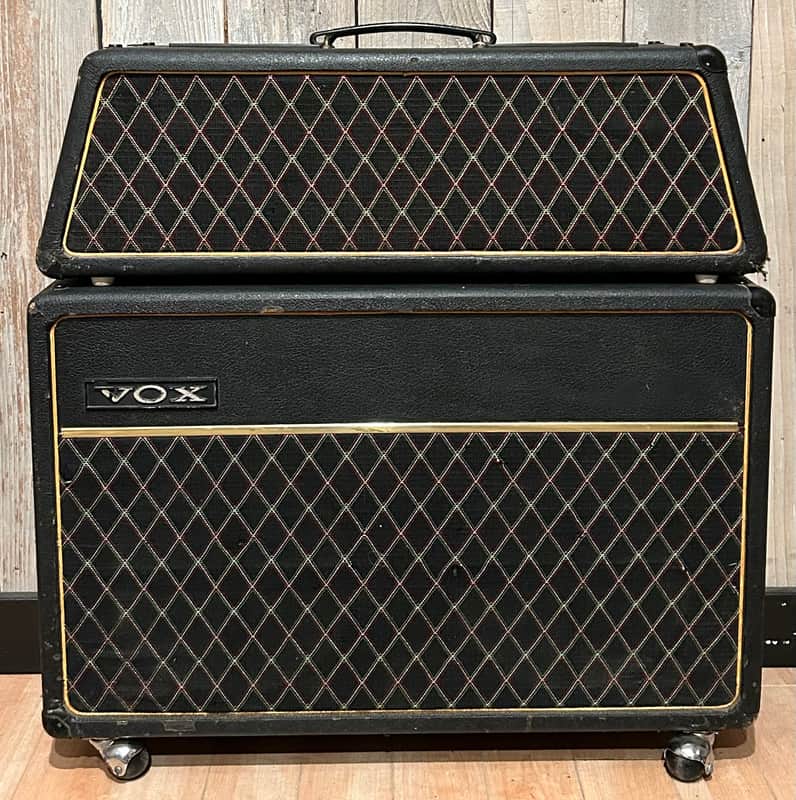
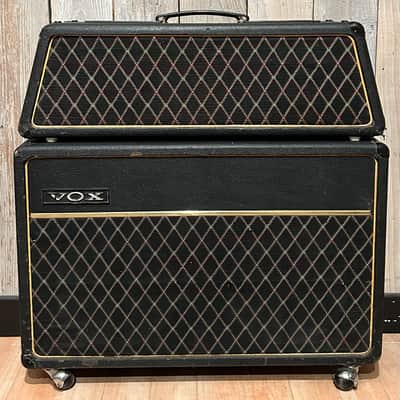
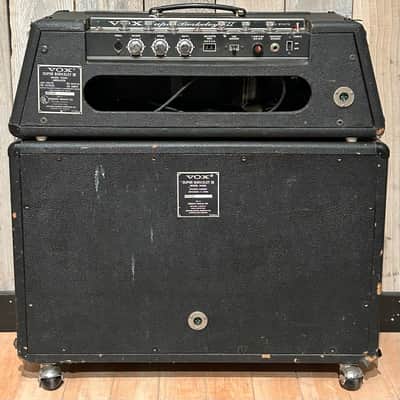
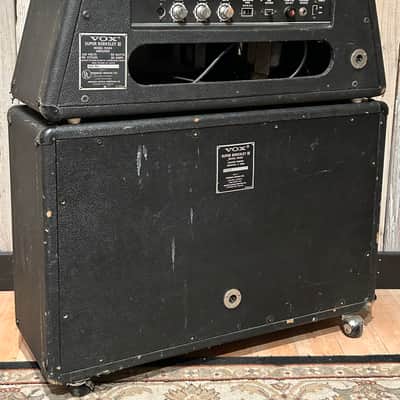
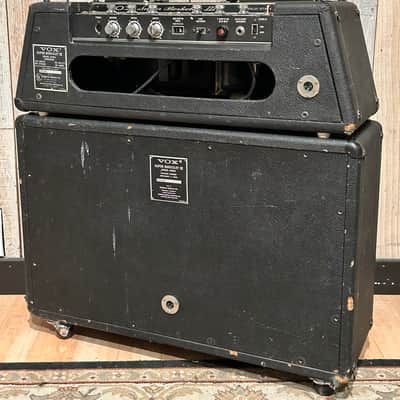
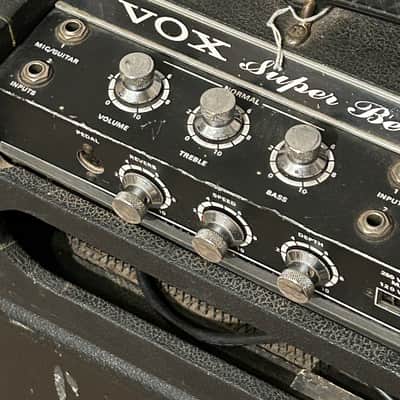
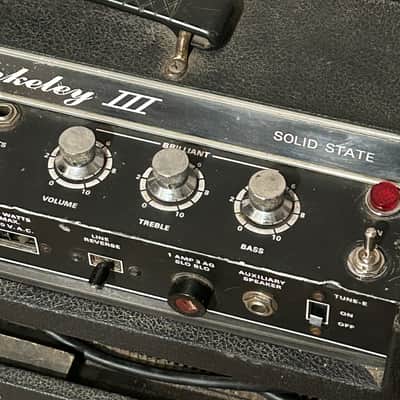
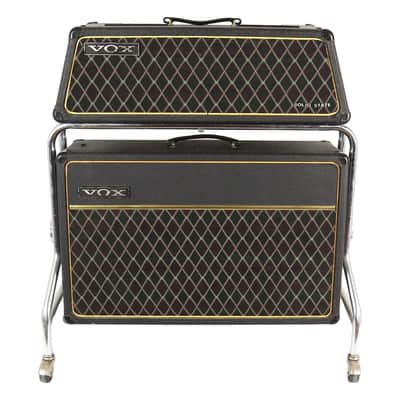
1968 Vox V1083 Berkeley III Super Reverb 2-Channel 35-Watt 2x10" Piggyback Guitar Amp, Serviced and Sounding Great!

Only 1 left
Grab it before it's gone


Rare Find
These don't show up often
Our users rate Reverb
1968 VOX V1083 Berkeley III Super Reverb 2x10" Piggyback Guitar Amp, Step back in time and take this VOX out on a Day Trip, It won't take you long to find out!
Serial Number: I139018
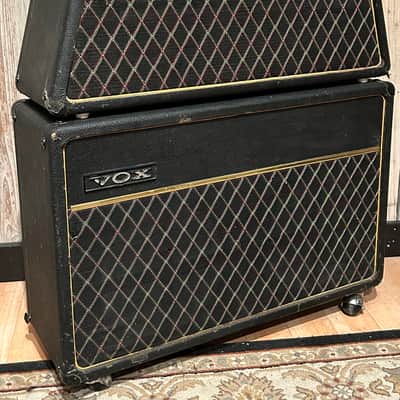
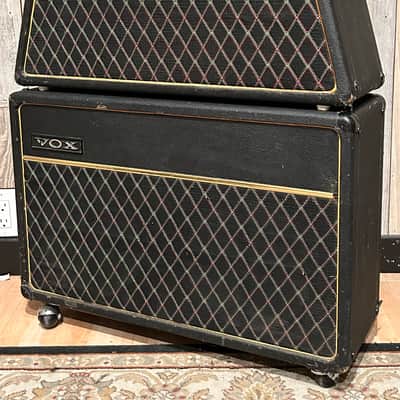
CONDITION: This vintage VOX amplifier just went through our in house amp tech, and passed our rigorous multi-phase bench test with flying colors. Cosmetically, this amp has been played and gigged since 1968. The plastic corners on the head and cabinet are damaged, and there is wear to the tolex. The top handle on the cabinet is missing.
HISTORY: V1083 Vox Berkeley III Amplifier - The V1083 Vox Berkeley III was the last in a series of four generations of Berkeley amps offered by the Vox division of the Thomas Organ Company. The Berkeley III was first offered in the January 1968 US Vox price list but it made additional appearances in 1968, 1969 and 1970 US Vox literature.
Four Generations of the Vox Berkeley Amplifier
The commercial success of the Beatles in 1964 caused a flood of demand for Vox products in the US market. Rather than set up shop in the states, Jennings Musical Industries (JMI), the UK manufacturer of Vox, decided that it would be best to choose an established US firm to distribute their amplifiers in America. The Thomas Organ Company, based in Sepulveda CA, was chosen to be this American distributor in September, 1964.
One of the earliest amp models Thomas imported to the US from JMI was the AC-10SRT ("Super Reverb Twin"). The AC-10 SRT was an all tube 10 watt, single channel amp head featuring reverb, tremolo and a tone control combined with a separate 2x10" enclosure mounted to a tubular swivel trolley. Thomas Organ changed the name of the amp for the US market from "AC-10SRT" to simply "Berkeley." This JMI version of the Berkeley amp was featured in the Thomas 1965 "Vox - King of the Beat" catalog, shown below and at right.
By mid 1965, Thomas Organ had grown weary of the high costs of importing amplifiers from the UK and negotiated a licensing contract with JMI that would allow Thomas to build Vox amps in America. This led to the development and production of the V8 Vox Super Reverb Twin. The all tube, 18 watt, single channel V8 Berkeley Super Reverb head included reverb, tremolo, bass and treble controls and a stylish trapezoid cabinet. The matching 2x10" open backed enclosure featured two 10" Celestion speakers and a chrome swivel trolley.
However, Thomas Organ was not content producing tube amplifiers. To the organ engineers at Thomas Organ, tube circuits must have seemed archaic. Transistorized circuits were cheaper to produce, generated no heat, required less maintenance and in theory offered a longer service life. Within six months of the introduction of the tube powered Berkeley Super Reverb Twin, it was replaced by the transistorized V1081 Berkeley II.
Like it's predecessor, the solid state V1081 Berkeley II was a single channel 18 watt amp in a trapezoid head cabinet. It included volume, treble and bass controls, foot switchable "MRB" mid boost, tremolo and reverb. The 18 watt RMS power amp stage utilized a pair of germanium output transistors.
The Berkeley went through a yet another redesign for 1968. Now known as the V1083 Berkeley III, the power amp section was increased from 18 to 32 watts RMS. The Berkeley III power amp stage was made more dependable due to a switch from germanium to silicon output transistors. The Berkeley III preamp stage featured two channels and four inputs while the Berkeley II had one channel with three inputs.
The Berkeley III included a three button foot switch to provide remote access to the reverb, tremolo and MRB (mid range boost) effect. While adjustments to the reverb and tremolo could also be made from the control panel, the mid boost was controlled solely by the foot pedal. A six pin Switchcraft DIN plug connected the foot switch cable to the lower control panel.
The Berkeley III also included a "E-tuner" circuit. Based on a basic single frequency organ tone generator, it acted as an electronic "pitch pipe" of sorts. It provided a 323.6 cycle reference pitch for tuning the E strings on a guitar. A slide switch mounted to the lower control panel actuated the tuner.
Name Plates and Escutcheons
The V1083 Vox Berkeley II head and speaker enclosure both featured a rectangular Vox nameplate. It featured gold hot stamped letters and was fastened to the cabinet by two molded plastic pins.
An additional "solid state" logo graced the lower right hand corner of the amplifier head. Thomas was obviously proud of their new solid state models and this new logo to helped to distance their new transistorized amps from the manufacturers still holding on to those "old school" tube circuit designs. It was also fastened to the cabinet by molded pins.
Speaker Jacks
A Switchcraft three pin XLR jack was mounted to the vinyl covered back panel of the V1083 head for speaker connection. While using what would normally be considered to be a microphone jack in this application might seem a bit unusual, Thomas Organ was simply following the English Vox tradition of providing locking XLR speaker cables to interconnect their heads and speaker cabs.
Thomas also provided a conventional 1/4" Auxiliary Speaker jack on the rear panel of the Berkeley III.
About Capital City Guitars:
We are a small brick and mortar music store, we take pride in earning the respect of our customers. We specialize in safe secure worldwide shipping. Thanks for looking at our items. We always give things a final inspection and going over before shipping. Need anything? Just ask! Contact us directly on our website or call the shop Tues-Sat 11am-6pm PST🎸 😎Thanks,
Capital City Guitars
(360) 956-7097
108 4th Ave. E
Olympia, WA 98501
Please like Us on Facebook & Follow Us on Instagram @capitalcityguitars
| Condition | Very Good (Used) Very Good items may show a few slight marks or scratches but are fully functional and in overall great shape.Learn more |
|---|---|
| Brand | |
| Model |
|
| Finish |
|
| Categories | |
| Year |
|
| Made In |
|
| Effects Loop |
|
| Number of Channels |
|
| Power Tube Type |
|
| Built-In Effects |
|
| Direct Output |
|
| Number of Inputs |
|
| Electronics |
|
| Speaker Configuration |
|
| Color Family |
|
| Reverb |
|
| Impedance |
|
| Output Power (Watts) |
|
Product safety information may be available here.

