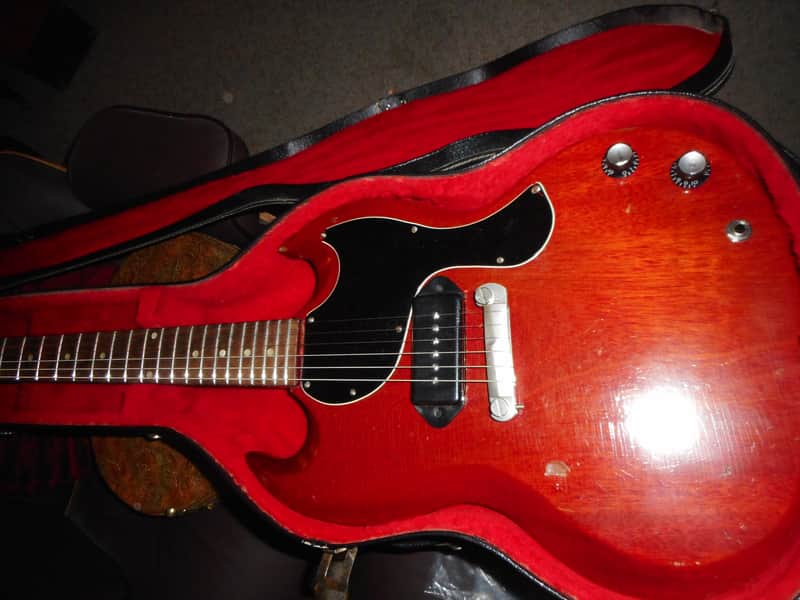
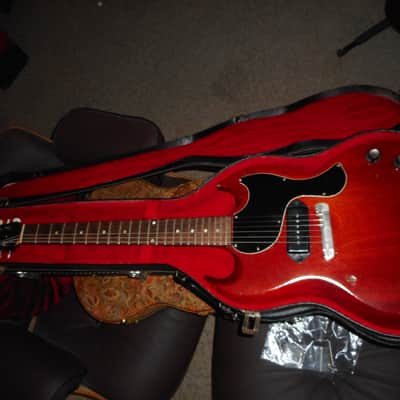
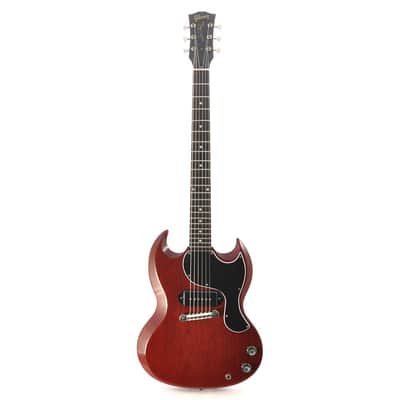
Gibson Les Paul Junior 1961 - Cherry
This seller has not set a shipping cost for United Kingdom. Please contact them to ask about shipping.

Predicted to Sell Soon
Only 1 available and 1 other person has this in their cart

Our users rate Reverb
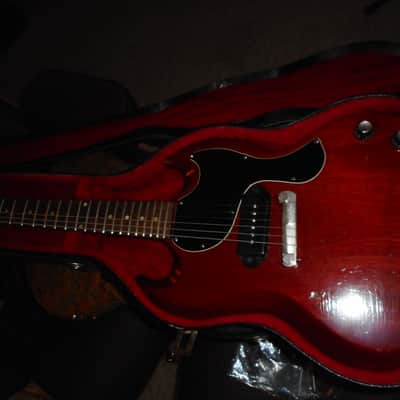
1961 Les Paul Jr.
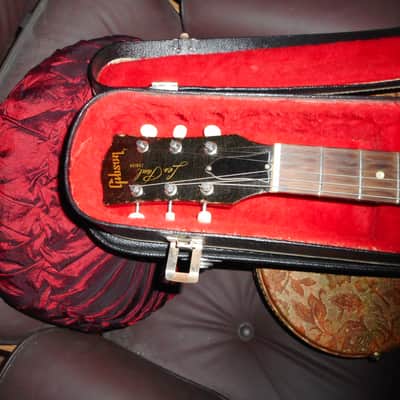
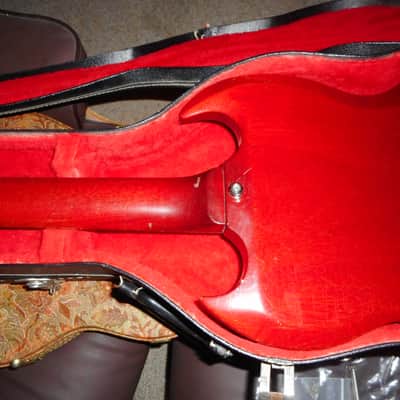
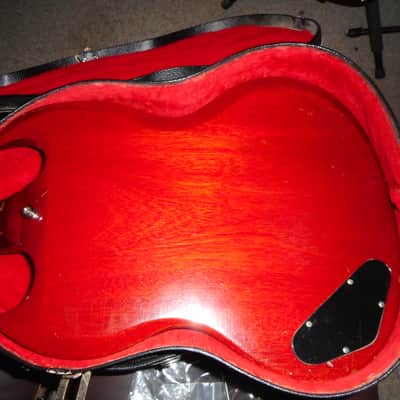
This is a great old Les Paul Jr. from the first year of the new design, the design that would later be called the SG. This guitar has had some upgrades but all the original parts including the original wiring harness is included in the original 60's Yellow lined hard shell case. A solid guitar, never broken, nicely worn but not crazily worn, still red (not brown from too much UV exposure), a neck that fells really great and a truss rod that works! Fantastic new Fret job that is perfect. Original Gibson case
The problem with vintage guitars is they often don't play that well. I've read many claims about vintage guitars that "play great", but as a person who has owned modern electrics from makers like Anderson and PRS, it's my experience that vintage guitars seldom play as well as modern quality guitars unless someone has really had work done to them as is the case with this guitar.
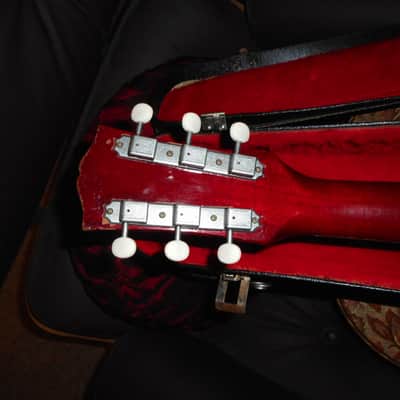
As stated, the guitar has never been broken. The frets were smallish and in just okay shape. The tuners were original, and none of the six buttons are shrunken, and they all work. But it makes me nervous tuning a guitar with plastic buttons that are more than 60 years old, I didn't want any of them to crumble in my hand, so I replaced them with look a likes from Stew Mac, but using the original screws (and no new holes, these replacements fit perfectly with no modification to the guitar). The originals are included, of course.
I believe the bridge that came on the guitar is original, and of course it won't intonate properly do to the unwound modern G string etc.... So I put a "Music City Bridge" compensated bridge on the guitar (the original will be included, of course). The Music City bridge was designed by Tom Bukovac in conjunction with the guys at Joe Glaser's shop in Nashville, and it fixes several problems.
The biggest issue it addresses is intonation. The bridge has an offset ridge along its top that adjusts the length of each string optimally so that the guitar can be properly setup with proper intonation. Intonation is also known as compensation - you're compensating for the fact that the strings have to be stretched in order to reach the fretboard. Higher action means more stretching to get the string to the fretboard, and consequently more compensation.
This problem is handily addressed with this bridge, so finally, a Les Paul Jr that plays in tune! This bridge really takes care of this tuning problem, the guitar intonates very well now and sounds like a modern guitar in the sense that it plays in tune. It's really a game changer.
Another issue this bridge addresses is the placement of the lower mounting stud. For some reason that is very hard to understand, certain Gibsons through the 1950s and into the very early 1960s had the lower stud mounted way forward of the upper stud. A little forward would be understandable, and this is what they've done since that time, but these early guitars had the stud w-a-y forward of where it should have been, and so you end up with a bridge that is extremely angled. The Music City bridge has a lower opening that sits forward of the body of the bridge (Music City calls it a "stud finder"), which allows the bridge to sit on the guitar at a less steep angle. This is a welcome addition. And the bridge is thin, to ensure that you can get the action as low as you need to without the bridge bottoming out against the guitar top. Some old SGs have this problem - the bridge is all the way down, against the top, and the action is still too high. Time for a neck reset, which is not an easy task on an SG. Or, a thinner bridge!
Speaking of low action, you can only get low action if the frets are level. The tops of the frets must all be in the same plane in order to get low action (some relief notwithstanding). Low spots caused by wear, or unevenness caused by years of fretboard expansion/contraction that causes the frets to move around, or unevenness just because the frets were never properly leveled in the first place - all of these things cause fret buzz that is either addressed directly with fretwork, or addressed indirectly by raising the action until the buzz is mitigated.
When there's a lot of meat left on the frets you can level them, but this guitar needed new frets. So now it has 6100 fretwire installed .
Dunlop 6100 wire is big. If you like to bend strings then you'll likely prefer taller wire to shorter wire. But 6100 is up there, it's .110" wide and .055" tall before being dressed. That's big. Too big for some people, but that's what comes in the PRS DGT (as an example) because David Grissom likes 6100 wire. So do I. If you're not sure, it might be helpful to know that 6100 is the same height as 6105 wire (which has been used by Fender on a number of modern Strats and Teles), but it's wider. Both are .055" high, but where 6100 is .110" wide, 6105 is .090" wide. So .020" wider, roughly the thickness of your G string. If you're familiar with 6105 but not 6100 then that will give you some perspective. So anyway, now this guitar feels more modern, like it's just egging you on to bend strings. We love it.
The neck is very straight, meaning very little relief, and the truss rod works like a charm. The original nut is on the guitar, and the slots are cut to perfection. The action is low - 1/16" at the 22nd fret. That's the spec used by Anderson, Suhr, and other high end makers, it's generally regarded as the lowest you can go without excessive fret buzz. But to get there the frets have to be level, and these are level.
This is a pro refret, I'd put it up against most anyone's work (except maybe Collings, those guys are like magicians). Properly installed by someone who knows what they're doing, properly leveled and crowned, and properly polished with a buffer and polishing compound to look like jewelry.
The guitar plays as well as anything. As well as any $10,000 boutique guitar, and it plays better than 95% of vintage guitars. All of the shortcomings have been addressed: the frets, the nut slots, the bridge, the intonation. The guitar is simply right. And other than the frets, I didn't make any permanent mods to the guitar. Everything else is completely reversible.
The pickup is original, but the wiring is not. It has two new 500k CTS pots, Switchcraft jack, and an Orange Drop .022µF cap.
And the knobs were pretty rough (like, seriously rough), so It has matching new ones. The originals are included, or what we think are the originals, though can't know for sure can't know for certain.
Someone dug around under the pickup a little but very little material was removed, and thankfully it's completely hidden by the pickup. Have no idea what they were doing, maybe someone stuck a Filter'Tron on there or something and needed a little clearance for polepiece screws or whatever. I have no idea, but again, invisible unless you remove the pickup.
So there you go. A first-year guitar, never broken, seriously ready to play. All the original parts are included with the exception of the pots/cap/jack.
The guitar is dinged here and there and checked all over. Not excessively worn, but the kind of wear that people pay Gibson thousands of dollars to do. Well, this is real. The guitar is ready to gig.
Comes in an original 60s Gibson soft shell case with a Red interior. Black, decent condition, latches work.will ship in an after market Hardshell case for safety.
If you're not that familiar with the early Gibson Les Paul story, here's a little history, some of which comes from the horse's mouth (Ted McCarty - Gibson president from 1950 - 1966):
1950
Leo Fender releases the Broadcaster, soon to be the Telecaster. McCarty and some other industry insiders deride it. It is plain, unconventional, and unsophisticated, unlike Gibson's guitars. "The boat paddle" and similar pejorative names surface.
1952
McCarty, having watched that stupid boat paddle grab surprising amounts of market share for two years comes to understand that Gibson is getting left behind in this new solidbody guitar market. He and his team design a new solidbody electric guitar, but he needs a heavyweight player to endorse it. He makes a deal with Les Paul - a smoking guitar player who is just coming off a string of hits, but whose star will soon wane as rock'n'roll is born. The guitar is designed by Gibson - Les Paul has essentially no input into it - his name will simply be slapped on the guitar and a royalty of $1 paid for each unit sold.
1952 - 1960
Gibson continually refines the guitar. The trapeze goes away, as does the "staple" pickup (LP Custom). The stoptail emerges, followed by the ABR-1. The humbucker appears in 1957, and for 1958-1960, the color is changed from gold to sunburst. But it doesn't matter, Gibson can't sell the guitars. While the Tele, Strat, and P-Bass change the world and make Fender the world's largest guitar maker, Gibson is failing to sell Les Pauls (not to mention Flying Vs, Explorers, and Modernes). They realize that they need to completely revamp the guitar, and they do this for 1961 - introducing the all-new Les Paul Model, which Les Paul doesn't care for.
1961 - 1962
Les Paul's handshake agreement with Ted McCarty ends in 1962. Gibson needs a new name for what has been the Les Paul, so they decide that since the guitar is a "solid guitar", they'd better call it SG.
| Listed | 2 years ago |
|---|---|
| Condition | Excellent (Used) Excellent items are almost entirely free from blemishes and other visual defects and have been played or used with the utmost care.Learn more |
| Brand | |
| Model |
|
| Finish |
|
| Categories | |
| Year |
|
| Made In |
|
| Fretboard Material |
|
| Body Material |
|
| Neck Construction |
|
| Body Shape |
|
| Right / Left Handed |
|
| Number of Strings |
|
| Neck Material |
|
| Bridge/Tailpiece Type |
|
| Color Family |
|
| Body Type |
|
| Pickup Configuration |
|
| Scale Length |
|
| Model Sub-Family | |
| Model Family | |
| Number of Frets |
|
Product safety information may be available here.

