Waldorf M - Wavetable Synthesizer






Waldorf M - Wavetable Synthesizer


14-Day Return Policy
Enjoy peace of mind with your new gear
Our users rate Reverb
Mit M kehren wir zu unseren Wurzeln zurück und lassen die Microwave- und die Microwave II-Klangerzeugung im modernen Gewand als Hybrid-Wavetable-Synthesizer wieder aufleben. M verfügt über einen analogen Tiefpass mit 24 dB/Okt. VCF – SSI 2144 Improved Ladder Type – mit Resonanz- und analoger Sättigungsfunktion, einen echten analogen Stereo-VCA mit Panning-Option und vieles mehr in einem Desktop-freundlichen Format mit einer Vielzahl einzigartiger Sounds. Insgesamt verfügt M über 16 Bänke mit je 128 Speicherplätzen. Die vorinstallierten Klänge – insgesamt 1024 (aufgeteilt in 8 Bänke mit je 128 Sounds) – wurden von weltbekannten Sounddesignern programmiert und beinhalten auch alle klassischen Microwave-Soundsets wie MW1 Factory Sound Set, MW1 Soundpool 1-5, die fett klingenden Analogue und Bassco sowie PPG Wave 2.3-Sounds.
Darüber hinaus bietet M auch frisch programmierte Sounds, die die unzähligen neuen Funktionen nutzen – von echtem Hard Sync (im Modern Microwave II/XT-Modus) über den ARP (Arpeggiator) bis hin zum MIDI-synchronisierbaren globalen LFO (Low Frequency Oscillator). Der musikalische Kern des M als achtstimmiger polyphoner, vierstimmiger multitimbraler WAVETABLE SYNTHESIZER – besteht aus zwei Wavetable-Oszillatoren mit unabhängigen Wavetable-Erzeugungsmodi Classic Microwave 1 und Modern Microwave II/XT. Das bedeutet, dass sich die Wavetable-Oszillatoren in diesen beiden Modi unterschiedlich verhalten (erreichbar durch Drücken der Mode-Taste neben dem hochauflösenden Grafik-Display mit vier Endlos-Drehgebern für noch mehr praktische Kontrolle). Folglich gibt es im Classic Microwave I-Modus, in dem 16-Bit-Wavetables auf 8-Bit reduziert sind und eine nicht-antialisierte Sample-Rate von 240 kHz geboten wird, weder Hard Sync noch Ringmodulation, während der Modern Microwave II/XT-Modus eine Sample-Rate von 40 kHz mit bandbegrenzten Wavetables bietet, obwohl beide Oszillatoren – OSC 1 und OSC 2 – die gleichen Panel-Parameter bieten.
Zwei LFOs erzeugen eine periodische Wellenform mit einstellbarer Frequenz Rate und Shape, die für Modulationszwecke verwendet werden kann. Im Gegensatz zu anderen Waldorf-Synthesizern gibt es im M jedoch keine klassische Modulationsmatrix. Es ist eine bewusste Design-Entscheidung, die Modulationsmöglichkeiten des M direkt auf der entsprechenden Display-Seite einzustellen, um dem 1989er Microwave Tribut zu zollen.
Zurück im Hier und Jetzt hebt M die Performance auf ein ganz neues Niveau, dank des fortschrittlichen Arpeggiators mit 16 voreingestellten Patterns, Akkordmodus und der Möglichkeit, zur MIDI-Clock zu synchronisieren. Darüber hinaus ermöglichen vier programmierbare ENVELOPES experimentierfreudigen Anwendern die Bearbeitung von Sound-Parametern über Rate- oder Timing-Modulationen.
Für die Verbindung zur Außenwelt bietet der M fünf analoge Stereoausgänge (auf der Rückseite), die als MAIN OUT (L/Mono und R) und AUX OUT (A, B, C und D) angeordnet sind, wobei letztere verwendet werden können, um bei Bedarf jeden der vier Multi-Parts (multitimbral) auf verschiedene Ausgänge zu routen. Ein Stereo-Kopfhörerausgang (mit zugehörigem Lautstärkeregler zusätzlich zum Master-Lautstärkeregler auf der Oberseite), ist ebenfalls vorhanden. 5-polige MIDI IN, OUT und THRU DIN-Anschlüsse, ergänzt durch einen USB 2.0-MIDI-Anschluss stehen für die Verbindung mit einem Computer bereit. Zum Aktualisieren der M-Firmware, zum Importieren/Speichern von Sound-Patches und zum Importieren/Speichern von M-spezifischen Daten, wie z. B. Benutzer-Wavetables gibt es einen SD-Kartensteckplatz und – last but not least – einen Steckplatz für ein Kensington®-kompatibles Sicherheitsschloss.
______________________________________________________________________________________________________________
With M, we are musically returning to our roots by bringing back classic Microwave and ‘modern’ Microwave II tone generation as a new-generation classic hybrid wavetable synthesizer with an analogue lowpass 24 dB/Oct VCF — SSI 2144 Improved Ladder Type — with resonance and analogue saturation feature, true stereo analogue VCA with panning option, and much more to explore in a desktop-friendly form factor featuring a wide range of unique sounds. M has a total of 16 banks with 128 memory slots each. The included sound presets – 1024 in total (divided into 8 banks of 128 sounds) — professionally programmed by world- renowned sound designers also include all of the classic Microwave sound sets, such as MW1 Factory Sound Set, MW1 Soundpool 1-5, the fat-sounding Analogue and Bassco, as well as PPG Wave 2.3 sounds cleverly converted for the original Microwave. Moreover, it also features freshly-programmed sounds utilising M’s myriad new features — from true hard Sync (when working in its Modern Microwave II/XT mode) to the ARP (arpeggiator) and MIDI-syncable global LFO (Low Frequency Oscillator).
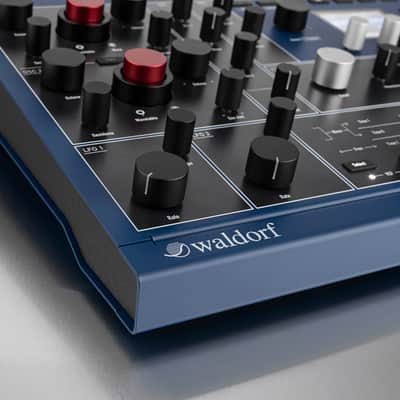
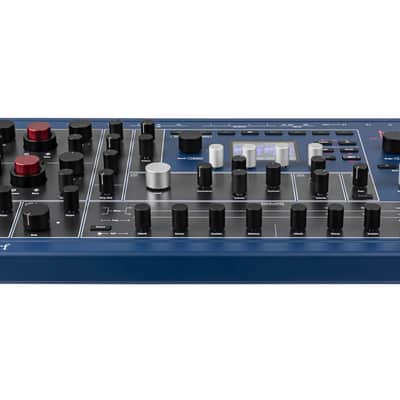
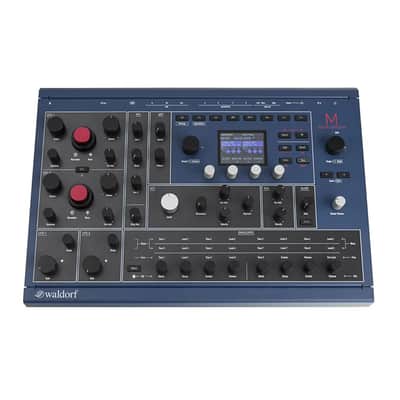
But beating at M’s musical heart as an eight-voice polyphonic, four-part multitimbral WAVETABLE SYNTHESIZER — as boldly blazoned in red across its full-metal blue- coloured casing, itself hinting at its illustrious Microwave heritage — are two wavetable oscillators with independent wavetable-generating Classic Microwave 1 and Modern Microwave II/XT modes, meaning that the wavetable oscillators behave differently in both of those modes (accessible by pressing the Mode button beside the helpful high-resolution graphic display with four endless encoders for yet more hands-on control). Consequently, there is no hard Sync or ring modulation available in the Classic Microwave I mode, where 16-bit wavetables are bit-reduced to 8-bit and a 240 kHz non-anti-aliased sample rate is offered, whereas the Modern Microwave II/XT mode offers a 40 kHz sample rate with band-limited wavetables, although both oscillators — OSC 1 and OSC 2 — offer the same panel parameters.
Two LFOs are generating a periodic waveform with adjustable frequency Rate and Shape that can be used for modulation purposes, are also always at hand. However, unlike other Waldorf synthesizers, there is no classic modulation matrix in M. Making a conscious design decision to set up M’s modulation facilities directly on the corresponding display page, to paying tribute to the 1989-vintage Microwave.
Back in the here and now, M takes performance to a whole new level, thanks to that advanced ARP with 16 preset patterns, chord mode, and an ability to synchronise to MIDI clock. Furthermore, four programmable ENVELOPES allow adventurous users to manipulate sound parameters via rate or timed modulations.
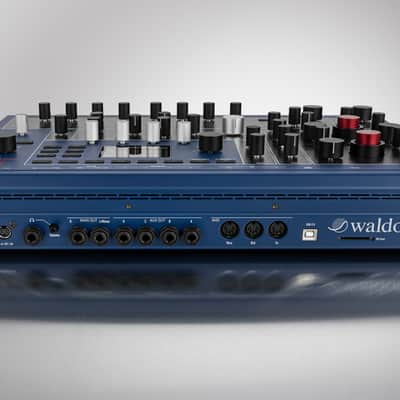
Musically making a connection to the outside world is important to any synthesizer, so M offers five (rear panel-positioned) stereo analogue outputs — arranged as MAIN OUT (L/Mono and R) and AUX OUT (A, B, C, and D), the latter of which can be used to route each of the four Multi (multitimbral) parts to different outputs, if desired; a stereo headphone output (with an associated Volume knob in addition to the topside Master Volume knob); 5-pin MIDI IN, OUT, and THRU DIN connectors, complimented by a USB 2.0 MIDI port (for computer connection to transmit and receive MIDI data); an SD Card slot (for updating M’s firmware, importing/saving sound patches, and importing/saving M-specific data, such as user wavetables); and — last but not least — a Kensington® compatible security lock slot.
Specifications:
- Oscillators: 2 Wavetable oscillators with independent wavetables and two different tone generation models – Waldorf Microwave I model and Waldorf Microwave II model. 96 Factory Wavetables + 32 slots for User Wavetables
- Filter: Analog low-pass 24 dB/Oct VCF (SSI 2144 Improved Ladder Type) with saturation and resonance
- Amplifier: Analog true stereo VCA for each voice with panning option
- Envelopes: 4 Envelope Generators; 8 point loopable time/level Wave envelope generator, VCF and VCA ADSR envelopes and a free assignable loopable 4 points time/level envelope
- LFOs: 2 LFOs with different waveforms
- Arpeggiator with 16 preset patterns, chord mode and the ability to synchronise to MIDI clock
- Sound storage: 2048 Sound programs + 128 Multi programs
- Polyphony: 8/16 voices polyphony (16 voices available with the expansion board installed)
- Multitimbrality: 4 Parts (4 parts can be assigned to 4 individual stereo outputs)
- Outputs: Stereo Main Out, 4 stereo AUX Out, Headphone out with an associated Volume knob
- MIDI: USB 2.0 and DIN (5-pin DIN connector with In/Out/Thru)
- Compatible with classic Waldorf Microwave I sysex messages (sound bank transfer/sound transfer)
- SD Card for loading / storing user content as sound banks and wavetables
- VESA 75 recepticle on the bottom (mountable on monitor stand using the VESA standard)
| Condition | Brand New (New) Brand New items are sold by an authorized dealer or original builder and include all original packaging.Learn more |
|---|---|
| Brand | |
| Model |
|
| Categories | |
| Year |
|
| Made In |
|
| MIDI I/O |
|
| Polyphony |
|
| Analog / Digital |
|
Product safety information may be available here.

