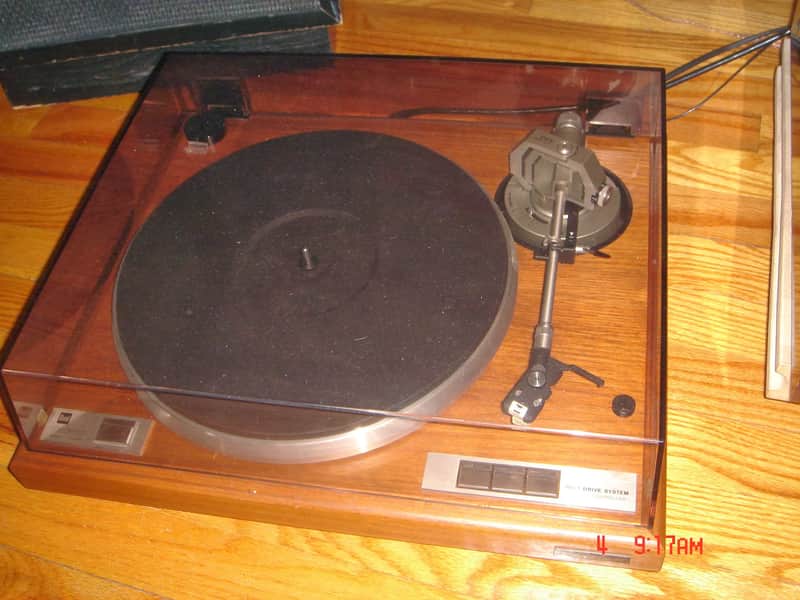
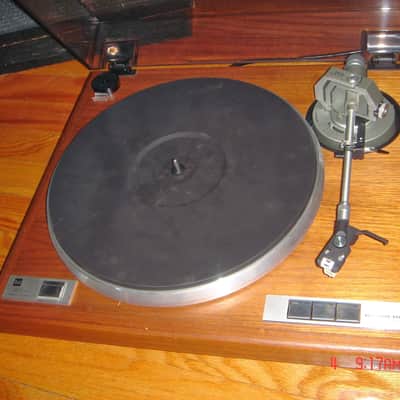
Dual turntable quartz belt drive, 1 extra head shell no cartridge is included CS-5000
This seller has not set a shipping cost for Ireland. Please contact them to ask about shipping.

Our users rate Reverb
Excellent condition. I must ship it partially disassembled. Some assembly required. Will demonstrate operation on pick up. No cartridges included. 1 additional original head shell with no cartridge is included.
Here is the review from magazine
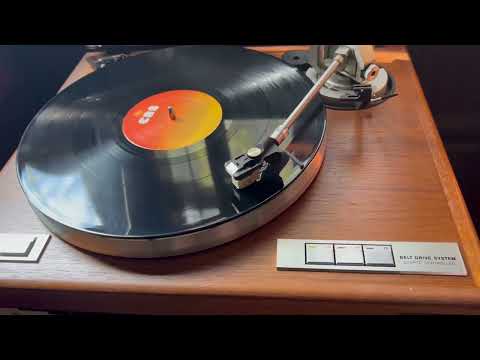
The three-speed Dual CS 5000 is a semi-automatic turntable that starts rotating when the arm is moved from its rest and stops when the arm is returned. At the end of a record’s side (which is sensed optically), the arm lifts and returns to its rest and the motor shuts off. The platter, which weighs 3-3/4 pounds including its thick rubber mat, is belt-driven from a tiny, flat, disc-shaped motor. The motor’s speed is electronically controlled by a quartz-crystal reference oscillator and a microprocessor. In addition, a second control loop measures the platter’s speed with an optical sensor and corrects the motor speed as required to maintain the correct playing speed. Unlike almost all other currently available record players, the Dual CS 5000 operates at 78 rpm as well as 33% and 45 rpm.
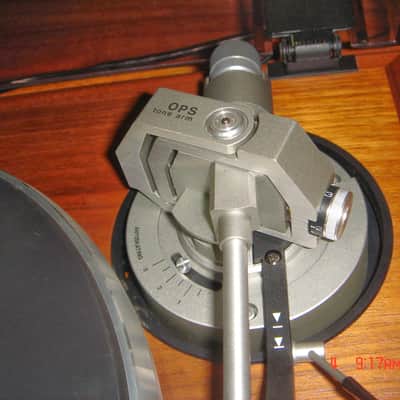
The tonearm of the CS 5000 is designed to minimize many of the recognized weaknesses of typical pivoted tonearms. It is supported by gimbal pivots for both axes of motion and operates at all times in a fully balanced state (the downward tracking force is supplied by a coiled spring). Dual points out that the arm-support system eliminates any need for critical leveling of the turntable, which can in theory be operated at almost any angle to the horizontal.
Another potential problem, warp wow, is a common result of playing a warped record with a tonearm whose vertical pivot is located above the record’s plane. The combination causes a periodic fore-to-aft shift of the stylus as the arm travels over the warp and superimposes a frequency modulation (wow) on the program. The Dual CS 5000’s tonearm has its vertical pivot in the plane of the record, which reduces warp wow to its lowest possible level.
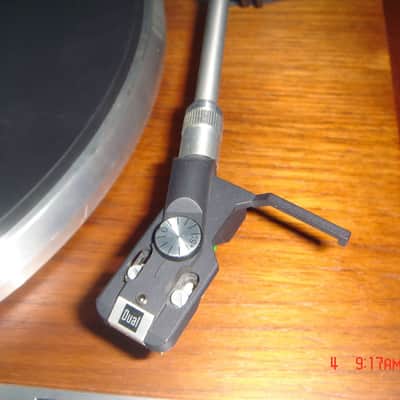
The slim, tubular-aluminum tonearm has a removeable head-shell featuring Dual’s adjustable vertical tracking angle (VTA). The cartridge can be tilted by a knob on top of the shell, varying the VTA over a ± 5-degree range. A critical listener can do this by ear, and Dual also recommends VTA settings for a number of popular cartridges. The tracking-force and antiskating controls are on the tonearm’s pivot structure, near the arm rest and cueing-lift lever.
Most turntables, including the CS 5000, have platters that are designed to concentrate their mass around the outer edge, where it contributes the most to the inertia of the system. These platters resemble a shallow bell, and they usually ring like one when struck or otherwise excited mechanically, a characteristic that can color or muddy the reproduced sound. The platter of the CS 5000 features a unique damping system to eliminate such resonance. Inside the outer rim of the cast aluminum-alloy platter is a heavy metal ring covered by a plastic hose that acoustically couples it to the platter and damps the bell resonances.
The turntable system of the CS 5000, consisting of the platter, the tonearm, and their common supporting structure, is suspended from the wood base on four adjustable, shock-absorbing feet. The spring in each shock absorber can be compressed by turning a knurled ring to vary the degree of damping and the softness (or stiffness) of the suspension. The manual gives instructions for adjusting the shock absorbers to meet specific operating conditions.
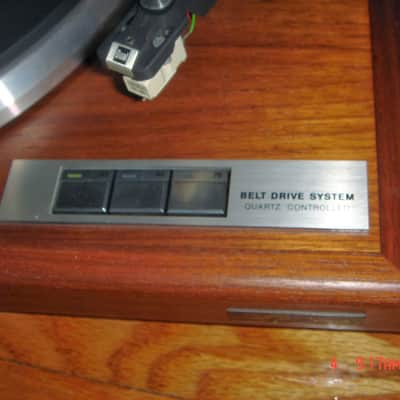
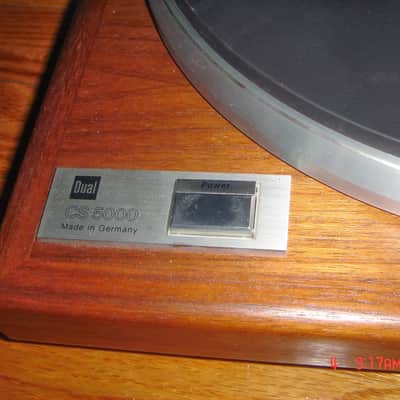
The CS 5000 has a walnut-veneer base and a hinged, clear-plastic dust cover. The power switch, a flat button, is at the left front of the motor-board. On the right side are the three speed-selector buttons, with lights that indicate the operating speed. The Dual CS 5000 measures 17-3/8 inches wide, 15 inches deep, and 5-1/8 inches high. It weighs 16-3/4 pounds. Price: $400.
Lab Tests
We installed a high-quality magnetic cartridge, designed to track at 1 gram, in the head shell of the CS 5000. With the aid of an overhang gauge that Dual supplies (it must be cut out of the last page of the turntable’s instruction manual), the process was no more difficult than usual. Initial balancing was very easy because of the threaded adjustment knob on the counterweight and the obviously very low friction of the arm bearings.
The tracking-force calibrations were extremely accurate, coinciding exactly with the readings of a good separate tracking-force gauge over the range of 1 to 3 grams. The arm’s tracking error was less than 0.4 degree per inch over almost the entire record surface. A computer analysis of the arm’s geometry, based on Dual’s specifications and some of our own measurements, showed that zero tracking error occurred at radii of 2.71 and 4.37 inches. The CS 5000’s tonearm, therefore, has the essential properties of an ideal pivoted arm of its dimensions.
The arm and the rather compliant cartridge resonated at 7 to 8 Hz, a somewhat low frequency. The 13.5-gram effective mass of the tonearm, however, places it in the medium-mass category, and it should be compatible with most cartridges. The signal cable’s capacitance to ground in each channel was 150 picofarads, suitable for most moving-magnet cartridges as well as all moving-coil cartridges. The antiskating compensation was approximately correct at the 1 -gram setting, although there was some improvement in tracking when it was set at 1.5 grams.
The Dual CS 5000’s tonearm has its vertical pivot in the plane of the record, reducing warp wow, a common problem with warped records, to its lowest possible level.
The turntable’s flutter measured ±0.1 percent CCIR-weighted peak and 0.06 percent CCIR-weighted rms. The ARLL-weighted rumble was — 59 dB, and with DIN-B weighting it was — 68 dB. The three operating speeds (which are not user-adjustable, by the way) were very close to their nominal values, with errors of — 0.07 percent at 33-1/3 rpm, —0.27 percent at 45 rpm, and +0.28 percent at 78 rpm.
We were unable to measure the isolation effectiveness of the turntable’s mounting feet because of the unusual control operation of the CS 5000. The stylus cannot be lowered onto a record until the turntable has reached its correct speed. Since we normally place the stylus into the groove of a stationary record when measuring isolation, we looked for ways to defeat this feature. Removing the belt from the motor pulley gave us a stationary platter, and (surprisingly) the pickup descended to the disc as though it were turning at 33 V3 rpm. After a few seconds, however, the pickup lifted and our measurements were interrupted. To complicate matters further, the pickup continued to descend and rise alternately at intervals of several seconds! Possibly the platter-speed sensor was sending confusing messages to the motor servo. Whatever the reason, we could not make the measurement.
Comments
Although announcements of new turntables are becoming infrequent, Dual presents a convincing rationale for the development of the new CS 5000. While acknowledging the impressive growth of the compact disc medium in recent years, Dual points out that the many millions of existing analog records, along with the many LP’s and 45’s that are sure to be issued in the years to come, will require playback support for the foreseeable future. With that in mind, the company’s engineers have produced what is almost certainly the finest record player to bear the Dual name—and quite possibly one of the most advanced turntables ever made to sell at its price level.
Except for the sometimes frustrating enforced wait for the platter speed to stabilize before we could play a record, the operation of the Dual CS 5000 was totally straightforward. We tested the spring-damping adjustment range of the mounting feet subjectively by jarring the turntable and observing the rate and duration of the platter’s oscillation. At one extreme setting, the system had a highly “bouncy” action that would be ideal with an installation on rigid, stable supports, isolating it from any vibration conducted through its feet. At the other limit, it had a stiff, “locked-up” response that would be much more suitable for operation on a table or shelf that’s subject to jarring, though it would probably be more sensitive to conducted vibration. Overall, the adjustable damping system seemed to work just as Dual’s literature indicated it would.
On the other hand, while the manual refers to levers on each of the mounting feet that could adjust the damping over its full range with a limited rotation, there was no sign of these levers on our test sample. The adjustment required many turns of the knurled knobs, and there were no reference calibration points to use as a guide for matching the settings of the four feet. We estimate that a full setup adjustment of the damping system would be at least as laborious as mounting a phono cartridge or setting its vertical tracking angle by listening to the playback of a record. In other words, it is not a task to be undertaken lightly.
The CS 5000 did a very good job of playing warped records, and its tonearm design appeared to reduce warp wow to negligible (or at least acceptable) levels. Incidentally, while it would not play at extreme angles, such as resting on one edge, it was not bothered by tilts of at least 30 or 40 degrees.
The CS 5000 is a handsomely styled, innovative, and reasonably priced record player that represents a distinct departure from previous Dual turntables in both its design and its apparent intended market. Phonophiles, especially those with large collections of 78-rpm discs, should find it an answer to their prayers.
This item is sold As-Described
This item is sold As-Described and cannot be returned unless it arrives in a condition different from how it was described or photographed. Items must be returned in original, as-shipped condition with all original packaging.Learn More.
| Listed | 2 years ago |
|---|---|
| Condition | Excellent (Used) Excellent items are almost entirely free from blemishes and other visual defects and have been played or used with the utmost care.Learn more |
| Brand | |
| Model |
|
| Finish |
|
| Categories | |
| Year |
|
| Made In |
|
Product safety information may be available here.