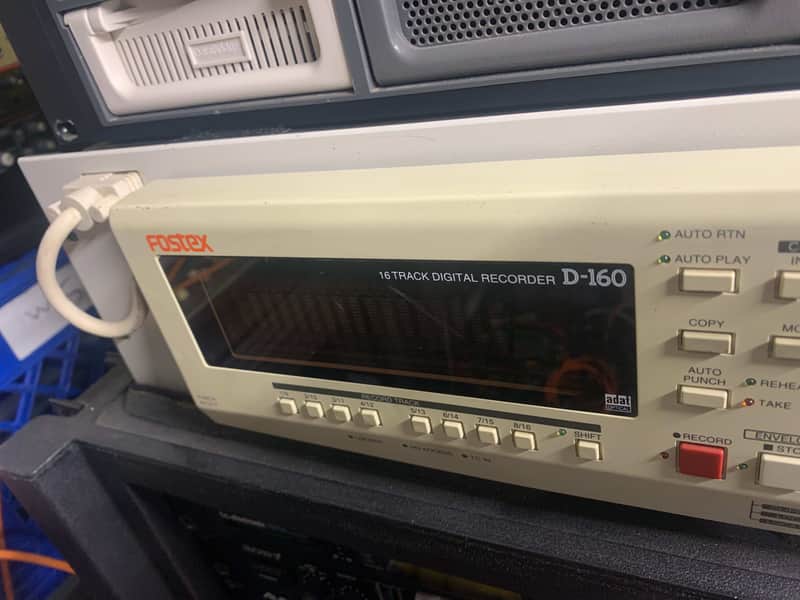
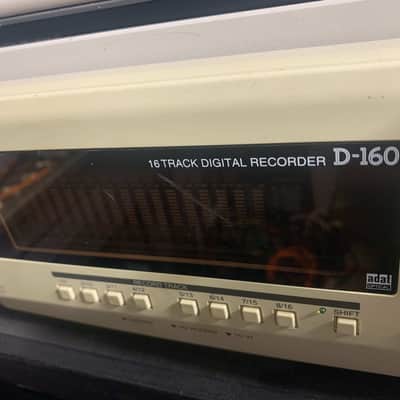
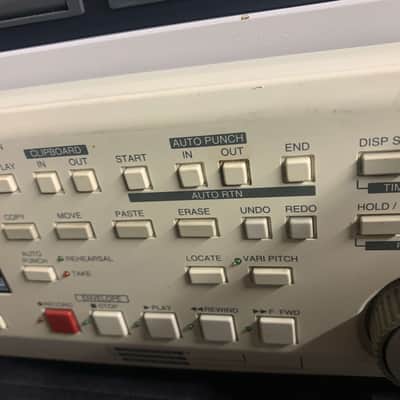
Fostex D-160 1995 - White
This seller has not set a shipping cost for Slovakia. Please contact them to ask about shipping.

Our users rate Reverb
If I had to describe the D160 in just one sentence, I'd say it's about as close as you can get to a tapeless 16‑track tape recorder. It doesn't process sounds, it doesn't mix sounds and it doesn't double as a MIDI sequencer or cappuccino maker — it simply provides 16 tracks of audio recording with some basic cut, copy and paste editing facilities thrown in. It comes well equipped with sync functions for use with a MIDI sequencer or to run alongside a digital multitrack equipped with an MTC output, but further sync options are available for those who need to integrate the machine into a professional video environment.
The D160 is in many ways similar to the 8‑track D90 reviewed back in August 1997, and if you compare front panels you'll notice that, apart from a few differences in the display, the layout is identical. Even so, the D160 is a little more than just a 16‑track version of the D90, as it incorporates a number of new features, both in its standard form and as options, including the provision of a SCSI2 interface in the basic model. Hard drives of up to 3.2Gb can be housed in a removable disk caddy, and up to 38 minutes of 16‑track recording (all tracks recorded), is possible from a single 3.2Gb drive using the latest Fostex FDMS3 disk management system. FDMS3 is a great improvement over the systems used in earlier machines that gave the same maximum recording time, regardless of how many tracks were used. Now the disk space is managed in an intelligent fashion, which means that if you only use half the tracks, the unused disk space is available for use in other songs.
In addition to the basic 16 tracks, a further eight 'ghost' tracks may be recorded to store alternative versions of takes (some people call these virtual tracks — see the separate box for more on these). For AV users, the optional 8345 module enables the D160 to generate, or chase and lock to LTC (Linear SMPTE Time Code), with provision for video or wordclock sync. A further expansion option (5041) is available to provide fully balanced inputs and outputs at +4dBu on standard 'D' connectors; as supplied, the D160's ins and outs are on unbalanced, ‑10dBV phonos. A similar balancing option is now available for the D90.
Though this is a 16‑track recorder, users who don't have access to equipment with the ADAT optical digital interface will only be able to record a maximum of eight tracks at any one time. To save on cost, there are only eight sets of input converters, but by using an ADAT interface, eight digital inputs plus the eight analogue inputs can be recorded together, or alternatively, 16 channels of digital inputs can be recorded in one shot, providing the two digital sources are sync'ed together. Multiple D160s, or combinations of D160s, D90s, D80s and DMT8s, may also be locked together when more tracks are needed.
Like its 8‑track counterpart, the D160 has comprehensive MIDI options, including integral MTC generation for sync'ing MIDI sequencers. The input converters are 18‑bit, 64x oversampling delta‑sigma types with 20‑bit, 128x oversampling converters on the output, and the data recorded to disk is 16‑bit at either 44.1kHz or 48kHz (ADATs are usually run at 48kHz), with no data compression. Varispeed of up to plus or minus 6% is available.
Though this is a 16‑track recorder, users who don't have access to equipment with the ADAT optical digital interface will only be able to record a maximum of eight tracks at any one time.
The D160 Package
The D160 uses the same basic 3U packaging as the D90 and only weighs half a kilogram more. The storage medium is an EIDE hard drive fitted into a removable caddy, and further caddies are available, allowing drives to be swapped when there's a need to switch projects. The caddy bay is located on the front panel of the main unit, but under normal operating conditions it's hidden by the control panel. However, because hard drives are not entirely silent, Fostex have included the provision to remotely mount the front panel using either one or two 5‑metre extension cables, and as the front panel also contains the metering, the bulk of the hardware can be mounted well out of the way.
Unbalanced phono inputs (8) and outputs (16) are fitted as standard, along with two sets of ADAT optical ins and outs. MIDI In, Out and Thru sockets are located to the right of the 25‑way SCSI2 'D' connector. On the review model, there were three balanced 25‑way 'D' connectors providing access to the 5041 balancing option. Also pre‑fitted to the review model was the 8345 timecode board, which has XLRs for timecode in and out, as well as BNC connectors for wordclock in and out and video input and thru. Both the wordclock and video inputs have switchable 75Ω termination.
| Listed | 3 years ago |
|---|---|
| Condition | Very Good (Used) Very Good items may show a few slight marks or scratches but are fully functional and in overall great shape.Learn more |
| Brand | |
| Model |
|
| Finish |
|
| Year |
|
| Made In |
|
Product safety information may be available here.

