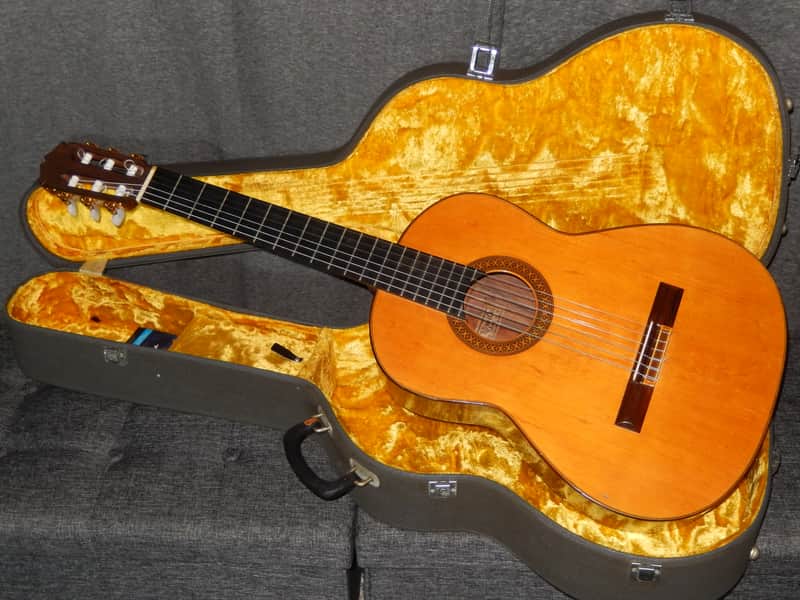
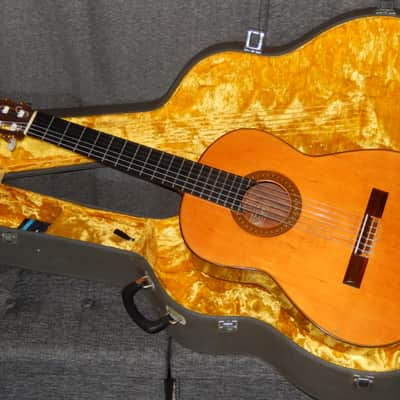
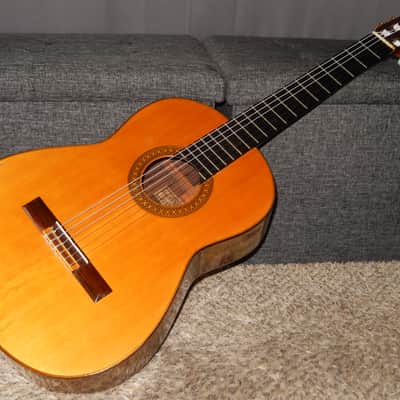
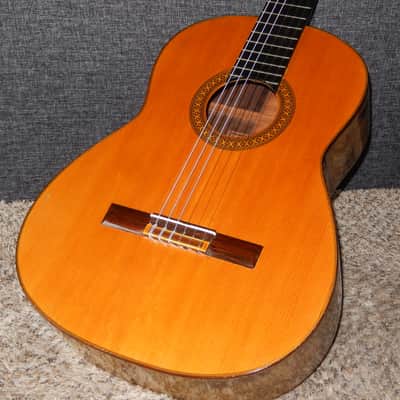
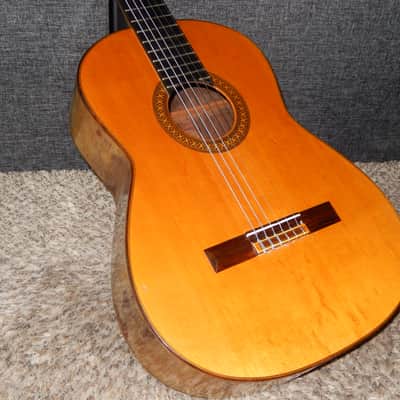
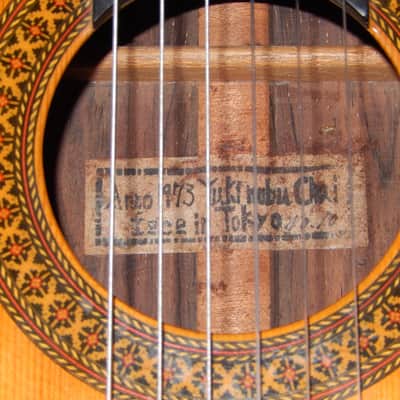
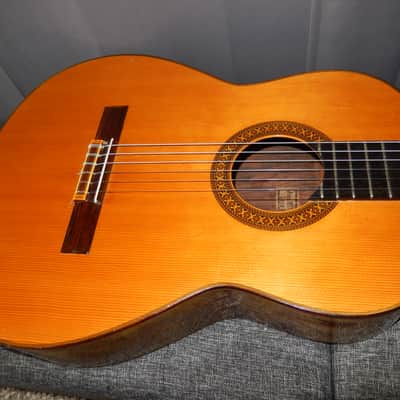
BARGAIN - YUKINOBU CHAI 10 1973 - SANTOS HERNANDEZ CLASS - CLASSICAL CONCERT GUITAR - SPRUCE/BRAZILIAN ROSEWOOD
This seller has not set a shipping cost for Brazil. Please contact them to ask about shipping.


YOU ARE LOOKING AT A WORLD CLASS INSTRUMENT PRICED AT THE BARGAIN LEVEL. CURRENTLY BRAND NEW GUITARS OF VERY SIMILAR CLASS MADE BY JAPANESE LUTHIERS USING OLD GROWTH BRAZILIAN ROSEWOOD ARE PRICED MINIMUM $15000USD. DISCONTINUED IN 2025 YAMAHA GC70 WAS PRICED $18000.
Yukinobu Chai No10 1973
This guitar was made in 1973 by Master Luthier Yukinobu Chai. It was his high end model of that era. It represents the highest level among Japanese made classical guitars of any era.
Although he was originally a violin maker, Yukinobu Chai started making guitars in late 1960s and over the years he became one of the highest respected luthiers in Japan. Most likely the major reason for that were very moderate prices for his truly wonderful instruments.
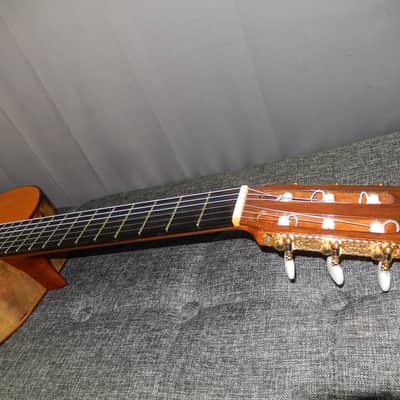
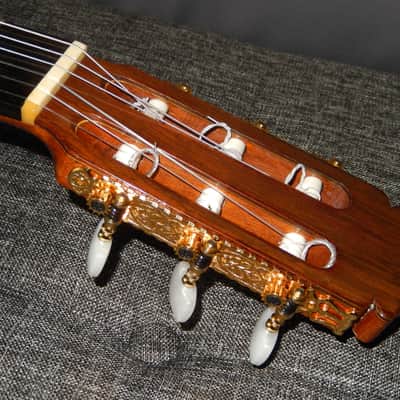
Yukinobu never apprenticed at any other workshop. In the 1950s he learned violin making based on books and the real violins. He was also making other string instruments, before in the early 1960s he became seriously interested in making guitars. He naturally was looking at guitars made by many famous European luthiers, but was especially inspired by Antonio de Torres, Herman Hauser and Santos Hernandez. While he was constantly adding his own innovations, his guitars made from the late 1960s through early 1980s were mostly inspired by Santos Hernadez’s blueprints, which (on the outside) was manifested by Santos’s headstock design. After selling several Yukinobu’s guitars from that era, I dare to say that they are of equal class with those made Santos Hernandez.
****************************************************
Santos Hernadez (1874-1943) was the actual maker of a famous guitar given by Manuel Ramírez (1864-1916) to Andrés Segovia in 1912.
Segovia visited Ramírez’s Madrid workshop to rent a guitar for a concert, but Ramírez was so impressed by the young musician's playing that he gifted him the instrument, which Segovia used for 25 years and referred to as La Inédita. This instrument is considered a pivotal tool in Segovia's early career and the establishment of the modern classical guitar.
Hernández’s guitars were also played by other well-known guitarists, including Regino Sainz de la Maza (for whom Concierto de Aranjuez was written), Eduardo Abreu, and the Romero family.
Santos Hernández left the Manuel Ramírez workshop in 1921 and he opened his own store on street “Calle de la Aduana, 27” in Madrid. This new workshop became a place for social gatherings attended by the most established classical guitarists, including Andres Segovia, Daniel Fortea and Miguel Llobet, as well as flamenco players – Ramón Montoya, Sabicas, and Luis Molina.
Santos Hernadez together with Antonio Torres and Herman Hauser, is one of the most important guitar luthiers in History. For the past 100 years guitarists have valued Santos Hernández’s guitars for their charming, introverted quality of tone and the traditional sound.
********************************************************
In the early 1980s Yukinobu Chai became the major supplier for Niibori School of Guitar Ensemble, making not only whole range of prime (regular size and scale) models but also many alto, soprano, bass, and contrabass guitars. Since Yukinobu's passing in 2011, his workshop is managed by his son Yukihiro, who is a great luthier on his own. Yukinobu's most famous pupils are Ichizo Kobayashi, Tatsuro Kobayashi, Sakae Ishi and Kuniyoshi Matsui.
In 1973 top of the line Masaru Kohno’s model 30 and Sakazo Nakade’s Master 30 were priced 300 000 yen. Few other well established Japanese makers had 200 000 yen models (Yamaha GC20D, Mitsuru Tamura 2000, Masaji Nobe 20 or Teruaki Nakade C20). For several other makers 150 000 yen was the maximum they could charge for their top models (Toshihiko Nakade 1500, Hiroshi Tamura P150, Ryoji Matsuoka 150 or Kazuo Yairi Y150). For many other (less prominent) makers 100 000 yen was that maximum price.
Made with figured Brazilian Rosewood b/s model 30 was Yukinobu’s top of the line until 1981 and only his custom-made guitars were priced higher. Since 1982 the same class guitar was sold as No 50, being the only model made with figured Brazilian Rosewood b/s until 1995.
Because in early 1970s Japan experienced a quite rapid inflation (it reached 25% in 1974), all guitar makers were frequently raising prices for their top models. In 1977 Masaru Kohno introduced his priced 500 000 yen model 50, that was no different from his model 30 made in 1976.
As of today, top of the line models made by Japanese elite makers are priced at $15000USD level. However, custom made models with old Brazilian Rio Rosewood b/s are being priced $18000USD (like Yamaha GC70).
I hope that all this information will help you recognize the true value of the instrument you are looking at.
In early 1980s Yukinobu became the major supplier for Niibori School of Guitar Ensemble, making not only whole range of prime (regular) models but also many alto, soprano, bass and contrabass guitars. Since Yukinobu's passing in 2011, his workshop has been managed by his son Yukihiro, a great luthier on his own. Yukinobu's most famous pupils are Ichizo Kobayashi, Tatsuro Kobayashi, Sakae Ishi and Kuniyoshi Matsui.
To my ears, Yukinobu Chai was one of the best Japanese luthiers ever and remains my favorite Japanese luthier since I encountered his guitars made in 1970s. I am totally not bothered by discolorations of finishes on his guitars from that era. After selling several of his guitars I know that truly experienced guitarists looking for a “truly special” instrument are not bothered by these cosmetic imperfections either. I deeply understand why Hiroki Niibori has decided to offer Yukinobu such lucrative contract.
This guitar offers very high volume and super response, combined with uniquely magical tonality: relatively deep punchy somewhat metallic (cello like) basses, very strong round but ultra-clear ringing trebles (one could describe as resembling midsize crystal bells), all well balanced, with superb note clarity and separation and very impressive sustain.
The overall condition of this guitar can be described as "very good for its age". While it is structurally sound and is very playable, it comes with several imperfections.
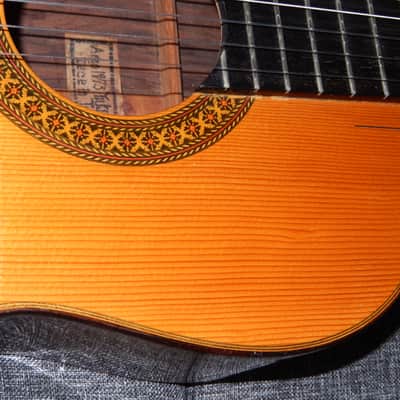
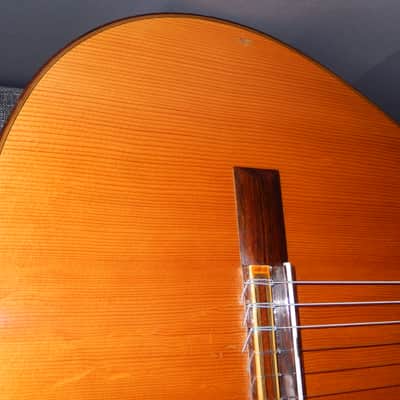
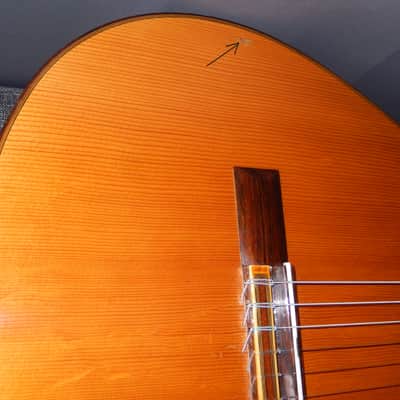
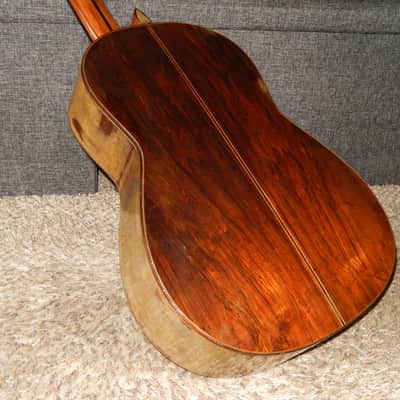
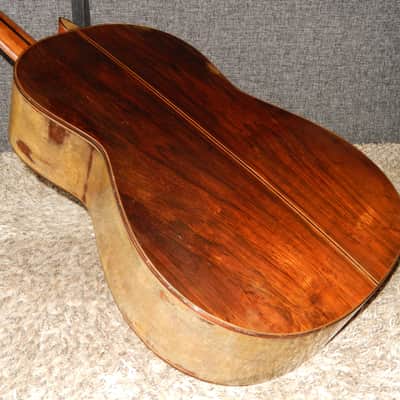
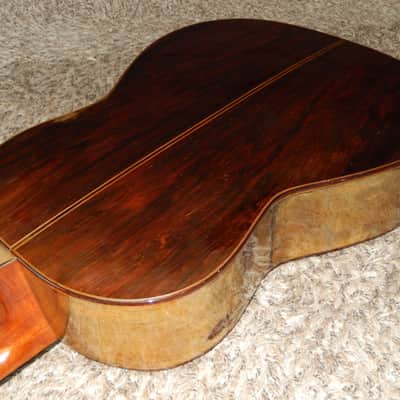
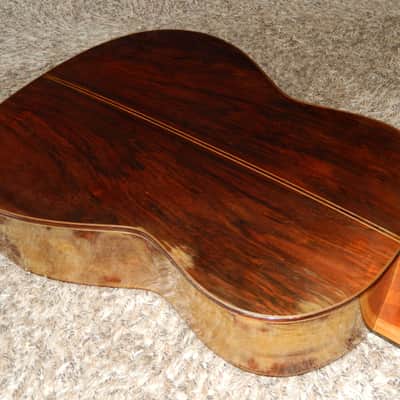
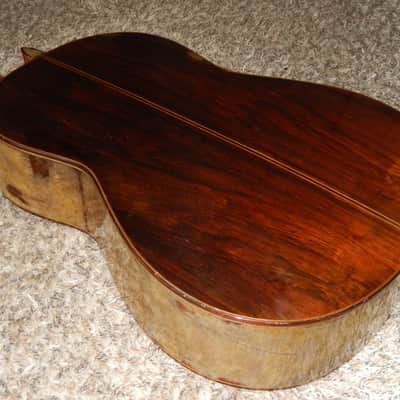
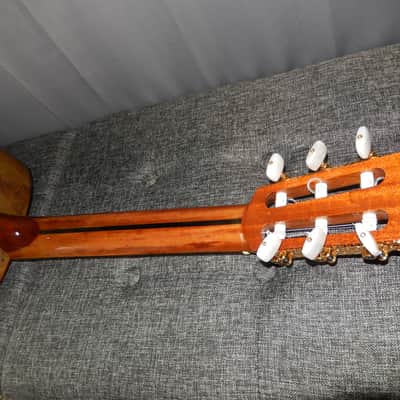
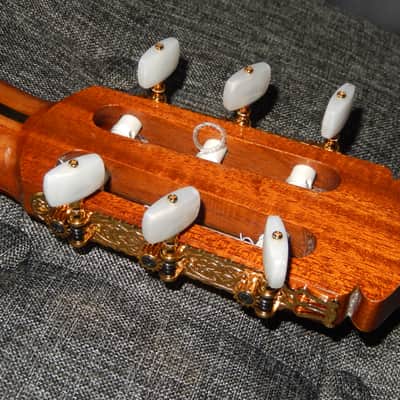
Its top bears several small scratches, one small but deep dent and about 2 inch long (repaired) crack. Its back and sides bear several light scratches and rubbing marks. Several light dents/attritions are visible along its bindings. There are a few light dents on the tip of the headstock. There are at least a few other minor cosmetic imperfections one can find on the body of this guitar.
Sections of original finish at the seam between E1 side of the fingerboard and the soundboard, have dried and later exfoliated. Yet it is not associated with any crack or gap in that area.
Perhaps the most noticeable “imperfection” is that its sides are “cloudy”. Such cloudiness occurs only within the finish while the wood itself doesn’t lose its natural color. It is often a result of mixing finishes, like covering shellac with cashew lacquer. After cashew lacquer dries it is harder, more durable and scratch resistant than shellac. Later as the shellac ages it becomes “cloudy”. Intensity of this cloudiness also depends on what shellac formula was used. Sometimes instead of uniform cloudiness, there are only a few “fingerprints” visible. These “fingerprints” are traces of shellac pads. Such finish cloudiness is most pronounced on Brazilian Rosewood.
The fingerboard shows some wear, especially on the treble side with deepest grooves located between 2nd and 3rd fret. The frets however are not visibly worn. Quite likely, this guitar has been re-fretted sometime in the past yet without sanding the surface of the ebony fingerboard. Only another re-fret would allow the repair technician to re-level (smooth out) the surface of the fingerboard. Yet this is not necessary to be done any time soon. Guitar can be played “as it is” for several more years.
Very likely, soon after you start enjoying the gorgeous sound of this guitar, you will understand why someone else played it so intensively. You will also realize that this guitar is worth any kind of repair. You will not be bothered by the cloudiness of it finishes either.
Defective original tuners were replaced with brand-new high-grade Gotoh set.
Should any of described above imperfections bother you, you can simply turn to American luthiers and with some luck you may get similar class instrument for below $25000.
The great majority of Japanese luthiers while finishing their high-end models, were using very thin coat of cashew lacquer as the last layer over the shellac usually only on the back and sides. Some luthiers (like Masaru Kohno, Ryoji Matsuoka, Hiroshi Tamura) were using this approach also on the soundboards. Cashew lacquer is more durable and resistant to wear and scratches etc. and that is why Japanese were using this method. Therefore, when there is Cashew lacquer on the surface, it is very likely there is a shellac underneath.
ALL YUKINOBU CHAI GUITARS MADE IN 1970s OFFER FEW HUGE ADVATAGES OVER GREAT MAJORITY OF VINTAGE CLASSICAL GUITARS: THEIR NECKS ARE SLIMMER THAN NECKS OF MOST VINTAGE GUITARS, THEIR ACTION CAN BE SET VERY LOW (IF DESIRED), THEIR GREAT RASPY RESPONSE TO RASQUEADOS AND BRILIANTLY CRISPY RESPONSE TO PICADOS MAKES THEM EXCEPTIONALY GREAT CHOICE FOR FLAMENCO PLAYERS.
Specifications:
Top: High Grade Solid (Bear Claw) Yezo Spruce/Shellac
Back & Sides: Highest Grade Solid Figured Brazilian Rosewood/Cashew lacquer
Neck: Mahogany with Ebony insert
Fingerboard: Ebony
Scale: 650 mm
Nut width: 51 mm
Its current action is set to 4.00 mm under E6 and 3.50 mm under E1, with extra room on the saddle allowing to lower this action to 3.00mm E6 and 2.50mm E1.
This guitar will be shipped in a brand new hard shell case.
WHEN YOU BUY ANY GUITAR, YOU MUST ANTICIPATE TAKING IT TO YOUR LOCAL GUITAR SHOP FOR FINAL ADJUSTMENTS CALLED “SETUP”. DEPENIDNG ON YOUR PLAYING TECHNIQUE, THIS SETUP ON USED GUITARS MAY INCLUDE NEW CUSTOM-MADE NUT AND SADDLE. IF YOU HEAR STRING BUZZ IT DOESN’T MEAN THAT GUITAR IS DEFECTIVE. IF YOU PLAY HARD ENOUGH ALL BASS STRINGS WILL BUZZ OVER THE FRETS, UNLESS THEY ARE SUSPENDED VERY FAR FROM THE FINGERBOARD. UNLESS YOU PLAY QUITE GENTLY, YOU CAN’T HAVE LOW ACTION AND NO BUZZES. KEEP IN MIND THAT CELLO-LIKE BASSES ON HIGH GRADE CLASSICAL GUITARS HAVE THEIR NATURAL “BUZZ”.
Real Value of Japanese Vintage Guitars
The key to understand value of vintage Japanese guitars is to acknowledge galloping price inflation throughout the late 1960s and 1970s with its peak of 25% in 1974.
During 1960s and most of 1970s model numbers of Japanese guitars were strictly connected with their prices in Japanese yen.
The same class guitar sold in 1970 for 100 000 yen (labelled as model 10), would be sold for 150 000 yen in 1972 (labelled as model 15), 200 000 yen in 1974 (labelled as model 20) and 300 000 yen in 1978 (labelled as model 30). Therefore, you shouldn’t be surprised that two Yamaha GC10 guitars made 10 years apart are two instruments of totally different class. The same rule applies to all guitar models made by all other Japanese makers.
Japanese inflation slowed down in the 1980s. By the early 1980s and during following decades model numbers were no longer strictly associated with their prices. Some Japanese guitar makers introduced model names instead of model numbers. For several economic reasons, since 1980s Japanese made guitars were becoming more and more expensive, while their exports slowing down. Today (2025) Japanese high end classical guitar models are priced at $20000USD level.
This item is sold As-Described
This item is sold As-Described and cannot be returned unless it arrives in a condition different from how it was described or photographed. Items must be returned in original, as-shipped condition with all original packaging.Learn More.
| Listed | 3 years ago |
|---|---|
| Condition | Very Good (Used) Very Good items may show a few slight marks or scratches but are fully functional and in overall great shape.Learn more |
| Brand | |
| Model |
|
| Finish |
|
| Categories | |
| Year |
|
| Made In |
|
| Right / Left Handed |
|
| Number of Strings |
|
Product safety information may be available here.

