Buchla 251e Quad Sequential Voltage Source

Only 1 left
Grab it before it's gone
Our users rate Reverb
The 251e is an extremely powerful four-way sequencer. Sequences can consist of up to 50 steps and include both loops and nested loops. Parameters such as step or pulse length can be edited per step and are not global values. The sequencers can start each other, re-synchronize, run at the same pace with each other or act completely independently. Various sync modes change the behavior of the individual sequencers on start and stop pulses or activate the internal or MIDI clock. A voltage controllable master clock parameter changes the tempos of all sequencers by a factor of 0.5 to 1.5.
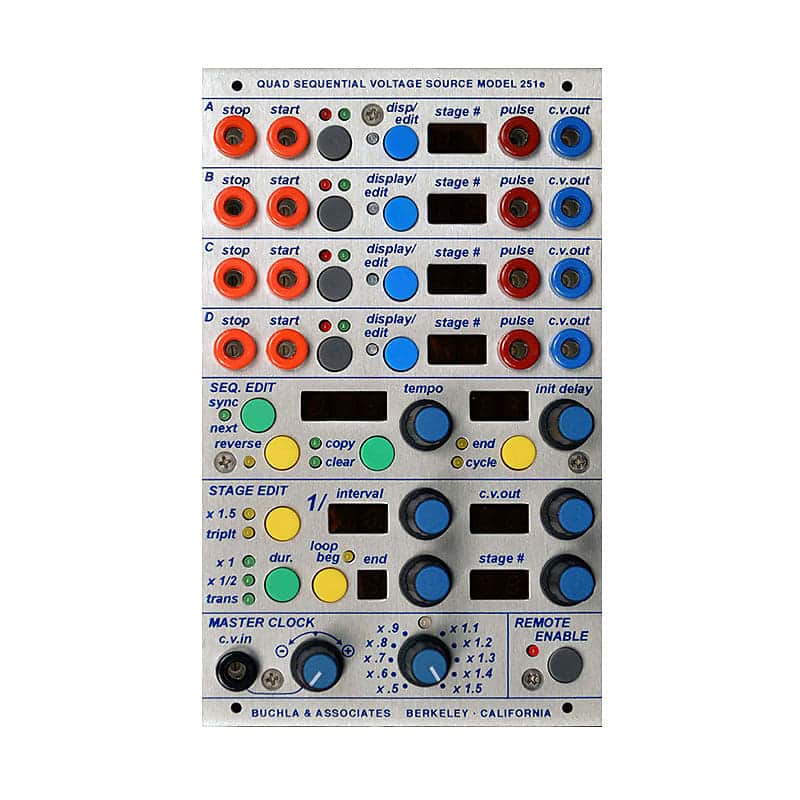
The 251e consists of four identical sequencers called A, B, C and D. Each sequencer has its own start and stop pulse input as well as a pulse and CV output. The edit / display switch of the respective sequencer activates or deactivates the edit mode for this sequencer. If the edit mode is activated for a sequencer, the settings of the SEQ take effect. EDIT and STAGE EDIT sections only on this sequencer.
In the SEQ.EDIT section, global settings such as tempo and playback direction are edited, which affect all steps. Here it is also determined whether the sequence starts immediately or only after an adjustable delay. The next adjacent sequencer can be started or reset using the "sync next" switch. If this parameter is used in sequencer D, it also affects sequencer A. In the SEQ.EDIT section it is also determined which step of the sequence is the last and whether the sequence automatically stops at this point or starts again.
The parameters of the individual steps are then set in the STAGE EDIT sections. The length of the step and the length of a possibly programmed pulse can be set for each step. Note values can be normal, dotted, or triplet. The parameter "cvout" regulates which voltage the step outputs at the CV output of the sequencer. It is set in steps of 0.1 V, which corresponds to a semitone step at 1.2 V / octave, or in millivolts, which leads to a change in pitch of 1/100 semitone = 1 cent. Loops are also programmed in this section. A loop not only consists of information for the first and last step of the loop, but also a loop counter that defines how often the loop is played before it jumps to the next step after the loop ends.
Regardless of the set tempos of the sequencer, all sequencers can be manipulated at the same time using the global parameter "Masterclock". The parameter is also CV-controllable and the scaling factor ranges from 0.5 to 1.5. The sequencers can generate their own clock, which is regulated in BPM. However, they can also be synchronized using analog pulse signals or the MIDI clock. If the synchronization takes place via pulse signals, there are various modes such as pulses in the start or stop input that influence the sequence.
For example, while in a mode a trigger at the start input jumps to the next step and a trigger at the stop input returns to the previous step, there are also modes in which the steps can be addressed directly by CV.
| Condition | Brand New (New) Brand New items are sold by an authorized dealer or original builder and include all original packaging.Learn more |
|---|---|
| Brand | |
| Model |
|
| Categories | |
| Made In |
|
Product safety information may be available here.

