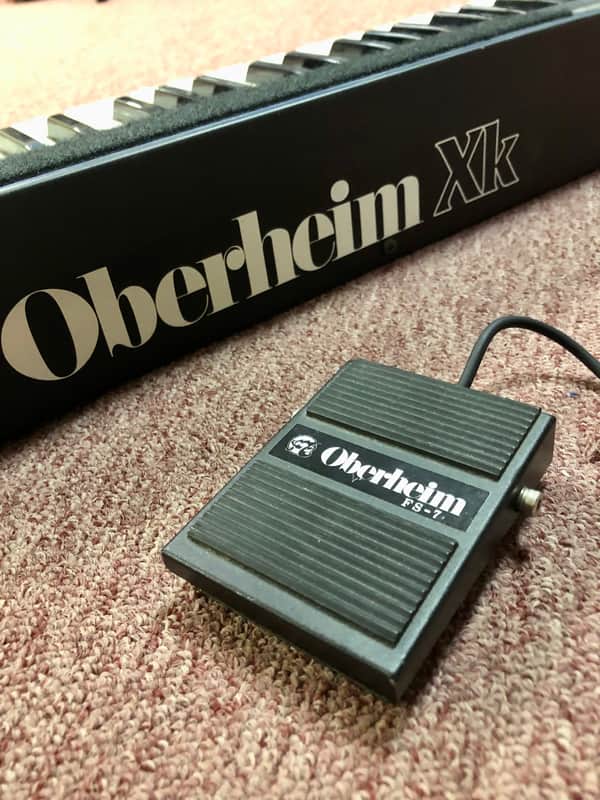
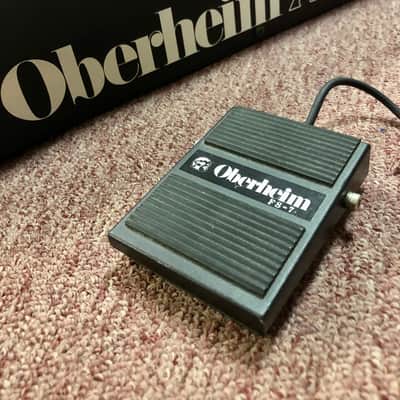
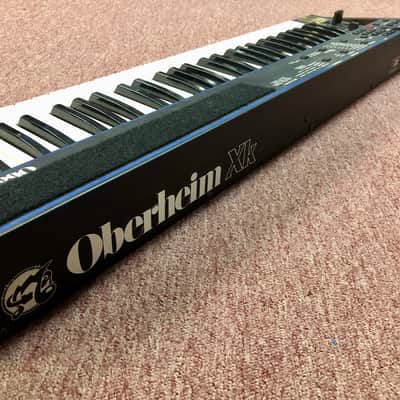
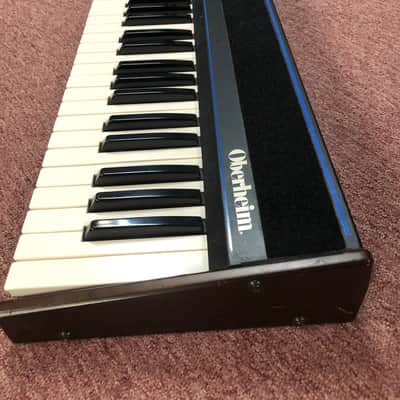
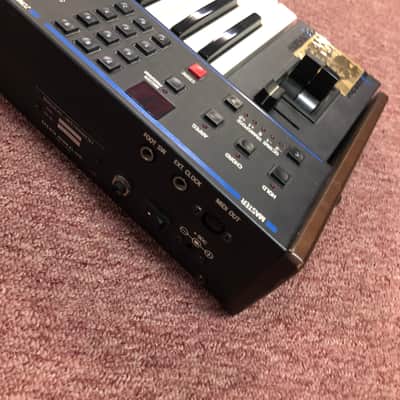
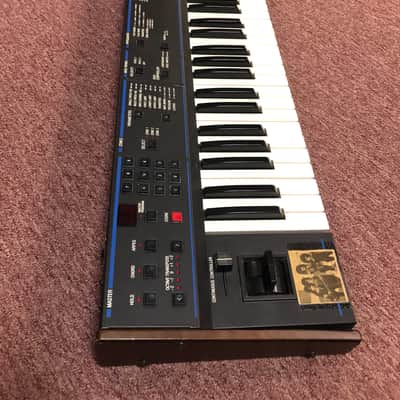
Oberheim OB-Xk MIDI controller with pedal and manual
This seller has not set a shipping cost for Bulgaria. Please contact them to ask about shipping.
Original Price€899.17
21% price drop
New Price€719.16
+ Shipping
Listed:4 years ago
Views:1,297
Saves:42
Offers:6

Cooper City, FL, United States
Our users rate Reverb
Vintage Oberheim OB-Xk 61-key MIDI controller
Well built, sturdy METAL STEEL CASE with genuine solid wood end cheeks.
Keybed feels great and has aftertouch.
Original OB sustain pedal INCLUDED.
All keys ok & parameter functions work as described in the included printed manual. Power supply is included.
Velcro top & “Mini-KISS” photo also included :)
More Details:
The Xk shows its Matrix lineage in its adoption of three keyboard zones, each of which can have its own user-defined range from one note to the entire length of the keyboard - so you can split and overlap zones in any way you want. This wouldn't be of much use unless you had some way of distinguishing zones, though, so you can program a MIDI transmit channel (1-16) for each zone.
Xk also allows you to program a patch number for each zone, which means you can send out up to three different patch numbers on three different MIDI channels - which goes some way towards alleviating the usual problems of aligning patches. Included for Matrix and Xpander owners is a facility for selecting single or multipatches, too.
Further zone-programmable features are the number of notes that the zone can play (up to 16), a transpose value (up an octave in semitone steps), MIDI Mono mode on/off, aftertouch transmit on/off, levers transmit on/off, and values for the continuous controller, footswitch and negative lever.
Setting a note limit under 16 for each zone brings the Xk's 'note spillover' system into action: any notes active in a zone over and above the specified amount are automatically sent on the next higher MIDI channel.
Lots of functions, then, but also lots of buttons to press each time you want to select a few of them. To avoid this, the Xk can store complete settings in any of 100 Master programs - equivalent to the Multipatches found on the Matrix synths and the Xpander. Oberheim haven't included the ability to chain these programs together and step through them with a footswitch, though, so it isn't as useful live as it could be. As it is, tapping in a two-digit number can instantly change your sonic configuration from piano, strings and harmonica to didjeridu, organ and gunshot. Being able to choose which pitch ranges these voices sound over, and which sounds respond to performance controllers (pitchbend and sustain, for instance) is potentially invaluable for both live and studio work. And the ability to multisplit a synth keyboard for MIDI data transmission is still rare, so the Xk really scores here.
You want programmable performance controllers? You got 'em. The Xk has two levers, one dedicated to pitchbend and the other programmable in forward and 'negative' directions, a 'continuous controller' slider, and a single footswitch input. Between them, they can be set to any of the 96 MIDI performance controller numbers, which means you can control any MIDI-introduced effect such as modulation, volume, sustain or portamento. The negative lever, continuous controller slider and footswitch are programmable per zone as well as per Master program, which rather usefully allows you to (say) sustain one of two layered sounds, but not the other.
The Xk also includes arpeggio, Chord and Hold facilities which may be associated with any one of the three zones; you can accompany yourself by playing on the keyboard whilst an arpeggio is playing back. The arpeggio's tempo can be controlled in real time from the front panel, but Oberheim have also included an external clock input designed to interface the arpeggiator with the Click Out (positive-edge trigger) of a pre-MIDI sequencer or drum machine, which might appeal to users of Oberheim's own pre-MIDI gear, for instance.
Hold allows you to sustain up to 15 notes indefinitely (providing you're using sustaining sounds, of course), while the Chord facility allows the notes input using Hold to be one-finger-played as a chord (with suitable transpositions) from any note.
Personally, I'm not sure about this aspect of the Xk's design. While some players will find the arpeggiator useful, I can't help feeling an onboard sequencer (even a fairly straightforward one) would have been a more tempting option.
And it's in the area of sequencing that the Xk poses an interesting problem. Modern sequencers invariably see MIDI recording as being based on a single channel; in other words, any given performance is allocated to one MIDI channel, either at the time of recording or retrospectively. Yet the Xk allows you to play over three MIDI channels simultaneously, with different patch-change and controller information for each channel. So how can you record an integrated multitimbral performance in the way that the Xk allows you to perform it? Tricky one.
Appropriately for a MIDI controller, the Xk allows you to trigger MIDI sequencers and drum machines from its front panel. You can send Start, Stop and Continue codes and MIDI Song Select numbers, but beyond that, you can't control the tempo or the position of a sequence remotely from the Xk, which is a pity.
Also included is the ability to send a MIDI Tune request and an All Notes Off command. The former isn't MIDI's version of Family Favourites, but an instruction for analogue synths to tune their oscillators. The usefulness of the latter (which is intended to offer a quick solution to those potentially embarrassing situations where notes are left hanging for some reason) is limited by the fact that not all synths respond to the command; like several other grey areas of the MIDI spec, its implementation was left optional.
For me, the idea of a separate controller keyboard is beginning to make more sense - though only if you've already got enough instruments to make it worthwhile, and enough money not to wish you'd bought a synth instead.
The Xk has plenty to recommend it, not least in its happy balance between flexibility and accessibility. Its three keyboard zones, together with the parameters that are definable for each zone, make it more flexible as a controller than any synth I can think of other than Oberheim's own Matrix 12. The plastic keyboard has a shallow travel, is pleasing to play, and responds to attack and release velocity and channel aftertouch - though not polyphonic aftertouch. It won't please the piano fans, but it's nicer than most ordinary synth keyboards.
Well built, sturdy METAL STEEL CASE with genuine solid wood end cheeks.
Keybed feels great and has aftertouch.
Original OB sustain pedal INCLUDED.
All keys ok & parameter functions work as described in the included printed manual. Power supply is included.
Velcro top & “Mini-KISS” photo also included :)
More Details:
The Xk shows its Matrix lineage in its adoption of three keyboard zones, each of which can have its own user-defined range from one note to the entire length of the keyboard - so you can split and overlap zones in any way you want. This wouldn't be of much use unless you had some way of distinguishing zones, though, so you can program a MIDI transmit channel (1-16) for each zone.
Xk also allows you to program a patch number for each zone, which means you can send out up to three different patch numbers on three different MIDI channels - which goes some way towards alleviating the usual problems of aligning patches. Included for Matrix and Xpander owners is a facility for selecting single or multipatches, too.
Further zone-programmable features are the number of notes that the zone can play (up to 16), a transpose value (up an octave in semitone steps), MIDI Mono mode on/off, aftertouch transmit on/off, levers transmit on/off, and values for the continuous controller, footswitch and negative lever.
Setting a note limit under 16 for each zone brings the Xk's 'note spillover' system into action: any notes active in a zone over and above the specified amount are automatically sent on the next higher MIDI channel.
Lots of functions, then, but also lots of buttons to press each time you want to select a few of them. To avoid this, the Xk can store complete settings in any of 100 Master programs - equivalent to the Multipatches found on the Matrix synths and the Xpander. Oberheim haven't included the ability to chain these programs together and step through them with a footswitch, though, so it isn't as useful live as it could be. As it is, tapping in a two-digit number can instantly change your sonic configuration from piano, strings and harmonica to didjeridu, organ and gunshot. Being able to choose which pitch ranges these voices sound over, and which sounds respond to performance controllers (pitchbend and sustain, for instance) is potentially invaluable for both live and studio work. And the ability to multisplit a synth keyboard for MIDI data transmission is still rare, so the Xk really scores here.
You want programmable performance controllers? You got 'em. The Xk has two levers, one dedicated to pitchbend and the other programmable in forward and 'negative' directions, a 'continuous controller' slider, and a single footswitch input. Between them, they can be set to any of the 96 MIDI performance controller numbers, which means you can control any MIDI-introduced effect such as modulation, volume, sustain or portamento. The negative lever, continuous controller slider and footswitch are programmable per zone as well as per Master program, which rather usefully allows you to (say) sustain one of two layered sounds, but not the other.
The Xk also includes arpeggio, Chord and Hold facilities which may be associated with any one of the three zones; you can accompany yourself by playing on the keyboard whilst an arpeggio is playing back. The arpeggio's tempo can be controlled in real time from the front panel, but Oberheim have also included an external clock input designed to interface the arpeggiator with the Click Out (positive-edge trigger) of a pre-MIDI sequencer or drum machine, which might appeal to users of Oberheim's own pre-MIDI gear, for instance.
Hold allows you to sustain up to 15 notes indefinitely (providing you're using sustaining sounds, of course), while the Chord facility allows the notes input using Hold to be one-finger-played as a chord (with suitable transpositions) from any note.
Personally, I'm not sure about this aspect of the Xk's design. While some players will find the arpeggiator useful, I can't help feeling an onboard sequencer (even a fairly straightforward one) would have been a more tempting option.
And it's in the area of sequencing that the Xk poses an interesting problem. Modern sequencers invariably see MIDI recording as being based on a single channel; in other words, any given performance is allocated to one MIDI channel, either at the time of recording or retrospectively. Yet the Xk allows you to play over three MIDI channels simultaneously, with different patch-change and controller information for each channel. So how can you record an integrated multitimbral performance in the way that the Xk allows you to perform it? Tricky one.
Appropriately for a MIDI controller, the Xk allows you to trigger MIDI sequencers and drum machines from its front panel. You can send Start, Stop and Continue codes and MIDI Song Select numbers, but beyond that, you can't control the tempo or the position of a sequence remotely from the Xk, which is a pity.
Also included is the ability to send a MIDI Tune request and an All Notes Off command. The former isn't MIDI's version of Family Favourites, but an instruction for analogue synths to tune their oscillators. The usefulness of the latter (which is intended to offer a quick solution to those potentially embarrassing situations where notes are left hanging for some reason) is limited by the fact that not all synths respond to the command; like several other grey areas of the MIDI spec, its implementation was left optional.
For me, the idea of a separate controller keyboard is beginning to make more sense - though only if you've already got enough instruments to make it worthwhile, and enough money not to wish you'd bought a synth instead.
The Xk has plenty to recommend it, not least in its happy balance between flexibility and accessibility. Its three keyboard zones, together with the parameters that are definable for each zone, make it more flexible as a controller than any synth I can think of other than Oberheim's own Matrix 12. The plastic keyboard has a shallow travel, is pleasing to play, and responds to attack and release velocity and channel aftertouch - though not polyphonic aftertouch. It won't please the piano fans, but it's nicer than most ordinary synth keyboards.
| Listed | 4 years ago |
|---|---|
| Condition | Very Good (Used) Very Good items may show a few slight marks or scratches but are fully functional and in overall great shape.Learn more |
| Brand | |
| Model |
|
| Categories | |
| Made In |
|
Product safety information may be available here.