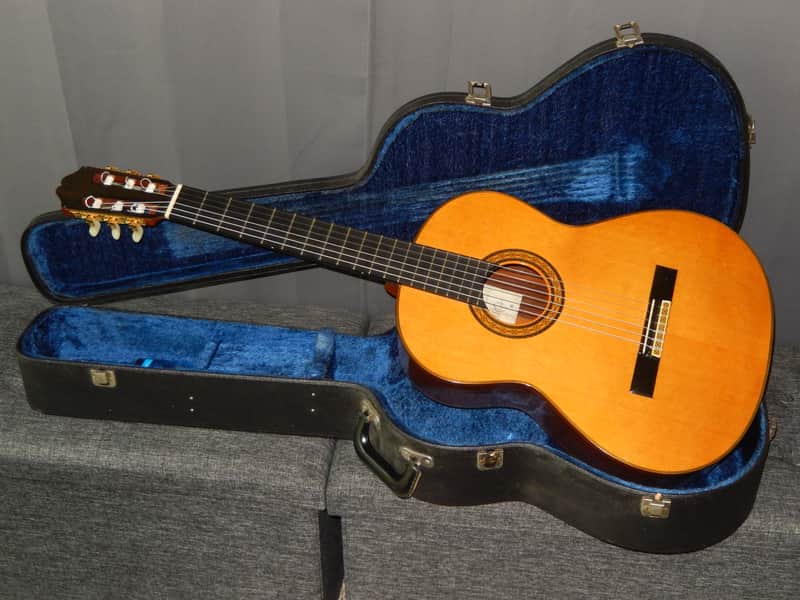
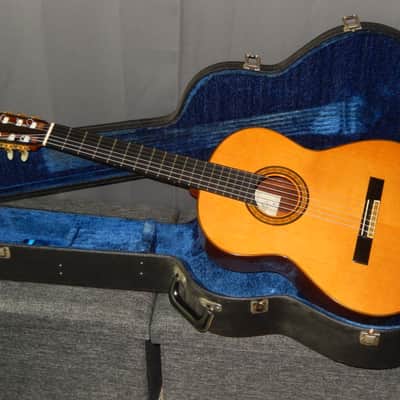
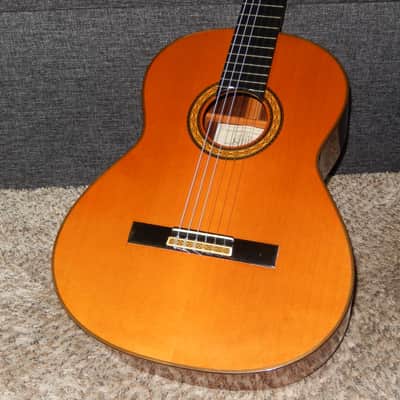
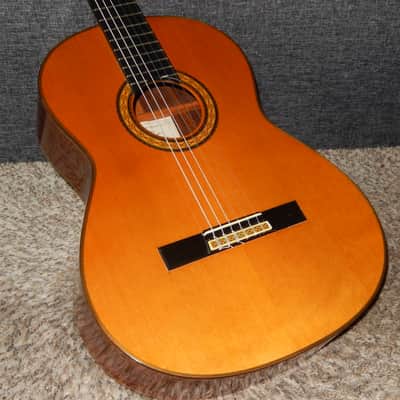
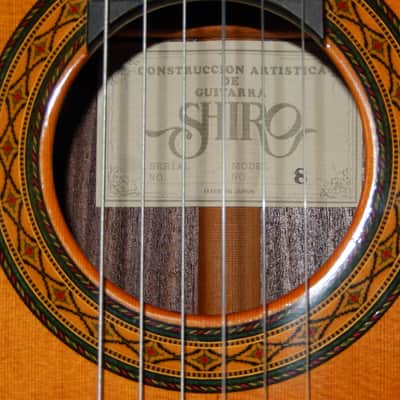
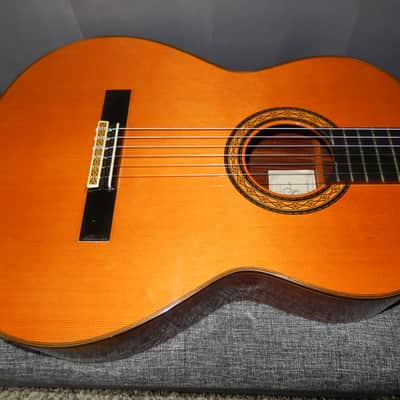
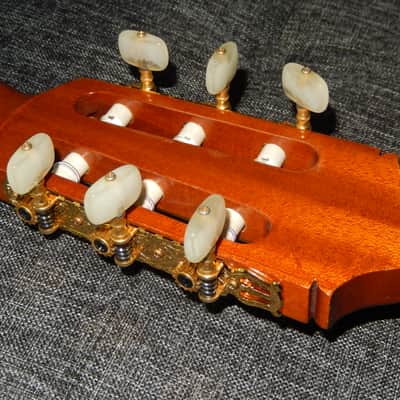
RARITY - MADE BY TAKAMINE & MASAKI SAKURAI - SHIRO No8 1980 - CLASSICAL CONCERT GUITAR
This seller has not set a shipping cost for Malta. Please contact them to ask about shipping.


Our users rate Reverb
Shiro No8 1980
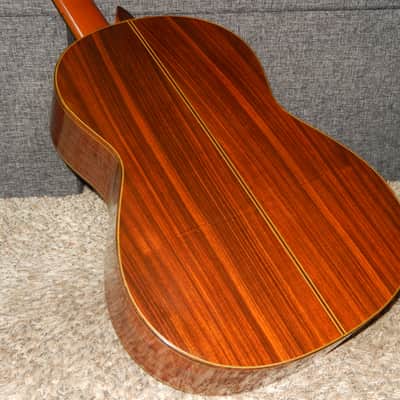
This guitar was handmade in 1980 for Shiro Arai & Co, in cooperation between Takamine and Masaru Kohno workshops, based on Masaki Sakurai's designs and under his personal supervision. These high end Arias are very hard to find on the secondhand markets. The excellent overall condition of this individual makes it a very rare find.
Since the origination of his ARAI & CO. INC in 1956, Shiro Arai was cooperating with several classical guitar makers. In early 1960s he was already representing Masaru Kohno workshop on international markets. Until today Arai & Co. is the only authorized international distributor of Kohno and Sakurai guitars.
After winning the 1st prize at international competition in 1967 in Belgium, international markets were wide open for Masaru Kohno “brand name”. He was smart enough to take full advantage of his fame, turning few new ideas into great profits. One of these ideas was to purchase Takamine co, in 1968 and placing his pupil Mass Hirade at its helm. Another idea was a line of very high-grade guitars designed for domestic market, sold at moderate prices, hence affordable to average Japanese citizens. Originally (1968) named Yamato guitars, they became Aranjuez guitars by early 1970s. While most models were entirely made by Takamine workshop, top Aranjuez guitars were assembled at Kohno’s workshop with soundboards also made at Kohno’s workshop. Until 1978 all Aranjuez guitars had Kohno stamp on their labels.
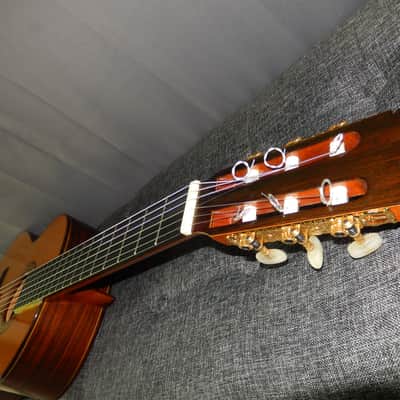
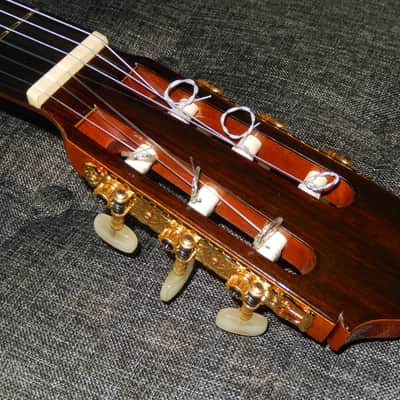
During late 1960s and early 1970s Aria AC classical guitars were made either by Ryoji Matsuoka’s or Masaru Matano’s workshops. Sometime around 1974/75 Shiro Arai started hiring other luthiers like Masaru Takeiri or Oguri Toshikazu, while Aria's AC series models were being replaced by SA and AG models, manufactured under Masaru Kohno workshop umbrella. It was Masaki Sakurai who was designing and supervising production of AG and SA series models, most of which were entirely by Takamine co. High-end models (like Aria AG80, SA80) had soundboards made at Masaru Kohno workshop by Masaki Sakurai himself. Masaki was also responsible for their final assembly. Only these very top Aria models had (copyright protected) Kohno’s design rosettes and bridge decoration. All AG and SA models had Masaki Sakurai’s design headstock, the same he uses until today.
Over recent decades, Masaki Sakurai was one of very top Japanese luthiers. He has won international competition in 1988 in Paris and after his uncle's death (in 1998) he took over Masaru Kohno workshop, which he was running for 27 years. He continuously supervised the production of Aranjuez guitars, assembling and making soundboards for top-of-the-line Aranjuez 725 model (sold with his personal label inside).
Masaki Sakurai passed away in July 2025, leaving the workshop to be managed by Masaru Kohno’s grandson, Satoshi Kimishima.
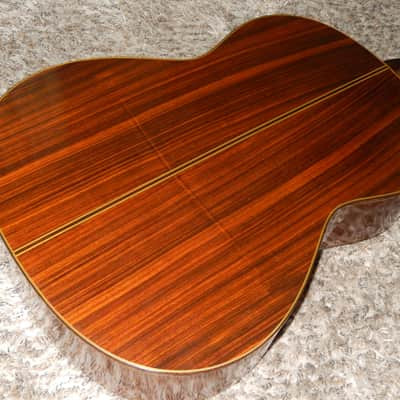
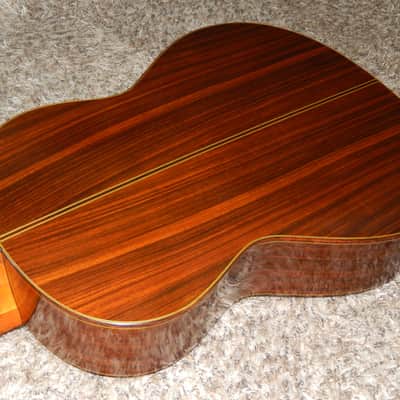
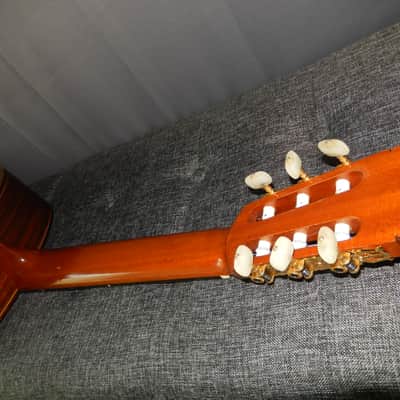
Despite few very small (non-conspicuous) marks on its body, the overall condition of this Shiro No8 guitar can be described as “excellent for its age”. Its neck is straight, while frets and fingerboard remain in excellent condition.
(Just like all Aria guitars) this guitar sold in Japan for 80 000 yen in 1980, was greatly underpriced. It sounds “on pair” with many much higher priced guitars made by most famous Japanese luthiers of that era.
It certainly is a concert level instrument, offering great volume combined with warm lyrical & colorful tonality. Despite being made with Cedar top it offers high level of note clarity and separation, and impressive sustain. With its current action it plays super easy.
If today you wanted to purchase brand new guitar of the same class made by Japanese luthier, you'd pay minimum $6500.
SPECIFICATIONS:
Top: High Grade Solid Cedar/Cashew lacquer
Back & sides: Solid Indian Rosewood/Cashew lacquer
Neck: Mahogany
Fingerboard: Ebony
With at the nut: 51 mm
Scale: 650 mm
Current action is set to 3.30 mm under E6 and 2.80 mm under E1 with practically no extra room on the saddle. Original saddle raises this action to 5.00mm Under E6 and 4.00mm under E1.
This guitar will be shipped in a used hard case in still decent condition, except for one broken latch.
THE ONLY PURPOSE OF THIS CASE IS TO PROTECT THE GUITAR DURING SHIPMENT. I WILL NOT PROVIDE ITS DETAILED DESCRIPTION OR MAKE ADDITIONAL PICTURES, NOR I WILL ACCEPT ANY COMPLAINTS. IF YOU DON’T LIKE THIS CASE YOU WILL NEED TO BUY A DIFFERENT ONE.
WHEN YOU BUY ANY GUITAR, YOU MUST ANTICIPATE TAKING IT TO YOUR LOCAL GUITAR SHOP FOR FINAL ADJUSTMENTS CALLED “SETUP”. DEPENIDNG ON YOUR PLAYING TECHNIQUE, THIS SETUP ON USED GUITARS MAY INCLUDE NEW CUSTOM-MADE NUT AND SADDLE. IF YOU HEAR STRING BUZZ IT DOESN’T MEAN THAT GUITAR IS DEFECTIVE. IF YOU PLAY HARD ENOUGH ALL BASS STRINGS WILL BUZZ OVER THE FRETS, UNLESS THEY ARE SUSPENDED VERY FAR FROM THE FINGERBOARD. UNLESS YOU PLAY QUITE GENTLY, YOU CAN’T HAVE LOW ACTION AND NO BUZZES. KEEP IN MIND THAT CELLO-LIKE BASSES ON HIGH GRADE CLASSICAL GUITARS HAVE THEIR NATURAL “BUZZ”.
Real Value of Japanese Vintage Guitars
The key to understand value of vintage Japanese guitars is to acknowledge galloping price inflation throughout the late 1960s and 1970s with its peak of 25% in 1974.
During 1960s and most of 1970s model numbers of Japanese guitars were strictly connected with their prices in Japanese yen.
The same class guitar sold in 1970 for 100 000 yen (labelled as model 10), would be sold for 150 000 yen in 1972 (labelled as model 15), 200 000 yen in 1974 (labelled as model 20) and 300 000 yen in 1978 (labelled as model 30). Therefore, you shouldn’t be surprised that two Yamaha GC10 guitars made 10 years apart are two instruments of totally different class. The same rule applies to all guitar models made by all other Japanese makers.
Japanese inflation slowed down in the 1980s. By the early 1980s and during following decades model numbers were no longer strictly associated with their prices. Some Japanese guitar makers introduced model names instead of model numbers. For several economic reasons, since 1980s Japanese made guitars were becoming more and more expensive, while their exports slowing down. Today (2025) Japanese high end classical guitar models are priced at $20000USD level.
History of Aria Guitars
One day, a friend came to visit Shiro's apartment with a guitar. Shiro was expecting to hear Koga-type Japanese popular music, but instead his friend started to play a piece by Bach. From this moment, he had been inspired by the sound of this instrument forever.
The very next day, Shiro bought his first guitar, costing over two months salary and began to teach himself to play. Now playing day and night, his passion for the guitar brought him to a famous classical guitar master in Nagoya, and soon became one of his students.
Shiro started work for a trading company in 1947, aged 17. In 1953, Shiro and two of his colleagues resigned their positions and founded their own trading firm. After the fledgling company failed after just one year, Shiro found himself homeless with nothing but his guitar. In order to live and settle the outstanding debts from this first business he started to teach the guitar.
In 1954 unable to buy guitars, music and strings in Japan's music stores, Shiro started to import classical guitars, Augustine guitar strings, and musical scores for himself and his students. These were the first classical guitars imported into post-war Japan and included instruments from renowned makers Jose Ramirez and Hermann Hauser. Recognizing an increasing demand for guitars from friends and players throughout Japan, Shiro grasped the opportunity to start his own business. On August 2nd, 1956, ARAI & CO., INC was founded.
At this time, although demand for classical guitars and accessories were increasing, it was still comparatively low and business was supplemented with other products including woolen material.
The name, "ARIA", which means expressive melody, was first used in 1958 when Arai exported Japanese built classical guitars fitted with steel strings to South East Asia in 1963. Also the letters of his name "ARAI" were just switched around to "ARIA as he recalled.
Shiro embarked on a tour of the US with two of the best Japanese KOHNO guitars. At that time Japanese guitars had a poor reputation for developing body cracks and warped necks after being exposed to drier conditions abroad. It was Shiro's intention to prove how good Japanese guitars were by performing and showing to fellow guitarists, teachers and music shops. After two months these guitars also started to crack.
Even the best available Kohno guitars faced the same problem. Shiro took these cracked guitars back to Japan to show their makers just how vital it is to use properly seasoned tone woods. This trip gave Shiro the experience and knowledge to improve the quality of guitars and export Japanese guitars worldwide.
It was as early as the late 50's when Arai started to import Fender guitars and amplifiers from the US, although at that time the Japanese market was not quite ready for the electric guitar! With the advent of rock n' roll demand for electric guitars took-off. Arai released its first ARIA brand electric guitars in 1963. Exporting to the US followed with models including the 1532T and 1802T.
To counter the decline of the solid body electric guitar boom, Arai released the Aria Diamond series hollow body semi-acoustic guitars. Aria Diamond was named after the imitation diamond inlayed into the headstock. This series lead to the release of the 1202 and 1302 models in 1966 and caused nothing short of a sensation in Japan. From 1967 Aria added a variety of models including the solid body 1962T, R-320, and violin shaped 12-string and bass guitars, and a full acoustic guitar, the 1262.
In 1975, Aria Pro II was developed from Aria's custom shop making high-end models for professional users. In 1976, Aria Pro II released its first original model, the PE-1500.
PE (Prototype Line) is a classic Aria design, also known as the legendary masterpiece, it featured an arched top, and all maple carved body with Aria's original "heel-less neck and DiMarzio Super Distortion Humbucking Pickups. Primarily designed for tone and playability, the PE series has been modified to match today's trends while keeping its original features and timeless design.
In 1978, Aria Pro II released another long-selling model, the SB-1000. The SB-1000 was highly regarded throughout the world and came to represent everything that was good about Aria and Japanese guitar building. Featuring a Canadian Ash body with neck through body and, to enhance playability, a heel-less neck. For its original tone, SB featured the Aria original BB circuit. Its exotic see-through finish and the eye position marks make the SB amongst the most distinctive basses ever made.
Aria Pro II led the way with the 80's shift to Hard Rock and Heavy Metal. Releasing many models such as XX, ZZ and U-1. Whilst not abandoning their routes also re-established the semi-acoustic guitar models, FA and TA. The 80s, also saw the introduction of the famous IGB (SB INTEGRA) bass series.
In the early 1990s, after the heavy metal rush, Aria Pro II released one of its favorite original models, the MA series to reinforce the PE and SB line-ups. MA series bodies are constructed with innovative crystal shaped carved top and back.
Continuing its remarkable progress, Aria released the very unique concept of the SWB (electric upright bass) series to the world in 1992. The SWB range offers compact modern design and features the Fishman custom bridge Piezo pickup and active tone circuit.
Aria has been at the forefront of guitar and Japanese guitar building excellence for 50 years, which means a wealth of experience and acquired expertise. The core value remains the same today, to constantly strive to achieve a higher level.
| Listed | 4 years ago |
|---|---|
| Condition | Excellent (Used) Excellent items are almost entirely free from blemishes and other visual defects and have been played or used with the utmost care.Learn more |
| Brand |
|
| Model |
|
| Finish |
|
| Categories | |
| Year |
|
| Made In |
|
| Body Shape |
|
Product safety information may be available here.

