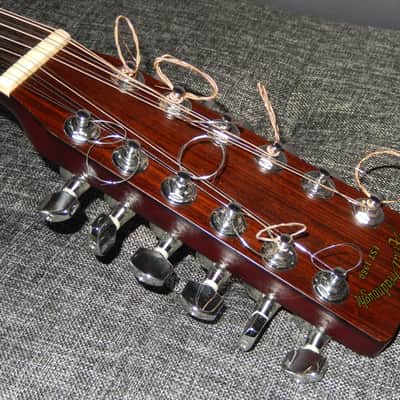
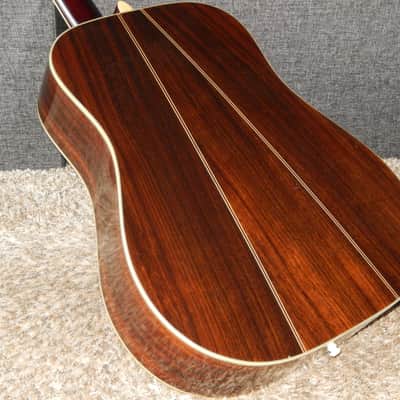
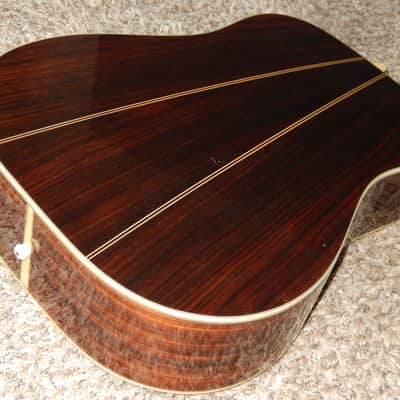
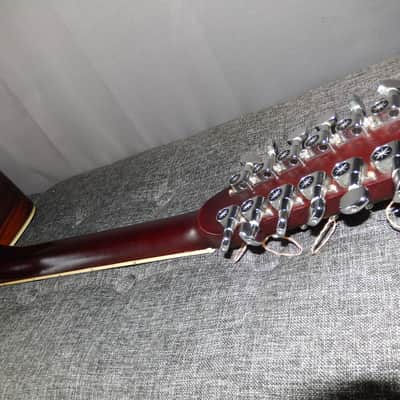
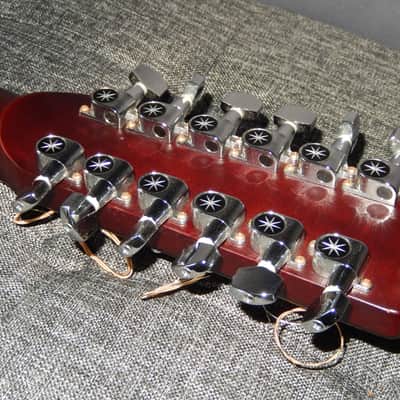
R.MATSUOKA'S - ARIA D80 1979 - MAGNIFICENT - MARTIN D35 STYLE - 12STRINGS ACOUSTIC GUITAR
This listing has ended
See similar gear from other Reverb sellers

Our users rate Reverb
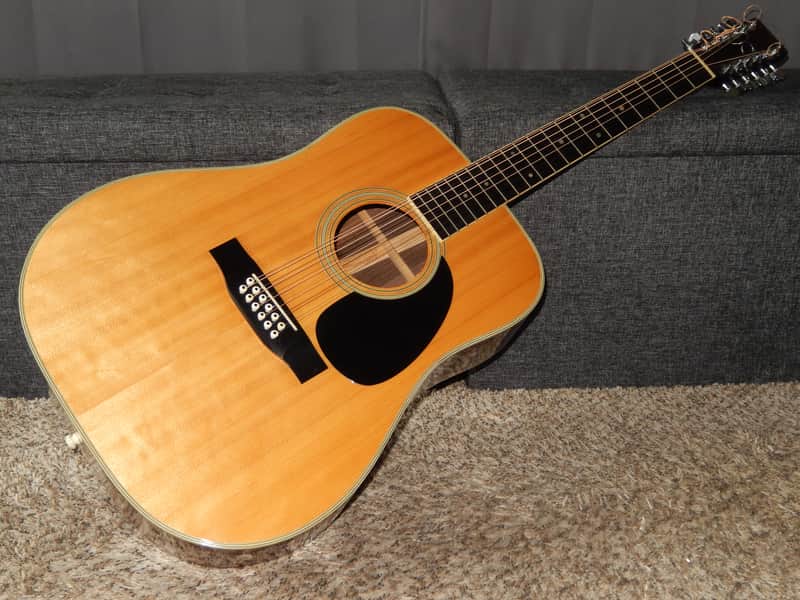
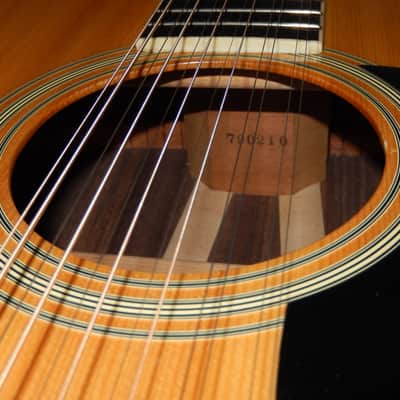
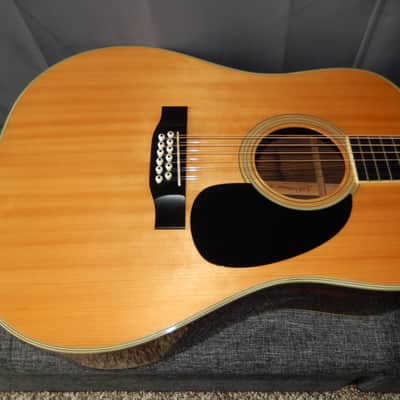
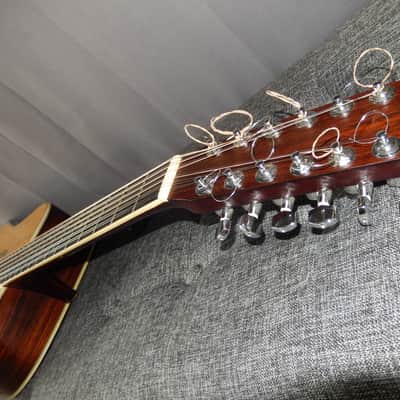
R.Matsuoka’s ARIA D80 12 STRINGS
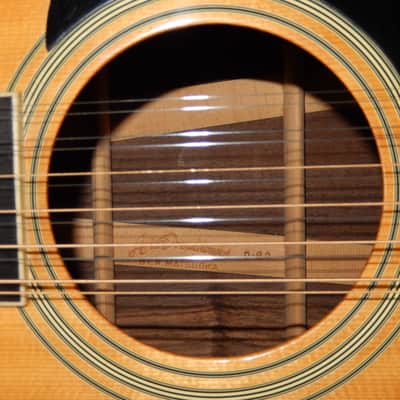
This guitar was handmade at Ryoji Matsuoka’s workshop in 1979.
Ryoji Matsuoka was making terrific acoustic Arias from early through late 1970s. The very top model of that era was D200 with solid Figured Brazilian rosewood b/s, followed by D150 with solid straight grain BR b/s and D100 with solid Indian Rosewood b/s. Models D200 and D150 both had Martin D45 looks and Matsuoka vertical logo. Aria’s catalog from 1976 presents all these guitars as “Masterpieces by Ryoji Matsuoka”. All these Arias had Matsuoka (wooden) label inside. Matsuoka also made Arias DS100, DS80 and DS60, all with Torch Inlay on the headstock and snowflake positions marks. In 1979 the lowest model in Aria’s lineup was D50. In earlier years there were also models D20, D30 and D40.
Since 1975 Arias introduced new acoustic guitar lineup with Aria’s own vertical logo made by other Japanese makers. The top models in that lineup were W100 and W80 (both with Martin D45 style looks). Perhaps only W100 was “all solid woods” construction.
All Matsuoka acoustics were made basing on Martin blueprints. I won’t however call them “copies” of Martin guitars. The word “copy” suggests a product of somewhat lower quality than the “original”. This guitar can easily beat many brand-new Martin guitars.
Although it was a midrange model such vintage Aria D80 is a truly terrific instrument that beats many “all solid woods” guitars currently sold on US market for $3500+USD.
It offers immense volume and superb response. Its sound is somewhat warm yet very rich, with quite deep yet clean basses and colorful sweet trebles, all with great note clarity & separation, and all magnified by very impressive sustain. Briefly saying, this guitar as musical instrument represents much more than you can expect just by looking at it. It is truly extraordinary ordinary guitar.
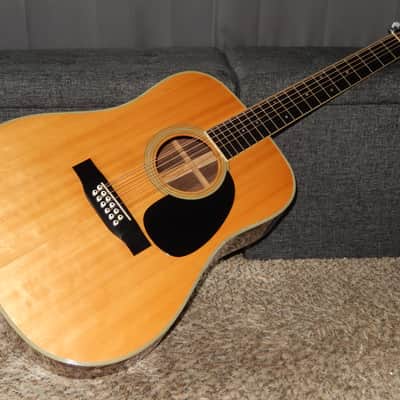
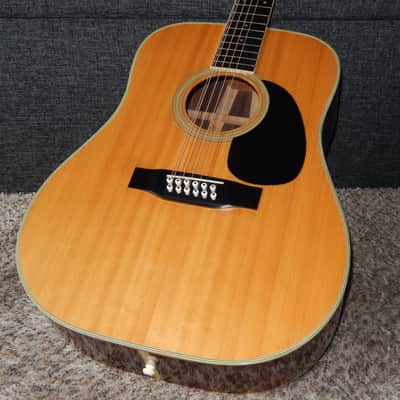
Despite several very minor marks on the top, back and sides overall condition of this guitar can be described as “excellent for its age”.
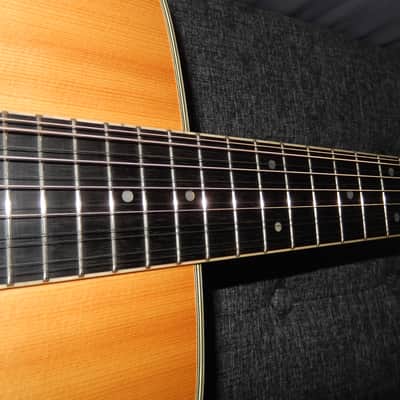
Very importantly its neck is straight, fingerboard and frets in excellent shape.
Specification:
Top: Solid Spruce with Martin style X bracing with not scalloped braces
Back & Sides: Brazilian Rosewood “laminates”
Neck: Mahogany with 2-way truss rod
Fingerboard: Rosewood
Nut width: 48mm
Scale: 645 mm
The action is set to 3.50 mm under E6 and 2.20 mm under E1, with very little extra room on the saddle.
This guitar will be shipped in used leather gig-bag and sturdy guitar shipping box.
Real Value of Japanese Vintage Guitars
The key to understand value of vintage Japanese guitars is to acknowledge galloping price inflation (devaluation of Japanese yen) during 1960s & 1970s. This inflation slowed down in 1980s.
During 1960s and most of 1970s model numbers of Japanese guitars were strictly interconnected with their prices in Japanese yen. By early 1980s and during following decades model numbers were no longer strictly associated with their prices. Some Japanese guitar makers introduced model names instead of model numbers. Others were still using model numbers with addition of letters and/or other symbols.
It is then important to understand that two Yamaha GC10 guitars made 10 years apart are two instruments of totally different class. The same applies to any other Japanese maker/brand.
The logical way to estimate the true class of any given Japanese made instrument is to compare its price with the average annual salary of wage workers in Japanese private sectors. This salary was: 450 600 yen in 1965 - 825 900 yen in 1970 - 1 868 300 yen in 1975 - 2 689 000 yen in 1980 - 3 163 000 yen in 1985 - 3 761 000 yen in 1990 - 4 107 000 yen in 1995 - 4 082 000 yen in 2000.
Any guitar priced 100 000 yen in 1970 (labelled as No10 or No100) would be priced 200 000 yen in 1975 (relabeled to No20, No200 or 2000), 300 000 yen in 1977 (labelled as No3, No30 or 3000) and 500 000 yen by 1985 (labelled as No50 or 5000).
Starting in 1977 Masaru Kohno introduced his new models No40 priced 400 000 yen and No50 priced 500 000 yen. By early 1980s Kohno started using model names instead of numbers and was steadily raising their prices without changing model labeling. His very top model 50 became model “Special”, and a decade later it became model “Maestro”. Naturally, all other Japanese guitar makers were doing similar pricing (labelling) upgrades.
Knowing all of that, you can bet on that Masaru Kohno No50 made in 1982 is practically the same grade instrument as Kohno No20 made in 1972, or Kohno no 30 made in 1975.
In early 1970s the lowest Ryoji Matsuoka (all plywood) model was 10, followed by (solid top) models 15, 20, 25, 30, 40, 50, 60, 80 and (all solid woods) models 100 and 150. Models 50, 60 and 80 were made with non-solid figured Brazilian Rosewood (double) back and sides and top model 150 was the only one made with solid figured Brazilian Rosewood b/s.
In 1980 the lowest Matsuoka model was (all plywood) 20, followed by (solid top) models 30,40,50, 60 and all solid woods models 80,100,150 and 200. By 1990 the lowest Matsuoka model was M40 and the highest was M300. By 2010 the lowest Matsuoka model was M50 and the top model was M270.
You can bet that Ryoji Matsuoka model 50 from 1980 is of the same grade as model M100 from 2000, model 100 from 1980 is of the same grade as model M150 from 2000, model 150 from 1980 is of the same grade as M200 from 2000 and model 200 from 1980 is of the same grade as model M300 from 2000.
It is important to mention that if modern era luthiers are using 40+ years old woods to make an “all solid” wood classical guitar, its price is minimum $8000.
All vintage guitars made with Brazilian Rosewood are especially precious, including those made straight grain varieties and those with non-solid b/s.
Because response and tonal properties of Spruce soundboards are improving over time, long seasoned Spruces are far more precious than long seasoned Cedars.
It is not very difficult to find out what are current prices of such guitars made by world’s leading luthiers.
| Listed | 5 years ago |
|---|---|
| Condition | Excellent (Used) Excellent items are almost entirely free from blemishes and other visual defects and have been played or used with the utmost care.Learn more |
| Brand | |
| Model |
|
| Finish |
|
| Categories | |
| Year |
|
| Made In |
|
| Body Shape |
|
Product safety information may be available here.