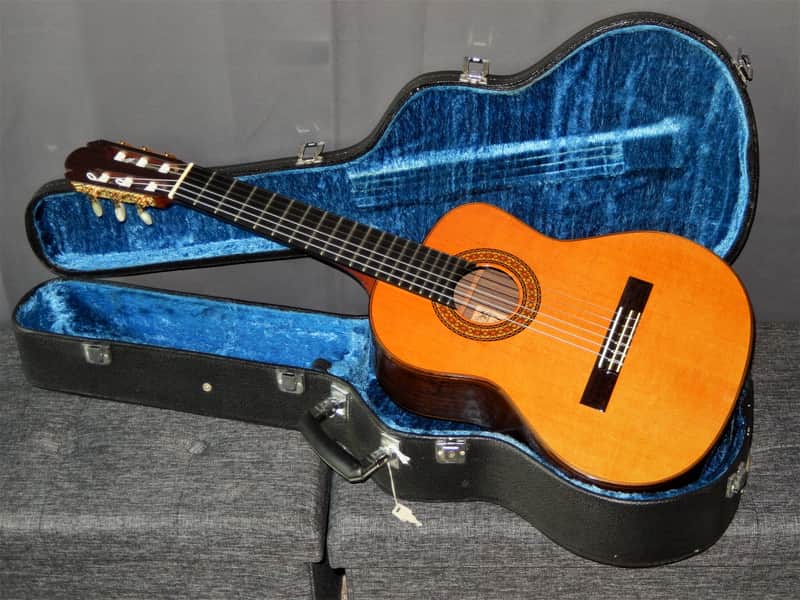
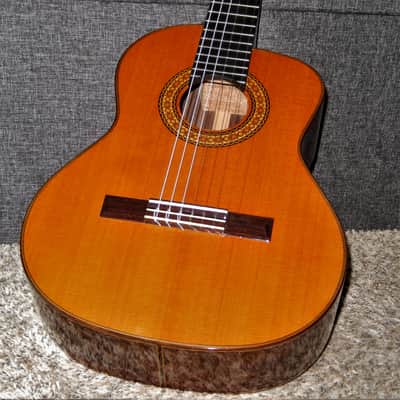
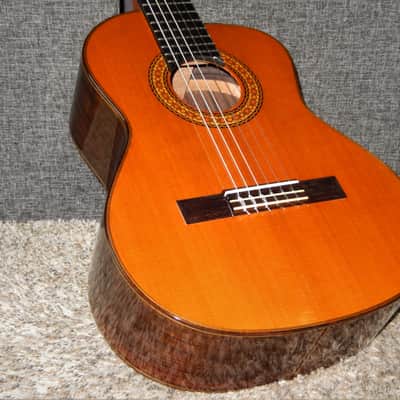
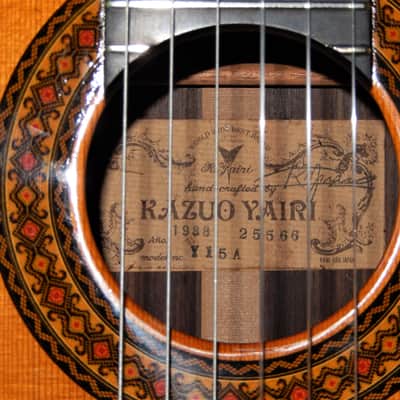
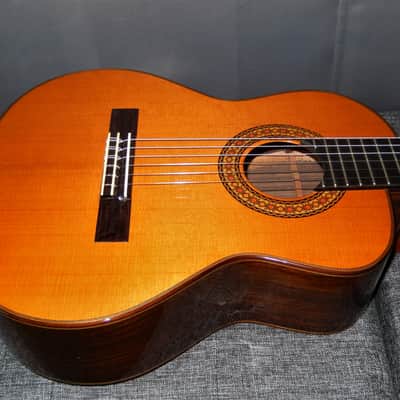
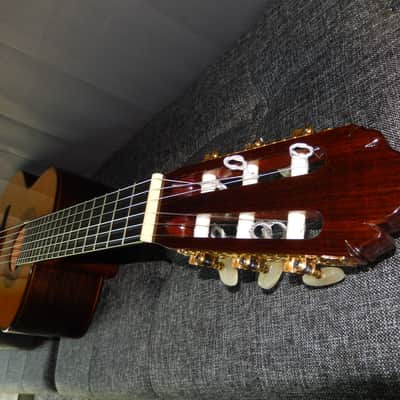
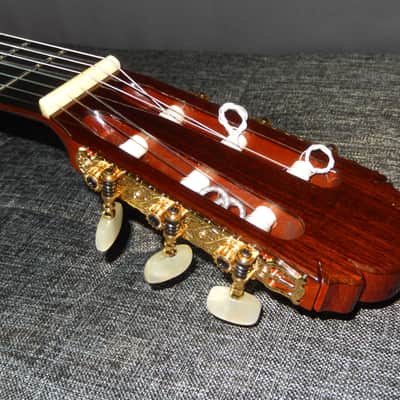
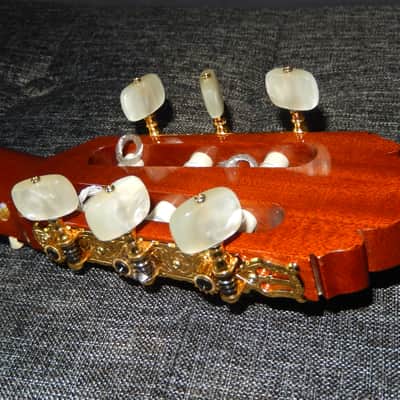
RARITY - KAZUO YAIRI Y15A 1988 - CONCERT GRADE CLASSICAL ALTO/REQUINTO GUITAR
This seller has not set a shipping cost for Croatia. Please contact them to ask about shipping.


Our users rate Reverb
Kazuo Yairi Y15A 1988
Beyond any doubt Kazuo Yairi was one of the best Japanese luthiers. His classical and steel string acoustic guitars have been, are and will be treasured by players all around the world.
Thanks to Kazuo's business philosophy, his terrific guitars have always offered exceptional value for the money. This value was associated with the fact that over the years Kazuo has hired and trained many younger luthiers, who were later making his signature guitars. There have been many regular line models of guitars made over the years by Yairi’s “factory” located in Kani (Gifu province), Japan. Some models were made only for export. Great majority of Kazuo’s models have never been distributed in USA or Europe.
Guitar you are looking at was made in 1988 and it was either the top or second from the top alto model Yairi’s lineup of that era. Among Yairi’s full size guitars made in late 1980s models like YC200, H15 or T15 were the very top of the line.
This guitar being priced 150000yen in 1988 it was quite expensive instrument.
Just like all other high end Yairi models, this guitar was significantly underpriced if compared with equal grade guitars sold by most prominent Japanese luthiers. Masaru Kohno, Sakazo Nakade and Yamaha co. would surely charge at least 50% more for similar grade instrument. Such very modest pricing was important part of Kazuo’s business philosophy, and certainly one of major reasons for his international success.
This instrument represents very high level not only among Japanese made altos but also among high end models made by European makers.
Similar grade brand new alto guitars made by Japanese elite luthiers are priced minimum $5500. Solid top Alto model made by Asturias, which (if available on US market) would be priced at least $3500, is absolutely no match to a guitar you are looking at.
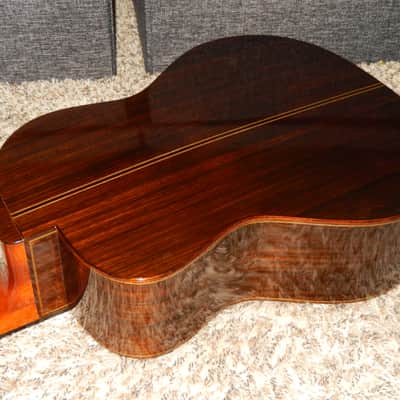
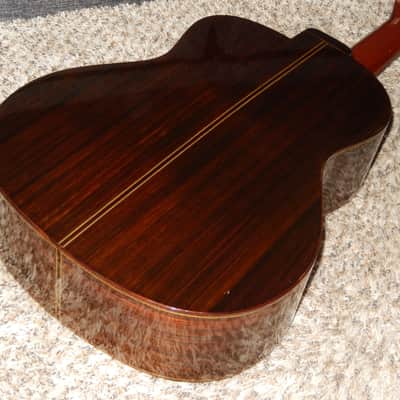
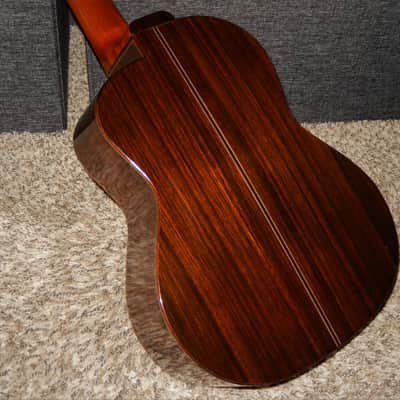
Despite tiny dent on its back and another tiny dent on the back of its neck the overall condition of this guitar shall be described as "excellent for its age”.
This guitar produces truly wonderful notes, very clear, glassy, yet very colorful trebles, somewhat metallic basses, all very well separated, and all with very impressive sustain. Despite its smaller (alto) body guitar, its volume is quite impressive too.
Specifications:
Total length: 850mm
Body length: 415 mm
Upper bout width: 240 mm
Lower bout width: 325 mm
Waist width: 200 mm
Body depth: 95-98 mm
Top: AA Grade Solid Cedar/lacquer
Back & Sides: Solid Indian Rosewood/urethane
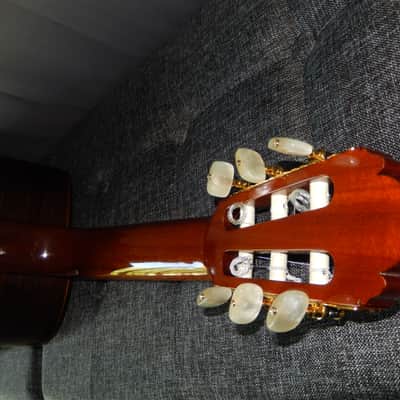
Neck: Mahogany
Fingerboard: Ebony
Scale: 530 mm
Nut width: 52 mm
String spacing at the nut: 43 mm
String spacing at the bridge: 57 mm
Its current action is set to 3.50 mm under E6 and 3.00 mm under E1, with very little extra room on the saddle.
Guitar is currently strung with D'Addario EJ52 ProArte Alto Strings designed for alto (B-B) tuning. If you'd like to play it with regular (E-E) tuning, you need regular classical guitar strings. Alto strings are of much lower gauge than regular strings, hence would feel too soft in regular (E-E) tuning. You must not try alto tuning with regular strings because that could lead to ripping off the bridge of the guitar.
Guitar will be shipped in used original hard shell case.
THE ONLY PURPOSE OF THIS CASE IS TO PROTECT THE GUITAR DURING SHIPMENT. I WILL NOT PROVIDE ITS DETAILED DESCRIPTION OR MAKE ADDITIONAL PICTURES, NOR I WILL ACCEPT ANY COMPLAINTS. IF YOU DON’T LIKE THIS CASE YOU WILL NEED TO BUY A DIFFERENT ONE.
WHEN YOU BUY ANY GUITAR, YOU MUST ANTICIPATE TAKING IT TO YOUR LOCAL GUITAR SHOP FOR FINAL ADJUSTMENTS CALLED “SETUP”. DEPENIDNG ON YOUR PLAYING TECHNIQUE, THIS SETUP ON USED GUITARS MAY INCLUDE NEW CUSTOM MADE NUT AND SADLLE. IF YOU HEAR STRING BUZZ IT DOESN’T MEAN THAT GUITAR IS DEFECTIVE. IF YOU PLAY HARD ENOUGH ALL BASS STRINGS WILL BUZZ OVER THE FRETS, UNLESS THEY ARE SUSPENDED VERY FAR FROM THE FINGERBOARD. UNLESS YOU PLAY QUITE GENTLY, YOU CAN’T HAVE LOW ACTION AND NO BUZZES. KEEP IN MIND THAT CELLO-LIKE BASSES ON HIGH GRADE CLASSICAL GUITARS HAVE THEIR NATURAL “BUZZ”.
Guitar ensemble and guitar orchestra music has been developed and promoted by Hiroki Nibori since 1957 and is gaining popularity among guitar players throughout the world. Playing in a group is great fun. It is an excellent opportunity to make new friends and learn from the more advanced players. One of the most valuable aspects of playing in a guitar ensemble is that it gives students the exposure of playing on a stage in front of an audience. When you combine the sounds of alto, bass, and contra bass guitars with standard (prime) guitars, a whole new world of sound comes alive. Even the beginner will find it easy to pick up any of these guitars and enjoy a variety of new and exciting musical styles.
An ALTO GUITAR is usually tuned a 5th higher than a standard (prime) guitar. Its open tuning notes sound the same as a standard guitar played on the 7th fret position: B,E,A,D,F#,B.
BASS GUITAR is tuned 4th lower than standard guitar, one octave lower than Alto guitar: B,E,A,D,F#,B
CONTRA BASS GUITAR is tuned one octave lower than standard guitar: E,A,D,G,B,E
Real Value of Japanese Vintage Guitars
The key to understand value of vintage Japanese guitars is to acknowledge galloping price inflation throughout the late 1960s and 1970s with its peak of 25% in 1974.
During 1960s and most of 1970s model numbers of Japanese guitars were strictly connected with their prices in Japanese yen.
The same class guitar sold in 1970 for 100 000 yen (labelled as model 10), would be sold for 150 000 yen in 1972 (labelled as model 15), 200 000 yen in 1974 (labelled as model 20) and 300 000 yen in 1978 (labelled as model 30). Therefore, you shouldn’t be surprised that two Yamaha GC10 guitars made 10 years apart are two instruments of totally different class. The same rule applies to all guitar models made by all other Japanese makers.
Japanese inflation slowed down in the 1980s. By the early 1980s and during following decades model numbers were no longer strictly associated with their prices. Some Japanese guitar makers introduced model names instead of model numbers. For several economic reasons, since 1980s Japanese made guitars were becoming more and more expensive, while their exports slowing down. Today (2025) Japanese high end classical guitar models are priced at $20000USD level.
This item is sold As-Described
This item is sold As-Described and cannot be returned unless it arrives in a condition different from how it was described or photographed. Items must be returned in original, as-shipped condition with all original packaging.Learn More.
| Listed | 5 years ago |
|---|---|
| Condition | Excellent (Used) Excellent items are almost entirely free from blemishes and other visual defects and have been played or used with the utmost care.Learn more |
| Brand | |
| Model |
|
| Finish |
|
| Categories | |
| Year |
|
| Made In |
|
| Body Shape |
|
Product safety information may be available here.

