Buchla 223e Multi-Dimensional Kinesthetic Input / Tactile Input Port

Only 1 left
Grab it before it's gone
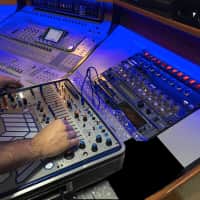
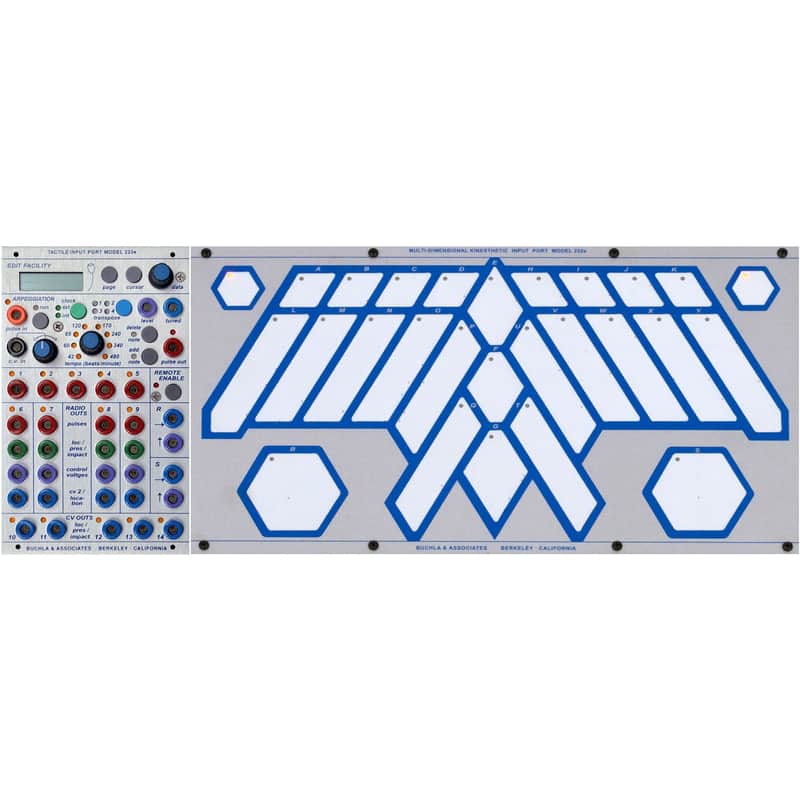
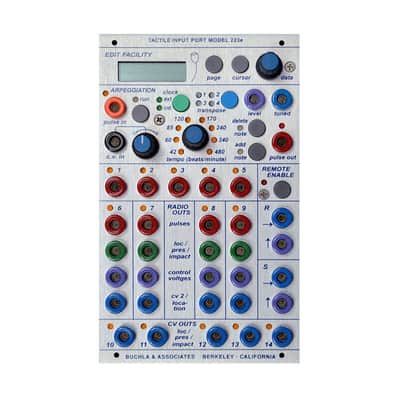
The module 223e Tactile Input Port is the control unit for the included Multidimensional Kinesthetic Input (Controller), a three Buchla Panel Units wide touch controller that offers 27 pressure and partially position-active contact areas. The module converts the data sent by the controller into CV voltages and pulses. With the module it is possible to combine several contact areas into groups in order to create independent keyboard groups. The module also offers an arpeggiator. The multidimensional kinesthetic input can either be built into a boat or used externally in a special passive housing.
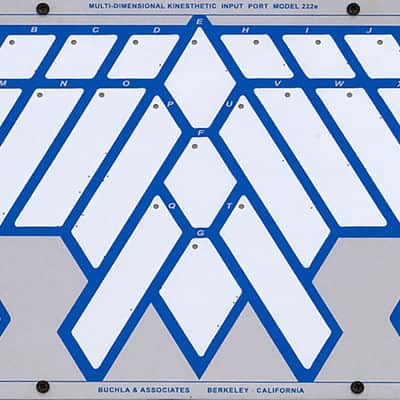
The multidimensional kinetic input, which is managed by the 223e, offers 27 touch-sensitive contact surfaces. Two of these surfaces are intended for the functions of the arpeggiator without labeling and fixed. Two large hexagonal areas, titled "R" and "S", work two-dimensionally and always output the tensions of their horizontal and vertical position at fixed CV outputs. Twelve elongated contact surfaces can also be used one-dimensionally like a fader.
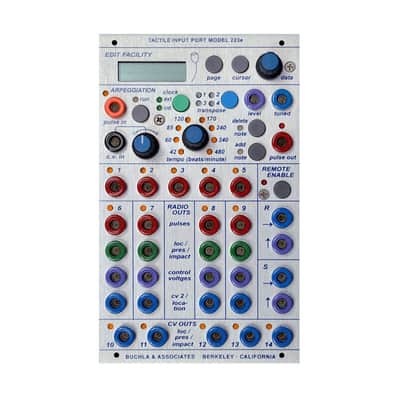
Any individual contact areas can be assigned to the pulse outputs 1-5 of the 223e. They can be configured as switches or buttons.
Any individual contact areas can be assigned to CV outputs 10-14. There you either output the parameters Location, Pressure or Impact by corresponding voltages.
The "Radio Outs" are four groupings to which entire groups of buttons can be assigned. In this way, up to four different keyboard groups can be created. Each group or radio output offers a pulse output, a CV output that can output either location, pressure or impact data, a further CV output that outputs a voltage that can be set for each contact surface (for example, by the frequency of an oscillator), as well as another CV output for an alternative voltage or the parameter location. If required, these radio outputs can also be used for polyphonic play.
The arpeggiator integrated in the 223e can either generate its own tempo, be synchronized with a pulse at the "pulse in" input or synchronize to a MIDI clock generated via the 225e via the internal 200e bus. Internal tempo and MIDI clock divider can be modulated by CV. The arpeggiator has the patterns "Rising", "Falling", "Triangle", "Random" and "Spiral". In addition to a CV and pulse output, the arpeggiator offers an additional CV output called "Level". It is used to gently thread the arpeggiator at the start or after it stops. The fade-in and fade-out times can be set. When the arpeggiator is started or stopped, voltages of 0-10V or 10-0V are generated,
All settings of the input port and the arpeggiator can be saved and recalled via the preset manager of the 206e or 225e.
The multidimensional kinesthetic input can be firmly integrated into a boat, requiring three panel units. Alternatively, it can be used externally in a special passive housing (201e-3), which is not included in the scope of delivery.
| Condition | Brand New (New) Brand New items are sold by an authorized dealer or original builder and include all original packaging.Learn more |
|---|---|
| Brand | |
| Model |
|
| Categories | |
| Made In |
|
| Modular Synth Format |
|
| Synth Module Function |
|
Product safety information may be available here.

