


Polyend Seq MIDI Step Sequencer 2021 - Wood & Black alloy finish

Our users rate Reverb
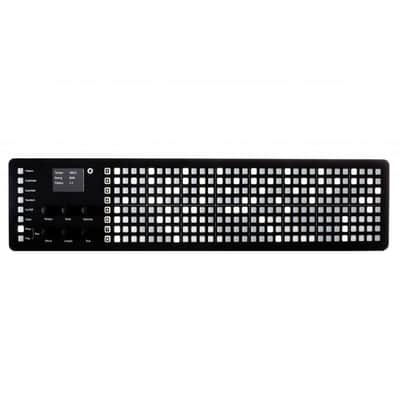
The Polyend Seq is a premium, large-format desktop MIDI step sequencer that is famous for its "what you see is what you get" user experience. Unlike most modern sequencers that require menus, screens, and button combinations to jump between tracks or pattern pages, the Seq relies on a massive, dedicated grid layout where all tracks and steps are visible simultaneously.
Full Details & Specifications
- Physical Design: Crafted with high-end, hand-finished oak wood and an aluminum chassis. It features a bright, dedicated TFT display for contextual parameter readings.
- The Grid: Populated by 272 premium illuminated silicone rubber pads. It is physically configured into 8 parallel tracks with 32 physical steps per track.
- Polyphony: Every step on all 8 tracks can handle full MIDI polyphony, allowing you to sequence rich chords and melodies seamlessly.
- Control Architecture: Equipped with 6 clickable endless encoders to manipulate Note, Velocity, Gate Length, Modulation (MIDI CC), and Roll (ratcheting) per step or per track.
- Memory & Storage: Stores up to 256 patterns organized into banks, featuring an aggressive autosave function so changes are never accidentally lost.
- Compositional Features: Includes scale quantization, 29 built-in chord presets, track nudge (micro-timing offset), swing, randomization, step division/multiplication, and independent play directions per track (Forward, Backward, Ping-Pong, Random).
- Connectivity:
- 2 independent standard 5-pin MIDI DIN Outputs
- 1 5-pin MIDI DIN Input & 1 5-pin MIDI DIN Thru
- 1 USB Type-B port (Bidirectional USB MIDI)
- 1 1/4-inch Footswitch jack (single press for play/stop, double press to record) [1]
The 5 Closest Competing Models: To establish the strengths of the Polyend Seq, it is best compared against the five most prominent hardware sequencers that handle multi-track MIDI arrangements:
--Squarp Hapax: A deep, dual-project studio hub with a 128-pad grid and multi-screen architecture.
--OXI Instruments One: A compact, highly portable sequencer featuring 4 highly configurable engines and Bluetooth MIDI.
--Arturia KeyStep Pro / BeatStep Pro: Performance-oriented controllers with integrated sequencers and built-in keys/pads.
--Elektron Digitakt II: A powerhouse sampler featuring Elektron's famous, deeply programmable 16-track MIDI step sequencer.
--Pioneer DJ Toraiz SQUID: A specialized multi-track hardware sequencer focused heavily on live phrase manipulation and direction mechanics.
Main Strengths of Polyend Seq Over Competitors
1. Zero Page-Menu Diving (Unmatched Visual Overview)
- The Advantage: Most competitors—like the Squarp Hapax, OXI One, or Elektron Digitakt II—force you to switch pages or shift banks to view longer sequences, because they rely on 16 step-buttons. The Polyend Seq provides all 32 steps across 8 tracks simultaneously. You can look at the physical grid and see your entire song architecture instantly without ever pressing a "Page Next" button.
2. Premium, Instrument-Grade Build Quality
- The Advantage: While devices like the Arturia KeyStep/BeatStep Pro and Pioneer SQUID rely on plastic enclosures, the Polyend Seq features a luxury wood and thick aluminum housing. Its custom-molded silicone buttons are dense and tactile, behaving more like a high-end acoustic or boutique electronic instrument than a utilitarian studio utility box.
3. True 32-Step Linear Horizon
- The Advantage: Almost every standard hardware sequencer is natively built around a 16-step grid layout. To build a 32-step or 64-step phrase on an Elektron or Arturia machine, you must program steps 1–16, hit a page toggle, and then program 17–32. The Seq's extended linear width natively opens up longer compositional paths smoothly, which is a major benefit when programming intricate jazz chords or complex polyphonic structures over time.
4. Dual Independent MIDI Outs (Hardware Brain)
- The Advantage: Unlike more compact models like the OXI One or BeatStep Pro (which typically offer a single MIDI Out breakout), the Seq features two distinct, hardware-isolated standard 5-pin MIDI Out DIN ports. This allows you to split the sequence data across completely different hardware chains without causing the latency or data choke issues common with MIDI thru daisy-chains.
5. Absolute Simplicity & "Autosave" Muscle Memory
- The Advantage: Devices like the Squarp Hapax or Digitakt II are deeply complex computers that require project management, saving files, and memorizing modifier key combinations. The Polyend Seq features automatic parameter saving on every single step tweak. There is no "Save Project" menu; it behaves like a live modular synth system where what you see on the board is exactly what is playing and preserved
This item is sold As-Described
This item is sold As-Described and cannot be returned unless it arrives in a condition different from how it was described or photographed. Items must be returned in original, as-shipped condition with all original packaging.Learn More.
| Listed | 7 days ago |
|---|---|
| Condition | Very Good (Used) Very Good items may show a few slight marks or scratches but are fully functional and in overall great shape.Learn more |
| Brand | |
| Model |
|
| Finish |
|
| Categories | |
| Year |
|
| MIDI I/O |
|
| Analog / Digital |
|
Product safety information may be available here.


