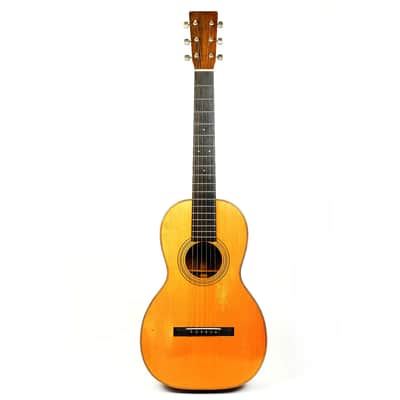
C. F. Martin 0-18 Model 32 Flat Top Acoustic Guitar (1932), ser. #52474, black tolex hard shell case.


C. F. Martin 0-18 Model 32 Flat Top Acoustic Guitar (1932), ser. #52474, black tolex hard shell case.
This seller has not set a shipping cost for Malta. Please contact them to ask about shipping.
Price€20,914.90
+ Shipping

Listed:5 hours ago
Views:60
Saves:7
Offers:0

Brooklyn, NY, United States
Our users rate Reverb
C. F. Martin 0-18 Model 32 Model Flat Top Acoustic Guitar (1932), made in Nazareth, PA, serial # 52474, sunburst top, natural mahogany back and sides finish, mahogany back, sides and neck, spruce top, rosewood fingerboard, black tolex hard shell case.
This is a really lovely and historic Martin, made at a crucial turning point in the company's history. This 14 fret version of the 0-18 was introduced in early 1932 as the "0-18 Special", sometimes later called a "Baby OM". At the time the Depression was at its worst, and one of the few things creating sales enthusiasm for Martin were the 000 sized 14-fret OM "Orchestra Model" guitars. To expand this new market, Martin applied the new formula to the smaller 0-18, creating a novel design that quickly supplanted the old 12-fret models, the first spread of the new 14 fret flat-top paradigm from the specialist OM's into the "standard" line.
This new-pattern Martin 0-18 was given the designation "Model 32" and first promoted in March, 1932 at the same $40 price as the old 0-18. Another new feature was a dark shaded top finish, shared in 1932 with the OM-18 making the "family resemblance" more overt. Quoted in Grieg Hutton's "Hutton's Guide to Martin Guitars" (a must have for the dedicated enthusiast) Martin wrote to a major dealer: "Our aim is to make it such a good value, with all the latest features, that a prospective customer would feel a real urge to buy it. It seems to take a lot of urge to pry a customer's dollars loose these days so we are hoping this new guitar will do the trick for the common good of dealers and for ourselves".
Fortunately for Martin and their dealers the "Model 32" was indeed a success, with 427 of them shipped in 1932. The older 12-fret 0-18 was instantly obsolete, and Martin eventually dumped the leftover inventory to dealers at bargain prices. The all-mahogany 0-17 was also altered to this "Model 32" pattern, and over the next few years Martin made 14-fret guitars the new normal, with the old 12-fret "standard" models being the outliers.
This 0-18 was built in late 1932, one of the last of the shaded-top "Model 32" version shipped; after December 1932 the 14-fret neck design remained, but the shaded top was discontinued except on special order. This lovely little guitar has a mahogany back, sides and neck with a delicately scallop-braced Adirondack spruce top, ebony bridge and the then-new tortoise celluloid pickguard. The body has tortoise celluloid outer binding with multi-purfling around the top and soundhole, nicely setting of the beautiful dark shaded finish. The neck has a slim soft-V profile topped with an ebony fingerboard that has small dot inlay done in particularly attractive abalone that seems to glow in the light. The headstock face is adorned with the earliest "C.F. Martin" logo, gold with no border.
This is not only a serious piece of Martin history but a superb playing and fine sounding example of one of these turning-point-in-history guitars, showing some notable old repair but still better preserved than many from this period. Although built in decent numbers over just this one year these "Model 32" 0-18s rarely turn up; this is the first one we have had and is a real honey. It rings with an amazingly deep and powerful tone for an 0-sized guitar, and looks divine in the process!
Overall length is 38 3/4 in. (98.4 cm.), 13 9/16 in. (34.4 cm.) wide at lower bout, and 4 1/4 in. (10.8 cm.) in depth at side, taken at the end block. Scale length is 24 3/4 in. (629 mm.). Width of nut is 1 3/4 in. (44 mm.).
This is a simply superb sounding guitar overall showing some typical wear and notable repair but no modifications. The finish is original except for the entire lower side, which was overfinished as part of a repair process. The rest of the lacquer remains original and has wear overall; the beautiful shaded top has heavier picking wear mostly to the area below the fingerboard extension and forward of the pickguard; the lower soundhole rim is worn into as well. The rest of the instrument shows dings, scrapes and scratches. The back of the neck is relatively clean with wear to the wood along both edges and a spot on the spine and a few small scuffs and dinks with a few feelable dings behind the sixth fret.
The body has several serious crack repairs on the treble side from what must have been a hefty bash long ago. A long repaired grain split runs through the center of the waist from the apex of the lower bout, with another shorter one above it, both solidly repaired. There is an impact crack repair running across these right at the apex of the lower bout, with the back/side join reinforced from the inside with putty. The entire lower side from the neck heel to the endpin was overfinished as part of these repairs, which are solidly done but visible.
The back has three tight grain cracks on opposite ends of the lower bout, neatly sealed with no overfinish, the one along edge of lower bout on the treble side sitting underneath the kerfing. The top has no cracks, neither does the upper side. The original tortoise celluloid pickguard is very solid with minimal shrinkage. The original ebony bridge shows some re-working with a repaired crack from bass side wing through low E to B bridge pin holes, solidly glued up but visible and has been fitted with a newer compensated bone saddle.
Internally the original delicate braces and tiny maple bridgeplate remain intact and unaltered. The neck has been neatly reset but the original bar frets are still intact, recrowned along the way with some light wear. The original open back Grover tuners appear long gone; modern repro Martin-branded tuners are currently fitted but marks on the back of the headstock indicate 1940s flat-plate Klusons were installed at one point. A strap button has been added on the heel. Despite some trauma in its past this is a fine playing and truly superb sounding 0-18, a historically important instrument residing in a modern HSC. Overall Very Good + Condition.
This is a really lovely and historic Martin, made at a crucial turning point in the company's history. This 14 fret version of the 0-18 was introduced in early 1932 as the "0-18 Special", sometimes later called a "Baby OM". At the time the Depression was at its worst, and one of the few things creating sales enthusiasm for Martin were the 000 sized 14-fret OM "Orchestra Model" guitars. To expand this new market, Martin applied the new formula to the smaller 0-18, creating a novel design that quickly supplanted the old 12-fret models, the first spread of the new 14 fret flat-top paradigm from the specialist OM's into the "standard" line.
This new-pattern Martin 0-18 was given the designation "Model 32" and first promoted in March, 1932 at the same $40 price as the old 0-18. Another new feature was a dark shaded top finish, shared in 1932 with the OM-18 making the "family resemblance" more overt. Quoted in Grieg Hutton's "Hutton's Guide to Martin Guitars" (a must have for the dedicated enthusiast) Martin wrote to a major dealer: "Our aim is to make it such a good value, with all the latest features, that a prospective customer would feel a real urge to buy it. It seems to take a lot of urge to pry a customer's dollars loose these days so we are hoping this new guitar will do the trick for the common good of dealers and for ourselves".
Fortunately for Martin and their dealers the "Model 32" was indeed a success, with 427 of them shipped in 1932. The older 12-fret 0-18 was instantly obsolete, and Martin eventually dumped the leftover inventory to dealers at bargain prices. The all-mahogany 0-17 was also altered to this "Model 32" pattern, and over the next few years Martin made 14-fret guitars the new normal, with the old 12-fret "standard" models being the outliers.
This 0-18 was built in late 1932, one of the last of the shaded-top "Model 32" version shipped; after December 1932 the 14-fret neck design remained, but the shaded top was discontinued except on special order. This lovely little guitar has a mahogany back, sides and neck with a delicately scallop-braced Adirondack spruce top, ebony bridge and the then-new tortoise celluloid pickguard. The body has tortoise celluloid outer binding with multi-purfling around the top and soundhole, nicely setting of the beautiful dark shaded finish. The neck has a slim soft-V profile topped with an ebony fingerboard that has small dot inlay done in particularly attractive abalone that seems to glow in the light. The headstock face is adorned with the earliest "C.F. Martin" logo, gold with no border.
This is not only a serious piece of Martin history but a superb playing and fine sounding example of one of these turning-point-in-history guitars, showing some notable old repair but still better preserved than many from this period. Although built in decent numbers over just this one year these "Model 32" 0-18s rarely turn up; this is the first one we have had and is a real honey. It rings with an amazingly deep and powerful tone for an 0-sized guitar, and looks divine in the process!
Overall length is 38 3/4 in. (98.4 cm.), 13 9/16 in. (34.4 cm.) wide at lower bout, and 4 1/4 in. (10.8 cm.) in depth at side, taken at the end block. Scale length is 24 3/4 in. (629 mm.). Width of nut is 1 3/4 in. (44 mm.).
This is a simply superb sounding guitar overall showing some typical wear and notable repair but no modifications. The finish is original except for the entire lower side, which was overfinished as part of a repair process. The rest of the lacquer remains original and has wear overall; the beautiful shaded top has heavier picking wear mostly to the area below the fingerboard extension and forward of the pickguard; the lower soundhole rim is worn into as well. The rest of the instrument shows dings, scrapes and scratches. The back of the neck is relatively clean with wear to the wood along both edges and a spot on the spine and a few small scuffs and dinks with a few feelable dings behind the sixth fret.
The body has several serious crack repairs on the treble side from what must have been a hefty bash long ago. A long repaired grain split runs through the center of the waist from the apex of the lower bout, with another shorter one above it, both solidly repaired. There is an impact crack repair running across these right at the apex of the lower bout, with the back/side join reinforced from the inside with putty. The entire lower side from the neck heel to the endpin was overfinished as part of these repairs, which are solidly done but visible.
The back has three tight grain cracks on opposite ends of the lower bout, neatly sealed with no overfinish, the one along edge of lower bout on the treble side sitting underneath the kerfing. The top has no cracks, neither does the upper side. The original tortoise celluloid pickguard is very solid with minimal shrinkage. The original ebony bridge shows some re-working with a repaired crack from bass side wing through low E to B bridge pin holes, solidly glued up but visible and has been fitted with a newer compensated bone saddle.
Internally the original delicate braces and tiny maple bridgeplate remain intact and unaltered. The neck has been neatly reset but the original bar frets are still intact, recrowned along the way with some light wear. The original open back Grover tuners appear long gone; modern repro Martin-branded tuners are currently fitted but marks on the back of the headstock indicate 1940s flat-plate Klusons were installed at one point. A strap button has been added on the heel. Despite some trauma in its past this is a fine playing and truly superb sounding 0-18, a historically important instrument residing in a modern HSC. Overall Very Good + Condition.
| Listed | 5 hours ago |
|---|---|
| Condition | Very Good (Used) Very Good items may show a few slight marks or scratches but are fully functional and in overall great shape.Learn more |
| Brand | |
| Model |
|
| Finish |
|
| Categories | |
| Year |
|
| Pickup |
|
| Series | |
| String Type |
|
| Right / Left Handed |
|
| Number of Strings |
|
| Neck Material |
|
| Finish Style |
|
| Top Material |
|
| Back Material |
|
| Body Shape |
|
| Sides Material |
|
| Fretboard Material |
|
| Model Family | |
| Color Family |
|
| Active Preamp |
|
| Number of Frets |
|
Product safety information may be available here.

