
Chase Bliss Audio Automatone MKII Preamp 2020 - 2024 - SIlver Excellent Condition Free Shipping
This seller has not set a shipping cost for Estonia. Please contact them to ask about shipping.


Chase Bliss Automatone Preamp MKII – Excellent – Original Box & Documentation– Free Shipping
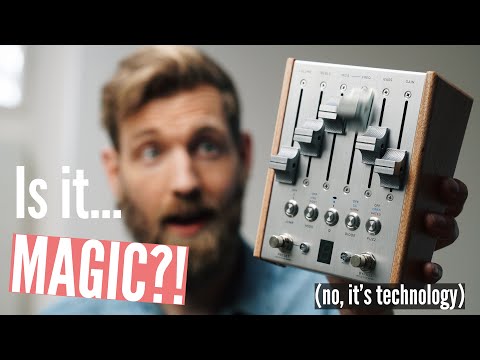
Fell in love with this effect the moment I saw it on Paul David's YT channel (see link). You will too! C-B made a very powerful pedal: boost, EQ, overdrive and fuzz pedals—but with all of these effects under preset and MIDI control. Hard to believe they don't make this any more!
Description
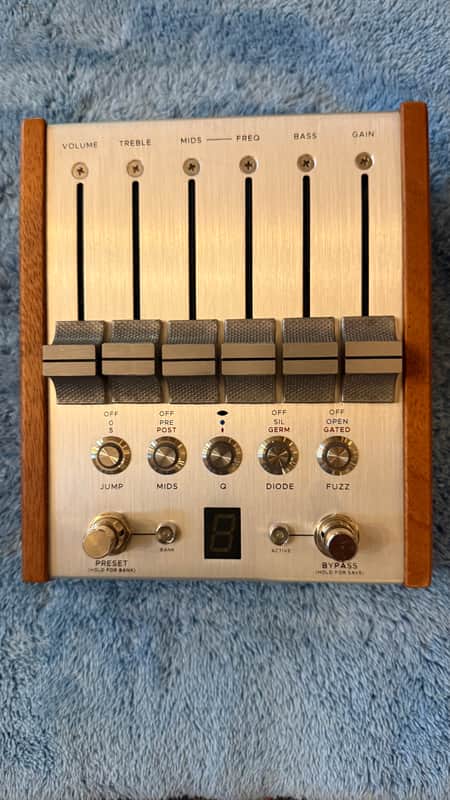
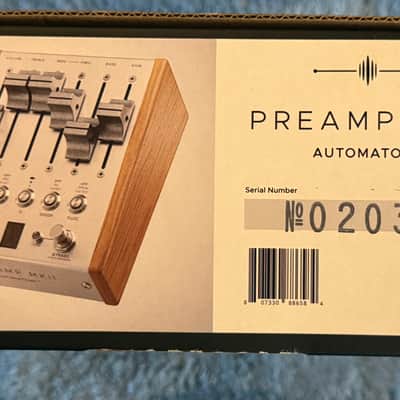
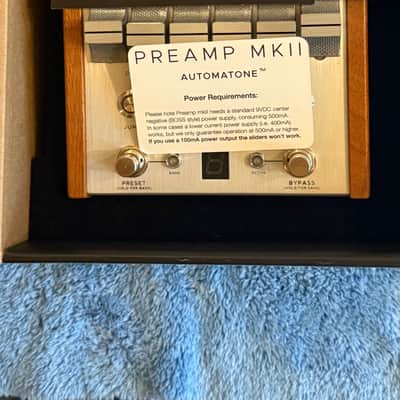
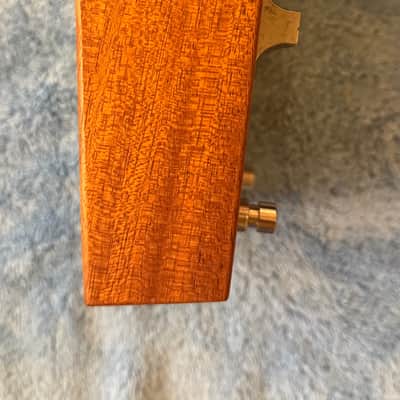
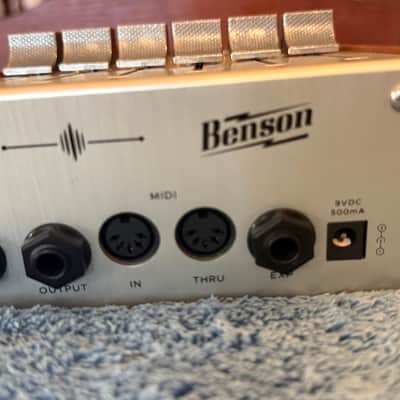
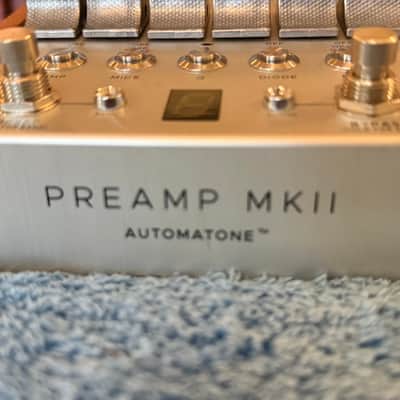
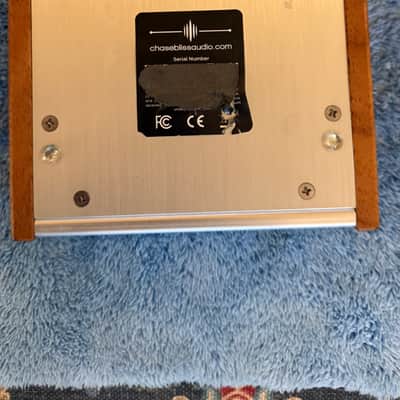
Chase Bliss Automatone MKII in Excellent condition, fully functional and very clean overall. Includes the original box, MIDI instructions, and electronics card.
The Automatone MKII is a highly flexible analog effects platform designed for players who want deep control, extensive MIDI capability, and precise recall without sacrificing an intuitive hands-on interface. Chase Bliss is known for combining analog circuitry with advanced digital control, making this a strong fit for both pedalboard use and studio integration.
Features
- Advanced analog effects architecture
- Extensive MIDI control and preset integration
- Highly adjustable parameters for detailed sound shaping
- Designed for both live performance and studio use
- Premium Chase Bliss build quality
- Compact format with deep programmability
Condition
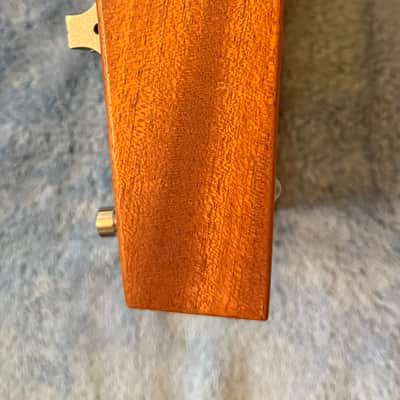
Excellent. Very clean overall with only light signs of careful use. Please review the photos closely for the exact cosmetic condition.
Included
- Chase Bliss Automatone MKII
- Original box
- MIDI instructions
- Electronics card
FREE SHIPPING within the continental United States.
A great option for anyone looking for a high-end Chase Bliss pedal with the original packaging and documentation included.
For those interested in the history and some cool insights on the Automatone...continued reding
Executive Summary
Chase Bliss Automatone Preamp MKII, the first pedal in Chase Bliss’s Automatone format and one of the most ambitious programmable analog gain pedals ever produced. Developed with Christopher Benson of Benson Amps, it combines a Benson Chimera-derived analog preamp, parametric midrange EQ, selectable silicon/germanium clipping, open and gated fuzz, 30 presets, MIDI/CV/expression control, and six motorized “flying” faders that physically move to their saved positions when presets are recalled. Most importantly, the audio path remains 100% analog despite the extensive digital control system.
This is a particularly compelling piece for a player who would otherwise need several separate boost, EQ, overdrive and fuzz pedals—but wants those sounds under preset and MIDI control.
What Makes This Special
The Preamp MKII is not simply an overdrive with presets. Its basic preamp architecture comes from the front end of the Benson Chimera tube amplifier, with FET transistors substituted for the amp’s 12AX7 triode stages. Around that core, Chase Bliss added a ±18 dB parametric midrange section adapted from its Condor, variable mid frequency, selectable mid-Q, pre/post positioning of the mid circuit, three clipping structures, and two dedicated fuzz modes.
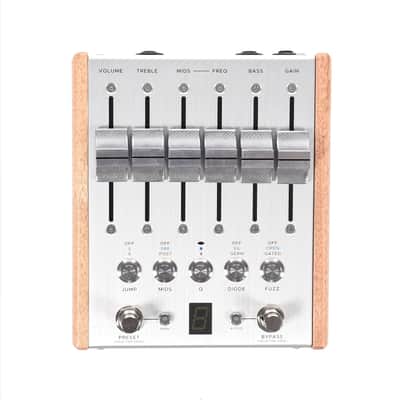
The six main faders—Volume, Treble, Mids, Frequency, Bass and Gain—are motorized. Recall a preset and the faders physically travel to the stored positions, so what you see on the pedal corresponds to what you hear. The same faders can respond dynamically to MIDI, expression, or CV. Chase Bliss gives the pedal 30 onboard presets, divided into three banks of 10.
The audio itself stays analog: Chase Bliss explicitly specifies an all-analog signal path, with the digital system handling control, memory and fader movement rather than digitizing the core gain sound. That combination—analog dirt plus automated physical recall—is what distinguishes the Automatone architecture from more conventional MIDI-capable drive pedals.
It is equally useful as a restrained tone-shaping preamp or as the main gain section of a sophisticated MIDI rig. The official architecture spans clean boost, low-gain breakup, overdrive, aggressive clipping and two very different fuzz responses.
History of This Effect / Unit
The official name is Chase Bliss Preamp MKII, and it was the first Automatone product. Chase Bliss developed it in collaboration with Christopher Benson, using the front-end concept of Benson’s Chimera amplifier and expanding it with Chase Bliss control architecture. The project was shown in prototype form around the 2019 NAMM period and reached the market in 2020; Reverb catalogs production as 2020–2024. Contemporary launch coverage placed the original price at approximately $749.00.
Production was later discontinued. Chase Bliss states that the Preamp MKII was among a group of pedals affected by changing EU/UK RoHS requirements involving a light-dependent-resistor/vactrol component containing cadmium sulfide. Chase Bliss’s legacy announcement also says it extended its lifetime repair warranty to the Preamp MKII, although a used buyer should confirm current eligibility and transferability directly with Chase Bliss rather than treating that as a seller warranty.
That discontinuation is important from a buyer’s perspective: this is no longer simply a high-end current-production overdrive competing on retail price. It is now a finite-production Chase Bliss/Benson design with a mechanical control system that Chase Bliss has not replicated in its standard compact pedal format. Reverb identifies examples as U.S.-made and places the model in its overdrive/boost and preamp categories.
Key Features & Benefits
The Benson-derived preamp provides the core dynamic gain structure, designed to move naturally from clean boost through breakup and heavier overdrive rather than behave as a single fixed clipping voice. The three diode choices are transistor-only, symmetric silicon, and asymmetric germanium; the official manual describes the silicon mode as tighter/more compressed and the germanium option as an asymmetric alternative.
The parametric midrange section is unusually powerful for a dirt pedal. Mids can be boosted or cut by approximately ±18 dB, the center frequency is continuously adjustable from roughly 150 Hz to above 4 kHz, the Q can be switched among wide, focused, and narrow responses, and the entire mid circuit can be placed before or after the preamp. That means the Mids/Frequency section changes not only EQ but, when positioned pre-gain, how the clipping itself responds.
The two fuzz modes sit before the preamp and midrange circuitry. Open fuzz is the larger, less constrained voice; gated fuzz produces a tighter, more splatty and compressed response. Chase Bliss notes that the fuzz circuit has a low input impedance and works best directly from a guitar, an important consideration for players arranging complex pedalboards.
For live and MIDI users, the 30 internal presets are a major advantage. Program Change 0–29 recalls presets 0–29, while CC #27 with values 0–29 can save the current configuration directly to the corresponding preset slot. A preset can also be stored from the pedal itself by holding the Save/Bypass control according to the manual.
Other official specifications include mono input/output, MIDI PC/CC support, CV and expression control, true bypass, a 9 V DC center-negative supply requirement at approximately 500 mA, and chassis dimensions of roughly 5.75 × 6.5 × 2.5 inches.
Famous Artists / Acts / Studios That Use It
The Preamp MKII has credible documented use in professional touring rigs rather than merely celebrity promotional demos.
Billy Strings had an Automatone MKII Preamp documented in his 2023 touring rack by Premier Guitar, in a MIDI-controlled system centered around an RJM Mastermind GT.
Rhett Shull uses one in his live board, with Premier Guitar specifically reporting that he calls on the Automatone for boost, EQ, fuzz, or overdrive depending on the song—almost exactly the use case the design was intended to solve.
Dweezil Zappa carries a Preamp MKII in the rack section containing much of his dirt arsenal, as documented in his 2025 Premier Guitar Rig Rundown.
Celisse Henderson, then associated with Lizzo’s touring work, named the Chase Bliss/Benson Preamp MKII her No. 1 pedal in Premier Guitar in 2020 and specifically highlighted its ability to cover boost, transparent-style overdrive, lead sounds, gated fuzz and open fuzz.
More recently, Logan MacKenzie, touring with Hayley Williams and also associated with Paramore, was documented in 2026 using an Automatone Preamp MKII on an RJM-controlled board alongside a Chase Bliss CXM 1978, Eventide H9 and Strymon TimeLine.
Tips and Tricks
5 EXTRAORDINARY SOUNDS TO TRY
The Preamp MKII goes far beyond a conventional overdrive. Its combination of Benson-derived preamp circuitry, selectable clipping, Open/Gated fuzz, routable parametric mids, three Q settings, motorized faders and expression control makes it capable of sounds ranging from touch-sensitive amp breakup to resonant, almost synth-like fuzz. (Chase Bliss)
Note: Fader settings below use an easy 0–10 scale — 0 = fader fully down, 10 = fully up. These are starting points rather than factory presets; adjust Volume for your amp and guitar.
1. “TONE PONY” — GERMANIUM MID-PUSH DRIVE
A thick, harmonically rich overdrive with a pronounced mid push and excellent note separation. Chase Bliss specifically describes the asymmetrical Germanium clipping mode as providing a “tone pony” flavor. (manualzz.com)
- Volume: 6.5
- Treble: 6
- Mids: 6.5
- Freq: 4.5
- Bass: 4.5
- Gain: 5
- Mids Routing: POST
- Q: BLUE / Focused
- Diode: GERM
- Fuzz: OFF
- Best For: Big rhythm guitars, articulate leads, blues, indie and stacking into another drive.
- Try This: Roll the guitar volume back and the sound becomes cleaner without losing its basic tonal character.
2. “TUBE SQUEEZER” — FOCUSED SILICON LEAD
A tighter, more compressed drive with controlled bass and a focused midrange that can help a lead line stand forward in a dense mix. The symmetrical Silicon clipping mode is the MKII’s tighter “tube squeezer” flavored option. (manualzz.com)
- Volume: 6.5
- Treble: 5.5
- Mids: 7.5
- Freq: 5.5
- Bass: 3.5
- Gain: 6.5
- Mids Routing: POST
- Q: BLUE / Focused
- Diode: SIL
- Fuzz: OFF
- Best For: Solos, classic rock, blues-rock, alternative and pushing an already breaking-up amp.
- Try This: Raise Mids toward 8 and move Freq slowly until the guitar finds the exact part of the mix where it jumps forward.
3. “OPEN FUZZ WALL” — MASSIVE, WIDE-OPEN FUZZ
This is where the Automatone stops behaving like a sophisticated preamp and becomes enormous. OPEN engages the MKII's low-impedance silicon fuzz ahead of the preamp and midrange circuitry. Chase Bliss describes Open as its powerful, massive fuzz setting. (Chase Bliss)
- Volume: 5.5
- Treble: 4
- Mids: 3.5
- Freq: 4.5
- Bass: 7.5
- Gain: 8
- Mids Routing: POST
- Q: OFF / Wide
- Diode: OFF
- Fuzz: OPEN
- Best For: Huge riffs, doom, stoner rock, shoegaze, power chords and sustaining single-note lines.
- Try This: Run the guitar directly into the MKII when possible. Chase Bliss notes that the fuzz is intentionally low impedance and responds particularly well to a direct guitar connection. (Chase Bliss)
4. “VELCRO MACHINE” — GATED, SPUTTERING FUZZ
A deliberately broken, aggressive fuzz texture with abrupt decay, sputter and gated attack. This is one of the sounds that immediately demonstrates why the MKII is much more than a programmable overdrive.
- Volume: 6
- Treble: 4
- Mids: 6.5
- Freq: 6
- Bass: 5
- Gain: 9
- Mids Routing: POST
- Q: RED / Narrow
- Diode: OFF
- Fuzz: GATED
- Best For: Jack White-style garage textures, industrial sounds, octave-style riffs, experimental leads and deliberately unstable fuzz.
- Try This: Use short, staccato notes and let the gate become part of the performance. The Gated mode is designed for the MKII's squashed, penetrating, stop/start fuzz character. (Chase Bliss)
5. “RESONANT FUZZ SWEEP” — EXPRESSION-CONTROLLED FILTER MAYHEM
One of the most unusual things you can do with the Preamp MKII: combine Gated fuzz with its very narrow parametric EQ and then sweep the FREQ fader with an expression pedal. Instead of simply changing the amount of distortion, you move a sharply emphasized frequency through the fuzz sound, creating wah-, filter- and synth-like movement. The MKII's midrange can sweep from roughly 150 Hz to just over 4 kHz, and its faders can respond to expression/CV control. (Squarespace)
- Volume: 5.5
- Treble: 4.5
- Mids: 8.5
- Freq: Start around 2 and sweep toward 9
- Bass: 5
- Gain: 8
- Mids Routing: POST
- Q: RED / Very Narrow
- Diode: OFF
- Fuzz: GATED
- Expression: Assign the FREQ fader and sweep it with your foot
- Best For: Experimental guitar, synth-like leads, psychedelic passages, transitions, noise rock and studio sound design.
- Try This: Hold a sustained note or chord while slowly sweeping FREQ. Then try the same sweep rhythmically. With the narrow Q and gated fuzz working together, the MKII can move into territory that sounds more like an animated filter than a conventional dirt pedal.
BONUS TIP — SAVE THEM AND WATCH THE FADERS FLY
Once you find versions of these sounds that match your guitar and amp, save them into the MKII's 30 onboard preset locations. Changing presets recalls the sound immediately and the six motorized faders physically move to their saved positions. The JUMP function can also be programmed to move quickly to Preset 0 or 5, making radically different sounds available with minimal footwork. (manualzz.com)
These settings are intended as creative starting points, not claimed factory or artist presets. The control functions and signal-routing behavior are based on Chase Bliss's documentation.
These examples are especially revealing because they show how the MKII is meant to be programmed: the faders are only half the equation. Mids PRE versus POST determines whether the parametric EQ shapes what hits the clipping stage or shapes the result after it, while Q determines how broadly or surgically the mid adjustment operates. The Diode and Fuzz buttons then change the gain topology itself.
For any of the five sounds, dial in the faders and switches, then save it locally using the pedal’s save procedure. In a MIDI rig, send CC #27 with a value from 0–29 to write the current configuration to that slot. Later, send Program Change 0–29 to recall the corresponding preset. Because the faders are motorized, they will physically move to the saved settings on recall.
For anyone wanting to hear how broad the gain range actually is, one of the better external demonstrations is That Pedal Show’s comparison against benchmark Klon, King of Tone and Fuzz Face-style sounds; Paul Davids also produced a detailed musical demonstration, while Chase Bliss published its own deep-dive and mini-documentary.
| Listed | 3 hours ago |
|---|---|
| Condition | Excellent (Used) Excellent items are almost entirely free from blemishes and other visual defects and have been played or used with the utmost care.Learn more |
| Brand | |
| Model |
|
| Finish |
|
| Categories | |
| Year |
|
| Made In |
|
Product safety information may be available here.

