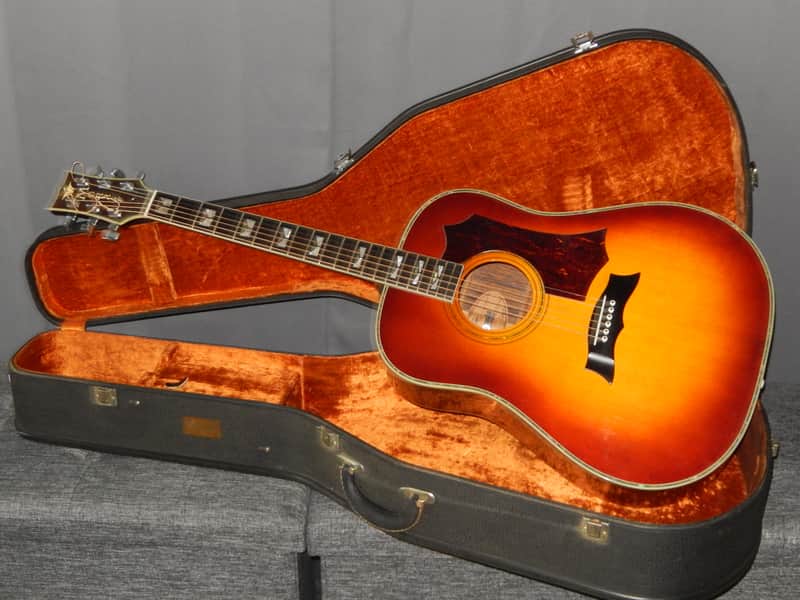
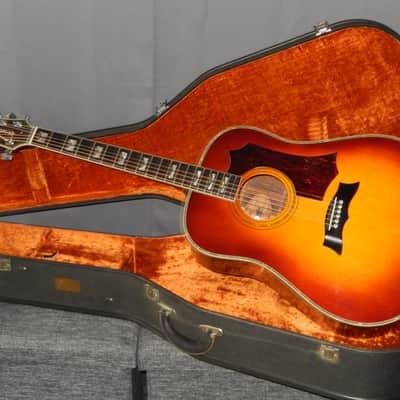
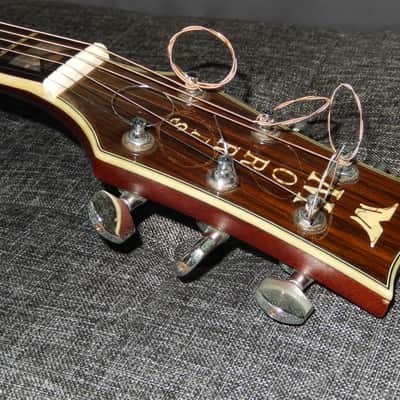
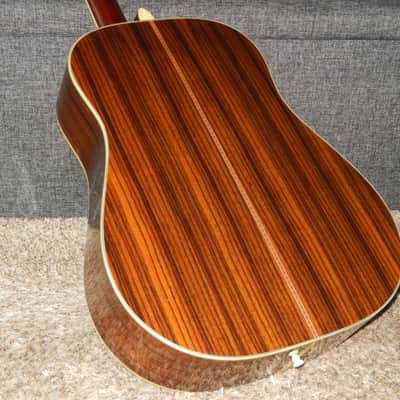
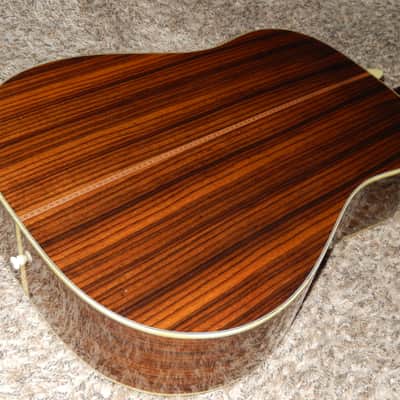
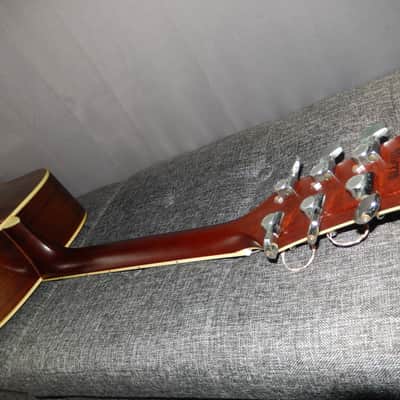
MADE IN JAPAN 1991 - MORRIS MG60 - SUPERB - GIBSON STYLE - ACOUSTIC GUITAR
This seller has not set a shipping cost for Croatia. Please contact them to ask about shipping.


Our users rate Reverb
Morris MG60 1991 acoustic guitar
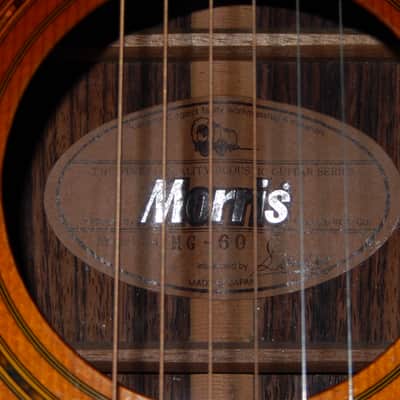
This guitar was handmade in the early 1990s by best Morris’s luthiers at their Matsumoto workshop led by Headmaster Luthier Shinji Tanimura. It was a part of Morris's regular line. In earlier years (since 1981) the same model was labelled as MG600.
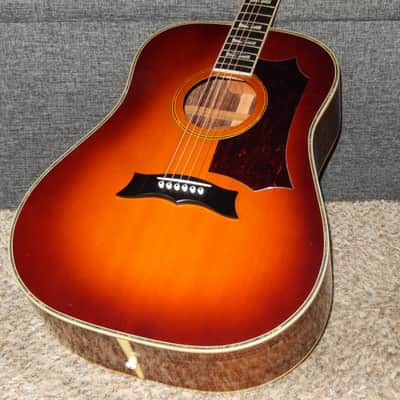
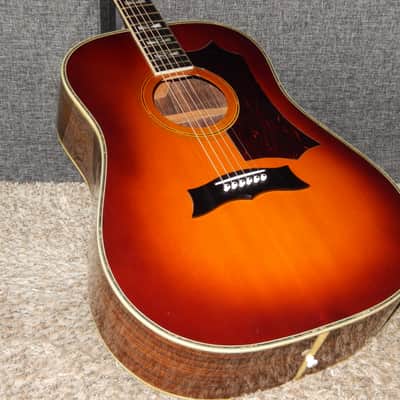
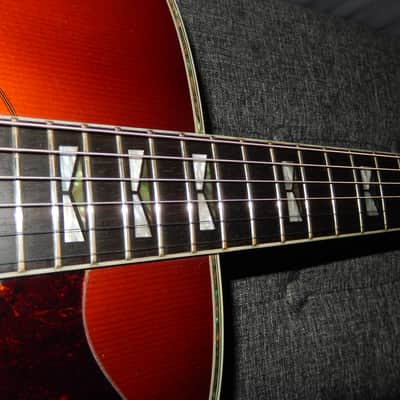
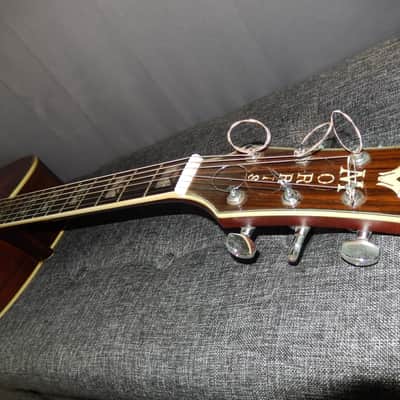
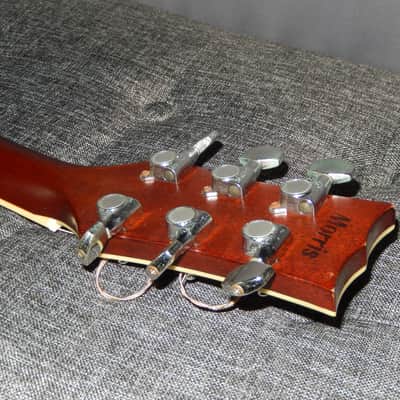
In 1990s Morris co. was already one of major Japanese acoustic guitar makers and TF (Martin dreadnought style) models highly regarded all around the world. Models MG are often described as copies of Gibson guitars. Their body outline and bridge shape somewhat resemble Gibson Dove. However, fingerboard abalone inlays are very similar to those used by Guild, while headstock and pickguard resemble Grammer guitars. Soundboard X bracing is very similar to Martin's.
All I know for sure is that this terrific instrument can easily challenge many higher end guitars sold under mentioned above brand names. It wasn't a cheap guitar at all.
This guitar was really made in late 1990s and is no match to the guitar I am offering you:
https://reverb.com/item/94580707-morris-mg-60-1977-natural-made-in-japan-solid-spruce-top
As of today, Japanese factory made solid top guitars of similar construction and looks are priced at $2500 level. However, in terms of volume and tonality they stand no chance against a 35 year old vintage guitar. Only guitars made with 35 years old woods could do that (after being frequently played for at least a couple of years). This will be rather difficult to order such a guitar, because woods seasoned for so long are very hard to find. Guitars made in Japan with (only) 20 years old tops are priced at $4500 level. A similar class solid top guitar made by a well-established individual American luthier, can easily cost you 50% more. If you'd like to add solid back and sides made with 20 years old Indian Rosewood the price may very well double. If, however, you wanted to go "all the way" and have old growth Brazilian Rosewood b/s you need to be prepared for the price at $25000 level.
NONE OF THESE GUITARS WILL SOUND MUCH BETTER (IF BETTER AT ALL) THAN THE ONE YOU ARE LOOKING AT RIGHT NOW!
This guitar offers impressive volume and superb response. Its sound is ultra-rich yet very sweet and rather mellow. Basses are deep but very “clean”. Trebles are metallic but very sweet at the same time. All notes have their unique colors, all are super clear and super well separated. When chords/arpeggios are played guitar releases plenty of overtones and harmonies. Sustain is so extended that one can feel like playing electric guitar.
While one can find a few very small dents and couple very light scratches within the finish on the soundboard, the overall condition of this guitar can be described as "excellent for its age". Very importantly its neck is straight, fingerboard and frets with rather minimal signs of use, while neck body angle allows for quite low action. Original tuners lost a good bit of their original luster and have a bit of rust on their washers yet are fully functional and work smoothly with exception for G3 key working somewhat tighter. You can use them "as they are" and there is no need to replace them.
Specification:
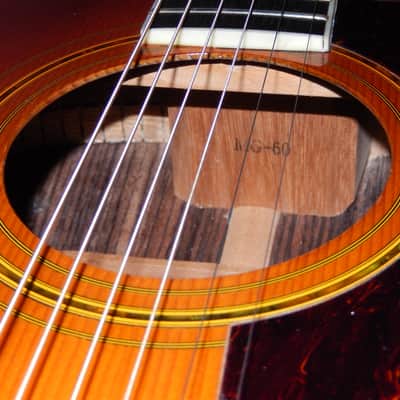
Top: Thin plate of very tight grain Solid Spruce with reinforcing ring of wood glued underneath the sound-hole /Martin style X bracing with not scalloped braces /very light gloss finish
Back & Sides: Indian Rosewood “laminates” /lacquer
“Laminated” is quite unfortunate term regarding Japanese made guitars. These plates were made from 2 layers of solid wood glued together with natural resins. They were made so well that they performed as good as solid wood while being far less expensive in guitar production and far more resistant to cracking in regular use. In recent years many guitar makers around the world adopted a new term "semi-solid" to describe these plates.
Neck: Mahogany with 2-way truss rod
Fingerboard: Ebonized Rosewood
Nut width: 43mm
Scale: 650 mm
Original action is set to 2.20 mm under E6 and 1.80 mm under E1, with very little extra room on the saddle.
This guitar will be shipped in a used Yamaha hard shell case.
THE ONLY PURPOSE OF THIS CASE IS TO PROTECT THE GUITAR DURING SHIPMENT. I WILL NOT PROVIDE ITS DETAILED DESCRIPTION OR MAKE ADDITIONAL PICTURES, NOR I WILL ACCEPT ANY COMPLAINTS. IF YOU DON’T LIKE THIS CASE YOU WILL NEED TO BUY A DIFFERENT ONE.
IF YOU BUY A GUITAR, YOU MUST ANTICIPATE TAKING IT TO YOUR LOCAL GUITAR SHOP FOR FINAL ADJUSTMENTS CALLED “SETUP”. STRING BUZZ DOESN’T MEAN THAT GUITAR IS DEFECTIVE.
My posted for sale guitars are stored in climate-controlled vault already packed into shipping boxes, with loosen strings. Because the strings are loosened, they don’t pull the neck or soundboard, and the neck may relax (straighten more) and the soundboard flatten a bit, which may result with the string action being lower than my it was with my original settings and lead to buzzes and/or dead notes after guitar arrives to you. Such a change in neck curvature can also happen just because of vibrations during the shipment and/or temperature fluctuations. Therefore, you must be ready to make final action adjustment yourself and or have it done by professional. All that really needs to be done is the simple neck adjustment by using the truss rod (turning the truss rod counterclockwise will relief the neck and strings will move away from the frets).
THAT IS WHY TRUSS RODS ARE INSTALLED IN THE NECKS OF ACOUSTIC GUITARS!!!
Moridaira (Morris Guitars)
Founded in 1967 by Toshio "Mori" Moridaira, the Moridaira factory produced high-quality guitars, including the infamous Morris badged guitar. Moridaira also produced badged guitars for Hohner including Coronado, Futurama, H.S. Anderson, Lotus (some) and Sakai.
The Morris Guitars company has been building quality handcrafted instruments in Nagano, Japan for a long time. Mr. Toshio Moridaira, the founder, was the first distributor in Japan to carry both Fender and Gibson lines. In 1964, due to his working relationship with Gibson, Mr. Moridaira was able to visit the Gibson factory in Kalamazoo, Michigan. An employee at Gibson nicknamed him “Mori” at that time.
In 1967, he founded the Morris Guitars company. He named it Morris, taken from the nickname given to him a while back. Morris produced copies of dreadnought and small jumbo models based on Martin and Gibson designs. Since then, Morris Guitars have enjoyed an outstanding reputation in Japan and other countries for making high quality guitars.
In 1974, Morris introduced their guitars at the NAMM show. In 1978, Morris introduced the Tornado line, thin body acoustic-electric guitars inspired by the Ovation design. Up until the early 80s, the U.S. market saw a variety of guitars that Morris imported from Japan.
In 2001, after a lengthy absence, Morris Guitars re-entered the U.S. market. They participate in the annual Winter NAMM Show in Anaheim, CA. Morris Guitars currently offer a wonderful line of fingerstyle guitars with a middle price range. Custom hand-built models are also available. Today, Morris Guitars are played by some of the world’s finest fingerstyle guitarists. Our products are available through a small number of dealers here in the U.S.
This item is sold As-Described
This item is sold As-Described and cannot be returned unless it arrives in a condition different from how it was described or photographed. Items must be returned in original, as-shipped condition with all original packaging.Learn More.
| Listed | 7 months ago |
|---|---|
| Condition | Excellent (Used) Excellent items are almost entirely free from blemishes and other visual defects and have been played or used with the utmost care.Learn more |
| Brand | |
| Model |
|
| Finish |
|
| Categories | |
| Year |
|
| Made In |
|
| Body Shape |
|
Product safety information may be available here.

