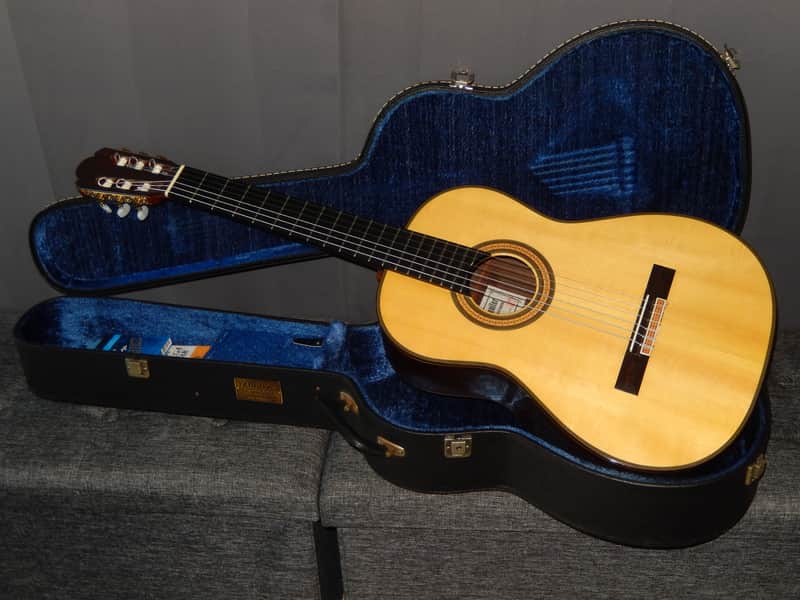
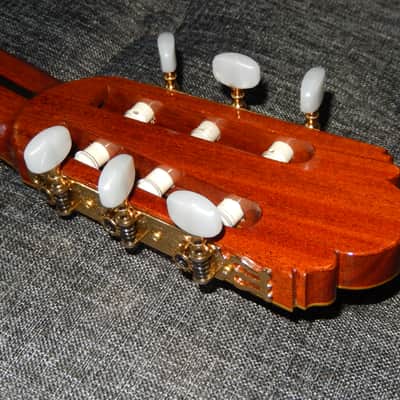
TARREGA TGE 1982 - MADE IN JAPAN - TORRES STYLE CLASSICAL CONCERT GUITAR
This seller has not set a shipping cost for Austria. Please contact them to ask about shipping.


Our users rate Reverb
Tarrega TG-E 1982
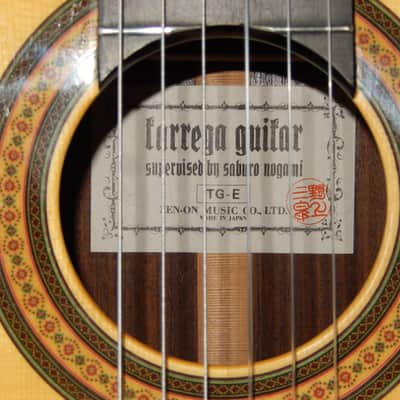
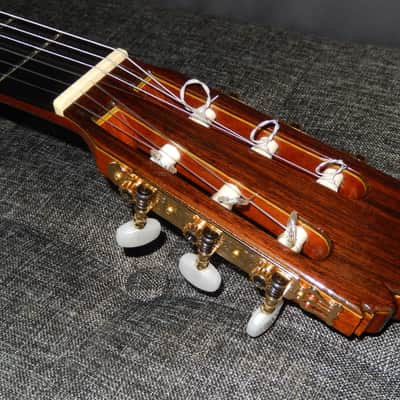
This guitar was ordered by Zen On Music co. and made in 1982 under supervision of legendary Japanese luthier Saburo Nogami. The names of actual makers were never published. TGE was highest end limited edition model within Tarrega guitars line.
Founded in early 1930s Zen-On is a highly reputable Japanese music score and musical instruments distributor. Zen-On had its own guitar manufacture until 1968. In later years Zen-On instruments were made by independent workshops led by great luthiers Toshihiko Hogawa, Shoichi Yanagisawa, Hiro Tamura and Saburo Nogami. There have been countless guitar models and brands sold under Zen-On umbrella, from beginner level to highest end ones. Tarrega guitars line was one of many sold under Zen-On umbrella.
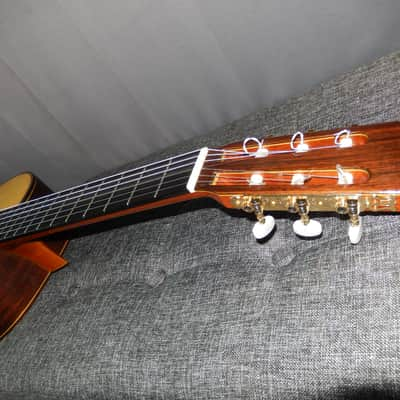
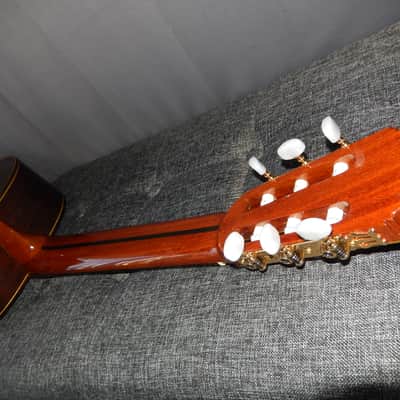
Although made with somewhat different style headstock the shape and construction of this guitar are based on Torres blueprints. Besides Saburo, Kazuo Yairi was the only other Japanese manufacturer making similar Torres style guitars. Both luthiers were friends and frequently cooperated on various projects, with Saburo designing and supervising production of several models sold with Kazuo's label.
Saburo Nogami was the first ever apprentice at Masaru Kohno workshop. He joined Kothe in 1959 and left his workshop in the early 1970s. Saburo Nogami's level of craftsmanship was at least equal to Kohno’s, and he became a luthier legend on his own. During his long career besides making regular classical guitars, he was also making alto, bass & contrabass guitars, lutes, vihuelas, and many traditional Japanese string instruments. Many of these "exotic" instruments were greatly decorated with carvings and paintings and made as "only one of its kind". Saburo Nogami's guitars and other instruments were and still are highly priced not only in Japan.
Saburo Nogami however was deeply engaged in making guitars for average "boy and girl". In mid 1970s Saburo supervised production of several guitar models made for Zen-On Music Co, Niibori School of Guitar Ensemble and Nishin Kogyo Co. Great majority of these guitars were made with "laminated" b/s. Laminated is quite "unfortunate" term regarding Japanese made guitars. These "laminates" were made from 2 layers of solid wood glued together with natural resins. They were made so well that they performed as good as solid woods while being far less expensive in guitar production. Since late 1970s through late 1990s Saburo Nogami was also closely cooperating with Kazuo Yairi, supervising production of many Kazuo Yairi's models at Yairi's Gifu factory. Yet again most of these absolutely wonderful instruments were made with "laminated" b/s.
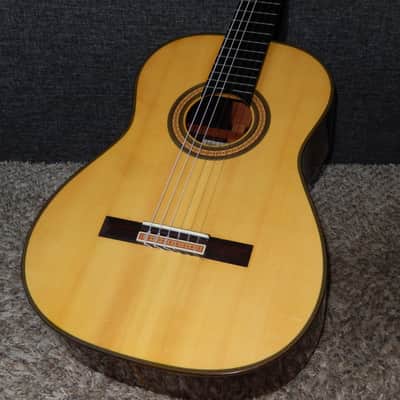
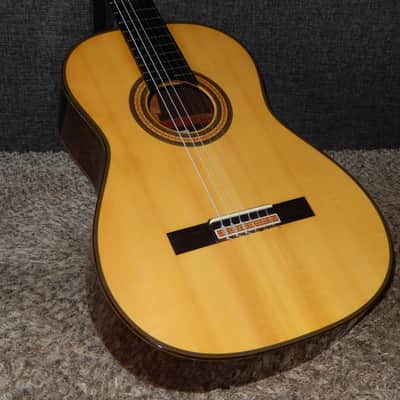
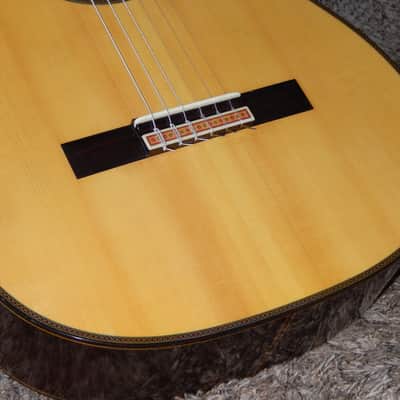
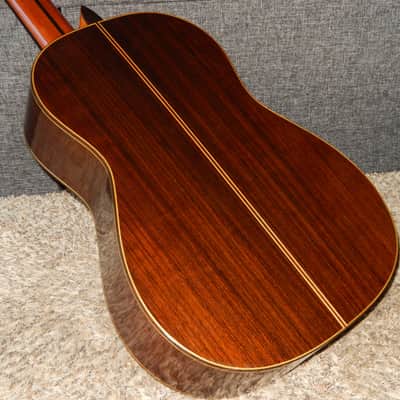
Despite having repaired crack on the soundboard (below the bridge, between strings E1 and B2) this guitar remains in "near mint" overall condition. Its body bears only few other very minor cosmetic imperfections, while the condition of its fingerboard and frets proves that this is practically unused instrument. The crack on the soundboard must have occurred during storage.
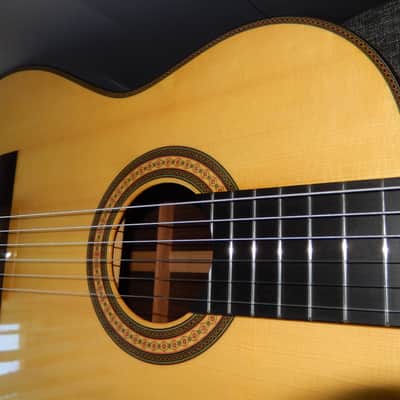
This guitar being made in Torres style has slightly smaller & somewhat narrower than average body, hence looks little "elongated". Despite its smaller size the body of this guitar delivers great volume combined with truly breathtaking tonality, very clear, glassy, yet very colorful trebles, somewhat metallic basses, all very well separated, and all with impressive sustain.
The same grade brand new guitars currently made by Japanese luthiers are priced at $10000 level.
Regarding the sound alone, this guitar is very competitive to $15000 Torres style guitars currently made by leading European or American guitar makers.
Specifications:
Top: AAA Grade Solid Spruce/shellac
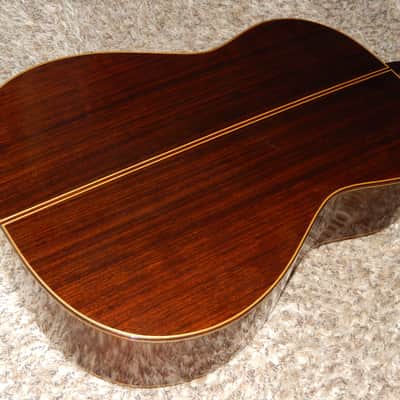
Back & Sides: Solid Indian Rosewood/lacquer
Neck: Mahogany with Ebony insert
Fingerboard: Ebony
Scale: 650 mm
Nut width: 50 mm
Its current action is set to 3.30 mm under E6 and 2.80 mm under E1, with still extra room on the saddle.
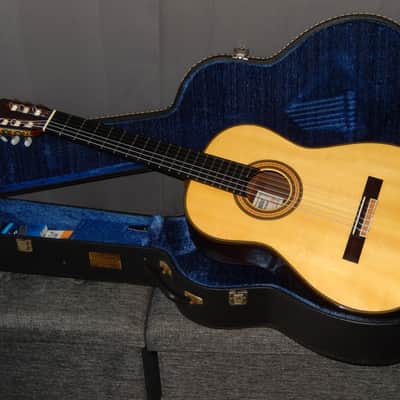
This guitar will be shipped in used original hard case in still good condition.
THE ONLY PURPOSE OF THIS CASE IS TO PROTECT THE GUITAR DURING SHIPMENT. I WILL NOT PROVIDE ITS DETAILED DESCRIPTION OR MAKE ADDITIONAL PICTURES, NOR I WILL ACCEPT ANY COMPLAINTS. IF YOU DON’T LIKE THIS CASE YOU WILL NEED TO BUY A DIFFERENT ONE.
WHEN YOU BUY ANY GUITAR, YOU MUST ANTICIPATE TAKING IT TO YOUR LOCAL GUITAR SHOP FOR FINAL ADJUSTMENTS CALLED “SETUP”. DEPENIDNG ON YOUR PLAYING TECHNIQUE, THIS SETUP ON USED GUITARS MAY INCLUDE NEW CUSTOM-MADE NUT AND SADDLE. IF YOU HEAR STRING BUZZ IT DOESN’T MEAN THAT GUITAR IS DEFECTIVE. IF YOU PLAY HARD ENOUGH ALL BASS STRINGS WILL BUZZ OVER THE FRETS, UNLESS THEY ARE SUSPENDED VERY FAR FROM THE FINGERBOARD. UNLESS YOU PLAY QUITE GENTLY, YOU CAN’T HAVE LOW ACTION AND NO BUZZES. KEEP IN MIND THAT CELLO-LIKE BASSES ON HIGH GRADE CLASSICAL GUITARS HAVE THEIR NATURAL “BUZZ”.
Real Value of Japanese Vintage Guitars
The key to understand value of vintage Japanese guitars is to acknowledge galloping price inflation throughout the late 1960s and 1970s with its peak of 25% in 1974.
During 1960s and most of 1970s model numbers of Japanese guitars were strictly connected with their prices in Japanese yen.
The same class guitar sold in 1970 for 100 000 yen (labelled as model 10), would be sold for 150 000 yen in 1972 (labelled as model 15), 200 000 yen in 1974 (labelled as model 20) and 300 000 yen in 1978 (labelled as model 30). Therefore, you shouldn’t be surprised that two Yamaha GC10 guitars made 10 years apart are two instruments of totally different class. The same rule applies to all guitar models made by all other Japanese makers.
Japanese inflation slowed down in the 1980s. By the early 1980s and during following decades model numbers were no longer strictly associated with their prices. Some Japanese guitar makers introduced model names instead of model numbers. For several economic reasons, since 1980s Japanese made guitars were becoming more and more expensive, while their exports slowing down. Today (2025) Japanese high end classical guitar models are priced at $20000USD level.
| Listed | 5 years ago |
|---|---|
| Condition | Excellent (Used) Excellent items are almost entirely free from blemishes and other visual defects and have been played or used with the utmost care.Learn more |
| Brand | |
| Model |
|
| Finish |
|
| Categories | |
| Year |
|
| Made In |
|
| Body Shape |
|
Product safety information may be available here.

