New Systems Instruments Discrete Map & D Map A / B / C Expander

Free Shipping
from DongHe Township, Taiwan


Our users rate Reverb
mint like new, barely used
A continuous-time sequencer for autonomous and controlled music
Discrete Map is designed to integrate sequencing with modular time, the natural motions of your modular system, allowing for new, organic methods of composition, control, and generation. It is designed from the ground up for finer control and more complex synchronizations than a conventional sequencer can produce, with explicit concern for generative, autonomous patches.
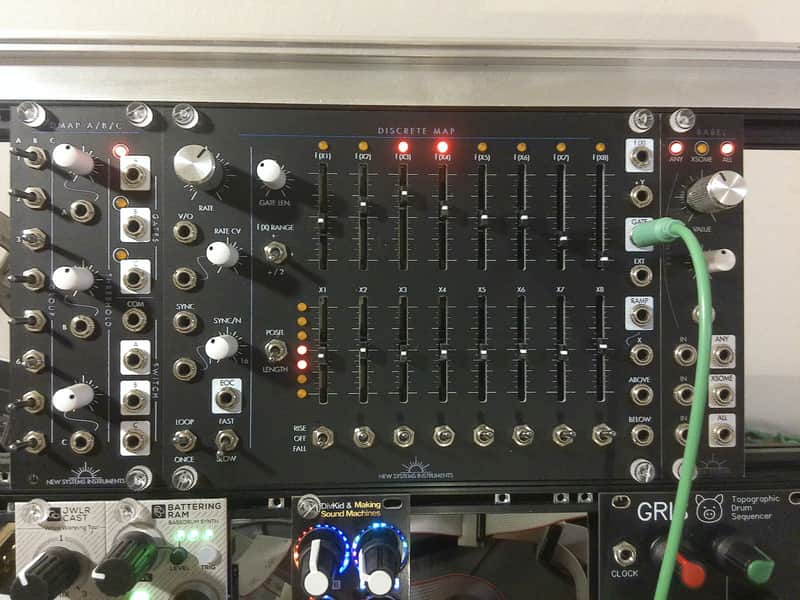
The lower section sets 8 rising or falling thresholds, and whenever the X input signal crosses those thresholds, the corresponding stage is activated. There is also a second mode for the lower sliders, where the sliders control the relative length between thresholds instead of the absolute position of those thresholds. The upper section controls the f (X) voltage that each stage produces when that stage is activated. For situations where these thresholds are purely temporal, the internal clock provides a ramp wave as an ideal means to transform time into voltage.
At its most basic, Discrete Map creates a repeating measure or phrase, where the lower sliders control either the position or the duration of each note, and the upper sliders control the pitch. However, when integrated with other elements of your modular system, the operation of Discrete Map can become arbitrarily complex. In a given patch, Discrete Map can be set up to behave as:
An LFO-synced sequencer
A responsive event generator
A quantizer, harmonizer, or chord generator
A 16 or 24 step sequencer (with two or three Discrete Maps)
A gate sequencer (with the A / B /C Expander)
A sequential switch (with the A / B / C Expander)
Discrete Map runs direcly on logic circuits and analog electronics, and does not contain a conventional DAC/ADC or microprocessor. Consequently, all parameters operate at audio rate without a limiting sample rate or bit depth. At audio rate, uses include:
A graphic VCO with 7 octaves of temperature compensated tracking
A waveshaper/bitcrusher
A VCO with phase modulation (with the A / B / C expander)
A temporal mixer (with the A / B / C expander)
Fundamentally, Discrete Map transforms (maps) continuously moving signals into a series of discrete events. Taking inspiration from Hegelian philosophy, Discrete Map introduces dialectical sequencing to the modular system. While conventional sequencers are based on a hierarchical model where the idea determines the performace, dialectical sequencing imagines the sequencer as a tool for placing compositional elements between interacting signals.
CV, Gates, and a Sequential Switch for the Discrete Map
The A / B / C Expander provides CV control over threshold voltages, individual gate outputs, and a sequential switch inspired by the Buchla MARF. Expanders are chainable, so it is possible to connect more than one expander to each Discrete Map.
The A / B / C Expander has a bank of switches to assign each of the eight stages into one of three groups: A, B, or C. Gates from each group are combined into the A, B, and C gate outputs. Each CV input adds to the thresholds of every stage in the corresponding group. Last, the sequential switch bidirectionally connects the common jack with the A, B, or C jack whenever a stage in the A, B, or C group is activated.
Among other things, the A / B / C Expander is useful for:
Percussive sequencing
Random and controlled adjustments to rhythms
Phase and pulse width modulation
Temporal mixing
Performatively changed sequencing with a sequential switch
This item is sold As-Described
This item is sold As-Described and cannot be returned unless it arrives in a condition different from how it was described or photographed. Items must be returned in original, as-shipped condition with all original packaging.Learn More.
| Listed | 3 days ago |
|---|---|
| Condition | Excellent (Used) Excellent items are almost entirely free from blemishes and other visual defects and have been played or used with the utmost care.Learn more |
| Brand |
|
| Model |
|
| Categories |
Product safety information may be available here.