


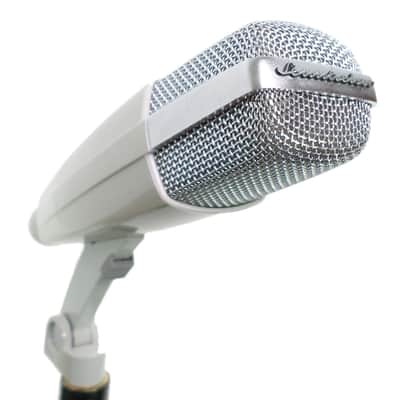
REFURBISHED MD 421-2 Cardioid Dynamic Microphone 1960s - 1980s - White


Our users rate Reverb
The Sennheiser MD 421/2 belongs to one of the most successful professional dynamic microphone families ever produced. More than half a century after its introduction, the MD 421 remains a familiar working tool in recording studios around the world. The 421-2 Version is originally a large Tuchel Studio version with a direkt single path and no on board filter.
OPTICAL CONDITION
EXCELLENT
Exceptionally well-preserved example with very little visible wear.
One very small hairline crack is present in the body. Nothing is broken or loose, and the crack is barely visible.
TECHNICAL CONDITION
EXCELLENT
FULLY TESTED
The microphone operates correctly and delivers excellent performance.
WHY DID THE MD 421 BECOME A STUDIO STANDARD?
The MD 421 was engineered as a serious professional working microphone. Its robust housing, dynamic moving-coil transducer and carefully developed directional acoustic system were designed for demanding use in studios, broadcasting, location recording and live production.
Yet durability alone does not explain the extraordinary longevity of the design.
why did the MD 421 become one of the most widely used and enduring microphones in recording history?
Part of the answer lies in something that is difficult to communicate through specifications alone: the MD 421 has an unusually large usable working range.
Many microphones sound wonderful at a particular distance but become increasingly compromised when moved extremely close to a source. The MD 421 behaves differently. Its sound certainly changes with distance—the proximity effect is very much part of its character—but those changes remain remarkably useful.
At moderate distances, the microphone can sound open, balanced and natural. Move it directly toward the source and the sound becomes larger, heavier and more dramatic, yet it can retain a convincing and coherent timbre.
This makes the proximity effect less of a technical problem and more of an artistic tool.
Distance becomes another way of shaping the recording.
For the engineer, this has enormous practical value. A microphone that remains musically satisfying at very close distances can be positioned directly beside an instrument, amplifier or drum while still producing a natural and usable sound. This provides excellent isolation, reduces unwanted room contribution and spill, and gives much greater control over phase relationships when several microphones are being used simultaneously.
In other words, the MD 421 allows the engineer to solve practical recording problems without necessarily sacrificing musicality.
SOUND CHARACTER
The MD 421/2 has a substantial, authoritative sound with excellent low-frequency weight, a clear and informative midrange and enough upper-frequency extension to retain articulation and openness.
But its defining quality is perhaps not one particular frequency response.
It is how well the microphone responds to placement.
Close placement can produce tremendous weight and intimacy without automatically becoming unpleasant or excessively harsh. Pulling the microphone farther away opens the sound and changes its balance naturally. Between these positions lies an unusually broad range of useful tonal possibilities.
This helps explain why the MD 421 became associated with such an enormous variety of sources: vocals and speech, toms and drums, guitar and bass amplifiers, brass, percussion and many other instruments.
Rather than having one narrow “correct” position, the microphone gives the engineer room to work.
ENDLESS PROXIMITY
the most remarkable quality of the MD 421 is simply how close you can get.
And because the MD 421 is a directional microphone, this ability has enormous practical value.
Extreme close placement increases the proportion of direct sound reaching the microphone while reducing the influence of the surrounding room and other sound sources. In a multi-microphone setup, the increased isolation can also make phase relationships and unwanted interaction between microphones considerably easier to manage.
The result is something particularly valuable in recording: the ability to create an immediate, isolated studio sound even in a room that is far from ideal.
This is perhaps one of the secrets behind the MD 421's extraordinary usefulness. The engineer can move closer for technical reasons—more isolation, less room, greater control—or for artistic ones, deliberately using the increasing proximity effect to create weight, intimacy and drama.
MORE THAN SOUND
The success of the MD 421 cannot be explained acoustically alone.
It combines its broad working range with robust construction, reliability and an unmistakable industrial design. It is elegant enough to have become visually iconic, yet fundamentally built as a professional tool. That combination matters.
A studio standard must do more than produce a beautiful sound under ideal circumstances. It has to survive repeated use, work predictably across very different sources and allow engineers to solve problems quickly.
The MD 421 manages all of these things while maintaining a distinctive musical character of its own.
HISTORICAL SIGNIFICANCE
Introduced by Sennheiser at the beginning of the 1960s, the MD 421 became established in recording, broadcasting, television, stage and location work and developed into one of the defining European dynamic microphone designs of the post-war recording era.
Its longevity is particularly remarkable.
Recording technology has changed enormously since the first MD 421 microphones appeared, yet the basic concept has never disappeared from professional studios. Vintage examples continue to work alongside modern condensers, ribbons and dynamics because the practical problems the MD 421 solves have not disappeared either.
Engineers still need isolation. They still need microphones that tolerate extremely close placement. They still need predictable directional behaviour, useful tonal variation with distance and equipment that can withstand everyday professional work.
Perhaps that is the simplest explanation for the MD 421's extraordinary reputation:
It does not merely sound good. It gives the engineer an unusually large number of ways to get a good sound.
Love this item? Explore more! Check out our store for more historic and professionally tested microphones. You might discover your next favourite piece!
| Listed | a day ago |
|---|---|
| Condition | Excellent (Used) Excellent items are almost entirely free from blemishes and other visual defects and have been played or used with the utmost care.Learn more |
| Brand | |
| Model |
|
| Finish |
|
| Categories | |
| Year |
|
| Made In |
|
| Electronics |
|
| Microphone Type |
|
| Wired/Wireless |
|
| Polar Pattern |
|
Product safety information may be available here.

