Shakmat Dual Dagger - silver


Our users rate Reverb
Four filters in six HP. The Dual Dagger is a stereo low-pass and a stereo high-pass, each 24dB per octave, sharing one panel and calibrated so the left and right sides track each other exactly. That calibration is the point: a stereo pair through two ordinary mono filters drifts apart at the extremes and the image smears. Here it does not, unless you ask it to.
Asking it to is where the module gets interesting. Each filter has its own pan CV input, which offsets the cutoff of the left channel against the right. Feed a slow LFO into PAN LP and the low end starts breathing across the stereo field while the top stays put. Feed something faster into PAN HP and you get width out of a source that was never stereo to begin with. This is the feature people buy it for, and it is not something you can fake with two mono filters and a mixer.
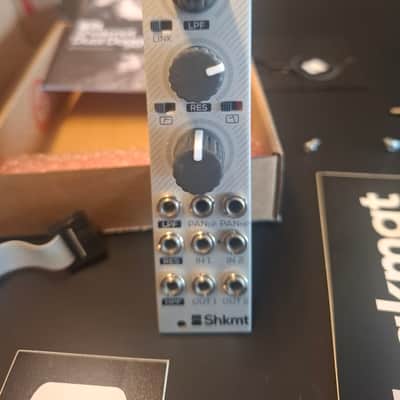
The resonance control is shared between both filters, and two small switches assign which of them it acts on: low pass, high pass, or both. It is a compact solution to a real panel-space problem, and in practice it is more musical than two separate resonance knobs, because you spend your time deciding where the emphasis should sit rather than balancing two controls against each other.
Flip the LINK switch and the whole thing becomes a 48dB per octave stereo bandpass. The high-pass control now sets the band frequency and the low-pass control sets the bandwidth, so one hand sweeps the band while the other opens and closes it. At that steepness with resonance on the band edges you can pull a narrow, singing slice out of a full mix and it stays clean rather than turning to mush.
CV inputs cover low-pass frequency, high-pass frequency, resonance, and the two pan controls. Stereo in and stereo out on the bottom row.
One thing to know before buying: resonance is one knob for both filters, assignable but not independent, so you cannot dial a screaming low-pass against a gentle high-pass at the same time. And check your power budget before you order. This draws 65 mA on +12V but 80 mA on -12V, which is the wrong way round from most modules; if your case has a thin negative rail with several hungry modules already on it, do the arithmetic first.
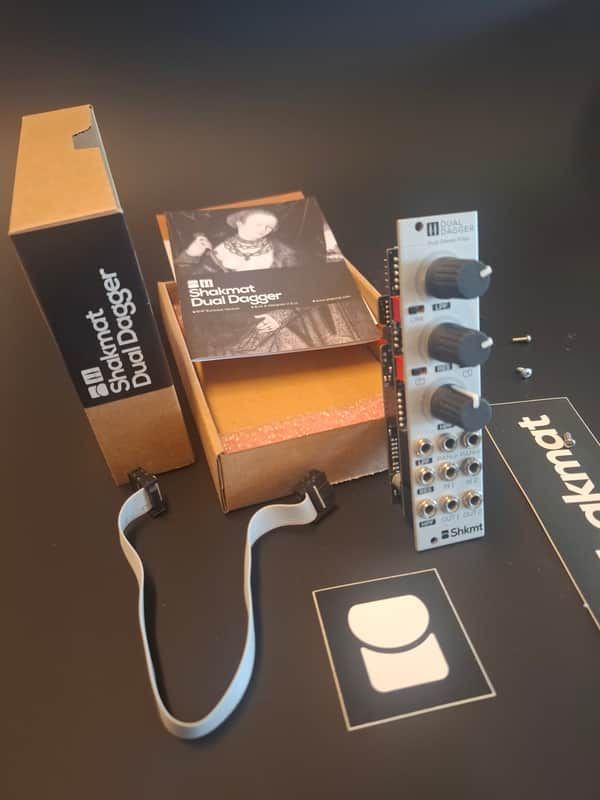
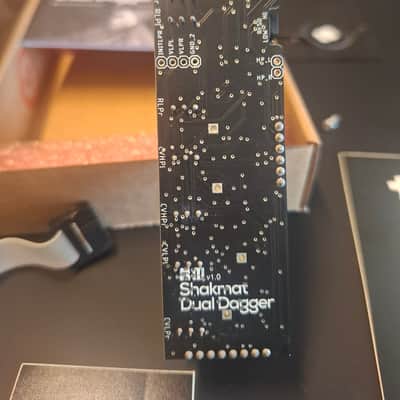
Condition: excellent. The panel is clean with no rack rash and the fine hatched print is sharp. All three knobs turn smoothly, the switches click positively and every jack is tight. The board is clean factory SMD work, marked v1.0, shown in the photos.
Included: the original Shakmat box, the printed manual, a ribbon cable, mounting screws and the Shakmat stickers.
Specs: 6HP wide, 29 mm deep. Current draw 65 mA on +12V and 80 mA on -12V. Dual 24dB/oct low-pass and high-pass, stereo throughout, switchable to a 48dB/oct bandpass. CV inputs for LP frequency, HP frequency, resonance, and pan on each filter. Stereo input and output, all jacks 3.5 mm. Built and designed in the EU by Shakmat.
Shipping from the Netherlands, tracked. Offers welcome.
This item is sold As-Described
This item is sold As-Described and cannot be returned unless it arrives in a condition different from how it was described or photographed. Items must be returned in original, as-shipped condition with all original packaging.Learn More.
| Listed | 2 hours ago |
|---|---|
| Condition | Excellent (Used) Excellent items are almost entirely free from blemishes and other visual defects and have been played or used with the utmost care.Learn more |
| Brand | |
| Model |
|
| Finish |
|
| Categories | |
| Year |
|
Product safety information may be available here.

