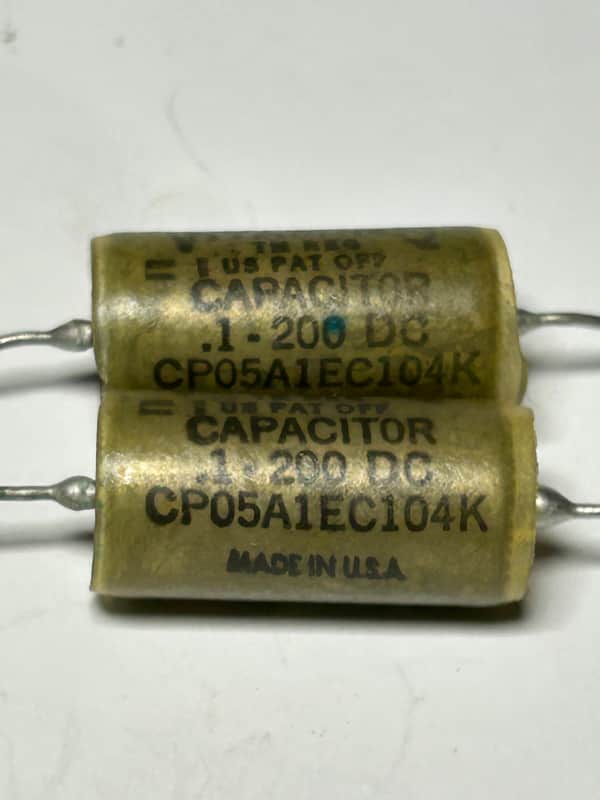
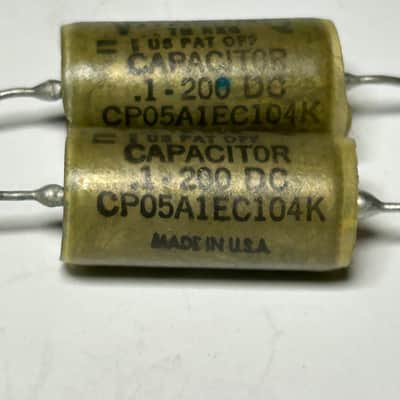
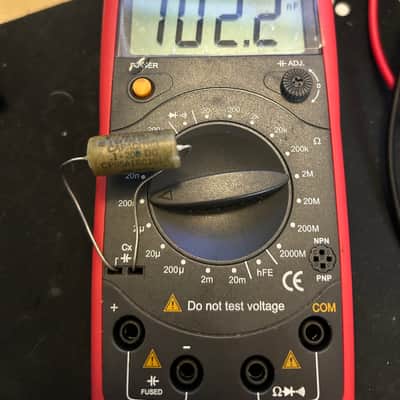
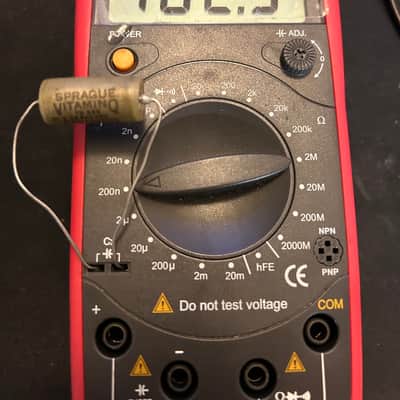
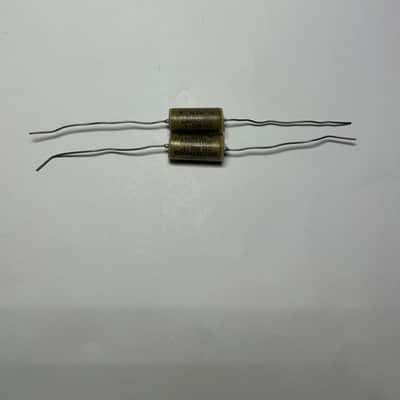
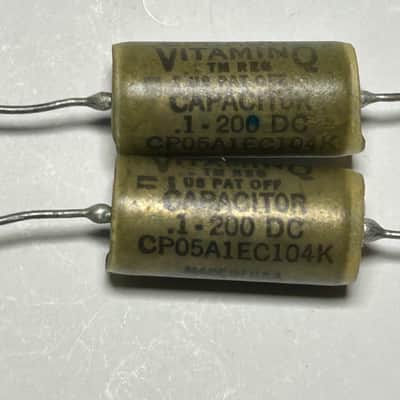
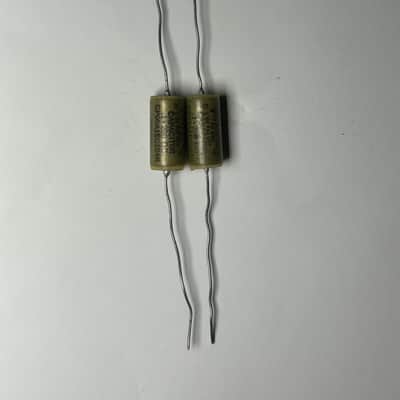
2 x Vitamin Q Sprague 0.1uF / 200V DC NOS (new, old stock), military grade. Perfectly matched. "Organic sound" for crossovers, mix buses, preamps, EQs, VCOs

Our users rate Reverb
For sale: 2 x Vitamin Q Sprague 0.1uF / 200V DC NOS (new, old stock), military-grade CP05A1EC104K (MIL-C-25A). PIO (paper in oil).
Never used. Original pinout.
It's perfect for all kinds of applications designed to color the sound towards an "organic" and vintage, analog sound – in analog summers, preamps, compressors, Eurorack sound modules (VCO mods), etc.
Ideal as bypass capacitors for crossovers for high and mid frequencies. Especially when the high frequencies are too sharp from titanium, aluminum, cheap paper, or even fabric domes. It transforms them beyond recognition. It can be used in home speaker crossovers, but excellent results are achieved in passive studio monitor crossovers. This is especially true for vintage or modern monitors, which tend to sound too harsh and are simply tiring when used for long periods.
What does this type of bypass in a crossover provide?
Smoothness and "wetness." Sprague Vitamin Q is famous for introducing a so-called "oily" smoothness to the presentation. Sibilants become more pliable and no longer piercing. The sound becomes creamier and more relaxing.
Adds three-dimensionality and spaciousness: Improves micro-detail in the reverb of cymbals and room acoustics. The space around the instruments becomes more airy, but in a natural way, not artificially sharpened.
If you experience excessively sharp attacks in harsh music (rock, symphonic), it will soften them with an analog tone, giving transients a more natural resonance (more like a concert, not a recording). The oil-based "Q" dielectric tends to slightly tone down very fast, hard impulses. If the main capacitor (e.g., dry polypropylene) was playing too technically and harshly, Vitamin Q would act as a "filter" toning down this technicality and hardness, the plasticity of the MKT or MKS polypropylene.
Generally, Vitamin Q gives instruments a deeper, more saturated tone, removing the digital, "plastic" tarnish. This is especially audible with brass instruments and strings.
This is a favorite trick (simple and inexpensive considering the increase in quality) of people listening to transistor and modern speakers, which are usually fast, tight, but also "plastic-smelling" :) and too sharp in the treble. It gives the sound a more natural, organic sound. A slightly undersaturated one, but only at the very top end. Without any coloration.
There's a reason why Vitamin Q is so legendary.
However, if you already have an amplifier-speaker system on the warmer side of the spectrum and not overly harsh on the top end, and you want to add a bit of Sprague magic (a "buttery," flowing, magical sound that's a pleasure to listen to for extended periods) without sacrificing the speed, punch, tightness, and contour of the bass, look for the Sprague 118D "Difilm" series (a cross between Vitamin Q and modern audiophile-grade MKP capacitors) or the Filmite "E" series (sounds like modern MKTs, but with the analogue quality of Sprague, very fast and "tight"). The Vitamon Q is a master of musicality and an "organic sound," but it's not suitable for the bass section. Only the treble or midrange (but you'll have to test it).
This capacitor is also suitable for some applications in solid-state-tube hybrid circuits (you have to be careful with the voltage requirement). In tube-based DACs, etc.
And the famous use of this capacitor in so-called "Vitamon Q" capacitors is also known. The Jimi Hendrix Stratocaster Mod 0.1uF transforms your Fender Stratocaster into a distinctive Strat with a low-end, meaty, saturated, analog, and often disturbing sound. Jimi fans know what I'm talking about :)
| Listed | a month ago |
|---|---|
| Condition | Excellent (Used) Excellent items are almost entirely free from blemishes and other visual defects and have been played or used with the utmost care.Learn more |
| Brand | |
| Model |
|
| Categories | |
| Year |
|
| Made In |
|
Product safety information may be available here.

