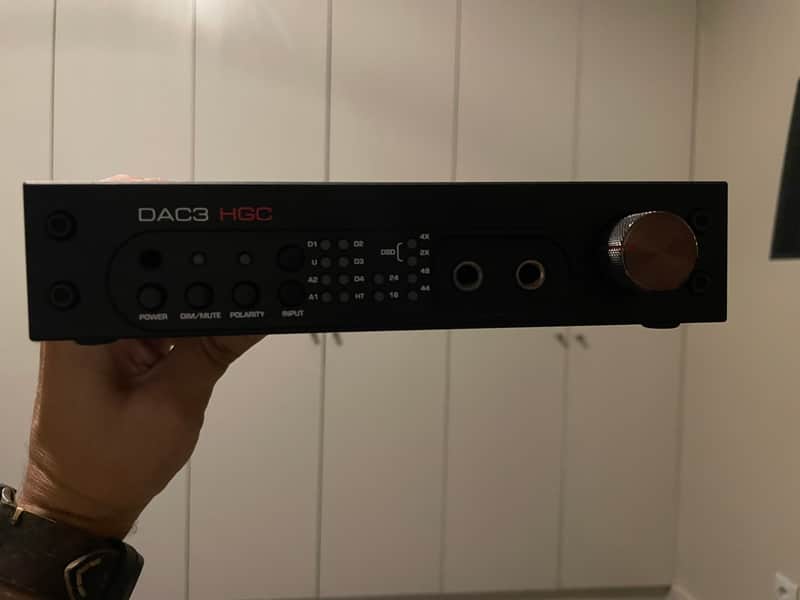
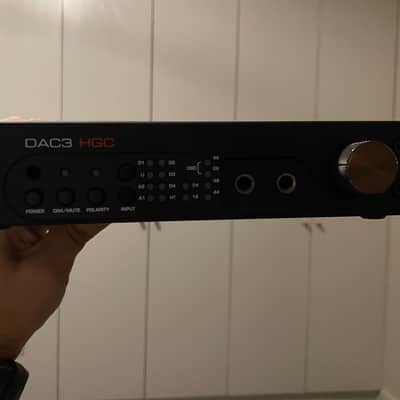
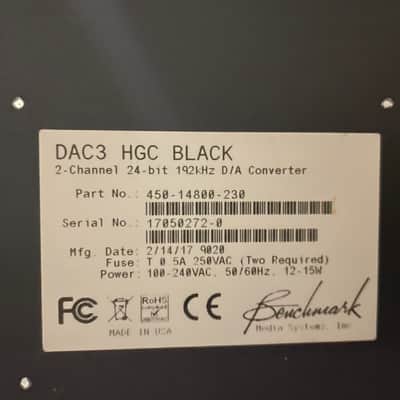
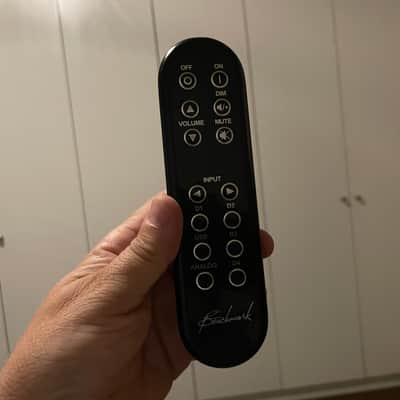
Benchmark DAC3 - HGC - Black - 2 channel 24bits 192khz DA converter 2017 - Black
Pricezł7,787.04
+ zł229.03 Shipping
Listed:3 months ago
Views:115
Saves:3
Offers:2

Porto, Portugal
Our users rate Reverb
The Benchmark DAC3 HGC is a reference-class, two-channel digital-to-analog converter, preamplifier, and headphone amplifier. Widely praised in both professional studios and high-end audiophile circles, it is designed for absolute transparency, utilizing the state-of-the-art ESS Sabre ES9028PRO converter chip.
Here is a comprehensive technical description and specification sheet for the Benchmark DAC3 HGC.
Key Technologies & Features
- Hybrid Gain Control (HGC): This unique system combines active analog gain control, passive analog attenuators, and digital gain control. It ensures that the volume control maintains the highest possible dynamic range, whether processing digital or analog sources.
- UltraLock3â„¢ Jitter Attenuation: An advanced jitter-reduction clock system that isolates the D/A conversion stage from any interface jitter, ensuring flawless signal clocking on all digital inputs.
- High-Headroom DSP: Benchmark’s digital processing provides an extra 3.5 dB of headroom above 0 dBFS. This completely prevents the inter-sample clipping distortion that commonly plagues other DACs.
- Active 2nd & 3rd Harmonic Compensation: Hardware-level compensation that minimizes harmonic distortion, driving performance levels close to theoretical limits.
- HPA2â„¢ Headphone Amplifier: A high-current, near 0-Ohm headphone amplifier with dual 1/4" jacks, capable of driving demanding headphone loads with zero distortion.
Technical Specifications
1. Audio Performance
- THD+N (1 kHz at 0 dBFS): -113 dBFS, -113 dB, 0.00022%
- THD+N (1 kHz at -3 dBFS): -119 dBFS, -116 dB, 0.00016%
- Signal-to-Noise Ratio (SNR): 128 dB (A-weighted), 126 dB (Unweighted)
- Frequency Response (at Fs = 192 kHz): * +0 dB / -0.015 dB (20 Hz to 20 kHz)
- -0.15 dB at 80 kHz
- Crosstalk: -137 dB at 20 Hz, -130 dB at 1 kHz, -116 dB at 20 kHz
- Inter-channel Differential Phase: \pm 0.25\text{ degrees} at 20 kHz
2. Connectivity & Digital Input Support
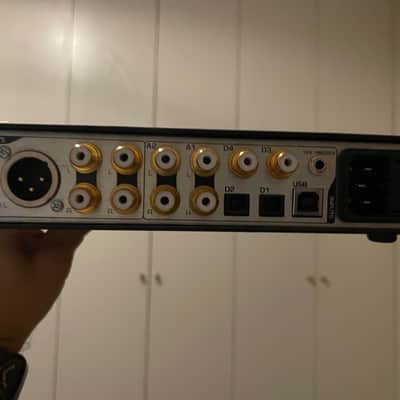
- Digital Inputs: * 1 x USB Audio 2.0 (Asynchronous)
- 2 x Coaxial S/PDIF (RCA)
- 2 x Optical TOSLINK
- Analog Inputs: 2 pairs of unbalanced stereo RCA inputs
- Analog Outputs:
- 1 pair of balanced stereo XLR outputs
- 2 pairs of unbalanced stereo RCA outputs
- 2 x 1/4" TRS headphone outputs (front panel)
- Digital Output: 1 x Coaxial S/PDIF (pass-through)
- Supported Sample Rates & Formats:
- Coaxial: 28 to 210 kHz (PCM up to 24-bit), DSD64 (DoP)
- Optical: 28 to 96 kHz (PCM up to 24-bit)
- USB: 44.1, 48, 88.2, 96, 176.4, 192 kHz (PCM up to 24-bit), DSD64 (DoP)
3. HPA2â„¢ Headphone Output Specs
- Output Impedance: < 0.11 Ohms
- Output Power: 1.25 W into 30 Ohms
- Maximum Output Current: 250 mA (current limited at 300 mA for protection)
- Bandwidth: > 500 kHz (-0.35 dB at 200 kHz)
4. Physical & Power Specifications
- Form Factor: 1/2 rack space wide, 1 RU high
- Dimensions (W x H x D): 249 mm x 44.5 mm x 237 mm (including connectors)
- Weight: 1.4 kg (net weight)
- Power Supply (Universal): Internal switch-mode, auto-ranging 90–260 VAC, 47–63 Hz (perfectly compatible with Europe's standard 230V / 50 Hz power grids)
- Power Consumption: < 0.5 W Idle, 12 W Typical, 15 W Max
| Listed | 3 months ago |
|---|---|
| Condition | Excellent (Used) Excellent items are almost entirely free from blemishes and other visual defects and have been played or used with the utmost care.Learn more |
| Brand | |
| Model |
|
| Finish |
|
| Categories | |
| Year |
|
| Made In |
|
Product safety information may be available here.

