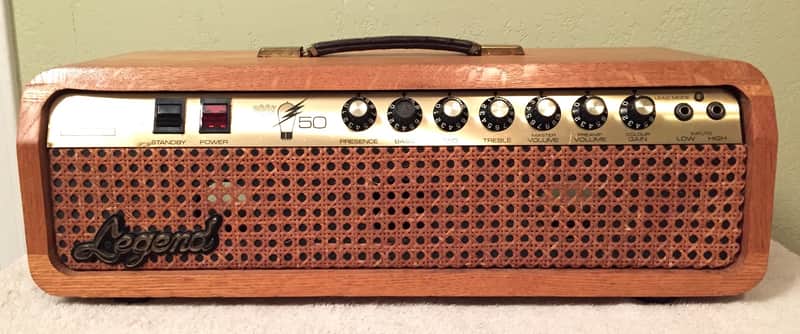
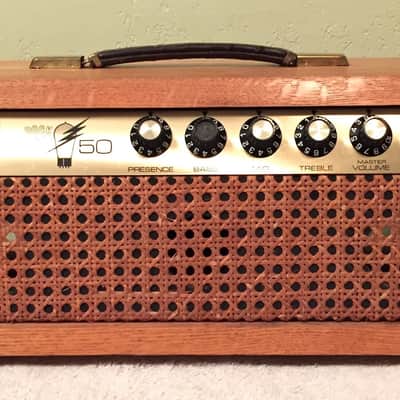
Legend Rock "N" Roll 50 Tube/SS Hybrid Head // The ZZ Top "Eliminator" Amp
This gear has sold
See similar gear from other Reverb sellers
Listed:11 years ago
Views:1,646
Saves:39
Offers:0
LETHBRIDGE, Canada
Our users rate Reverb
I would rather not have to do this, but I'm listing my highly coveted Legend Rock "N" Roll 50 head. If you're reading this listing, you probably already know what it is and have a general idea of what it can do, but I'll go into a bit of detail for those who don't.
This is a tube/solid state hybrid amp. It uses three 12AX7s in the preamp stage, which is then fed to the solid state output stage. So you have preamp tubes, but no power tubes. This is the opposite of what was being done at Legend's main competitor, Music Man*, who use a solid state preamp stage fed into a power-tube driven output stage.
This amp is notable in rock lore for being THE amplifier used by Billy Gibbons to record all of the guitar parts on ZZ Top's hit 1984 record "Eliminator." Yup. Gimme All Your Lovin, Got Me Under Pressure, Sharp Dressed Man, et al, were all recorded through a Legend Rock N Roll 50, albiet the combo version with the single Celestion G12H75 If I recall correctly. Regardless, it's still got "that" sound. Just pick a cabinet, plug in your humbucker driven guitar and go. If it's clean tone you're looking for, get a Fender Princeton or a Roland JC120 or something. This amp would never be my first choice for clean tones. It can pull it off, but holy cow is it ever chimey, and a little too compressed if what you want is a faithfully reproduced clean tone.
I spent a couple years hoping to run across one of these not too long ago, and when I finally did, I wasn't disappointed. These amps were made for a brief period in the late 70s and early 80s in Syracuse, New York. If I recall correctly, less than 8000 Legend amps made their way out of the company's doors before they went out of business, meaning they are few and far between nowadays.
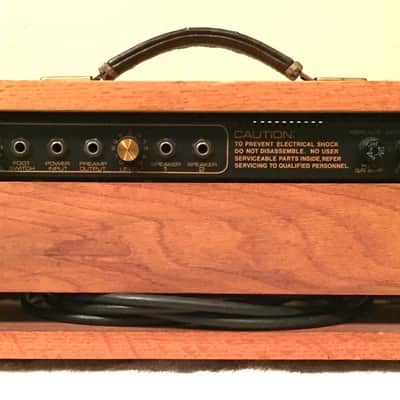
I play a distinctly heavier style of music than Billy Gibbons, leaning more toward stoner rock/stoner metal, and to that end that this amp excels. If you want to get crazy you can jumper the preamp output straight into the power input on the back and adjust the crushing yet luscious feedbacky fuzz to your liking with the trimpots on the back of the chassis, but just beware that single coils will squeal like hell. Humbuckers recommended for that kind of operation, but even then it's a dangerous game on the edge of usability.
As far as pedals are concerned, I'll be brutally honest, because I don't want anyone to think this amp is something that it isn't. This amp, along with its cousins the Super Lead and Model A, don't take pedals very well, even if you use the preamp out and power input as an effects loop. Maybe I'm spoiled by how well my Ampegs take pedals, but these Legends are the antithesis to those Ampegs. Overdrive, distortion, fuzz, even effects like phaser, chorus, and reverb all seem to get muddled under the blanket of what is this amp's signature characteristic tonal properties. Not that that's a bad thing. The amp has it's own "thing" and it does it well. It's "thing" just happens to be not being all that great at anything besides being its own "thing," if you get what I mean.
The EQ on this amp functions counterintuitively to any other amp I've ever used. Let's say you want more bass. Logically all you would have to do is turn the bass up, right? Wrong. Turn the treble down if you want more bass. Want more treble? Turn the bass/mids down. Presence doesn't do too much if you're pushing the gain really hard. You'll find yourself messing around with the preamp volume, master volume, colour gain, and lead/drive level knobs on the back of the amp for hours and still have hardly any idea of how to best set them. It's a unique amp in that respect; when you find a tone you like, treasure it, because the second you adjust any knob, you're throwing at least two other knobs that that first knob was gainstaging out of tonal balance, and each of those knobs seems to affect two other knobs in some never ending cascade of "what the f**k did I just do and how do I get back to where I just had it oh god I'm not good with amps how did I get here someone please help me."
That's my only gripe about the amp. It still sounds great and functions as it should, but if you're nitpicky about slight tonal changes and memorizable settings, this amp could be a never ending well of frustration due to how opposite to logic all of the knobs work. I've owned three Legend amps; this, a Super Lead 50, and a Model A 60, and they're all more or less the same in their backwardness. If you have the patience to get used to it, the amp will treat you well, but I wouldn't even want think about this amp in the hands of someone who just started playing guitar. They'd get fed up and frustrated with it pretty quick, and for that reason I'm pricing it at the higher end of its resale value so that it ends up in the possession of someone who really wants it, someone who wants it more than anyone else, someone who wants it the most.
I'm only selling this because I currently own both this Rock N Roll 50 and a Super Lead 50, plus about four other amp heads and a VT22. It's time to thin the herd to fund something new. For all intents and purposes the Rock N Roll 50 is practically the same amplifier as the Super Lead 50, with the latter having the added bonus of a reverb tank and an extra knob for more bottom end. The RNR50 lacks a reverb tank and has a bitier mid-high punch, which, if you're going for that Eliminator tone, you won't find disappointing.
As far as the guts are concerned, it's either this one or the Super Lead 50 that has a single faulty speaker output jack, will test and update this listing accordingly in the next day or two. My amp tech suggested replacing all three of the original electrolytic capacitor cans based on their age alone, which I opted not to do because they currently function just fine, but it might be something that you, the buyer, would want to look into.
The preamp out on the back of the amp works great if you want to record test tracks or demos straight to your board, your audio interface, or your DAW. That being said, the "preamp out straight into your DAW" sound is a bit more fizzy than if you were to record the same thing through a cab with your favourite on-axis, cone-facing dynamic mic, but if you have a board with channel EQ and know a few tricks you can get some half decent tones for demos. I've linked to a little demo track at the bottom of this page that I recorded exclusively through this amp by using the pre-amp out straight into my board. As far as recording through a cab with actual microphones, this amp is AWESOME. Because of the solid state output stage, this amp sacrifices a bit of dynamic range, which doesn't translate all that well to a live scenario but works great in studio. That said, it all depends on how you play, the style of music you're going for, and in the studio whether you have a compressor that you would rather pair up for use recording an amp that has more dynamic range or not. It's an excellent swiss army "set it and forget it" type of recording amp if you own or work in a studio and are looking for another unique head to entertain clients with that sounds great right from the get-go.
As for live use, I would think twice about dedicating this amp to the stage. The few times I've gigged with it, it always seemed to get lost in the room. I think it has to do with the dynamic range of the output stage. Couple this with how the amp doesn't like to play with pedals, and any tricks you had to boost your sound on the fly go right out the window. I much prefer to use my Ampeg V3 or Garnet Pro 200 Super live because if I lose track of my sound on stage all I have to do is play a little harder to boost myself over that threshold until my ears latch back onto where my sound is in the room. It's not really something I was able to do with the RNR50. Maybe that's a weird way of describing something that could be easily dealt with by a competent sound guy, but I don't have a sound guy, and my live amp needs reflect that. If you have a sound guy, this amp could be amazing on stage for all I know.
For it's age I would say it's cosmetically still in excellent condition. One of the knobs on the front is missing its gold cap and the leather handle has a few cracks, but it's been treated remarkably well for the last 30+ years.
*Correction: It was Music Man, not Mesa Boogie, that was Legend's main competitor with regard to having a solid state preamp and tube power amp section.
Terms: Shipping will be from Canada, to Canada and CONUS only. I ship via Canada Post with adequate insurance, tracking, and signature on delivery for buyer and seller protection. Shipping costs vary by location and there is no way for me to more accurately estimate those costs until the item is completely boxed up and taken to the post office. As such, the shipping prices below are educated guesses. If the parcel is outside of the size range that Canada Post is able to ship, my next preference of courier is UPS, but prices tend to increase dramatically and will have to be dealt with on a case-by-case basis accordingly, regardless of the quoted estimate posted below. I will refund any significant over-estimated cost, but in the event of an under-estimate, I will be unable to send the item until the remaining balance has been paid by the buyer. This is how I've been doing it on eBay since 2006. If you don't agree to these terms, please shop elsewhere.
This is a tube/solid state hybrid amp. It uses three 12AX7s in the preamp stage, which is then fed to the solid state output stage. So you have preamp tubes, but no power tubes. This is the opposite of what was being done at Legend's main competitor, Music Man*, who use a solid state preamp stage fed into a power-tube driven output stage.
This amp is notable in rock lore for being THE amplifier used by Billy Gibbons to record all of the guitar parts on ZZ Top's hit 1984 record "Eliminator." Yup. Gimme All Your Lovin, Got Me Under Pressure, Sharp Dressed Man, et al, were all recorded through a Legend Rock N Roll 50, albiet the combo version with the single Celestion G12H75 If I recall correctly. Regardless, it's still got "that" sound. Just pick a cabinet, plug in your humbucker driven guitar and go. If it's clean tone you're looking for, get a Fender Princeton or a Roland JC120 or something. This amp would never be my first choice for clean tones. It can pull it off, but holy cow is it ever chimey, and a little too compressed if what you want is a faithfully reproduced clean tone.
I spent a couple years hoping to run across one of these not too long ago, and when I finally did, I wasn't disappointed. These amps were made for a brief period in the late 70s and early 80s in Syracuse, New York. If I recall correctly, less than 8000 Legend amps made their way out of the company's doors before they went out of business, meaning they are few and far between nowadays.
I play a distinctly heavier style of music than Billy Gibbons, leaning more toward stoner rock/stoner metal, and to that end that this amp excels. If you want to get crazy you can jumper the preamp output straight into the power input on the back and adjust the crushing yet luscious feedbacky fuzz to your liking with the trimpots on the back of the chassis, but just beware that single coils will squeal like hell. Humbuckers recommended for that kind of operation, but even then it's a dangerous game on the edge of usability.
As far as pedals are concerned, I'll be brutally honest, because I don't want anyone to think this amp is something that it isn't. This amp, along with its cousins the Super Lead and Model A, don't take pedals very well, even if you use the preamp out and power input as an effects loop. Maybe I'm spoiled by how well my Ampegs take pedals, but these Legends are the antithesis to those Ampegs. Overdrive, distortion, fuzz, even effects like phaser, chorus, and reverb all seem to get muddled under the blanket of what is this amp's signature characteristic tonal properties. Not that that's a bad thing. The amp has it's own "thing" and it does it well. It's "thing" just happens to be not being all that great at anything besides being its own "thing," if you get what I mean.
The EQ on this amp functions counterintuitively to any other amp I've ever used. Let's say you want more bass. Logically all you would have to do is turn the bass up, right? Wrong. Turn the treble down if you want more bass. Want more treble? Turn the bass/mids down. Presence doesn't do too much if you're pushing the gain really hard. You'll find yourself messing around with the preamp volume, master volume, colour gain, and lead/drive level knobs on the back of the amp for hours and still have hardly any idea of how to best set them. It's a unique amp in that respect; when you find a tone you like, treasure it, because the second you adjust any knob, you're throwing at least two other knobs that that first knob was gainstaging out of tonal balance, and each of those knobs seems to affect two other knobs in some never ending cascade of "what the f**k did I just do and how do I get back to where I just had it oh god I'm not good with amps how did I get here someone please help me."
That's my only gripe about the amp. It still sounds great and functions as it should, but if you're nitpicky about slight tonal changes and memorizable settings, this amp could be a never ending well of frustration due to how opposite to logic all of the knobs work. I've owned three Legend amps; this, a Super Lead 50, and a Model A 60, and they're all more or less the same in their backwardness. If you have the patience to get used to it, the amp will treat you well, but I wouldn't even want think about this amp in the hands of someone who just started playing guitar. They'd get fed up and frustrated with it pretty quick, and for that reason I'm pricing it at the higher end of its resale value so that it ends up in the possession of someone who really wants it, someone who wants it more than anyone else, someone who wants it the most.
I'm only selling this because I currently own both this Rock N Roll 50 and a Super Lead 50, plus about four other amp heads and a VT22. It's time to thin the herd to fund something new. For all intents and purposes the Rock N Roll 50 is practically the same amplifier as the Super Lead 50, with the latter having the added bonus of a reverb tank and an extra knob for more bottom end. The RNR50 lacks a reverb tank and has a bitier mid-high punch, which, if you're going for that Eliminator tone, you won't find disappointing.
As far as the guts are concerned, it's either this one or the Super Lead 50 that has a single faulty speaker output jack, will test and update this listing accordingly in the next day or two. My amp tech suggested replacing all three of the original electrolytic capacitor cans based on their age alone, which I opted not to do because they currently function just fine, but it might be something that you, the buyer, would want to look into.
The preamp out on the back of the amp works great if you want to record test tracks or demos straight to your board, your audio interface, or your DAW. That being said, the "preamp out straight into your DAW" sound is a bit more fizzy than if you were to record the same thing through a cab with your favourite on-axis, cone-facing dynamic mic, but if you have a board with channel EQ and know a few tricks you can get some half decent tones for demos. I've linked to a little demo track at the bottom of this page that I recorded exclusively through this amp by using the pre-amp out straight into my board. As far as recording through a cab with actual microphones, this amp is AWESOME. Because of the solid state output stage, this amp sacrifices a bit of dynamic range, which doesn't translate all that well to a live scenario but works great in studio. That said, it all depends on how you play, the style of music you're going for, and in the studio whether you have a compressor that you would rather pair up for use recording an amp that has more dynamic range or not. It's an excellent swiss army "set it and forget it" type of recording amp if you own or work in a studio and are looking for another unique head to entertain clients with that sounds great right from the get-go.
As for live use, I would think twice about dedicating this amp to the stage. The few times I've gigged with it, it always seemed to get lost in the room. I think it has to do with the dynamic range of the output stage. Couple this with how the amp doesn't like to play with pedals, and any tricks you had to boost your sound on the fly go right out the window. I much prefer to use my Ampeg V3 or Garnet Pro 200 Super live because if I lose track of my sound on stage all I have to do is play a little harder to boost myself over that threshold until my ears latch back onto where my sound is in the room. It's not really something I was able to do with the RNR50. Maybe that's a weird way of describing something that could be easily dealt with by a competent sound guy, but I don't have a sound guy, and my live amp needs reflect that. If you have a sound guy, this amp could be amazing on stage for all I know.
For it's age I would say it's cosmetically still in excellent condition. One of the knobs on the front is missing its gold cap and the leather handle has a few cracks, but it's been treated remarkably well for the last 30+ years.
*Correction: It was Music Man, not Mesa Boogie, that was Legend's main competitor with regard to having a solid state preamp and tube power amp section.
Terms: Shipping will be from Canada, to Canada and CONUS only. I ship via Canada Post with adequate insurance, tracking, and signature on delivery for buyer and seller protection. Shipping costs vary by location and there is no way for me to more accurately estimate those costs until the item is completely boxed up and taken to the post office. As such, the shipping prices below are educated guesses. If the parcel is outside of the size range that Canada Post is able to ship, my next preference of courier is UPS, but prices tend to increase dramatically and will have to be dealt with on a case-by-case basis accordingly, regardless of the quoted estimate posted below. I will refund any significant over-estimated cost, but in the event of an under-estimate, I will be unable to send the item until the remaining balance has been paid by the buyer. This is how I've been doing it on eBay since 2006. If you don't agree to these terms, please shop elsewhere.
This item is sold As-Described
This item is sold As-Described and cannot be returned unless it arrives in a condition different from how it was described or photographed. Items must be returned in original, as-shipped condition with all original packaging.Learn More.
| Listed | 11 years ago |
|---|---|
| Condition | Excellent (Used) Excellent items are almost entirely free from blemishes and other visual defects and have been played or used with the utmost care.Learn more |
| Brand | |
| Model |
|
| Categories | |
| Year |
|
| Made In |
|
Product safety information may be available here.