
Troy, MI, United States
About this listing
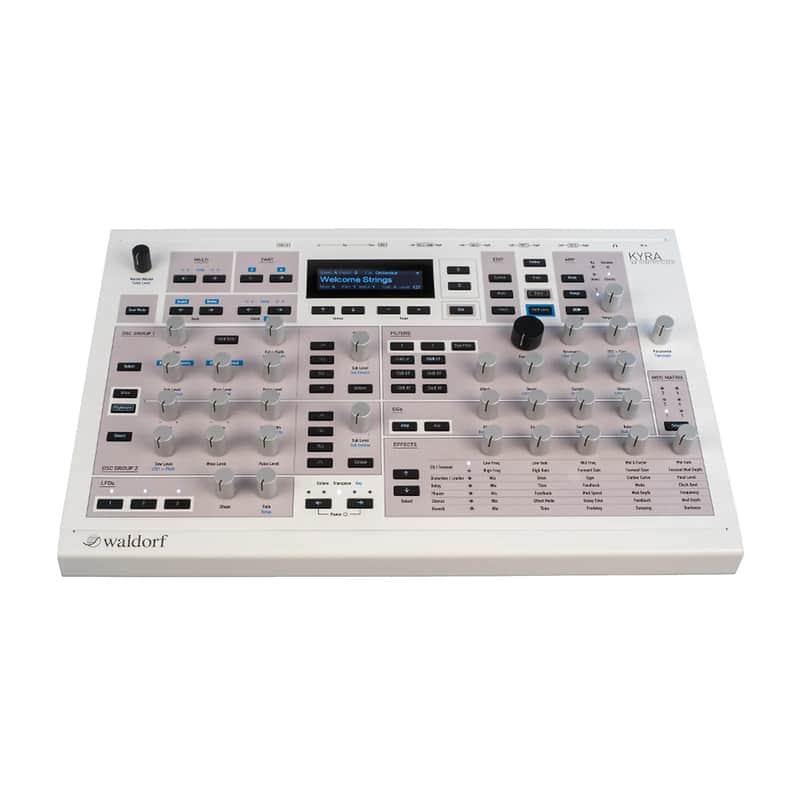
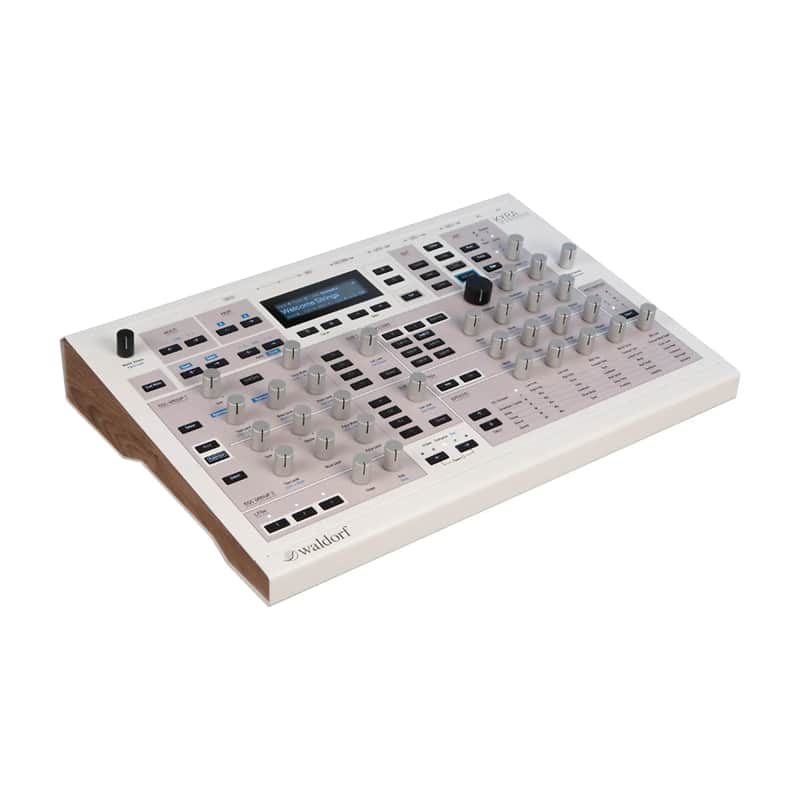
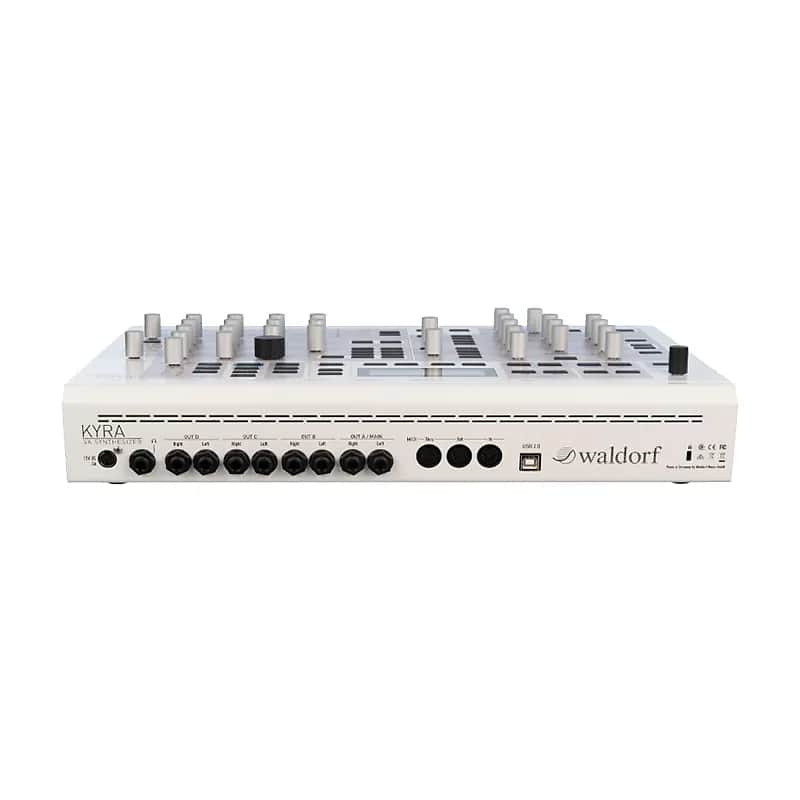
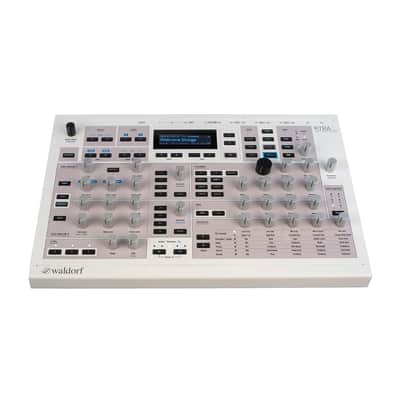
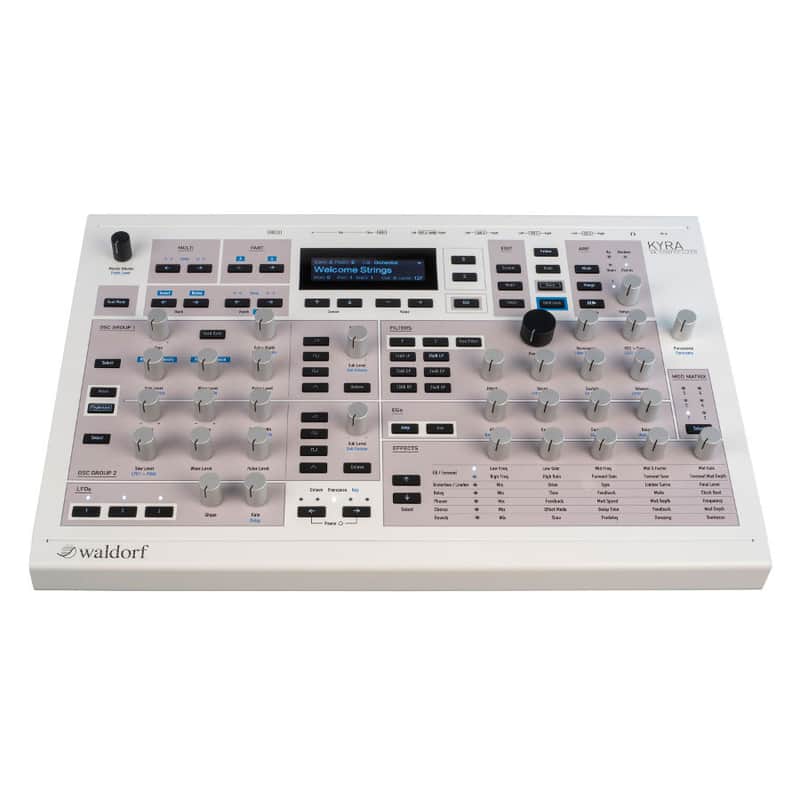
Waldorf Kyra FPGA Synthesizer ModuleFrom first glance it is patently obvious that Waldorf Kyra FPGA Synthesizer Module is a beautifully-designed desktop VA Synthesizer — as the wording elegantly emblazoned on its eye-catching front fascia subtly states. As a truly multitimbral instrument it features eight independent ‘parts’ with up to 32 notes per PART, each effectively being a complete synthesizer with sound sources (OSC GROUP 1, OSC GROUP 2, SUB 1, and SUB 2); FILTERS; modulators (EGs, LFOs, and MOD MATRIX); multi-effects unit (EFFECTS); and a USB 2.0 connection — can exchange MIDI (Musical Instrument Digital Interface) information, as well as send the audio from each stereo PART to a computer as eight stereo 24-bit streams at 96kHz (with 48 kHz downsample mode available) and one stereo audio return from the computer supporting a single 24-bit stereo audio stream from the host DAW (Digital Audio Workstation). With that being said, the only other resource they share are the four balanced, stereo output pairs — OUT A (Right and Left), OUT B (Right and Left), OUT C (Right and Left), and OUT B (Right and Left) — using 32-bit DAC (Digital-to-Analog Conversion) running at 96 kHz sampling rate connected to four internal stereo busses and that powerful pool of 128 hardware voices. Versatility further abounds as each PART has a dedicated multi-effects unit comprising nine stereo effects modules — namely, three-band EQ, Formant filter, input Limiter, Distortion module, Delay module, six-state Phaser, Chorus flanger, Stereo reverb, and output Limiter — with dedicated audio stream via USB (Universal Serial Bus). Patches Better still, each PART hosts a Patch from the pool available to the system. Kyra has a generous Patch storage capacity of 26 banks — A through Z, each containing 128 patches. That’s a total of 3,328! The first seven banks are ‘user’ patches stored in RAM, meaning users can change them quickly and individually using the Store sequence. The remaining 19 banks are ROM (Read-Only Memory) patches that users can recall and use just like RAM patches but cannot be replaced using the Store sequence. It is, however, perfectly possible to freely copy whole banks between RAM and ROM, so all are user- programmable. And any Patch can be recalled via MIDI program changes and Bank select commands. Oscillators As a sensational synthesizer with a spectacular specification, Kyra has two primary virtual alias-free oscillator groups (OSC GROUP 1 and OSC GROUP 2) per voice, each with Saw (sawtooth); Wave (waveform) — with no fewer than 4,096 18-bit linear PCM (Pulse Code Modulation) 32x oversampled waveforms covering a huge range of synthetic and emulated sound sources with two wave sources per voice; Pulse; and noise simultaneously available. Also OSC GROUP 1 and OSC GROUP 2 each has an independent detune-able oscillator — SUB 1 and SUB 2 — with four selectable shapes and two selectable (Octave) pitches. Real Hard Sync, ring modulation, and FM (Frequency Modulation) are available between those oscillator groups. Get this, though: switching from Wave mode — meaning Kyra adopts a virtual analog synthesis model which has the advantage that it is easy to construct sounds using intuitive subtractive synthesis — to Hypersaw mode configures the voice to use a special algorithm comprising six real oscillators to quickly create lush-sounding soundscapes. Digging deeper, Hypersaw mode replaces Wave mode’s two oscillator groups with a single source whose tonal content is constructed with just two adjustable controls — Hypersaw Intensity and Hypersaw Spread (geometric detuning). Built entirely out of multiple, harmonically-rich sawtooth waves or ‘partials’ each adjusted to that special algorithm, the Hypersaw provides characteristic soundscapes ideal for a wide range of uses — from high-impact lead sounds through to lush, animated pads. Placed in Dual Mode, the Hypersaw has 12 real oscillator sources with an additional adjustable stereo spread. Filter Successfully synthesizing sound is inextricably linked with flexible filtering. Fortunately for discerning users, Kyra’s FILTERS front panel perfectly positions powerful control, creatively implementing accurate emulations of classic analog ladder filters with 2-pole (12 dB/octave) low pass (12 dB LP), band pass (12 dB BP), and high pass (12 dB HP), plus 4-pole (24 dB/octave) low pass (24 dB LP), band pass (24 dB BP), and high pass (24 dB HP) configurations. Creatively, 128 filters are configurable for single or dual parallel (Dual Filter) true stereo operation. Envelope and LFOs Onwards and upwards, three fast-response ADSR (Attack, Decay, Sustain, Release) envelope generators with EG Slope setting are also at hand. Helpfully, one is assigned to the VCA (Voltage Controlled Amplifier), another to the filter, while the third can be freely assigned. All are available in the MOD MATRIX (modulation matrix), itself being a six-channel affair with up to three destinations per channel giving a maximum of 18 routings. It is also worth noting that the three LFOs (Low Frequency Oscillators) — with 128 waveforms, monophonic, polyphonic, random, anti-phase, and quadrature stereo phase settings — are also available in the MOD MATRIX and additionally as a MIDI clock sync source. Arpeggiator Creativity continues courtesy of an arpeggiator (ARP) on each PART with 128 preset patterns; Up, Down, Random, and Chords modes; and an ability to synchronize to MIDI clock. Arpeggiators are aimed at live performance, primarily, but can clearly complement composition. Kyra’s ARP is an integral part of a Patch, so settings are always stored. Display and Connections Far from forgetting its helpful high-resolution 256x64 pixel graphic OLED (Organic Light-Emitting Diode) display alongside the traditional array of MIDI In, Out, and Thru connections — complimenting USB 2.0 — on five-pin DIN, as well as full key microtuning capability with MIDI Tuning Standard (MTS support), it is fair to say that Kyra is, indeed, one of the most powerful music synthesizers ever built... a sensational synthesizer with a spectacular specification, set to take performances and compositions to higher states of musicality and sound design! Specifications: Virtual analog synthesis 128 voices 8 parts All sound features can be used simultaneously 26 patch banks (A to Z) with 128 slots each Arpeggiator with 128 preset patterns Octave Transpose Double Mode: layers the same sound two times and detunes them against each other Sturdy full metal case 256x64 pixel OLED Kensington Lock USB 2.0 for MIDI and audio 5-pin DIN MIDI In/Out/Thru 8 balanced analog audio outputs plus Headphone out
Original Price€2,167.33
17% price drop
New Price€1,805.96
+ Shipping

Only 1 left
Grab it before it's gone

30-Day Return Policy
Enjoy peace of mind with your new gear