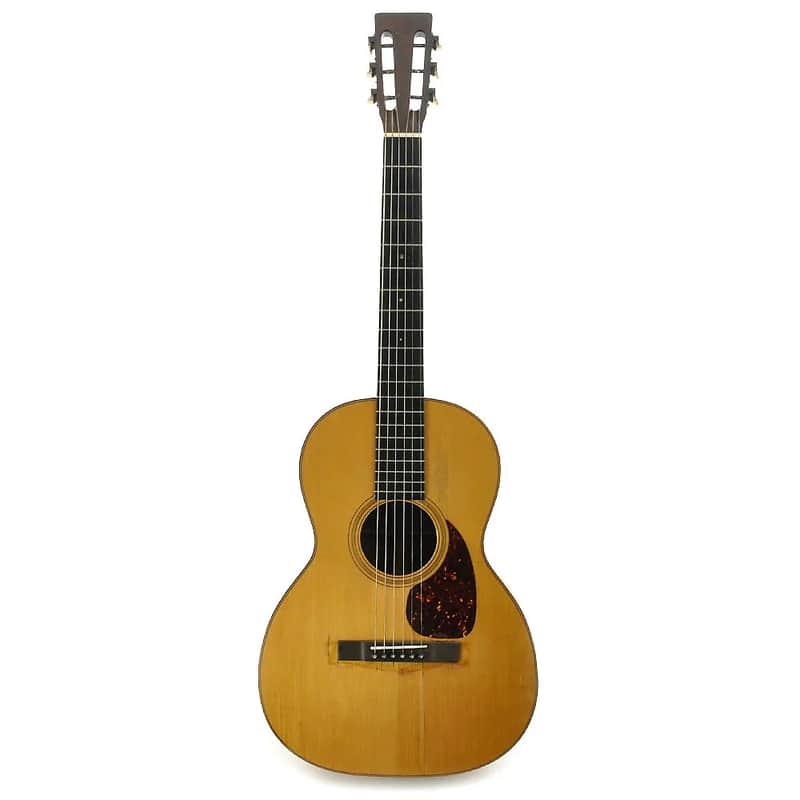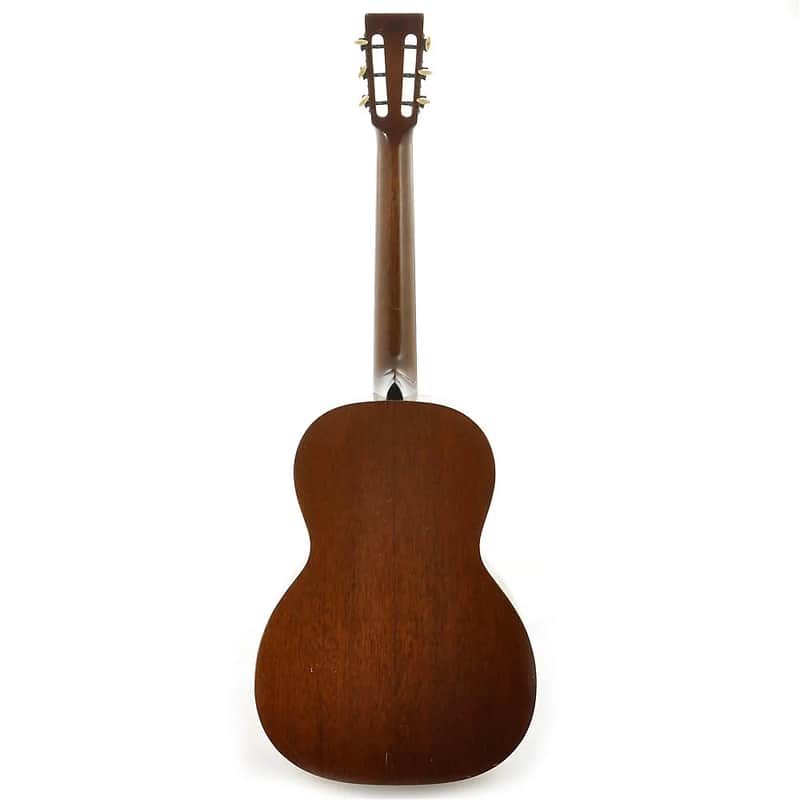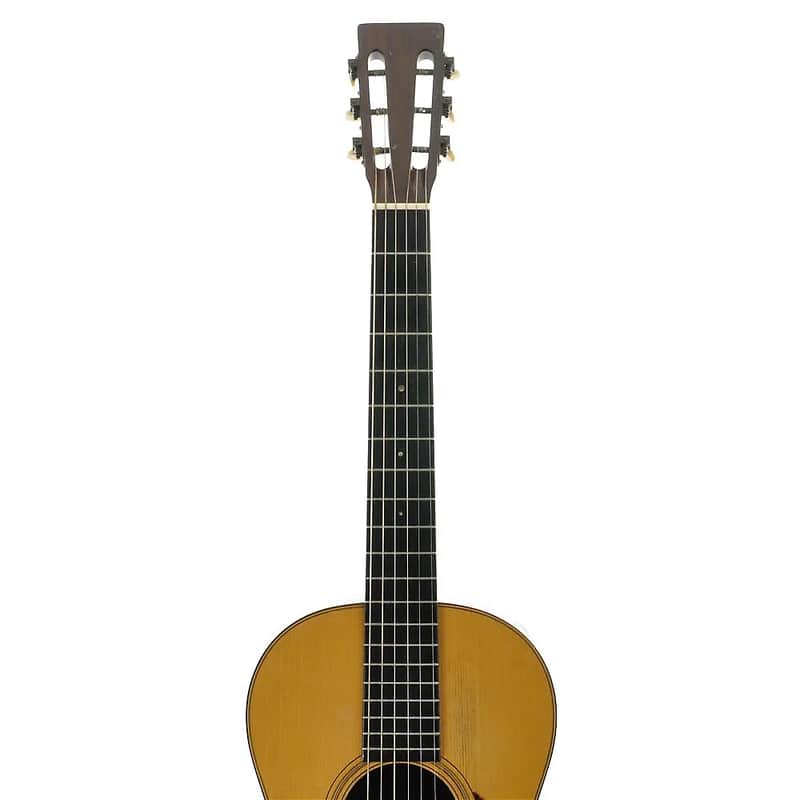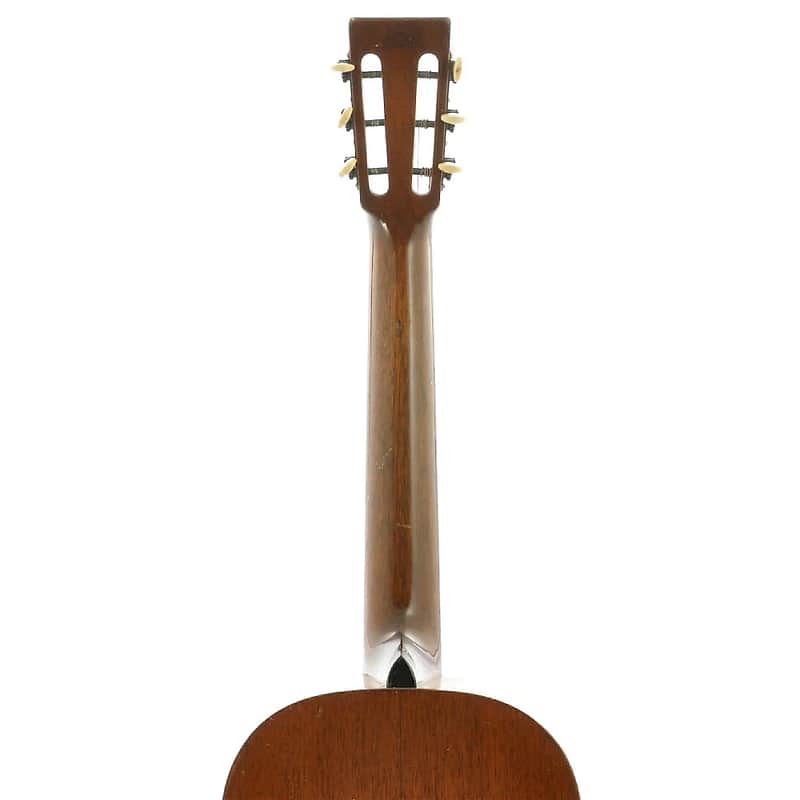
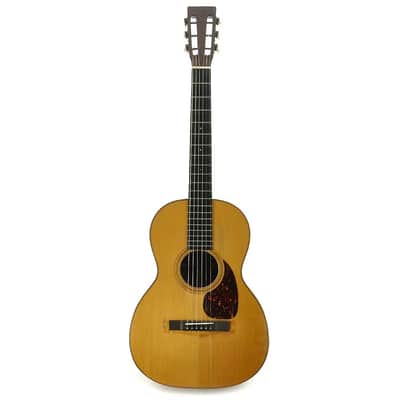
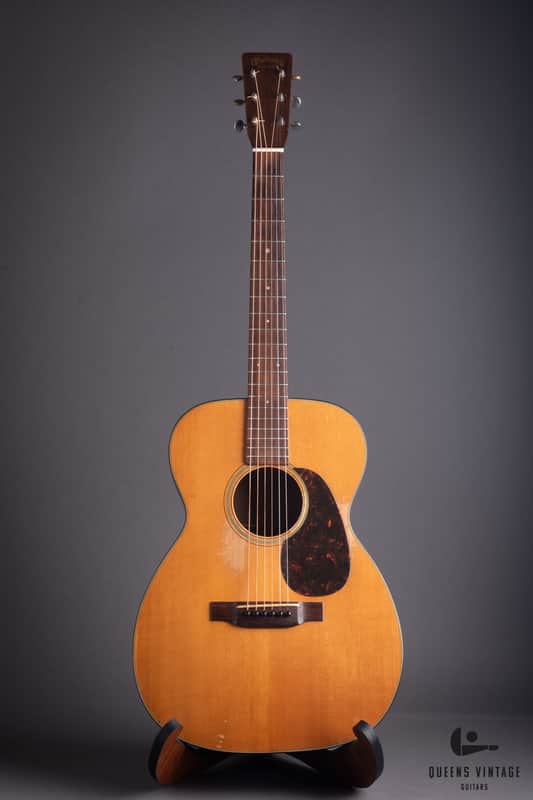

C. F. Martin 00-18 Model Flat Top Acoustic Guitar (1937), made in Nazareth, PA, serial # 68591, natural lacquer finish, mahogany body and neck, Adirondack spruce top, ebony fingerboard and bridge, black hard shell case.
The 00-18 may not be one of Martin's rarer creations, but to many players constitutes one of the company's most propitious combinations of wood, wire and inspiration. This late 1937 guitar combines a Honduras mahogany body and delicately scallop-braced Adirondack spruce top making for very light and a superbly responsive instrument.
This 00-18 was made right at the end of 1937, one of exactly 300 shipped that year. Listing at $45.00 (plus case) it was not a particularly expensive instrument by Martin standards but still represented a fairly substantial investment to many players in that still-depression ridden period. In late 1937 this model was several years into the 14-fret "Orchestra Model" pattern but still built with the now much desired earlier features including the "forward shifted" scalloped X brace and the wider 1 3/4" nut. The bridge and fingerboard are ebony, both changed to rosewood soon after.
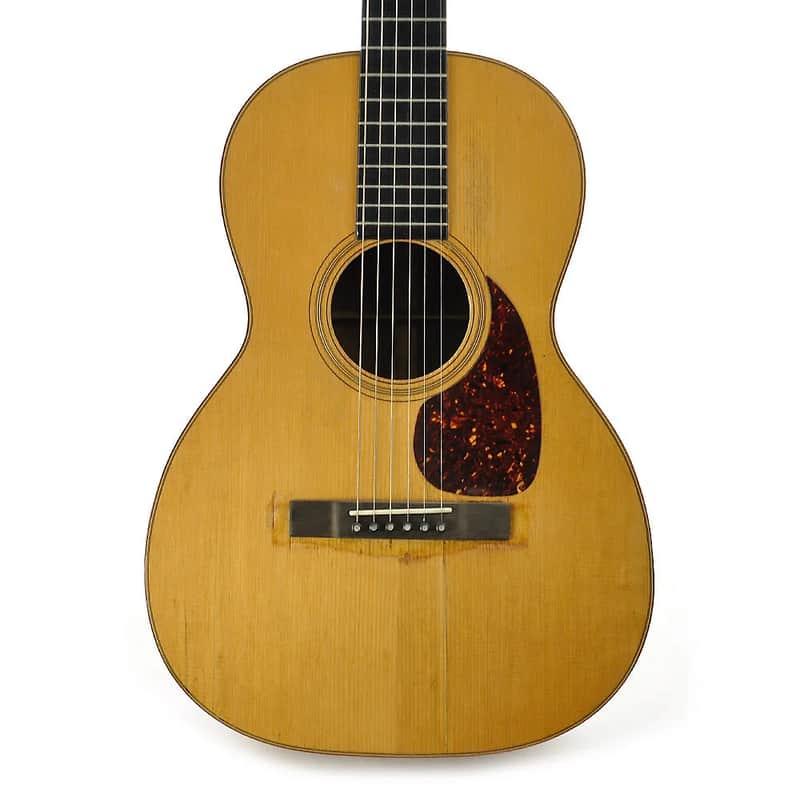
The 00-18 is not a flashy guitar; the trim is discreet with tortoise celluloid binding on the outer body edges, a tortoise celluloid pickguard and a simple multiply celluloid soundhole ring. In classic Martin style, the elegant understatement speaks for itself. The mahogany neck has a medium-chunky if fairly shallow profile with a subtle hint of a soft "V" and the wider nut used before 1939. The neatly bookmatched Appalachian spruce used for the top has a wider grain on the outside edges than many Martins of this period, thus was used on this less fancy model. Despite its smaller size body and lack of flash this was a fully professional-quality instrument described as fully suitable "for broadcasting or stage work".
In the decades since, Martins of this era have become the benchmark for nearly all subsequent acoustic guitar designs. The 00-18 is on the small side compared to the more ubiquitous Dreadnoughts, making for a very easily handling guitar. Despite this it offers a surprisingly powerful sound and is an extremely versatile instrument, a delightful fingerpicker with a strong reserve of sound if driven with a flatpick. The "advanced" scalloped bracing makes a major sonic difference on smaller bodied guitars, and this instrument has a wealth of tone not evident even on most 00's from the following decade. An ideal writing or recording instrument as well as stage guitar, this pre-war 00 is a wonderful creative tool and a fine survivor of Martin's undisputed "Golden Age".
Overall length is 39 3/8 in. (100 cm.), 14 3/8 in. (36.5 cm.) wide at lower bout, and 4 1/8 in. (10.5 cm.) in depth at side, taken at the end block. Scale length is 24 3/4 in. (629 mm.). Width of nut is 1 3/4 in. (44 mm.).
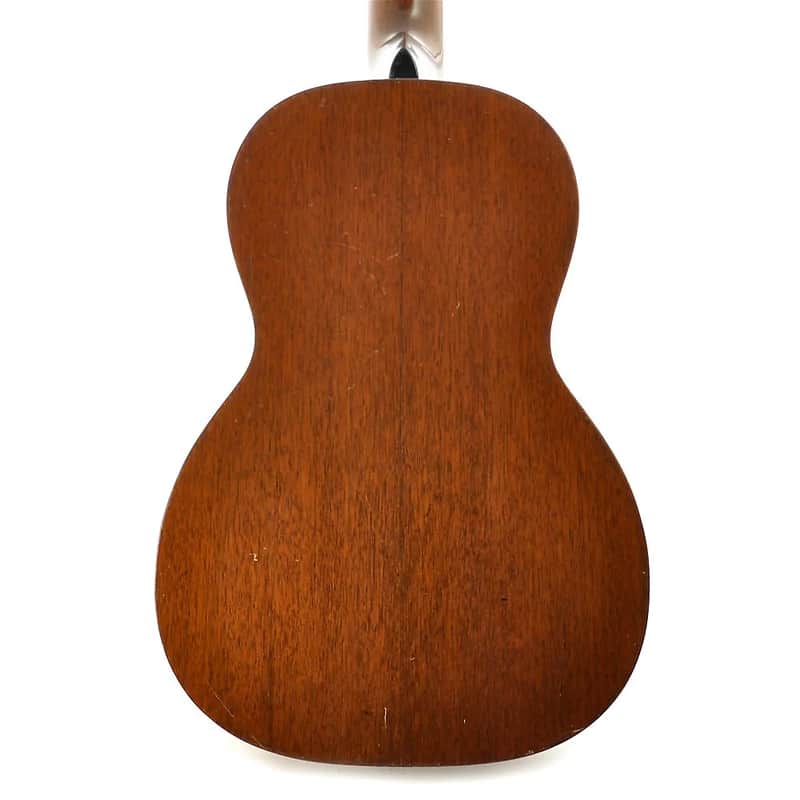
This is a decently well-preserved guitar for being nearly 90 years old, showing some typical wear and a number of mostly fairly discreet repairs. The finish has wear overall but remains original except one repair spot on the turn of the upper treble bout detailed below. There is moderately heavy pick wear to the top mostly around the pickguard and soundhole rim, with additional pick marks above the fingerboard extension. The top finish shows checking, dings and scrapes, one deep "case lid bite" near the top edge of the upper bass bout and a deep scrape mark behind the bridge. The back and sides have typical wear with dings, dents and scrapes, with fairly heavy belt buckle scratching to much of the back. The neck finish is partially down to the wood on the back with some shallow dings and dents.
The guitar has a number of mostly neatly done structural repairs. A tailpiece was previously installed and removed, with the small holes above the endpin filled and a small pressure mark on the top as evidence. Due to this we would normally expect the ebony bridge to be a replacement; this one looks correct and original but may be a very fine older reproduction. It has in any case been reglued and the top lowered a bit in a downward slope from the back edge. The small maple bridgeplate is original with a very slim narrow patch added atop it just over the pinholes.
The most conspicuous repair is an old impact mark just above the turn of the upper bout on the treble side, with a couple of attendant grain cracks running up from it towards the heel. This has been sealed up and reinforced internally with bias tape, and has the finish patched around it. This is an older less professional looking repair than evident on the rest of the instrument, fairly conspicuous with the original wood glued back in place but a few small spots just filled with finish. It is not the neatest but does not cause any structural issues.
Internally there is other visible repair work. The main X-brace on treble side has a tight split previously reglued about halfway back, with a diamond cleat located slightly above it. There are also two grain splits each with a small cleat beneath the fingerboard extension; these are fully under the board and not visible from above. The endblock had been previously split and reglued; this is noticeable internally but inconspicuous externally. There is also a tightly sealed crack on the bass side at the waist, with no internal reinforcement.
The neck has been cleanly reset with an ebony shim under fingerboard extension, and very neatly refretted with period-correct wire. The fingerboard was trued and shows no divoting. No strap button was ever added to the heel. The original metal button Grover tuners are intact and working well. Despite (or perhaps because of) this litany of repair the guitar is a very fine player, with a delightful and most expansive sound for a 00 sized instrument. It is housed in a vintage but later period HSC. Overall Very Good + Condition.
The 00-18 may not be one of Martin's rarer creations, but to many players constitutes one of the company's most propitious combinations of wood, wire and inspiration. This late 1937 guitar combines a Honduras mahogany body and delicately scallop-braced Adirondack spruce top making for very light and a superbly responsive instrument.
This 00-18 was made right at the end of 1937, one of exactly 300 shipped that year. Listing at $45.00 (plus case) it was not a particularly expensive instrument by Martin standards but still represented a fairly substantial investment to many players in that still-depression ridden period. In late 1937 this model was several years into the 14-fret "Orchestra Model" pattern but still built with the now much desired earlier features including the "forward shifted" scalloped X brace and the wider 1 3/4" nut. The bridge and fingerboard are ebony, both changed to rosewood soon after.
The 00-18 is not a flashy guitar; the trim is discreet with tortoise celluloid binding on the outer body edges, a tortoise celluloid pickguard and a simple multiply celluloid soundhole ring. In classic Martin style, the elegant understatement speaks for itself. The mahogany neck has a medium-chunky if fairly shallow profile with a subtle hint of a soft "V" and the wider nut used before 1939. The neatly bookmatched Appalachian spruce used for the top has a wider grain on the outside edges than many Martins of this period, thus was used on this less fancy model. Despite its smaller size body and lack of flash this was a fully professional-quality instrument described as fully suitable "for broadcasting or stage work".
In the decades since, Martins of this era have become the benchmark for nearly all subsequent acoustic guitar designs. The 00-18 is on the small side compared to the more ubiquitous Dreadnoughts, making for a very easily handling guitar. Despite this it offers a surprisingly powerful sound and is an extremely versatile instrument, a delightful fingerpicker with a strong reserve of sound if driven with a flatpick. The "advanced" scalloped bracing makes a major sonic difference on smaller bodied guitars, and this instrument has a wealth of tone not evident even on most 00's from the following decade. An ideal writing or recording instrument as well as stage guitar, this pre-war 00 is a wonderful creative tool and a fine survivor of Martin's undisputed "Golden Age".
Overall length is 39 3/8 in. (100 cm.), 14 3/8 in. (36.5 cm.) wide at lower bout, and 4 1/8 in. (10.5 cm.) in depth at side, taken at the end block. Scale length is 24 3/4 in. (629 mm.). Width of nut is 1 3/4 in. (44 mm.).
This is a decently well-preserved guitar for being nearly 90 years old, showing some typical wear and a number of mostly fairly discreet repairs. The finish has wear overall but remains original except one repair spot on the turn of the upper treble bout detailed below. There is moderately heavy pick wear to the top mostly around the pickguard and soundhole rim, with additional pick marks above the fingerboard extension. The top finish shows checking, dings and scrapes, one deep "case lid bite" near the top edge of the upper bass bout and a deep scrape mark behind the bridge. The back and sides have typical wear with dings, dents and scrapes, with fairly heavy belt buckle scratching to much of the back. The neck finish is partially down to the wood on the back with some shallow dings and dents.
The guitar has a number of mostly neatly done structural repairs. A tailpiece was previously installed and removed, with the small holes above the endpin filled and a small pressure mark on the top as evidence. Due to this we would normally expect the ebony bridge to be a replacement; this one looks correct and original but may be a very fine older reproduction. It has in any case been reglued and the top lowered a bit in a downward slope from the back edge. The small maple bridgeplate is original with a very slim narrow patch added atop it just over the pinholes.
The most conspicuous repair is an old impact mark just above the turn of the upper bout on the treble side, with a couple of attendant grain cracks running up from it towards the heel. This has been sealed up and reinforced internally with bias tape, and has the finish patched around it. This is an older less professional looking repair than evident on the rest of the instrument, fairly conspicuous with the original wood glued back in place but a few small spots just filled with finish. It is not the neatest but does not cause any structural issues.
Internally there is other visible repair work. The main X-brace on treble side has a tight split previously reglued about halfway back, with a diamond cleat located slightly above it. There are also two grain splits each with a small cleat beneath the fingerboard extension; these are fully under the board and not visible from above. The endblock had been previously split and reglued; this is noticeable internally but inconspicuous externally. There is also a tightly sealed crack on the bass side at the waist, with no internal reinforcement.
The neck has been cleanly reset with an ebony shim under fingerboard extension, and very neatly refretted with period-correct wire. The fingerboard was trued and shows no divoting. No strap button was ever added to the heel. The original metal button Grover tuners are intact and working well. Despite (or perhaps because of) this litany of repair the guitar is a very fine player, with a delightful and most expansive sound for a 00 sized instrument. It is housed in a vintage but later period HSC. Overall Very Good + Condition.
| Listed | 4 months ago |
|---|---|
| Condition | Very Good (Used) Very Good items may show a few slight marks or scratches but are fully functional and in overall great shape.Learn more |
| Brand | |
| Model |
|
| Finish |
|
| Categories | |
| Year |
|
| Pickup |
|
| Series | |
| String Type |
|
| Right / Left Handed |
|
| Number of Strings |
|
| Model Family | |
| Neck Material |
|
| Finish Style |
|
| Top Material |
|
| Body Shape |
|
| Back Material |
|
| Sides Material |
|
| Fretboard Material |
|
| Color Family |
|
| Active Preamp |
|
| Number of Frets |
|
Product safety information may be available here.