Trickfish Amplification Bullhead 5K Bass Head
This gear has sold
See similar gear from other Reverb sellers

How the Bullhead Works
There’s just 3 meaningful sections to any bass head:
1. The Instrument Input and Gain section:
a. Input Attenuator: This is the first block in building what is commonly called “Gain Structure”. The
signal (your instrument) plugs into the jack and depending on where you adjust the input sensitivity ‐ in the case of our amps it is labeled “HI/LOW”, here is where you set the first block of gain in the amplifier. The Bullhead input is designed to accept a wide range of sources from
7
BH.5K Guide 04272017
passive to active instruments as well as from a piezo acoustic bass pickup. This input is AC
coupled to prevent unknown sources from damaging the input circuitry with DC or spikes. b. The Gain Control sets the gain level into the EQ. If you under‐power the signal into the EQ
section you just won’t have enough voltage to get the EQ to work to its fullest potential and you’ll add noise. Overpower the input to the EQ section and you’ll simply have distortion. By adding EQ you also increase the Gain.
-
The EQ Section: Before we dissect the EQ circuit it should be noted that there are a couple schools of thought on running the EQ section of any audio device but for simplicity sake, let’s discuss bass amps. Some suggest that you should first set the instrument tone controls where you like them then adjust the EQ to suit the cabinet and room characteristics. Others (us included) suggest that you leave the instrument in a flat position (this presumes you have an active EQ on the bass) and dial in the amplifier EQ first. It should be noted that as you add volume (by turning up the master) you are changing the perceived tonality of the system. You’ll hear more low frequency at higher volumes (research “Fletcher and Munson Curves”) so when you’re setting up your amp you should try to approximate the volume levels at which you’ll be playing – a good time to do this is at the sound check. When you add EQ you are also adding gain (the reverse is true as well – cut EQ and you’re reducing gain). Think about this when judging the Gain Structure of the amp.
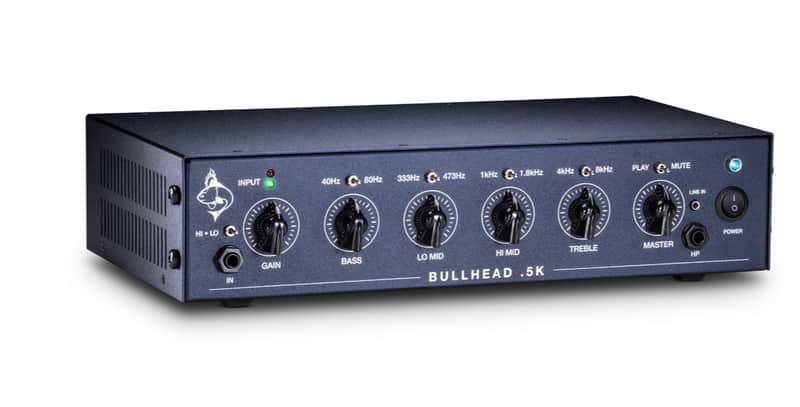
a. Bass Control: On most bass amplifiers and on the Bullhead .5K the bass filter is a shelving type of EQ. In the 12:00 position there is no cut or boost on the Bullhead so essentially you’re just passing a signal through. The Bullhead offers two low shelving frequencies” meaning that when you add or subtract bass you are affecting a range frequencies below that frequency. On the Bullhead those frequencies are 40Hz and 80 Hz – very musical frequencies as the low E string fundamental frequency is 41.2 Hz. By selecting the 40Hz setting you’re essentially adding deep bass and by selecting the 80Hz frequency you are affecting a warmer, punchier bass.
b. Low‐Mid Control: This filter could be characterized as a Variable Gain, Band‐Pass filter. As with all of the EQ controls when you have the knob in the 12:00 position you are simply passing a signal through the circuit and leaving the signal unaffected. The Low‐Mid control has a fixed width depending on the frequency point you select – either 333Hz or 473 Hz and the center frequency of these filters has been tuned for the most musical range. These frequencies were selected for their particular sonic characteristics and are very “Bass Instrument” specific.
c. Hi‐Mid Control: Just like the Low‐Mid control this is a Variable Gain, Band‐Pass filter and, as with all of the EQ controls, when you have the knob in the 12:00 position you are simply passing a signal through the circuit and leaving the signal unaffected. The Hi‐Mid control has a fixed width depending on the frequency point you select – either 1kHz or 1.8kHz. More often than not you’ll be cutting these frequencies to soften up the sound or, if you slap and pop, scoop out the nasty bits. Cutting helps to eliminate string noise without losing mid‐range punch. This control can really help shape your sound.
d. Treble: Like the bass control, the treble control is a shelving type EQ and covers a wide swath of frequencies. And like the bass control, in the 12:00 position there is no cut or boost on the Bullhead. The Bullhead offers two “hi‐pass frequencies”, 4kHz and 8kHz. For an airy, glassy high‐ end select the 8kHz setting. Want a bit more edge then you should select the 4kHz setting.
-
Power Amplifier/ Master Volume: The Master Volume is essentially the volume control for the power amplifier – which is the engine of the head. When you turn up the Master you are sending a signal to the input of the power amplifier and telling the amplifier to do its job, make things louder! The output of the
8
BH.5K Guide 04272017
amp sends the signal to the speaker outputs. On the Bullhead .5K we feature a “mute switch” that interrupts the signal to the power amp and the DI so that you can tune or warm up silently.
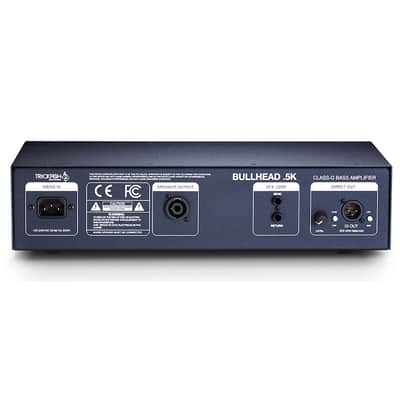
Routing: The ability to route a signal to various places is essential if you’re to use the amp in the real world. Digital tuners, effects, MP3 players, headphones – much of the technology we can use as musicians needs to integrate with the amp. The Bullhead .5K offers the following integration options:
-
Auxiliary In: for MP3 players, drum machines – any audio source. Note that the Aux input is not routed to the DI but it IS routed to the speaker and headphone output. You can share that tune the band is working on through your speaker or practice with a track. None of the volume or EQ controls affect the level of the Aux input; you’ll control the volume via the volume on your audio source.
-
Headphones accommodate private listening, listening to the Aux In, or for silent acoustic tuning.
-
Series EFX loop: Interrupt the signal path to insert a signal processing like a compressor or run effects
like reverb alongside the pure signal.
-
Balanced Direct Output: Very low‐noise, balanced output for routing the signal to a live console,
recording console or computer interface.
-
Direct Output Level Control: Use this to determine an optimal output volume for the destination
device.
-
Direct Output Pre/Post: In rare cases it’s best to send an unprocessed signal to a recording or live
console where the engineer can adjust the EQ of the bass signal. The input gain and EQ does not affect the “Pre” Direct Out signal. Conversely, the “Post” Direct Out signal is affected by input gain, FX and EQ.
-
Direct Output Ground Lift: Use this if you hear a hum or buzz in the output signal. This can happen when there is discrepancy between the power ground of the Bullhead .5K and the house sound system or recording system.
Power Output:
8 Ohms: (Continuous Power ‐ 253W @ .13% THD, 365W @1% THD), (Peak 506W @ .13% THD, 730W @1% THD)
4 Ohms: (Continuous Power ‐ 312W @ .13% THD, 702W @1% THD), (Peak 625W @ .13% THD, 1404W @1% THD)
Power Amplifier: Class D with Switch‐Mode Power Supply
Pre‐Amp: Low noise, all analog, solid state
Input: 1⁄4” Phone with switchable attenuation and rotary gain control
Input Level Indicator: Signal level and Clip LEDs (green/red)
EQ: 4 Band Switchable
Shelving Bass and Treble with selectable Hi‐Pass frequencies
Low‐Mid and Hi ‐Mid ‐Variable Gain, Band Pass EQ with selectable frequency/ bandwidth options Master Volume: Rotary Control
Line In: 1/8" mini jack
Headphone Out: Stereo 1⁄4" Phone jack
Mute Switch: mini toggle
AC Mains: 85‐132V, 195‐264V, 45‐65 Hz, 1000VA (Worldwide usage)
AC Mains Indicator: Blue LED
EFX Loop: Series
Direct Out: 600 Ohm Balanced, XLR, Pre/Post, Ground Lift and Level control
Speaker Output: 1 x Neutrik Combi‐Connectors
Chassis: Aircraft grade aluminum w/removable rubber feet
Rack Ears (Optional)
Size: (H x W x D in.) 3.3 x 15.1 x 8 (inches)
Shipping Carton Size: (H x W x D in.) 18 x 12 x 8 (inches)
Weight: Net 5.0 lbs. Gross 7.6 lbs.
Reverb Buyer Protection
Reverb has your back if your item is lost, damaged, or doesn't match its description. Simply report any issues within 7 days and we'll help you get a full refund.Learn more about Reverb Buyer Protection.
| Condition | Brand New (New) Brand New items are sold by an authorized dealer or original builder and include all original packaging.Learn more |
|---|---|
| Brand | |
| Model |
|
| Categories | |
| Year |
|
| Made In |
|
Product safety information may be available here.