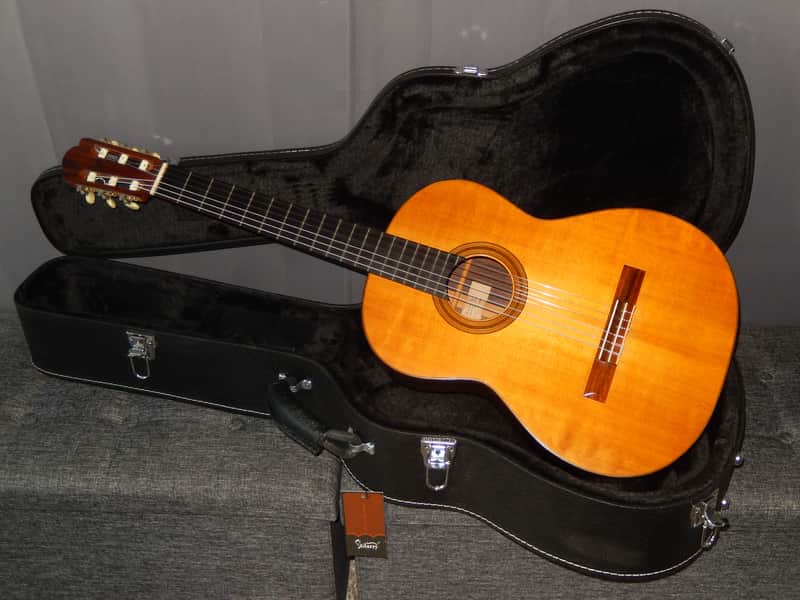
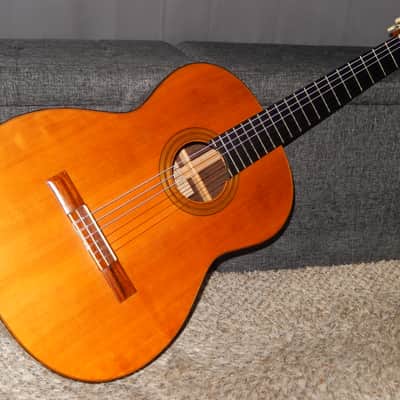
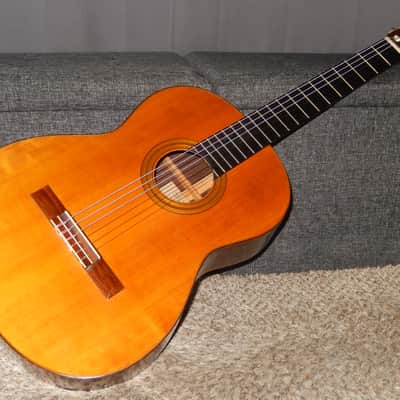
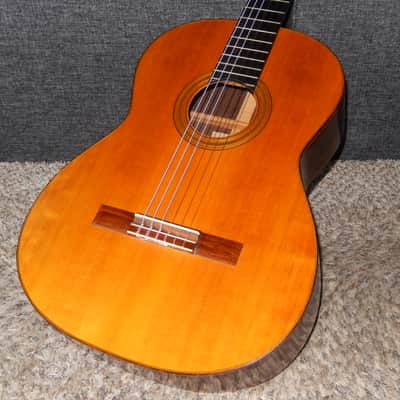
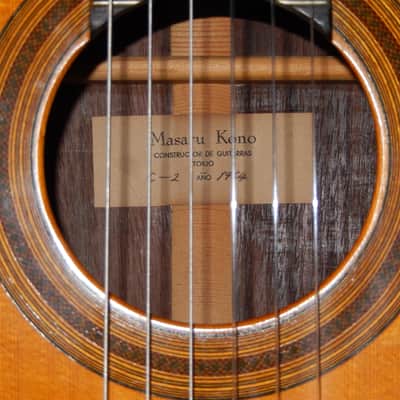
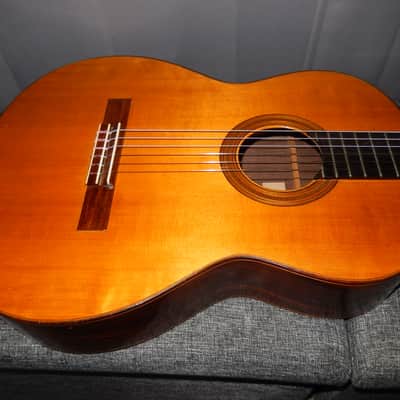
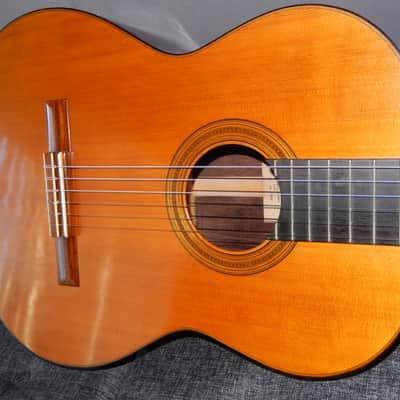
RARITY - MADE IN 1964 MASARU KOHNO C2 - FAMOUSLY GREAT CLASSICAL CONCERT GUITAR
This gear has sold
See similar gear from other Reverb sellers

Our users rate Reverb
Masaru Kohno C2 1964
Masaru Kohno was the most famous Japanese classical guitar maker and is still considered one the greatest among all world class luthiers that ever walked the Earth. His guitars have been and still are played by legendary classical guitar virtuosos.
If you are interested in classical guitars, it is highly unlikely that you have never heard of Masaru Kohno. If you’d like to deepen your knowledge about his deeds, there is plenty of info you can find on-line.
You may also find out that when contemporary luthier makes classical guitar from 40+ years old woods its price easily reaches $10000USD. Famous European luthiers may easily charge twice that much.
After you do all this research you shouldn’t be surprised by current prices of Kohno guitars. The older they are the more precious they are to collectors and players alike.
Any Kohno guitar made in mid 1960s is quite rare find. In those years Masaru Kohno along with his associates (Saburo Nogami, Hiroshi Komori, Mass Hirade, Osamu Tomita) was making no more than few hundred guitars per year. Only after his 1967 win in international luthier competition in Belgium, Masaru Kohno’s workshop started to make far greater numbers of guitars, to reach several thousand units per year by mid1970s. One reason for such output was Masaru Kohno’s fame. Perhaps more important was that labor market in Japan and currency exchange rates were very favorable to international buyers/importers. Yet towards the end of 1970s all these economical relationships were quickly changing and “hand made in Japan” instruments becoming more and more expensive to international players; hence demand was greatly declining. The end of 1970s was the end of Golden Era for most Japanese luthiers. Only those with strong international ties continued to prosper yet couldn’t expand their workshops at the same pace as it was possible in 1970s. Their workshops became smaller again and number of high-end models greatly reduced while their prices steadily going up.
It is then rather obvious that this guitar, besides being a truly magical instrument is also a highly collectible item. Because of its overall very good structural and functional condition, it is automatically a super precious find.
The sound this guitar produces matches the fame of its maker. It is very powerful, yet very lyrical, with strong piano-like trebles, cello like basses and very mystique tonality, and very extended sustain. This instrument can quickly take you away from all your earthly matters. With current action it plays super easy.
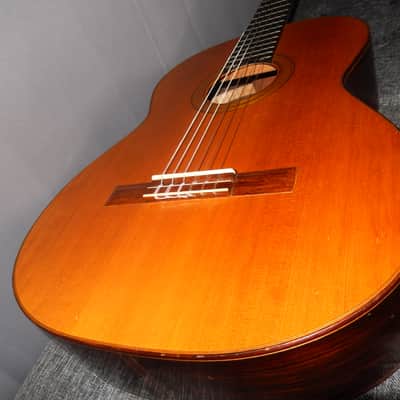
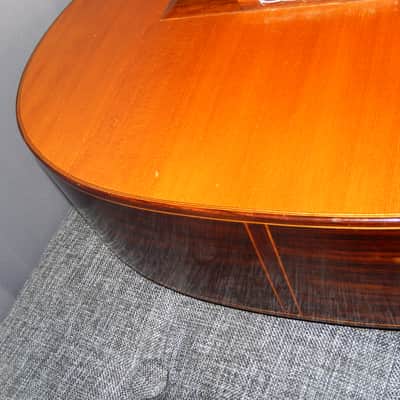
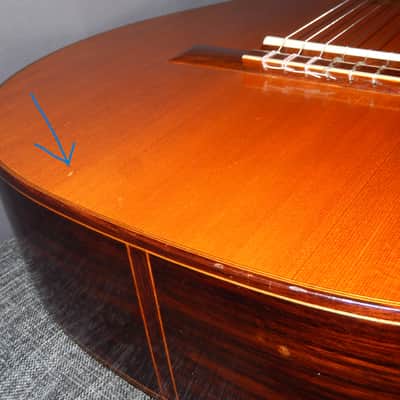
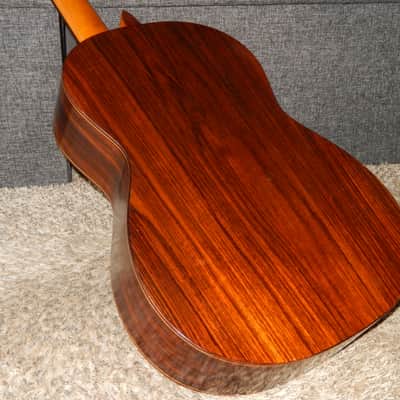
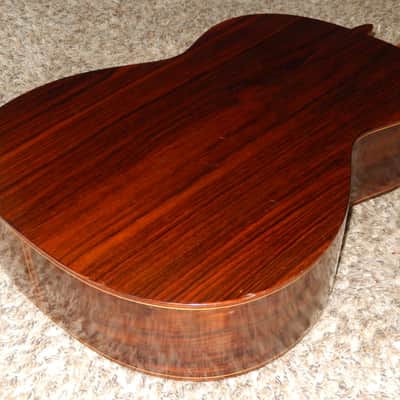
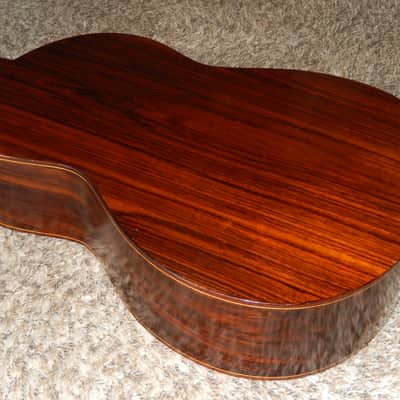
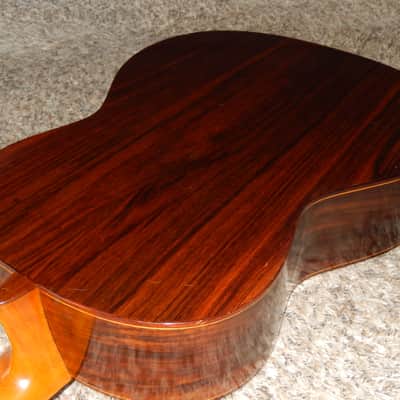
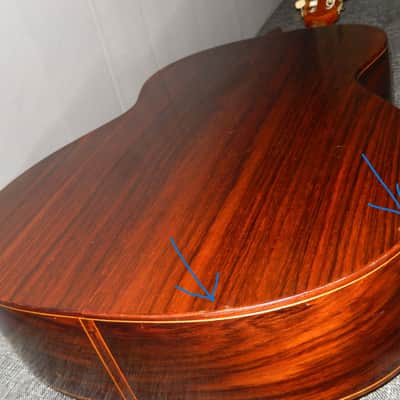
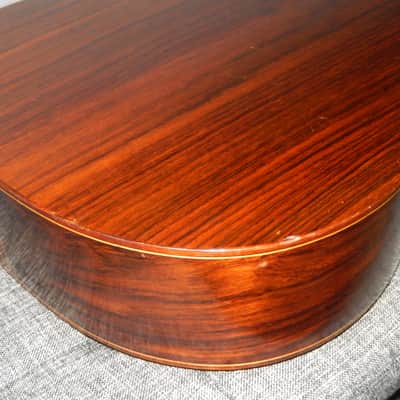
While it doesn’t have any structural flaws, the cosmetic condition of this guitar is “far from excellent”, but perhaps “quite good” considering the age of this great instrument. Its soundboard bears multitude of very small fingernail marks, scratches, and small dents, yet most are so light that become visible only from very close distance while looked at from certain angle, hence don’t show on in the pictures. Only one tiny dent reaches the wood. Similarly, back & sides have multitude of very light marks, with most hardly visible in regular light. Also, the edges bear multiple very small dents and abrasions. The most “serious damage” are 2 dents with very small fragments of varnish missing. They are both stabilized by drops of glue applied from the top.
Very importantly this guitar doesn’t have any structural flaws.
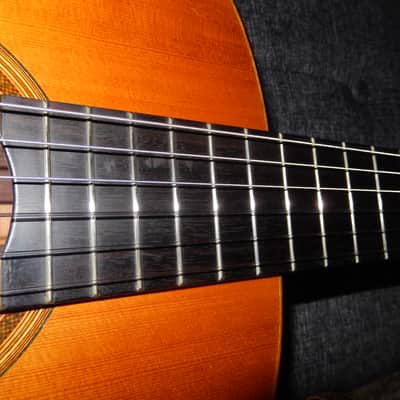
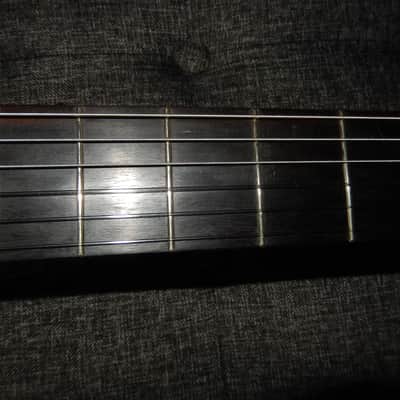
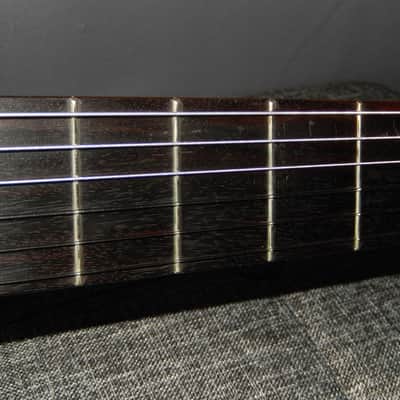
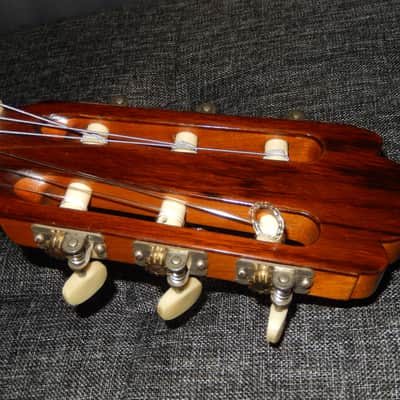
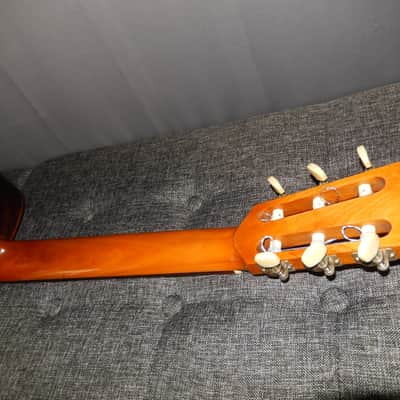
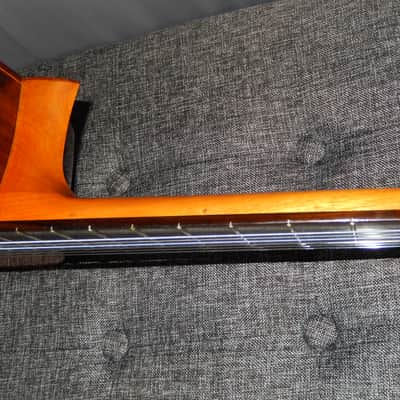
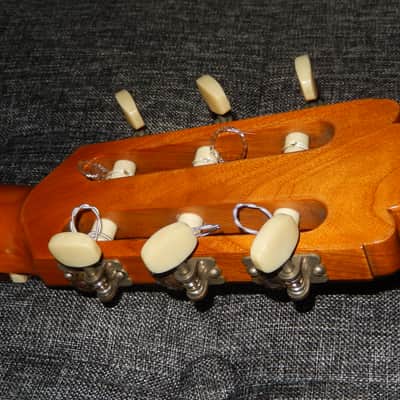
The neck is straight and quite slim for that era. The back of the neck and headstock survived in excellent cosmetic condition, with traces of 3 position marks located near the fingerboard. Original (spaced 39 mm apart) tuning keys are fully functional, with only E1 key working somewhat tighter or squeaky. Fingerboard and (stainless steel) frets remain in very good condition with only some minor sign of wear and a few light scratches located between zero and 3rd frets.
I simply don’t know how much this guitar was priced and what was Masaru Kohno top of the line model of that era. Even if it was priced 20 000 yen in 1964 it was still quite an expensive instrument. In 1964 for most Japanese makers 30 000yen was the maximum price they could get for their top models. Very top Yamaha model No300 was priced 30 000 yen. In 1964 Masaru Kohno was highly regarded mostly in the Tokyo area, not very famous yet, hence had to propose competitive prices no matter how great his instruments were. In 1966 he had a different model lineup but with prices still in line with most of other Japanese luthiers. Only after his international win in 1967 he could dictate much higher prices for his guitars.
Specifications:
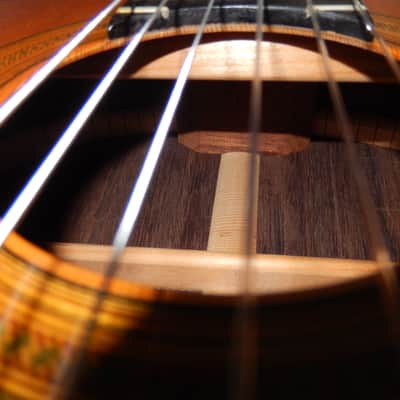
Top: Very Fine Solid Spruce/5 braces fan/cashew lacquer
Back & Sides: Solid Indian Rosewood/ cashew lacquer
Neck: Mahogany
Fingerboard: Striped Ebony
Scale: 650 mm
Nut width: 50 mm
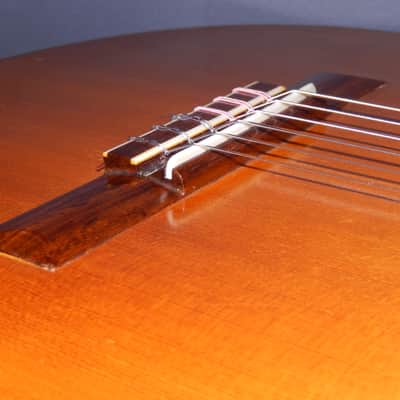
Action is set (very likely by its former owner) to 3.30 mm under E6 and 2.80 mm with still plenty of extra room on the saddle. I don’t produce buzzes while playing this guitar. If you do, you will need a higher saddle.
This guitar will be shipped in brand new hard shell case.
Real Value of Japanese Vintage Guitars
The key to understand value of vintage Japanese guitars is to acknowledge galloping price inflation (devaluation of Japanese yen) during 1960s & 1970s. This inflation slowed down in 1980s.
During 1960s and most of 1970s model numbers of Japanese guitars were strictly interconnected with their prices in Japanese yen. By early 1980s and during following decades model numbers were no longer strictly associated with their prices. Some Japanese guitar makers introduced model names instead of model numbers. Others were still using model numbers with addition of letters and/or other symbols.
It is then important to understand that two Yamaha GC10 guitars made 10 years apart are two instruments of totally different class. The same applies to any other Japanese maker/brand.
The logical way to estimate the true class of any given Japanese made instrument is to compare its price with the average annual salary of wage workers in Japanese private sectors. This salary was: 450 600 yen in 1965 - 825 900 yen in 1970 - 1 868 300 yen in 1975 - 2 689 000 yen in 1980 - 3 163 000 yen in 1985 - 3 761 000 yen in 1990 - 4 107 000 yen in 1995 - 4 082 000 yen in 2000.
Any guitar priced 100 000 yen in 1970 (labelled as No10 or No100) would be priced 200 000 yen in 1975 (relabeled to No20, No200 or 2000), 300 000 yen in 1977 (labelled as No3, No30 or 3000) and 500 000 yen by 1985 (labelled as No50 or 5000).
Starting in 1977 Masaru Kohno introduced his new models No40 priced 400 000 yen and No50 priced 500 000 yen. By early 1980s Kohno started using model names instead of numbers and was steadily raising their prices without changing model labeling. His very top model 50 became model “Special”, and a decade later it became model “Maestro”. Naturally, all other Japanese guitar makers were doing similar pricing (labelling) upgrades.
Knowing all of that, you can bet on that Masaru Kohno No50 made in 1982 is practically the same grade instrument as Kohno No20 made in 1972, or Kohno no 30 made in 1975.
In early 1970s the lowest Ryoji Matsuoka (all plywood) model was 10, followed by (solid top) models 15, 20, 25, 30, 40, 50, 60, 80 and (all solid woods) models 100 and 150. Models 50, 60 and 80 were made with non-solid figured Brazilian Rosewood (double) back and sides and top model 150 was the only one made with solid figured Brazilian Rosewood b/s.
In 1980 the lowest Matsuoka model was (all plywood) 20, followed by (solid top) models 30,40,50, 60 and all solid woods models 80,100,150 and 200. By 1990 the lowest Matsuoka model was M40 and the highest was M300. By 2010 the lowest Matsuoka model was M50 and the top model was M270.
You can bet that Ryoji Matsuoka model 50 from 1980 is of the same grade as model M100 from 2000, model 100 from 1980 is of the same grade as model M150 from 2000, model 150 from 1980 is of the same grade as M200 from 2000 and model 200 from 1980 is of the same grade as model M300 from 2000.
It is important to mention that if modern era luthiers are using 40+ years old woods to make an “all solid” wood classical guitar, its price is minimum $8000.
All vintage guitars made with Brazilian Rosewood are especially precious, including those made straight grain varieties and those with non-solid b/s.
Because response and tonal properties of Spruce soundboards are improving over time, long seasoned Spruces are far more precious than long seasoned Cedars.
It is not very difficult to find out what are current prices of such guitars made by world’s leading luthiers.
| Listed | 3 years ago |
|---|---|
| Condition | Very Good (Used) Very Good items may show a few slight marks or scratches but are fully functional and in overall great shape.Learn more |
| Brand | |
| Model |
|
| Finish |
|
| Categories | |
| Year |
|
| Made In |
|
| Body Shape |
|
Product safety information may be available here.