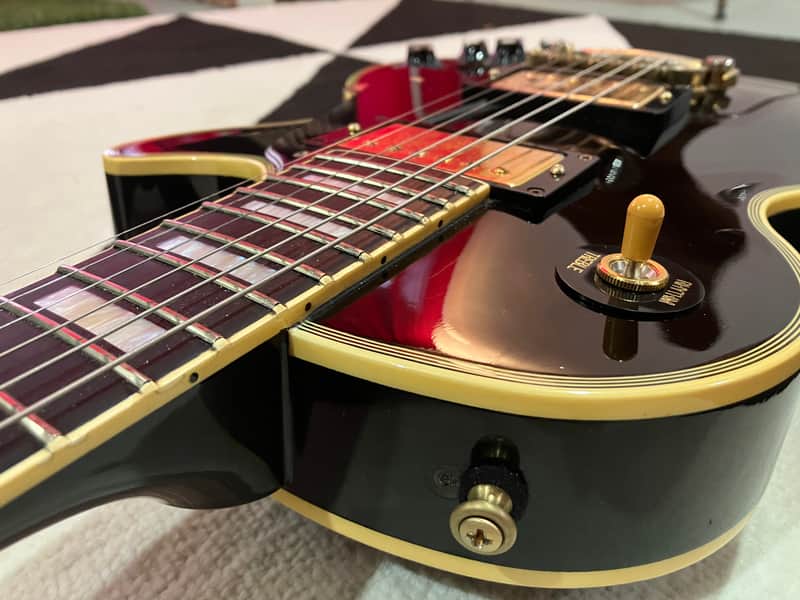
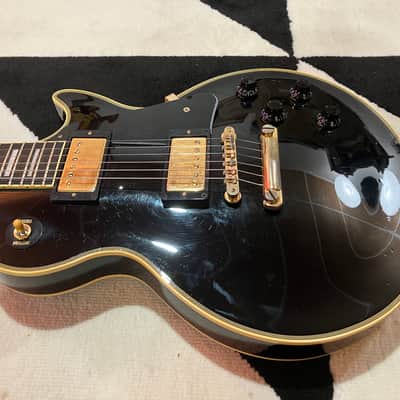
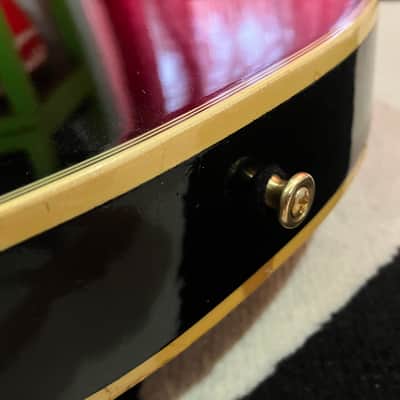
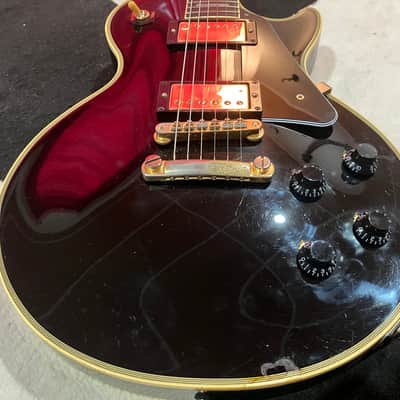
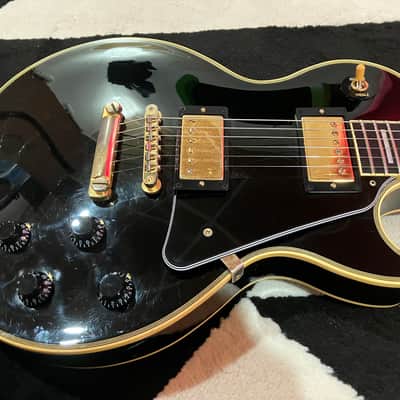
Orville by Gibson Les Paul Custom (LPC-57B; 1993)
This gear has sold
See similar gear from other Reverb sellers

Our users rate Reverb
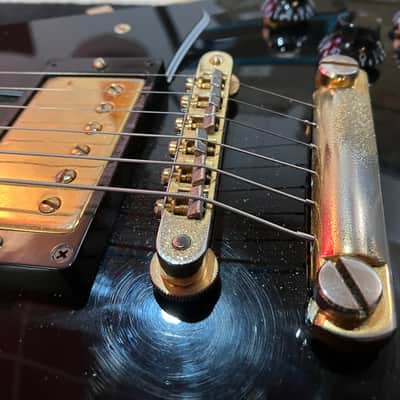
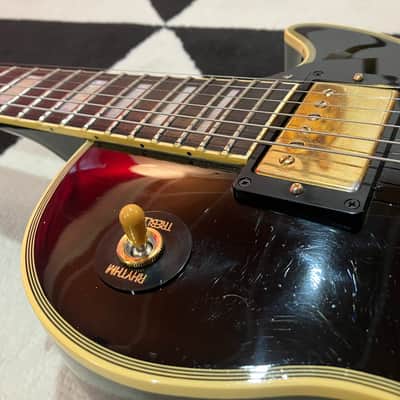
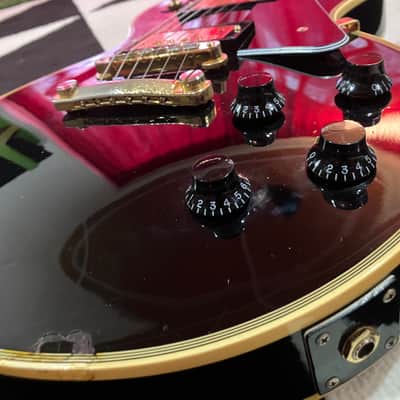
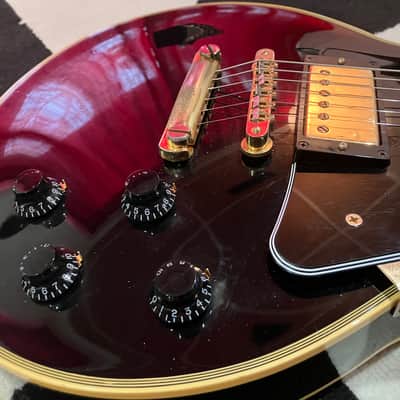
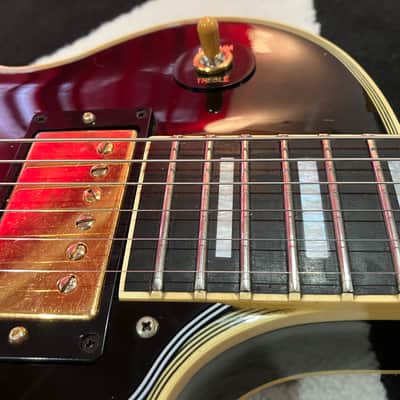
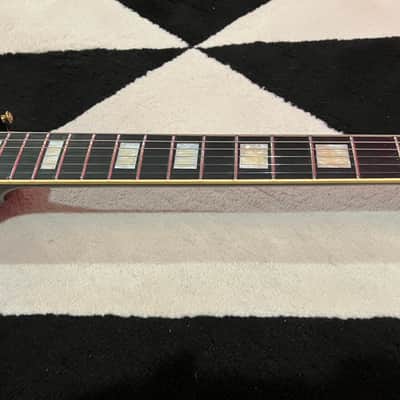
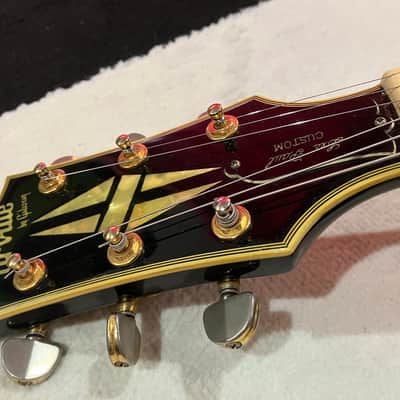
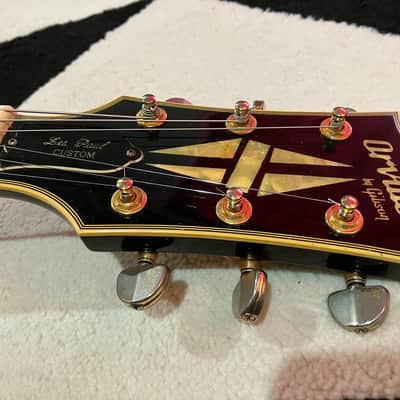
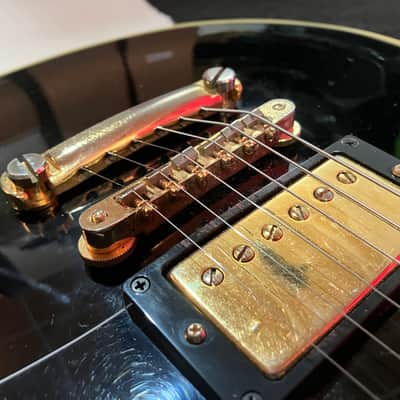
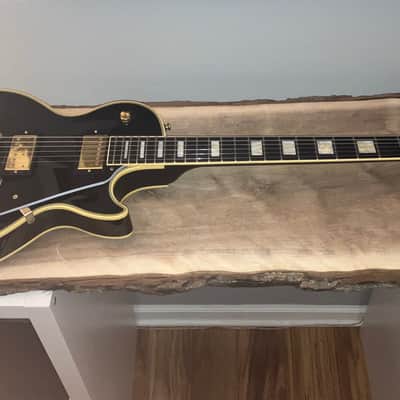
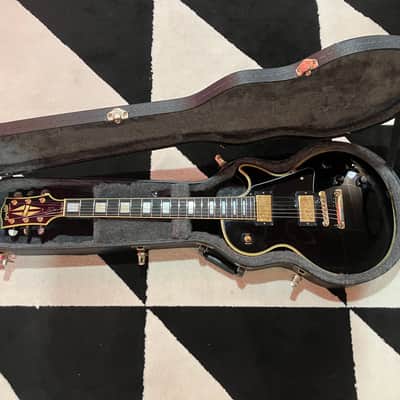
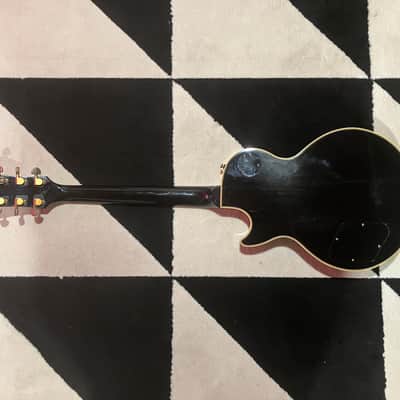
This is a very rare Orville by Gibson Les Paul Custom Black Beauty model LPC-57B. Unlike most Orville and Orville by Gibson guitars, this is one of the few "reissue series" made only for a few years (this one’s from 1993) with unique vintage features:
- ebony fretboard – not rosewood
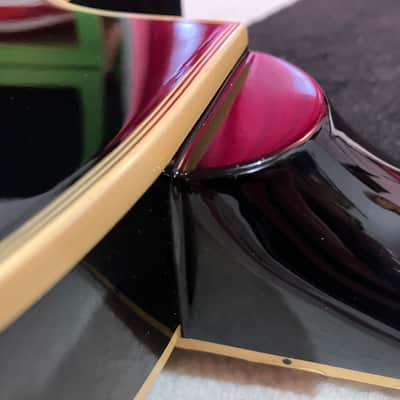
- black nitro paint – not poly
- fretboard edge binding with nibs
- long-tenon mahogany neck
- Gibson Classic 57 pickups
- ABR-1 bridge and stop tailpiece
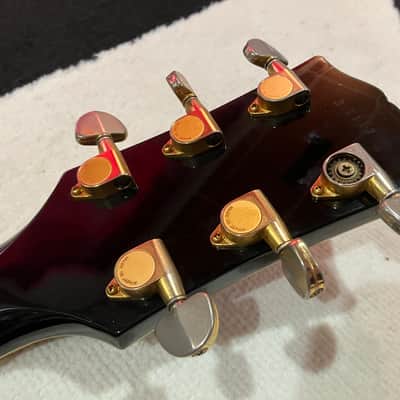
- Grover style "kidney" tuners – not tulips
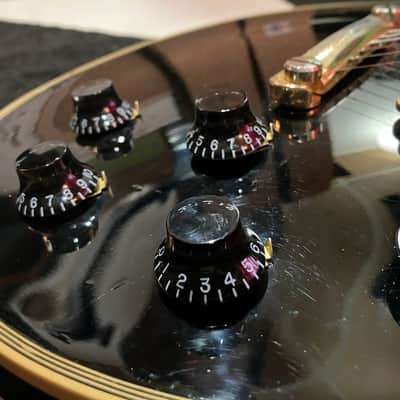
- black tophat knobs – not speeds
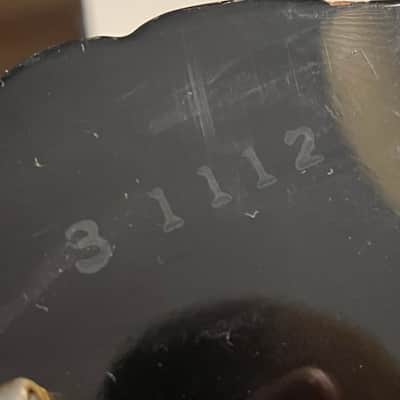
- 5-digit serial number inked behind headstock – not a sticker
- full mahogany body (no weight relief)
- gold hardware
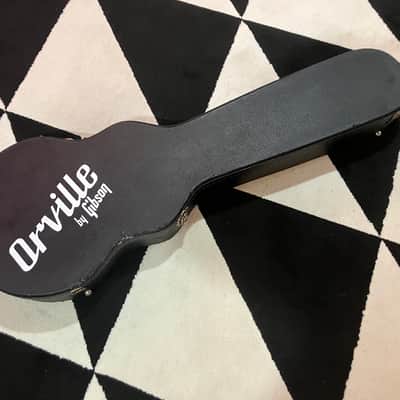
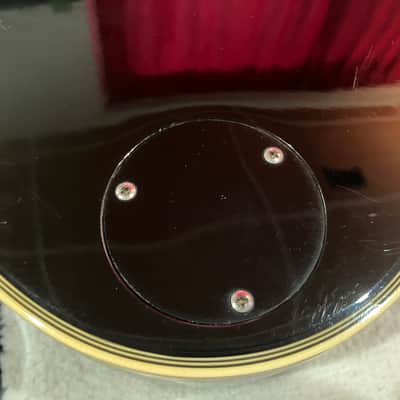
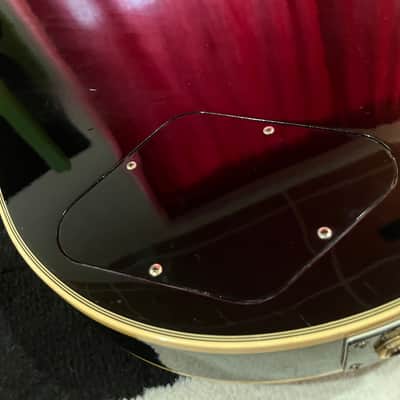
At 9.8 lbs, it’s a bit heavy for me, but it’s an all-around amazing guitar that rivals Gibson’s U.S.-made Customs. Comes with a non-original hardcase (I put the logo on it) that gets the job done. No breaks or repairs. Has a ding on top by the rear strap button; one of the tuners is missing the gear cover; and the strap button by the neck was slightly relocated. None of this affects the playability and sound – it rocks.
I'm in Michigan and put the shipping at $150 in the continental U.S. If it's less, I'll refund the difference to the buyer; if it's more, I'll cover it.
Quotes about ObG guitars:
“I have stopped buying Gibson once I start playing Orville by Gibson, the wood and the quality of Gibson is just disappointing unless you buy their custom shop guitars, which cost 3 to 4 times more than these japanese made gibson.”
“Orville by Gibson was a brand managed by Gibson for the Japanese domestic market from the '80's-90's... Both brands produced wonderful guitars that were, at the time, more accurate takes on the classic Gibson guitars than the U.S.-produced guitars of the same era. ObG also produced reissues from 1992-1995, which brought these Japanese-made guitars even closer to the classic specifications.”
Orville Les Paul - Epiphone Electrics - Gibson Brands Forums
AS90 Posted January 4, 2010: I have had a few Orvilles, they are great guitars! Regular Orvilles are nice but 'Orville by Gibsons' are exactly the same as Gibsons, the 58 and 59 reissues even have fret edge binding.
charlie brown Posted January 4, 2010: "Orville" IS..or rather WAS, Gibson! Gibson Japan! Same specs, or better. Long neck tenons, were pretty much standard, on Orville's...LP's SG's and their ES thinline models! Add to that legendary Japanese workmanship (AKA Pride), and it will be one Hell of a Guitar! "Better" than USA made Gibsons? Possibly, but certainly as good as...if not better. Again...IMHO, as always.
patharte Posted January 5, 2010: Hey guys. I am the buddy that Bonzoboy referred to. I do have my Orville Les Paul Custom back from the shop!!!! The guitar tech I deal with was very impressed this morning when he first took the guitar out of the case, but was even more impressed when he started working on it...it set up easier than any new guitar he's worked on in a long time, it has a nice low action now without any fretting out whatsoever. He loved the sound of the pickups and the quality of the guitar. He told me that he then went to the internet and reserched these guitars and checked out the prices of them on everybody's favourite auction site. He then wondered why somebody would spend 3x as much for the name on the headstock when you could get one of these..."It's a no brainer!!!" I believe was his reply!!!
Orville and Orville by Gibson Guitar Brand History (guitarsjapan.com)
Named after the founding father of Gibson guitars, Orville H. Gibson, these fully-authorized Japanese guitars came into existence through partnerships between Gibson USA and various Japanese manufacturers and dealers (such as Aria, Matsumoku and Yamano Music) that extend back into the 1970s.
It wasn't until 1986 -- when Yamano Gakki took over the distribution of Gibson (and Korean-made Epiphone) guitars in Japan and later, in 1988, decided to expand their lineup of guitar models -- that things really got rolling for the Orville and Orville by Gibson brands.
Yamano Gakki decided to go with a different name for this expanded line of guitars that were designed in the exact form of the most valuable and sought-after classic Gibson guitars. It was decided to use "Orville" as the new brand name, dedicating the brand to the founding father. As it was decided that some of these guitars would be equipped with Japanese-made pickups and some with USA-made pickups, they decided to include the post-script "by Gibson" for the models that had pickups of American origin.
All “Orville” guitars were equipped with Japanese replica PAF pickups, while the “Orville by Gibson” guitars were usually equipped with authentic Gibson USA PAF ’57 Classics, and sometimes the original Bill Lawrence HB-R/HB-L or Gibson 490s. Other than the difference in headstock logo and pickups, there are no other hidden or outward differences that I am aware of. Many collector friends have said that they think the Orville by Gibsons are overall better guitars, and while this may be so, many collectors have disagreed with this notion. There were many high-end and mid-range models of these guitars under both logos. I think mainly that the model number and original price dictated quality, not particularly the logo.
From Wiki:
…in 1987 Yamano Gakki obtained the Gibson and Epiphone dealership in Japan [1]. Yamano Gakki distributed Gibson and Korean Epiphone guitars and also produced a limited range of Epiphone Japan semi acoustic guitars in cooperation with Gibson. In 1988 Yamano Gakki decided to expand the Epiphone Japan model range to include solid body models as well as semi acoustic models.
Gibson and Yamano Gakki decided not to use the Epiphone brand name for the expanded model range and so the Orville name was chosen instead. Orville is the first name of the Gibson corporation's founder Orville Gibson. When the Orville by Gibson series was launched in 1988, Gibson was also selling American-made Gibson guitars, Japanese-made Epiphone guitars, and Korean-made Epiphone guitars in Japan. The Orville by Gibson and Orville series were distributed by Yamano Gakki and were priced midway between the American-made Gibson guitars and the Korean-made Epiphone guitars.
There were a number of changes to the Orville by Gibson and Orville model range between their beginning in 1988 and their end in 1998… The Orville series were discontinued in 1998 due to Gibson and Yamano Gakki deciding to export an expanded Epiphone model range that included solid body and semi acoustic models. Gibson and Yamano Gakki ended their relationship in late 2006.
There were two Japanese guitar factories involved in all of the Orville by Gibson and Orville production and they were Terada and Fuji-Gen. The Gibson Les Paul Book by Tony Bacon and Paul Day mentions that both the Orville by Gibson and Orville guitars, including the K Orville guitars (1989-1993) were made in Japan.
When the Orville by Gibson series began in 1988, Fuji-Gen were concentrating on making Fender Japan bolt-on neck guitars and so the G serial Orville by Gibson and K Orville set-neck guitars were all made by Terada. Fuji-Gen began making Orville by Gibson guitars in late 1992 and also Orville guitars in 1993 after they established Fuji-Gen Hirooka Inc in November 1991. After opening Fuji-Gen Hirooka Inc, Fuji-Gen resumed large scale set-neck guitar production. After Fuji-Gen were contracted by Yamano Gakki in late 1992, Fuji-Gen were assigned to make most of the Orville by Gibson and Orville solid body guitars and Terada shifted to its more traditional role of mostly making Semi Acoustic guitars .The production of the Terada solid body K Orville guitars and most of the Terada solid body G serial Orville by Gibson guitars were ended in 1993 as a result.
Fuji-Gen and Terada used different serial number formats (Orville by Gibson Terada decal box). Terada used a G or J letter at the start of the serial number and Fuji-Gen used a serial number consisting of only numbers and no letters. The Terada G serial number letter basically stood for "Gibson pickups" and the Terada J serial number letter basically stood for "Japanese pickups". When the K Orville guitars were made between 1989 and 1993, Terada were the only guitar factory making all of the Orville by Gibson and Orville guitars. The Orville by Gibson and Orville EB-3 SG Bass guitars which were priced at over 90,000 Yen were given G letter serial numbers by Terada. The lower priced (K) Orville guitars which were priced at 75,000 Yen and below were not given serial numbers by Terada. Serial numbers are not always essential when only one guitar factory is making all of the guitars, as the distributor (Yamano Gakki) knows exactly which guitar factory made the guitar even when the guitar has no identifiable guitar factory serial number. As Terada were the only guitar factory making all of the Orville guitars between 1989 and 1993, they did not need to serialize the (K) Orville guitars which were made more for the first time or intermediate player market.
When the (K) Orville guitars were released for retail sale between 1989 and 1993, Yamano Gakki applied a year dated (K) serial number sticker for warranty serial number tracking. The K serial number prefix letter stands for Kuramae which is where Yamano Gakki's wholesale division is located. The higher priced Orville by Gibson and Orville EB-3 SG Bass guitars were Yamano Gakki's and Terada's main priority in the early years and were made for the intermediate and professional player market and were therefore given serial numbers to be in step with Gibson's usual practice of using serial numbers on Gibson guitars. Different serial number letter prefixes are usually used when more than one guitar factory can be making the same brand and model of guitar at the same time. When Fuji-Gen joined together with Terada in making the Orville by Gibson guitars in late 1992 and the Orville guitars in 1993, serial numbers were used on all of the Orville guitars by both Fuji-Gen and Terada with Terada using a J letter serial number for all of the Orville guitars they made after the K Orville guitars ended in 1993. A 1993 75,000 Yen K Orville Les Paul and a 1996 75,000 Yen J letter serial numbered Orville Les Paul are basically the same guitars made by Terada.
The Orville by Gibson and Orville serial number format had 4 variations in the 10 years that they were produced. The Orville by Gibson guitars used ink stamped serial numbers and the Orville guitars used both ink stamped serial numbers and Yamano Gakki (K) serial number stickers.
The Orville by Gibson 1957 and 1959 Les Paul reissue models (LPS-57C, LPC-57B, LPS-59R) and the Orville by Gibson 1961 SG reissue model (SG-61R) had two different serial number formats.
The first reissue serial number format was a YMMPPP format: Y is the production year, 3=1993, 4=1994 etc. MM is the production month. PPP is the production number.
The second reissue serial number format was a YPPPP format. Y is the production year, 3=1993, 4=1994 etc. PPPP is the production number.
For example G3 6942 is dated 1993 and was made by Terada, 4 7345 is dated 1994 and was made by Fuji-Gen, G306385 is dated June 1993 and was made by Terada, 412562 is dated December 1994 and was made by Fuji-Gen.
The YPPPP Orville by Gibson reissue serial number format is the same format as the Gibson reissue serial number format. The reissue year is in the model number (LPS-57C = 1957) and the 1957 and 1959 Les Paul and 1961 SG reissue models were made from late 1992-1995 with some guitars having limited production runs.
Orville by Gibson models retailed for over 90000 Yen and were introduced in 1988. The Orville by Gibson guitars featured nitrocellulose finishes and Gibson pickups. In 1995 the Orville by Gibson models were discontinued and only Orville models were continued until 1998. The Terada G, J and K serial number Les Paul guitars featured a mixture of medium, medium long and long tenon neck joints. The Fuji-Gen no letter serial number Les Paul guitars featured long tenon neck joints.
How are the Orville Les Pauls compared to Gibson? - Quora
(I’ve cherry-picked the good stuff below.)
“Early to mid 70’s Japanese guitar makers were making high-quality knockoffs. By the early 80’s Gibson (and Fender) were facing quality production issues. Gibson decided to have Gibson-branded guitars made in Japan to compete against the increasingly popular knock offs. Orville guitars were never meant for sale in the US. They were primarily sold in Japan.
Japanese manufacturers began producing these licensed guitars in 1988 based on Gibson provided specs These would be made at Terada and FujiGen factories. Production would continue up to 1998. Gibson would go on to brand these guitars as Epiphone Japan from 1999 - 2000.
When I compare the build quality, tonality, and playability, I would have say that my 1988 and 1991 Orville by Gibsons are on equal measure with my other Gibson guitars.
Over time hardware may have been switched out by some owners. One way to tell is the wear on hardware across the guitar. If there is notable wear on the tune o matic bridge but the tuners are near pristine, there’s likely been some hardware changes - usually for the better.
There are two types of Orville Gibson Les Paul. There are Orville and Orville by Gibson (ObG). An Orville could be considered a Standard and the Orville by Gibson a Custom. With this distinction comes a price differential in that the Orville by Gibson are of higher value. (That Standard vs Custom distinction would be upended in later year builds. Just one of many inconsistencies that rule the Orville run.)
Either Gibson had various licensing agreements or the Japanese manufacturers used them more as guidelines based on demand/supply/economics. Whatever the case, some later model Orvilles would depart significantly from the basics.
Many of the distinctions between these two model types alone vary quite a bit over their years of production -- quality being one of those distinctions (ie, serial numbers designated with a K made by Terada in the 90’s were more affordable models and as such are seen as less desirable to collectors). The contoured tops are exceptional compared to Norlin era Gibsons. ObGs have very nice binding.
The increased interest in Orvilles means potential buyers need to be aware of the ins and outs. 30+ year old guitars are not likely to be in the best shape and all original. And if they are pristine and all original, they will likely command a premium to match. People simply looking for player guitar with an interesting history can still root one out for a fair price.
It’s worth noting that the limited runs and rare models can get pricey. Regardless how rare an ObG may be, it is likely to never outpace the value of US made Gibson counterpart. Keep that in mind when a seller’s price feels steep.
In short, it’s enough to say the Orville line was not a fluke in Japanese guitar manufacturing. Even Fender came to acknowledge this. Japan was now on the forefront producing very capable products and brands at affordable prices.”
This item is sold As-Described
This item is sold As-Described and cannot be returned unless it arrives in a condition different from how it was described or photographed. Items must be returned in original, as-shipped condition with all original packaging.Learn More.
| Listed | 3 years ago |
|---|---|
| Condition | Very Good (Used) Very Good items may show a few slight marks or scratches but are fully functional and in overall great shape.Learn more |
| Brand | |
| Model |
|
| Finish |
|
| Categories | |
| Year |
|
| Made In |
|
| Body Material |
|
| Neck Construction |
|
| Right / Left Handed |
|
| Number of Strings |
|
| Body Shape |
|
| Neck Material |
|
| Finish Style |
|
| Body Type |
|
| Bridge/Tailpiece Type |
|
| Pickup Configuration |
|
| Scale Length |
|
| Fretboard Material |
|
| Color Family |
|
| Number of Frets |
|
Product safety information may be available here.