Calsynth Grids (Mutable clone) trigger sequencer
This gear has sold
See similar gear from other Reverb sellers

Our users rate Reverb
Excellent condition
Trigger sequencer
Calsynth Grids Mutable clone
Featuring a high quality exclusive black FR4 panel and all metal T18 pots with matte black aluminum knobs.
uGrids is an 8hp variant of Mutable Grids - with endless varieties of possibilities to trigger percussion and other modules - bring a little random rhythmic freshness to your rig
Overview
Grids is a 3-channel trigger generator specialized in the creation and sculpting of rhythmic patterns.
At the core of Grids is a map, that has been obtained through machine learning techniques, of the drum patterns used in a large collection of electronic music tracks and drum loops. The skeleton and structure of the rhythm is programmed by selecting its X and Y coordinates on the map - with smooth interpolation/morphing between points.
Once this skeleton is in place, variations can be generated by controlling the "event density" of each of the three channels - gradually morphing from a sparse backbone to a frantic pattern. X / Y map position, and the density of the 3 channels are all CV-controllable, allowing rhythmic variations to be created by any modulation source. In contrast to Euclidean sequencers which are purely algorithmic, Grids' has "learned" patterns from actual data and with the right settings might generate a breakbeat or an influential Kraftwerkian beat.
Most patterns are best played with channel 1 = BD ; channel 2 = SD ; channel 3 = HH, but experimentation with other sound sources is of course encouraged.
Grids has a built-in clock, or it can accept external clock signals of variable resolution.
Grids' pattern generation algorithm
Grids is a 3-channel, algorithmic, rhythmic pattern generator based on data and models extracted from actual BD drum loops. Two steps are involved in the generation of the drum patterns:
Step 1: Synthesizing a pattern from the drum map...
A collection of drum loops has been spatially organized and compressed into a 2-dimensional map. Using interpolation techniques, any pair of X/Y coordinates can be translated into a rhythm, with smooth morphing from one rhythm into the other.
Step 2: ... and sculpting it!
Once a rhythmic skeleton is read from the map, variations can be generated by controlling the note density of each of the three channels - gradually morphing the pattern from a sparse backbone to a frantic pattern.
Controls
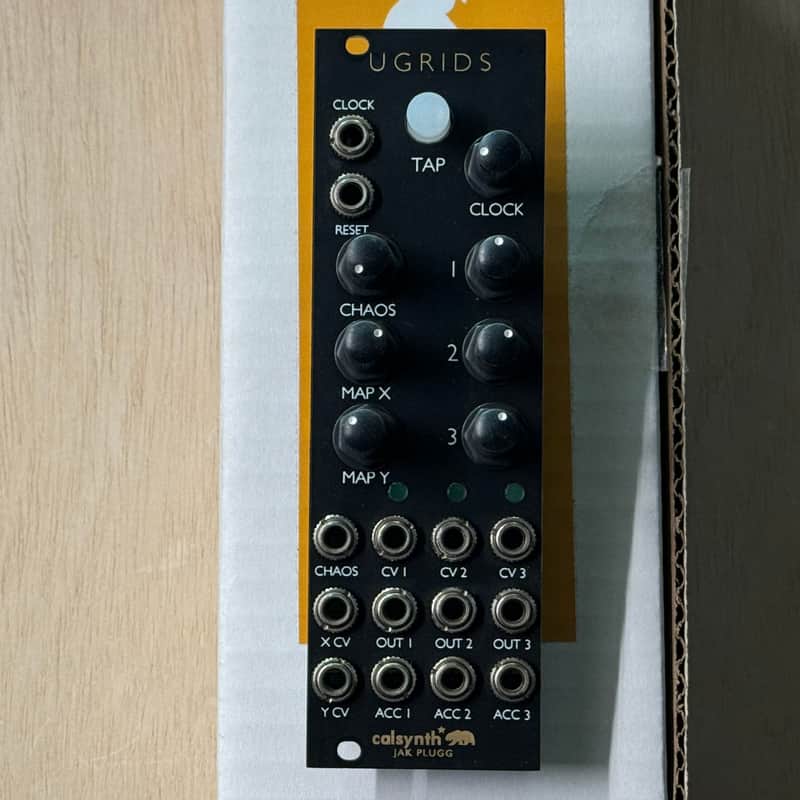
A: Internal clock rate. Ranges from 40 BPM to 240 BPM. When turned fully counter-clockwise, the internal clock is disabled and the unit expects a clock signal on its CLOCK input.
B: Tap (reset). This button acts as a tap tempo, and flashes on each beat. Tap it twice or more to set the tempo. The duration between the two most recent taps defines the duration of a beat. Once the tempo has been programmed with the tap tempo button, the CLOCK knob is locked and has no effect on the rhythm. Tap just once on the Tap button to unlock the CLOCK knob.
C1, C2: Map coordinates. These two knobs specify the region of the rhythm map from which is derived the structure / backbone of the rhythm.
D: Chaos amount. This button controls the amount of random perturbations applied to the three FILL parameters. When set to a high value, rolls/ghost notes will be randomly added to the pattern.
E1, E2, E3: Fill rate. These knobs indicate how dense the rhythmic pattern is for each of the three channels/instruments. Turn counter-clockwise to simplify the pattern (to the point of muting the channel entirely), turn clockwise to add notes (until the pattern is entirely filled). The position of the added/removed notes depends on the rhythmic backbone specified by the X and Y parameters.
Inputs and outputs
1. CLOCK: External clock input. The external clock is ignored unless the CLOCK knob is set to its minimum value and tap tempo is reset. Recommended level : 0 to +5V, though higher voltages are accepted.
2. RESET: Pattern reset input. A raising edge on this input resets the rhythmic pattern to its first step. Recommended level : 0 to +5V, though higher voltages are accepted.
3, 4, 5, 6. MAP X, MAP Y, CHAOS, FILL: Control voltages added to the value of the eponymous knob. The minimum position of the knob corresponds to 0V, and its maximum position to 5V.
7. TRIG: Trigger outputs for each of the 3 channels. Triggers have a +5V level and a duration of 1ms.
8. ACC: Accent outputs for each of the 3 channels. The accent indicates the structurally important steps in the pattern, and can be fed straight into x0x style modules. They have a +5V level and a duration of 1ms.
Options
Unplug all CV inputs and hold the TAP/reset button for half a second to adjust Grids' options. The switch stays illuminated. Hold the button again for half a second when you are done.
Clock resolution.
Clock resolution is set by E1. The 3 LEDs indicate the current value of this setting (4, 8, and 24 ppqn respectively). Grids does not try to regenerate a high-resolution clock from a low-resolution clock (think of it as a form of quantization). Thus, using the 4ppqn clock might distort the patterns that use 32-th notes; and using 8ppqn or 4ppqn might distort the patterns that use triplets.
Tap tempo vs reset.
The tap tempo / beat indicator button can be configured instead as a reset button / pattern start indicator. Turn E2 to switch between these two modes:
LEDs off: Tap to reset to the beginning of the pattern
LEDs on: Tap to set the tempo
Swing
Turn E3 to enable or disable swing on the internal clock. When enabled, swing is controlled by the CHAOS randomization setting (which it replaces) - and affects the internal clock only. The LEDs indicate the status of the swing setting:
LEDs off: Swing is disabled. CHAOS works as a randomization control
LEDs on: Swing is enabled on the internal clock. CHAOS controls its amount
It is not possible to add swing to a clock signal received on the CLOCK input; and it is not possible to add swing in euclidean sequencer mode.
Euclidean sequencer mode.
Why have less when you can have more? Grids can also work as a vanilla euclidean sequencer. Turn C1 (MAP X) to switch between the euclidean sequencer mode and grids' own flavor of pattern generation.
LEDs off: Grids is yet another euclidean sequencer
LEDs on: Grids is back to drumming duties
In euclidean sequencer mode, the C1, C2 and D knobs control respectively the cycle length/size of the pattern on channels 1, 2, and 3; and the E1, E2 and E3 knobs control the fill rate. The ACC outputs will spit a trigger on the first note of the pattern - that is to say, whenever the pattern completes a cycle.
Trig / Gate output.
By default, Grids produces trigger signals (short 1ms pulses). This behavior - which is recommended for 808 or 909-like sound modules - can be changed in order to produce gate signals more suitable for controlling envelopes or other modules' CV inputs. In this case, the output stays high for the whole duration of the clock's positive cycle. It is thus possible to alter the gate length by driving Grids from a clock module with a duty cycle parameter (or from a square VCO with pulse-width control). The internal clock has a fixed 50% duty cycle. To change the trig/gate configuration, turn C2 (MAP Y)
LEDs off: Outputs are triggers.
LEDs on: Outputs are gates.
Alternate output layout.
The row of 3 ACCENT outputs can be reconfigured to serve other purposes. The normal layout is: ACC 1 / ACC 2 / ACC 3 But it can be reconfigured as: ACC / CLK / RST Where ACC is a global accent output, that is high whenever one of ACC 1, ACC 2, or ACC 3 is high; CLK is a clock output (mirrors the clock input, or is the internal clock signal, whichever is in use); and RST is a reset trigger. To reconfigure the outputs and take advantage of the Clock / Reset outputs, turn the D (CHAOS) knob.
LEDs off: ACC 1 / ACC 2 / ACC 3
LEDs on: ACC / CLK / RST
Features
Clocking
Internal clock with a 40 to 240 BPM range.
Beat indicator / Tap tempo button (reconfigurable as a reset button).
External clock input, with selectable resolution (24, 8 or 4 ppqn).
Pattern reset trigger input.
Drum pattern generator
Based on a compressed representations of drum patterns and their variations.
X/Y (pattern selection) knobs with CV inputs.
Pattern complexity/density knobs for channels 1, 2, 3, with CV inputs.
Pattern randomization knob with CV input (reconfigurable as a swing control for the internal clock).
3 output channels (BD, SD, and HH/percussion).
3 additional outputs, configurable as Accent/Clock/Reset or per-channel accent.
Outputs can be either triggers or gates.
Specifications
Input impedances: 100k.
CV acquisition: 8-bit, 1kHz.
Output level: +5V.
Clock resolution and processing latency: 120µs.
Worst case jitter < 0.5% at 120 BPM.
Moving sale.
Everything is priced to sell, I’ve had my fun and now it's your turn!
TERMS:
“Mint” to me means unhandled, opened but new.
This looks excellent to me, but judge for yourself. I'm kind of obsessive and very into condition. These all pass muster for me, but you might be more OCD than me. If that’s you, maybe look for another one!
Legal- it's as described, but as is, no returns, good vibes only, sorry no demo.
Shipping-
Ships FedEx (usually), fast and with a real tracking number, unlike the Post Office.
Insured, if requested or required.
Continental US only unless negotiated otherwise.
Let me know if you want me to require a signature for delivery. Default for me is no signature (but anything requiring insurance requires a signature)
(I like to think I’ve priced it at the “give the man his money“ price. If you disagree, feel free to send me an offer. If it’s a good offer, I’ll try and respond quickly, but I've got a job and someone might scoop you, so you should just scoop it up now if you want it. That’s my recommendation. Don't wait! Ask me how I know....)
EURORACK:
These are all good modules, no, these are all GREAT modules.
I just made a deal with myself. Three cases only. So choices were made.
I use plastic screws with my Eurorack. I was very lucky that the first modules I bought, the seller taught me "plastic screws, don't overtighten". (You can buy them on ebay etc for cheap, just get the right size....)
Your chance to get great deals on some great modules
This item is sold As-Described
This item is sold As-Described and cannot be returned unless it arrives in a condition different from how it was described or photographed. Items must be returned in original, as-shipped condition with all original packaging.Learn More.
| Listed | a year ago |
|---|---|
| Condition | Excellent (Used) Excellent items are almost entirely free from blemishes and other visual defects and have been played or used with the utmost care.Learn more |
| Brand | |
| Model |
|
| Finish |
|
| Categories | |
| Year |
|
| Made In |
|
Product safety information may be available here.