NAD 7600 Monitor Series Receiver (Black)
This gear has sold
See similar gear from other Reverb sellers

Our users rate Reverb
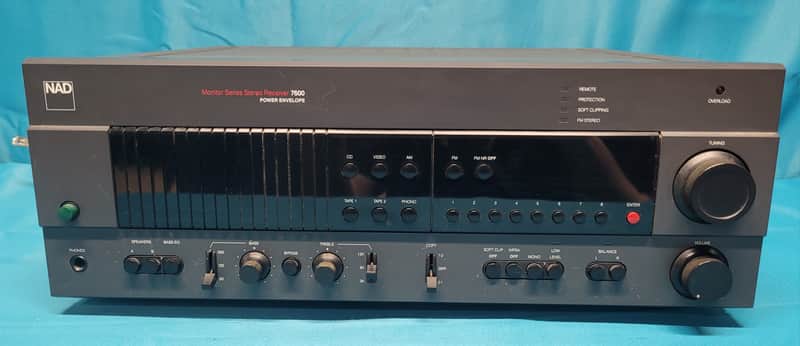
Here we have an awesome stereo receiver from NAD, the model 7600. NAD makes some beautiful home audio gear. This is one of the most clear and loud receiver I've ever heard. The bass and treble knobs have a nice boost function that can help achieve the tone you're after. With a dedicated phono input this receiver really amps up the sound on any record player. Definitely a high end receiver from a respected company.
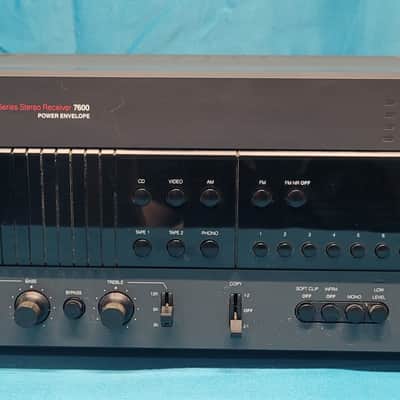
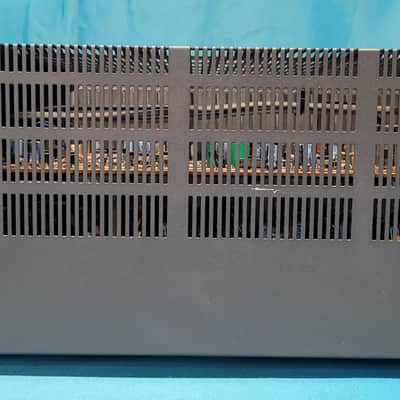
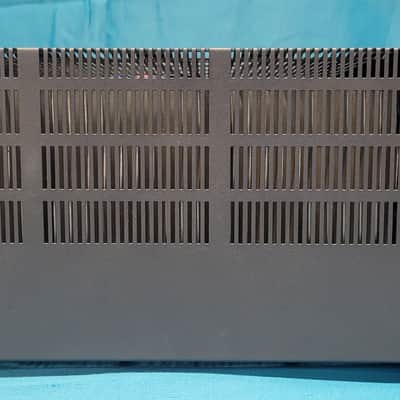
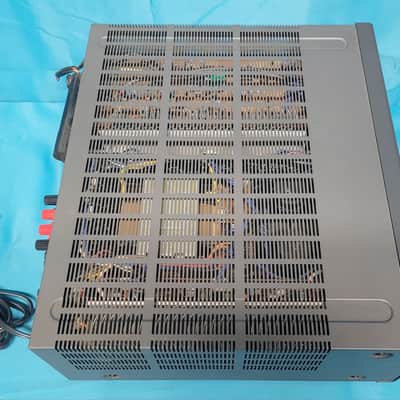
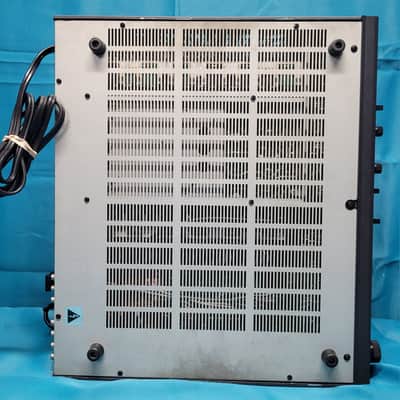
Overall the condition of this unit is excellent. All buttons function properly and all channels have been tested and are in fully working order. *See photos for exact condition*
Here's a write up from Hifi-Classic.net - "NAD describes the new Model 7600 Monitor Series stereo receiver as “the most powerful receiver” on the market. At a list price of $1,498, it is also one of the most expensive. But as a single-unit equivalent of three top-of-the-line NAD components—the Model 2600 power amplifier, the 1300 preamplifier, and the 4300 tuner, which list for a total of $1,844—the receiver could be considered economical. In addition, it comes with a wireless remote control that can be a complete system controller.
Like the Model 2600 power amplifier, the NAD 7600 employs a dual-voltage, signal-tracking power supply that makes possible an extremely high dynamic headroom (short-term power output) for a time far exceeding the 20 milliseconds of the standard dynamic power test. The amplifier section can deliver far more than its rated continuous output power for longer than 200 milliseconds, a period that NAD considers to be more representative of actual music requirements. NAD describes this characteristic by means of a “Power Envelope” rating, a plot of maximum power versus time. The concept of the rating makes sense to us, although it has no official standing, and we run this test on all amplifiers.
The NAD 7600 receiver is rated to deliver 150 watts per channel continuously into 8-ohm loads from 20 to 20,000 Hz with no more than 0.03 percent total harmonic distortion. Although a couple of other receivers on today’s market have similar or slightly higher ratings, NAD’s claim to the power championship is based on its ability to deliver dynamic (20-ms) outputs of 400, 600, and 800 watts into loads of 8, 4, and 2 ohms, respectively. Furthermore, the two channels can be bridged to deliver continuous mono output of 480 watts into 8 ohms, with dynamic ratings of 1,200 and 1,400 watts into 8- or 4-ohm loads. In this mode, a separate Model 2600 power amplifier (also bridged) is used to drive the other channel with the same power capability. As NAD points out, a combination of the Models 7600 and 2600 can deliver nearly 3 kilowatts of dynamic power into a pair of 4-ohm speakers!
The receiver’s preamplifier section features a switchable moving-magnet (mm) or moving-coil (MC) phono preamplifier with extremely low noise levels. Its bass and treble tone controls, which NAD describes as “semi-parametric,” are fairly conventional center-detented knobs except that each control provides a boost or cut over a two-octave band centered at one of three selectable frequencies. The center frequencies were chosen for their usefulness in correcting for common response problems. The tone controls can be completely bypassed with a front-panel button. A switchable bass eq circuit provides a maximum 8-dB boost at 35 Hz, where most speakers need help, combined with a steep infrasonic cut that prevents overloading the amplifier or speakers at sub-audible frequencies.
The receiver has high-level inputs for a CD player and a video sound source as well as full playback and recording facilities for two audio tape decks. Lever switches select tape-copying connections and the center frequencies for the tone controls. Small pushbuttons operate the other switching and selection functions as well as the balance control. Pressing the L or R button produces a smooth change of relative channel levels (a small light glows when the balance is centered). Each control button is clearly labeled to show its effect when pressed.
Its tuner specifications indicate that the Model 7600 is a top-quality product, with at least one superlative rating, an image rejection exceeding 120 dB. The tuner section has a switchable FM noise-reduction circuit (FMNR) that automatically blends the stereo channels over the full frequency range, instead of the more usual high-frequency blending, at low signal levels. Except for the very weakest signals, which would not be listenable in stereo in any case, the sound maintains its basic stereo qualities, with some reduction in separation but a typical noise reduction of about 10 dB (roughly comparable to the performance of the Dolby B system in tape recording).
Although the receiver has a digital-synthesis tuner section, the control knob’s tuning action is much like that of an analog tuner. But it has several major advantages. The tuning is always precise, and the tuned frequency is always visible on the large numeric display. When the tuning control is close to a station, arrows show the correct tuning direction; an amber light goes on when the station is tuned correctly.
The tuning knob does not actually vary anything in the receiver but merely turns a shaft encoder that sends digital pulses to the synthesizer circuit. The control is nearly frictionless, and a single spin will turn the knob for up to 10 seconds, time enough for the tuner to scan either radio band from end to end. The usual presets are provided, with each of the eight buttons assignable to one am and one fm frequency.
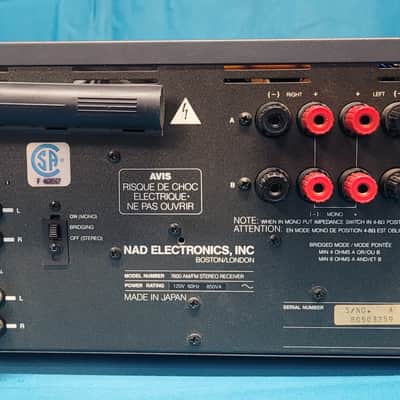
The rear apron of the Model 7600 contains the usual input and output phono jacks, including preamplifier outputs and two sets of power-amplifier inputs, marked lab and normal. Removable jumpers between the preamp outputs and the power-amp inputs simplify the use of an external Model 2600 amplifier in bridged mode or of various signal-processing accessories. The normal amplifier inputs have 12-dB-per-octave rolloffs below 15 Hz and above 40,000 Hz. In addition to the switched infrasonic filter in the preamplifier, these built-in rolloffs safeguard the system against overload from signals outside the audio range. Through the lab inputs, the bandwidth is 3 to 80,000 Hz.
A slide switch on the rear apron bridges the amplifier, and another optimizes its power-supply voltages for operation either with “high” speaker load impedances (8 to 16 ohms) or for “normal” loads (4 to 8 ohms). Also on the rear is the switch to select either mm or MC mode for the single pair of phono-input jacks and another switch to connect a nominal capacitance of 100, 200, or 300 picofarads (pF) across the fixed 47,000-ohm resistive input. In the MC mode, the input is 100 ohms in parallel with 1,000 pF.
The insulated spring-clip antenna inputs are designed for an external wire am antenna, and the receiver also has an integral hinged ferrite-rod AM antenna. The only FM input is a 75-ohm coaxial connector, but a coupler is provided for use with the more common 300-ohm fm antenna systems. Two of the three AC convenience outlets are switched. The master power rocker switch on the rear is normally left on so that the receiver can be turned on or off from the remote-control unit.
The remote control operates all the basic functions, omitting only the filters, tone controls, and tape-deck controls. It is designed to rest on a table or to be held in the hand, and its infrared output is emitted over a wide angle; in most cases there is no need to point the controller directly at the receiver.
The NAD Model 7600, finished in charcoal gray and black with white markings, measures about 17 inches wide, 15-3/4 inches deep, and 6-1/4 inches high. It weighs about 38 pounds."
SPECS
Tuning Range: FM, MW
Power Output: 400 watts into 8Ω (mono)
Frequency Response: 20Hz to 20kHz
Total Harmonic Distortion: 0.03%
Damping Factor: 120
Signal To Noise Ratio: 76dB (MC), 76dB (MM), 96dB (line)
Speaker Load Impedance: 2Ω to 8Ω
Dimensions: 435 x 162 x 422mm
Weight: 15.4kg
Truro
This item is sold As-Described
This item is sold As-Described and cannot be returned unless it arrives in a condition different from how it was described or photographed. Items must be returned in original, as-shipped condition with all original packaging.Learn More.
| Listed | 3 years ago |
|---|---|
| Condition | Excellent (Used) Excellent items are almost entirely free from blemishes and other visual defects and have been played or used with the utmost care.Learn more |
| Brand | |
| Model |
|
| Finish |
|
| Categories | |
| Made In |
|
Product safety information may be available here.